

Vertical farming · Cost and energy guide
Vertical Farming Automation: Energy, Whole-Farm Cost and Failure Risks
Hydroponic growing can use far less water per kilogram, but lighting electricity and whole-farm capital cost decide the result, and several large vertical farms went bankrupt or closed. This guide gives sourced figures and a calculator for lighting cost.
Key takeaways
- In one 2026 model, lettuce yield was 78 to 330 kg per square metre of growing area per year, against 68 for a Dutch greenhouse. The 330 figure is a NextGen target that needs 1.8 g/mol light-use efficiency, not a result (Meeuws and colleagues, 2026).
- Electricity is the main trade-off. Modelled farms used 2.3 to 7.8 kWh per kg of lettuce, one commercial farm reported about 10, and a Dutch greenhouse benchmark was 3.8, counting electricity only (Meeuws, 2026; Lovat, 2025).
- In a modelled Arizona comparison, hydroponic lettuce used 20 litres of water per kg against 250 for field lettuce, and 82 times more energy (Barbosa and colleagues, 2015).
- The best independently tested LED fixtures reached 2.5 to 3.0 micromoles per joule in 2020. The authors calculate limits of 3.4 to 4.1 with 2020 LED technology, 13 to 37% above the best tested fixture (Kusuma and colleagues, 2020).
- AeroFarms and Plenty went through Chapter 11 and exited it, and Bowery Farming was reported closed, so test any plan against your own electricity price, yield and labour cost.
In this article
- Introduction: What Vertical Farming Automation Actually Delivers
- Market Reality: Funding and Failures
- The Rise of Vertical Farming Automation
- Vertical Farming Sensors: What They Measure and Why
- 7 Trends in Automation in Vertical Farming
- Comparative Trends Table: Automation Technologies
- What a Vertical Farm Costs to Build and Run
- Vertical Farm Lighting Electricity Calculator
- How Farmonaut Powers Automated & Sustainable Agriculture
- Future Outlook: Automation in Vertical Farming
- Frequently Asked Questions about Vertical Farming Automation
- Get Started with Smart Farm Automation
Introduction: What Vertical Farming Automation Actually Delivers
Vertical farming automation is the use of sensor networks, AI-driven environmental control, and robotics to run stacked, indoor crop production without constant manual adjustment. An ARS scientist interviewed on the ARS website said some crops can yield 10 to 20 times more per acre in vertical farming than in open fields (undated interview, page modified January 2025). A modelled hydroponic greenhouse in Arizona used about 92% less water per kilogram of lettuce than field production, but about 82 times more energy (Barbosa and colleagues, 2015). Several large vertical farms have also gone bankrupt or closed. The sections below give sourced figures for yield, energy and cost, and a calculator for lighting electricity.
Chart
Lettuce yield per square metre of growing area, per year
kg of fresh lettuce per m² of net growing area (all 20 layers counted) per year. Model = a modelled vertical farm; the two scenarios differ in light-use efficiency, 0.8 and 1.8 g dry weight per mol of light, and in cultivar assumptions. Model results, not real farms.
Yield depends on how you measure it. US field head lettuce yielded 381 hundredweight per acre in 2024, which is about 4.3 kg per square metre per crop (USDA NASS, 2025). In a modelled 25 m tall farm with 20 layers, lettuce yield was 78 to 330 kg per square metre of growing area per year, against 68 for a Dutch greenhouse (Meeuws and colleagues, 2026). These figures already count every layer, and the 330 figure is a NextGen target scenario, not a result. Stacking itself shows up per square metre of floor: the paper gives 5,617 kg per square metre of footprint per year for lettuce in the NextGen case. Buyers see the yield case and now ask what the farm costs to build and to run.
Reviews of the data give a more modest picture per crop cycle. A 2023 meta-analysis of 121 lettuce papers found controlled-environment yields averaged 3.68 kg per square metre, against 1.88 for field lettuce from FAO data, and 6.88 for studies of stacked vertical systems (Gargaro, Murphy and Harris, 2023). The indoor trials averaged 40 days to harvest, against 60 to 120 days in the field, so the gain per year is larger than the gain per crop.
In the Arizona model, the hydroponic farm was a greenhouse with supplemental lighting, not a stacked indoor farm, and heating and cooling made up most of its energy (Barbosa and colleagues, 2015). Indoor lettuce is also the main crop for now. An ARS scientist interviewed on the ARS website names leafy greens and small fruiting crops such as tomatoes as the best candidates (USDA ARS interview page, modified January 2025).
Market Reality: Funding and Failures
Industry results show that vertical farming is a hard business. AeroFarms filed for Chapter 11 bankruptcy protection in June 2023 (Food Dive, 2023) and exited it in September 2023 (TechCrunch, 2024). Bowery Farming was reported to be shutting down in November 2024, and Plenty filed for bankruptcy in March 2025 and emerged from Chapter 11 in May 2025 (TechCrunch, 2024 and 2025; Plenty, 2025). The reports did not give one cause. A 2026 study names high energy use, labour needs and investment costs as concerns (Meeuws and colleagues, 2026), so the sections below look at each.
The Netherlands is a useful reference because it publishes national greenhouse benchmarks for cost and energy (KWIN 2023). A 2026 study compared modelled vertical-farm lettuce with those Dutch greenhouse benchmarks, and the charts below use its figures. The country has a large greenhouse-horticulture sector in areas such as Westland in South Holland.
Official statistics: For US production data in standard agricultural units, the USDA Census of Agriculture is published every five years. USDA NASS also publishes lettuce yield tables each year in its Vegetables Summary.
The 2023 AeroFarms filing came with $10 million of financing from earlier investors. Crunchbase put the company’s total funding at about $238 million, and the company said the whole industry faced headwinds (Food Dive, 2023). Bowery Farming had raised more than $700 million before its reported closure, and Plenty had raised nearly $1 billion before it filed for bankruptcy (TechCrunch, 2024; TechCrunch, 2025). AeroFarms exited bankruptcy protection in September 2023 and Plenty emerged from Chapter 11 in May 2025. Other farms keep running, but these cases show that a good yield does not guarantee a good business.
The Rise of Vertical Farming Automation
Vertical farming automation combines AI, IoT, robotics, and data analytics to run controlled, high-density growing environments suited to urban and peri-urban sites, or regions with limited arable land or water access.
Chart
Electricity use per kilogram of lettuce
kWh per kg of fresh lettuce. Bars use different bases: the Dutch greenhouse and model farms count electricity only (the greenhouse figure excludes heating fuel), the Arizona bars count all energy, and the commercial figure is one farm’s reported electricity. Model = modelled 20-layer vertical farm.
Sensors scan environmental parameters — humidity, nutrient concentration, temperature, light — continuously. When a reading drifts from the crop’s optimal range, automated systems trigger a correction: dosing pumps adjust, LED arrays dim or shift spectrum, HVAC cycles change. A closed-loop system recirculates water and nutrient solution rather than discharging it. Recirculation helps explain why a modelled hydroponic greenhouse used about 20 litres of water per kilogram of lettuce, against 250 for field lettuce in Arizona (Barbosa and colleagues, 2015).
Before the trend list, here’s what changes operationally once a facility is automated rather than manually monitored — covered in more depth on irrigation system installation:
- Resource optimization: in general terms, closed-loop dosing adjusts water and nutrients to set targets.
- Yield consistency: automated control can hold conditions close to set targets from one harvest to the next.
- Labor reduction: robotics and AGVs replace repetitive manual tasks — how much labour they save depends on the crop and the system, so this article gives no percentage.
- Data-driven decisions: continuous sensor logging gives operators data in addition to visual inspection rounds.
Energy is the main trade-off for the water and land savings. One commercial farm reported about 5 million kWh of electricity a year for about 500,000 kg of lettuce, or about 10 kWh per kilogram (Lovat, Noor and Milo, 2025, citing a 2023 life-cycle study). A model for ten locations found open greenhouses used 45% to 94% less energy than plant factories (Weidner and colleagues, 2021). US Department of Energy meeting notes say vertical farms use the second most energy per floor area of any building type, after data centres, and that switching all horticultural lighting to LED could cut its energy use by about one third (DOE and USDA ARS, 2022).
Vertical Farming Sensors: What They Measure and Why
“Vertical farming sensor” and “vertical farming sensors” are both search terms landing on this page, so here is the direct answer: vertical farms commonly use sensors like those below, each tied to an automated response. This is a general engineering description, not a sourced standard.
Chart
Grow-light efficacy: tested fixtures and a calculated best case
Micromoles of light per joule of electricity (higher is better). 2020 data. Tested values come from independent tests listed in the paper; the best cases are calculated.
| Sensor Type | What It Measures | Automated Response Triggered |
|---|---|---|
| Photometric / PAR sensors | Light intensity and spectrum reaching the canopy | LED dimming or spectrum shift per growth stage |
| Temperature/humidity probes | Air temperature, relative humidity, VPD | HVAC cycling, dehumidification |
| CO₂ sensors | Ambient CO₂ concentration | CO₂ injection for photosynthesis optimization |
| Nutrient/EC & pH probes | Electrical conductivity and pH of recirculating solution | Dosing pump adjustment |
| Water-level/flow sensors | Reservoir levels, flow rate through the loop | Pump control, leak/failure alerts |
Why the sensor stack matters commercially: in one 2026 model, lighting was the largest energy user in every scenario, so lighting control acts on the biggest running cost (Meeuws and colleagues, 2026). Satellite-based monitoring extends this same logic outdoors; Farmonaut’s platform applies the equivalent sensing model to open-field and plantation crops via the Large-Scale Farm Management Platform.
Lighting efficiency sets how much electricity each unit of light costs. The best independently tested LED fixtures reached 2.5 to 3.0 micromoles of light per joule in 2020, up from 1.7 for the best fixture in 2014, and the authors calculate limits of 3.4 to 4.1 with 2020 LED technology (Kusuma, Pattison and Bugbee, 2020). Lights also add heat. In one DOE example, a fixture at 3 micromoles per joule falls to about 2.5 once the cooling load is counted (DOE and USDA ARS, 2022). That is why the calculator below adds a cooling share to the lighting load.
7 Trends in Automation in Vertical Farming
-
AI-Powered Environmental Control & Precision Sensors
Machine-learning control loops now hold light intensity, temperature, humidity, CO₂, and nutrient delivery inside crop-specific setpoints without a human resetting them each shift. Each stacked layer can have its own microclimate.
- Optimizes each stacked layer’s microclimate for maximum photosynthesis and yield.
- Reduces resource waste by delivering only what each crop needs, when it needs it.
- IoT integration enables remote oversight and adjustment by farm operators off-site.
-
Autonomous Robotics for Planting, Maintenance, and Harvesting
Robotic arms and automated guided vehicles (AGVs) now handle planting, maintenance, harvesting, and packaging. Labour is a large cost on some farms, so robots are a common target for automation. How much they save depends on the crop, the layout and the machine.
- Delivers consistent crop handling and uniform product quality across shifts.
- Can give consistent crop handling from shift to shift.
- AGVs handle internal logistics — nutrient delivery, crop relocation between growth stages.
Discover Farmonaut’s Fleet Management for enhanced robotic and vehicle automation efficiency
-
IoT-Driven Resource and Infrastructure Management
Networked IoT sensors track reservoir levels, energy draw, and nutrient flow continuously, which can feed predictive-maintenance tools that flag a failing pump or a drifting dosing line. Flow monitoring can catch leaks and pump faults in a recirculation loop early.
- Predictive maintenance aims to flag equipment faults early.
- Networked sensors track water, nutrient, and energy flows to minimize consumption.
- Instant alerts and remote corrective actions for pump failures or temperature deviation.
-
Satellite Imagery and AI-Based Health Monitoring
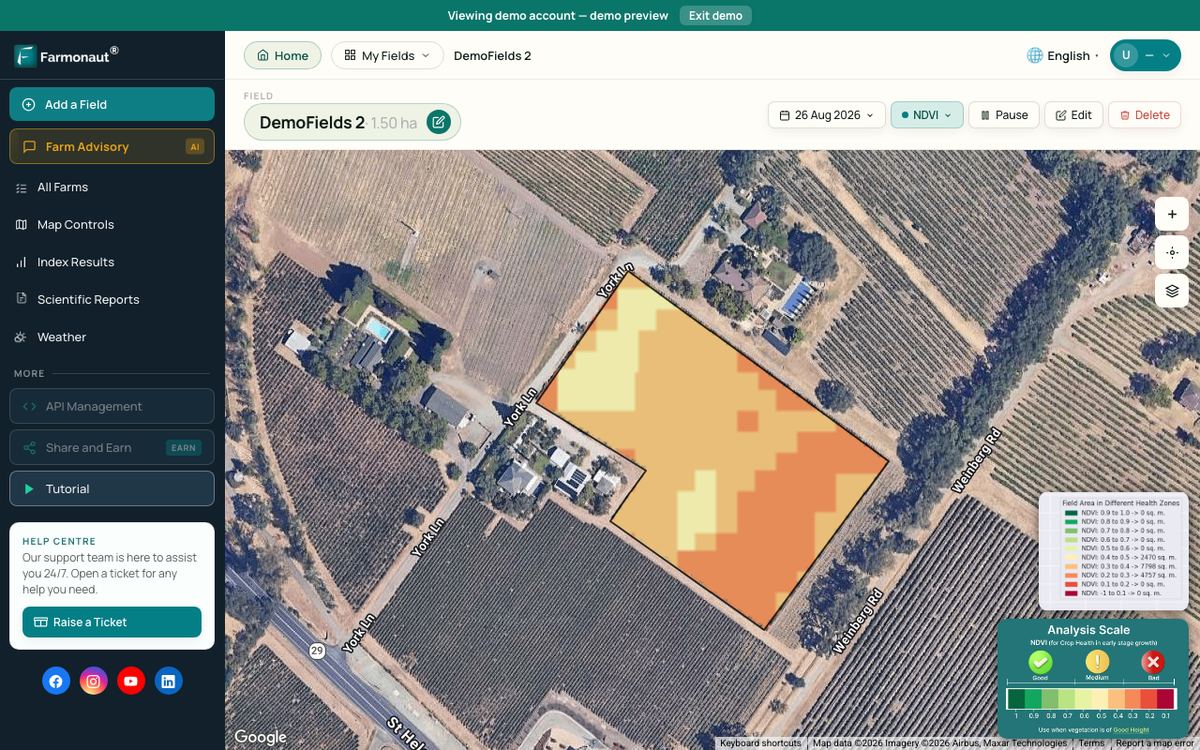
Multispectral satellite data and AI diagnostics extend the same real-time monitoring logic used inside vertical facilities out to open-field and plantation crops — vegetation health (NDVI) and soil moisture indicators for outdoor acreage. Satellite indices show where vegetation changes; confirm the cause in the field.
- Shows where crops may be stressed, so you can check the cause in the field.
- Farmonaut’s satellite and AI monitoring covers outdoor fields and plantations. For indoor lighting, see this guide to vertical farming lighting setups in the US.
Explore Farmonaut’s Blockchain Traceability for secure, transparent food supply chains
-
Blockchain for Product Traceability and Food Safety
Blockchain records each stage of a product’s path — planting, feeding, harvesting, packaging — as a tamper-evident entry. The record is protected after entry, but it does not prove that what was entered is true. It may matter to operators who supply retail chains with audit requirements.
- Gives buyers a record they can check, though it only shows what was entered.
- Can help trace a batch when a quality issue arises.
- May help growers who sell to buyers that ask for verified produce.
-
Autonomous Drones for Vertical and Outdoor Applications
Drones equipped with multispectral and thermal imaging monitor crop health, scout pests, and apply targeted treatment — used both around vertical-farm rooftops/outdoor supply plots and on larger conventional acreage tied to the same operation.
- Enables fast, targeted intervention on nutrient or pest issues, which can cut unnecessary pesticide use. Follow the product label and local rules for any treatment. Drone spraying is regulated: use a licensed operator where required and check that the product label allows aerial application.
- Supports both urban vertical operations and large-scale outdoor acreage.
- Can feed yield forecasts for outdoor crops.
-
Cloud-Based Management Platforms and Data Integration
Cloud platforms integrate data from every sensor, robot, and device on-site, giving operators a single dashboard for remote monitoring and control from a phone, tablet, or desktop.
- Gives farm managers analytics and control access from anywhere.
- Integrates with financial, logistics, and supply-chain software for end-to-end management.
- Applies predictive algorithms across the full data set to continuously refine productivity.
Comparative Trends Table: Automation Technologies
The table lists the technology behind each trend and the action it automates. This article found no measured figure from an official or peer-reviewed source that belongs to any one of these technologies, so none is shown.
| Trend | Core Technology | Primary Automated Action | Sourced figure |
|---|---|---|---|
| AI Environmental Control & Sensors | AI, IoT, precision sensors | Per-layer microclimate adjustment | No sourced figure |
| Autonomous Robotics | Robotic arms, AGVs, machine vision | Planting, harvesting, packaging | No sourced figure |
| IoT Resource Management | IoT networks, cloud connectivity | Predictive maintenance, flow monitoring | No sourced figure |
| Satellite & AI Crop Monitoring | Multispectral imaging, AI analytics | NDVI-based stress detection | Extends indoor sensing logic to open-field acreage |
| Blockchain Traceability | Blockchain, digital ledgers | Seed-to-shelf audit trail | No sourced figure |
| Autonomous Drones | UAVs, multispectral/thermal cameras | Pest/health scouting, targeted treatment | No sourced figure |
| Cloud Management Platforms | Cloud computing, data integration | Remote monitoring & control | Consolidates all sensor/robotics data streams above |
Where the table says “no sourced figure”, the yield and water figures in this article come from studies of whole farms, not from any one technology listed.
What a Vertical Farm Costs to Build and Run
Published build-cost figures vary widely with farm size, number of layers and level of automation, so get written quotes for your own design. This article found no published price for sensors, robots or software alone. In a 2026 model of a 25 m, 20-layer lettuce farm, yearly capital cost for the whole farm (depreciation, maintenance and interest on lighting, climate and growing systems) came to €0.36 to €1.34 per kilogram, and lighting was the largest part of it (Meeuws and colleagues, 2026).
Chart
Modelled cost per kilogram of lettuce
Euro per kg of fresh lettuce. Shown: the Current scenario at 0.8 g/mol and the NextGen target at 1.8 g/mol, two end cases of 18 scenarios. Capital cost covers the whole farm (lighting, climate and growing systems), not sensors or robots. Dutch cost levels, 2023 prices.
Small farms differ too. Two Italian microgreen farms, with 250 m² and 80 m² of space, reported setup investments of about €320,000 and €300,000 (Amici and colleagues, 2025).
Capital is only part of the picture. Electricity, labour and loan costs recur every year, and the next sections show how large some of them can be.
Energy cost per kilogram depends on your local electricity price and your light efficiency, so use your own tariff, not a national average. Ask your equipment vendor for a kWh-per-kg estimate. Compliance costs for labour, food safety and permits vary by state or province, so ask your local agricultural extension office and follow local rules.
Cost shares differ by crop and country. On two Italian microgreen farms, labour was 46% and 41% of total cost, energy only 4% and 3%, and depreciation 14% on the farm that had not yet paid off its equipment (Amici and colleagues, 2025). Microgreens grow fast and need under 12 hours of light a day, so their energy share is not typical of lettuce. A simple electricity-only floor for lettuce is about $0.5 per kilogram at about 4 cents per kWh, which excludes labour and capital (Lovat, Noor and Milo, 2025). The model chart below shows how capital cost falls as light-use efficiency and yield per square metre rise.
Vertical Farm Lighting Electricity Calculator
Enter your own growing area, light power, hours and electricity price to estimate yearly lighting and cooling electricity cost. Add a yield to see the cost per kilogram.
Try the numbers for your own farm below.
Calculator
What will lighting electricity cost my vertical farm?
Enter your own numbers. The values below are examples.
- Lighting electricity: 584,000 kWh/yr
- Lighting plus cooling electricity: 700,800 kWh/yr
- Annual lettuce output: 100,000 kg/yr
- Electricity per kilogram: 7.0 kWh/kg
- Electricity cost per kilogram: 0.84 $/kg
Example values only, not a benchmark. Growing area means the total area of all layers. Light power per square metre depends on your fixtures (for example, a light level in micromoles per square metre per second divided by the fixture efficacy in micromoles per joule gives watts per square metre). The cooling share is an input: a US Department of Energy meeting summary gives an example of about 0.2 J of cooling per joule of light (DOE and USDA ARS, 2022). The formula fixes 365 operating days a year. Real farms also use electricity for pumps, fans, dehumidifying and heating, which this calculator leaves out.
How Farmonaut Powers Automated & Sustainable Agriculture
Farmonaut’s platform applies the same automation logic described above — satellite sensing and AI-driven advisory — to the outdoor and plantation side of a farming operation, available via Android, iOS, web app, and API.
-
Satellite Imagery for Crop Monitoring: Multispectral satellite imagery and NDVI analytics give farmers visibility into crop health, soil moisture, and vegetation indices, supporting irrigation and fertilization decisions.
(Large-Scale Farm Management Platform) - AI advisory: Farmonaut analyzes satellite and weather data to give crop-management advice for open-field and plantation crops. Satellites cannot see inside a closed grow room. For indoor lighting, see this guide to vertical farming lighting in the US.
- Blockchain Traceability: Blockchain-based traceability gives both corporate clients and individual producers a transparent, tamper-evident record of each product’s journey.
- Resource & Fleet Management: Fleet tracking and vehicle management tools help manage vehicles and equipment.
- Environmental Sustainability: The carbon footprinting service helps track operations against sustainability targets.
- API Integration: Developers can integrate satellite and weather data via the API and developer docs.
Satellites monitor outdoor fields, while indoor farms need their own sensors. Both rely on the same loop of measuring, deciding and acting, and Farmonaut covers the outdoor side of that loop.
Future Outlook: Automation in Vertical Farming
Three things will shape the outlook: the cost of building farms, the price of electricity and how efficiently plants turn light into food. In the 2026 model, a 10% fall in electricity price cut lettuce cost by about 2.3%, while a 10% gain in light-use efficiency cut it by about 5.9% (Meeuws and colleagues, 2026).
- Continued integration: some farms combine sensors, software and robots, but this article found no data on how common that is.
- Urban supply: indoor farms can sit close to cities, but today they grow mainly leafy greens and small fruiting crops. An ARS scientist interviewed on the ARS website says cereals and row crops are better suited to the field (USDA ARS interview page, modified January 2025).
- Wider access depends on falling capital costs. In the 2026 model, yearly capital cost per kilogram of lettuce fell from €1.34 to €0.36 as light-use efficiency and yield per square metre rose (Meeuws and colleagues, 2026).
- Resource use: water use per kilogram can be far lower than in the field, but energy use per kilogram is higher than for field lettuce, and open greenhouses used less energy than plant factories in all ten locations of one 2021 study (Barbosa and colleagues, 2015; Weidner and colleagues, 2021).
- API access: some platforms, including Farmonaut, offer an API for outdoor field data.
Energy, labour and capital cost are among the concerns raised about vertical farming (Meeuws and colleagues, 2026). Test any plan against your own electricity price, yield and labour cost, and take independent advice before you commit money. Staff skills and access to technology are further constraints.
Every figure in this article carries the year of its source. Check each linked source for newer data before you rely on a number.
Frequently Asked Questions about Vertical Farming Automation
What is vertical farming automation and how does it work?
It’s the use of sensors, AI, IoT, robotics, and cloud platforms to control and optimize the growing environment in vertically stacked production. These systems continuously monitor lighting, temperature, humidity, and nutrients, adjusting in real time. An ARS scientist interviewed on the ARS website said some crops can yield 10 to 20 times more per acre in vertical farming than in open fields (undated interview, page modified January 2025).
What does vertical farming automation cost?
Published figures vary widely. In a 2026 model, yearly capital cost came to €0.36 to €1.34 per kilogram of lettuce, and electricity use was 2.3 to 7.8 kWh per kilogram (Meeuws and colleagues, 2026). Get written quotes for your own design.
Have vertical farming companies stayed in business?
Some have not. Bowery Farming was reported closed in 2024. AeroFarms and Plenty went through Chapter 11 bankruptcy and exited it, in September 2023 and May 2025. Other companies keep operating, so check each company’s own results.
How does the Netherlands compare?
Dutch greenhouse lettuce used 3.81 kWh of electricity per kilogram in the national benchmark (KWIN 2023) that a 2026 study used. The study’s modelled vertical farm used 7.83 kWh in its lower-efficiency case and 2.31 in its higher-efficiency case.
What sensors do vertical farms commonly use?
In general terms, these kinds of sensors: photometric/PAR sensors for light, temperature/humidity probes, CO₂ sensors, nutrient EC/pH probes, and water-level/flow sensors — each tied to an automated response like LED dimming, HVAC cycling, or dosing-pump adjustment.
Can small farms afford vertical farming automation?
It can be, but costs and results vary. Two Italian microgreen farms were profitable on 2023 data (Amici and colleagues, 2025), while several large US companies went through bankruptcy or closed. Test your own numbers first.
How much labor does automation actually save?
Labour was the largest single cost on two Italian microgreen farms, at 41% and 46% of total cost (Amici and colleagues, 2025). The share differs by crop and farm.
How does Farmonaut support automation in farming?
Farmonaut provides a satellite-powered farm management platform delivering real-time crop analytics, AI-based advisory, blockchain traceability, fleet/resource monitoring, and carbon-footprint tracking for farms of any size or format.
Get Started with Smart Farm Automation
Ready to evaluate automation, precision control, and data-driven management for your own operation? Sign up for a Farmonaut subscription — for individual farmers, agribusinesses, or government bodies, the platform covers outdoor crop, plantation and forestry monitoring.
Farmonaut crop monitoring
See your outdoor fields from space
Farmonaut Satellite + AI Farm Monitoring System shows crop health maps for open fields and plantations on web, Android and iOS.



Keep reading
 BlogsIs Vertical Farming Eco Friendly? The Data, Not the Hype
 BlogsVertical Farming Disadvantages: Top 7 Key Drawbacks
 usaNorth America Vertical Farming: 7 Scalable Crop Trends
Sources
- Barbosa et al., Comparison of Land, Water, and Energy Requirements of Lettuce Grown Using Hydroponic vs. Conventional Agricultural Methods, Int. J. Environ. Res. Public Health (2015): pmc.ncbi.nlm.nih.gov
- Kusuma, Pattison and Bugbee, From physics to fixtures to food: current and potential LED efficacy, Horticulture Research (2020): pmc.ncbi.nlm.nih.gov
- Meeuws et al., Vertical farming economics: crop performance targets for cost-competitive vertical farming, Frontiers in Sustainable Food Systems (2026): frontiersin.org
- Lovat, Noor and Milo, Vertical farming limitations and potential demonstrated by back-of-the-envelope calculations, Plant Physiology (2025): pmc.ncbi.nlm.nih.gov
- Weidner, Yang and Hamm, Energy optimisation of plant factories and greenhouses for different climatic conditions, Energy Conversion and Management (2021), University of Oxford record: ora.ox.ac.uk
- Amici et al., From seed to profit: a comparative economic study of two Italian vertical farms, Frontiers in Sustainable Food Systems (2025): frontiersin.org
- USDA Agricultural Research Service, Vertical Farming – No Longer A Futuristic Concept (interview page, undated, page modified January 2025): ars.usda.gov
- USDA NASS, Vegetables 2024 Summary (February 2025): nass.usda.gov
- US Department of Energy Solid-State Lighting Program and USDA-ARS, R&D Meeting on horticultural lighting (June 2022): energy.gov
- Gargaro, Murphy and Harris, A Meta-Analysis of Influencing Factors on Lettuce Crop Yields within Controlled-Environment Agriculture Systems, Plants (2023): pmc.ncbi.nlm.nih.gov
- Food Dive, AeroFarms files for Chapter 11 bankruptcy protection (June 2023): fooddive.com
- TechCrunch, Bowery Farming is ceasing operations (4 November 2024): techcrunch.com
- TechCrunch, Plenty files for bankruptcy after raising nearly $1B (24 March 2025): techcrunch.com
- Plenty, Plenty completes restructuring and emerges from Chapter 11 (29 May 2025): plenty.ag
Discussion
Questions, corrections or field experience? Share them below. First-time comments are reviewed before they appear, and your email is never published.
No comments yet. Be the first to add a question or your experience.

 Azure Clouds
 MCSOD
MCSOD Marei Nursery
 eKGIS
eKGIS Mostas Tech
 Native Seeds
 Andex
Andex FCF India
 Unifrutti Gulf
 Deluxe Conseil
 TVS Electronics
 WICO
WICO Chimera Innovation
 SkyHarvest
 Polaris Digitech
 Licence holder · Niger · Gold










