

Vertical Farming Automation: What It Costs, Saves and Runs On
Reviewed against Market.us vertical farming market research and peer-reviewed controlled-environment agriculture data indexed on NCBI/NIH.
Try it: Run your own numbers →
Table of Contents
- Introduction: What Vertical Farming Automation Actually Delivers
- Market Size: US and Netherlands/EU Numbers
- The Rise of Vertical Farming Automation
- Vertical Farming Sensors: What They Measure and Why
- 7 Trends in Automation in Vertical Farming
- Comparative Trends Impact Table
- What a Vertical Farm Automation System Actually Costs
- Vertical Farm Automation Cost & Payback Calculator
- How Farmonaut Powers Automated & Sustainable Agriculture
- Future Outlook: Automation in Vertical Farming
- Frequently Asked Questions (FAQ)
- Get Started with Smart Farm Automation
- Try it: Run your own numbers
Introduction: What Vertical Farming Automation Actually Delivers
Vertical farming automation is the use of sensor networks, AI-driven environmental control, and robotics to run stacked, indoor crop production without constant manual adjustment. The concrete payoff, per peer-reviewed data indexed on NCBI/NIH: yields of 10x to 20x per square meter versus field crops, roughly 95% less water than traditional field agriculture, and up to a 40% cut in harvest labor where automated harvesting systems are running at their measured 95% efficiency rate. Those are the numbers that separate an automated vertical farm from a manually-run one — everything below explains where they come from and what it costs to get there.
This isn’t a hypothetical. A commonly cited peer-reviewed comparison puts vertical-farmed lettuce yield at 1,500 kg per square meter against roughly 80 kg per square meter for conventional field-grown lettuce — a factor that lands squarely inside that 10x–20x range once growing-cycle counts are factored in. The gap is the reason vertical farming automation shows up as a search term across the US and Netherlands: buyers already know the yield case, and are now pricing the automation layer that makes it operable.




Market Size: The Real US and Netherlands/EU Numbers
The US vertical farming market was sized at $735.6 million in 2023 and reached $1.98 billion in 2025, according to Market.us. The same report projects growth to $12.03 billion by 2035, a 20.5% compound annual growth rate across 2025–2035. That’s the figure behind “vertical farming automation” as a US search term — a market roughly tripling between 2023 and 2025 alone, and still expected to grow at over 20% a year for the following decade.
For readers searching “vertical farming netherlands” specifically: the Netherlands sits inside the broader EU vertical farming market, which Market.us sizes at $10.6 billion in 2025, projected to reach $73.7 billion by 2035 at a 21.4% CAGR across 2026–2035 — a faster projected growth rate than the US market, on a larger current base. The Netherlands itself is one of the most automation-dense growing regions in the EU because of its greenhouse-horticulture legacy (Westland, South Holland), though Market.us’s public report does not break out a Netherlands-only figure separate from the EU total.
How to get a fresher number than this one: Market.us updates these reports periodically; check the linked pages directly for the current edition. For US-specific production data measured in standard agricultural units rather than market-research dollars, the USDA Census of Agriculture is published every five years, with annual interim updates available through IBISWorld and Statista reports. For EU production-method breakdowns, Eurostat (ec.europa.eu/eurostat) updates its agricultural statistics quarterly, and the EU’s Agriculture and Agri-food Trade Database (AGDB) tracks production by method, which is the closest public proxy for vertical/CEA acreage currently available.
The Rise of Vertical Farming Automation
Vertical farming automation is the reference model for automation farming broadly — a blueprint that automatic farming systems in other formats (greenhouses, container farms) increasingly copy. It combines AI, IoT, robotics, and data analytics to run controlled, high-density growing environments suited to urban and peri-urban sites, or regions with limited arable land or water access, without needing a large on-site labor force to hold conditions steady.
Sensors scan environmental parameters — humidity, nutrient concentration, temperature, light — continuously. When a reading drifts from the crop’s optimal range, automated systems trigger a correction: dosing pumps adjust, LED arrays dim or shift spectrum, HVAC cycles change. This is the mechanism behind the water-efficiency figure above: a closed-loop system recirculates water and nutrient solution rather than discharging it, which is the primary reason vertical systems reach roughly 95% water savings against open-field irrigation.
Before the trend list, here’s what changes operationally once a facility is automated rather than manually monitored — covered in more depth on irrigation system installation:
- Resource optimization: closed-loop dosing cuts water and fertilizer waste versus manual scheduling.
- Yield consistency: machine-learning control adjusts conditions per crop cycle rather than per season, which is how vertical systems sustain the 10x–20x yield multiple cited above across repeated harvests.
- Labor reduction: robotics and AGVs replace repetitive manual tasks — the peer-reviewed 40% harvest-labor reduction figure applies specifically to harvesting operations, not the whole facility.
- Data-driven decisions: continuous sensor logging feeds forecasting and pest-response models instead of relying on visual inspection rounds.
Vertical Farming Sensors: What They Measure and Why
“Vertical farming sensor” and “vertical farming sensors” are both search terms landing on this page, so here is the direct answer: a fully-instrumented vertical farm typically runs five sensor categories, each tied to a specific automated response.
| Sensor Type | What It Measures | Automated Response Triggered |
|---|---|---|
| Photometric / PAR sensors | Light intensity and spectrum reaching the canopy | LED dimming or spectrum shift per growth stage |
| Temperature/humidity probes | Air temperature, relative humidity, VPD | HVAC cycling, dehumidification |
| CO₂ sensors | Ambient CO₂ concentration | CO₂ injection for photosynthesis optimization |
| Nutrient/EC & pH probes | Electrical conductivity and pH of recirculating solution | Dosing pump adjustment |
| Water-level/flow sensors | Reservoir levels, flow rate through the loop | Pump control, leak/failure alerts |
The reason this sensor stack matters commercially: it’s what makes the 95% automated-harvesting-efficiency figure and the 40% labor-reduction figure achievable in the first place — without continuous, automated environmental logging, the harvesting robotics have no reliable signal for when a crop is at optimal maturity. Satellite-based monitoring extends this same logic outdoors; Farmonaut’s platform applies the equivalent sensing model to open-field and plantation crops via the Large-Scale Farm Management Platform.
7 Trends in Automation in Vertical Farming
-
AI-Powered Environmental Control & Precision Sensors
Machine-learning control loops now hold light intensity, temperature, humidity, CO₂, and nutrient delivery inside crop-specific setpoints without a human resetting them each shift. Each stacked layer gets its own microclimate, which is the operational reason vertical yield multiples reach the 10x–20x range referenced above rather than the lower end of that range.
- Optimizes each stacked layer’s microclimate for maximum photosynthesis and yield.
- Reduces resource waste by delivering only what each crop needs, when it needs it.
- IoT integration enables remote oversight and adjustment by farm operators off-site.

-
Autonomous Robotics for Planting, Maintenance, and Harvesting
Robotic arms and automated guided vehicles (AGVs) now handle planting, maintenance, harvesting, and packaging. Peer-reviewed data puts automated harvesting-system efficiency at 95% in controlled-environment settings, with a corresponding 40% reduction in harvest labor — the single clearest ROI line item for any operator comparing automation against a manual-labor model.
- Delivers consistent crop handling and uniform product quality across shifts.
- Enables output scaling without a proportional headcount increase.
- AGVs handle internal logistics — nutrient delivery, crop relocation between growth stages.
Discover Farmonaut’s Fleet Management for enhanced robotic and vehicle automation efficiency
-
IoT-Driven Resource and Infrastructure Management
Networked IoT sensors track reservoir levels, energy draw, and nutrient flow continuously, feeding predictive-maintenance models that flag a failing pump or drifting dosing line before it causes a crop loss. This is the connective layer underneath the water-efficiency figure: without continuous flow monitoring, a closed recirculation loop cannot sustain the ~95% water savings figure over months of operation.
- Predictive maintenance reduces unplanned downtime.
- Networked sensors track water, nutrient, and energy flows to minimize consumption.
- Instant alerts and remote corrective actions for pump failures or temperature deviation.

-
Satellite Imagery and AI-Based Health Monitoring
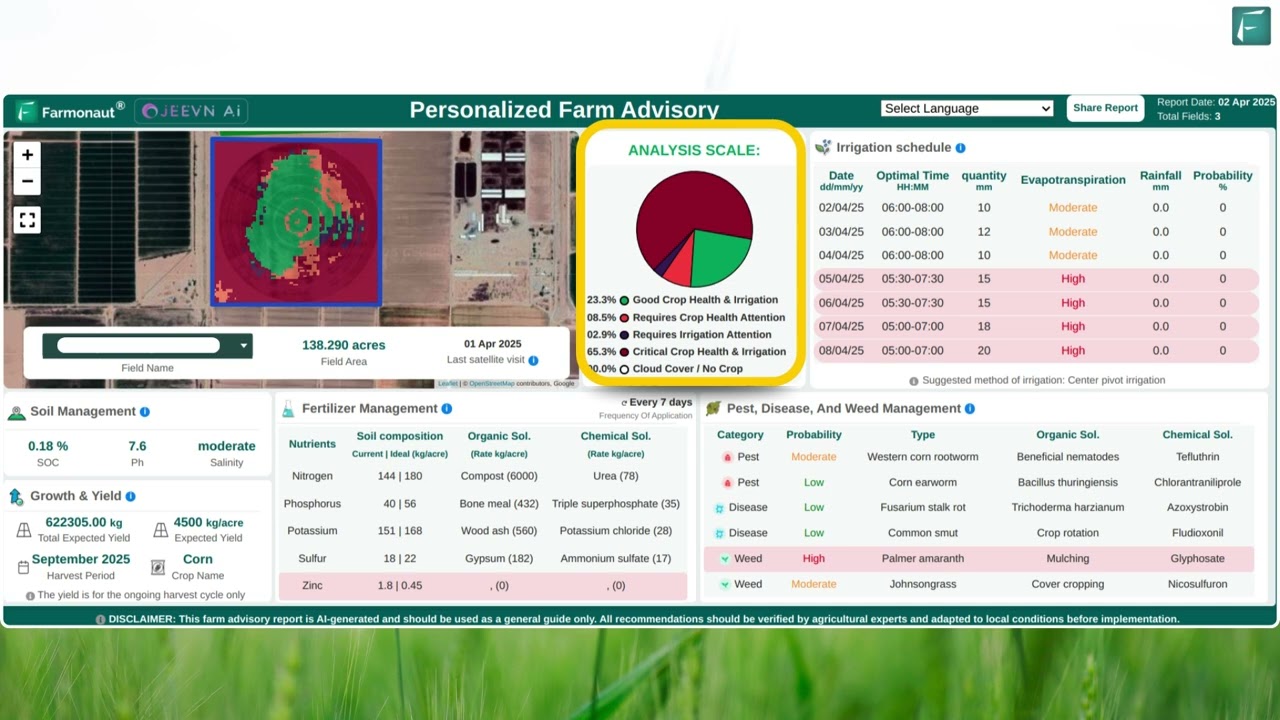
Multispectral satellite data and AI diagnostics extend the same real-time monitoring logic used inside vertical facilities out to open-field and plantation crops — vegetation health (NDVI), soil moisture, and pest-risk indicators, surfaced for outdoor acreage the way indoor sensors surface conditions inside a grow room.
- Detects disease or nutrient stress early, reducing crop loss and preserving quality.
- AI-driven advisory tools such as Jeevn AI help optimize production and efficiency for farms of any size, including vertical farming lighting setups in the US.
Explore Farmonaut’s Blockchain Traceability for secure, transparent food supply chains
-
Blockchain for Product Traceability and Food Safety
Blockchain records each stage of a product’s path — planting, feeding, harvesting, packaging — as an immutable entry, which matters most for vertical-farm operators supplying retail chains with strict seed-to-shelf audit requirements.
- Gives buyers and retailers proof of origin, reducing fraud risk.
- Speeds recalls when a quality issue does arise, limiting downstream damage.
- Lets growers target premium accounts that require verified, sustainably-grown produce.
-
Autonomous Drones for Vertical and Outdoor Applications
Drones equipped with multispectral and thermal imaging monitor crop health, scout pests, and apply targeted treatment — used both around vertical-farm rooftops/outdoor supply plots and on larger conventional acreage tied to the same operation.
- Enables fast, targeted intervention on nutrient or pest issues, cutting unnecessary pesticide use.
- Supports both urban vertical operations and large-scale outdoor acreage.
- Improves yield forecasting and supports reforestation/carbon-sequestration monitoring.
-
Cloud-Based Management Platforms and Data Integration
Cloud platforms integrate data from every sensor, robot, and device on-site, giving operators a single dashboard for remote monitoring and control from a phone, tablet, or desktop.
- Gives farm managers analytics and control access from anywhere.
- Integrates with financial, logistics, and supply-chain software for end-to-end management.
- Applies predictive algorithms across the full data set to continuously refine productivity.
Comparative Trends Impact Table: Automation, Yield & Resource Management
The figures below combine the peer-reviewed baseline metrics cited above (yield multiple, water savings, harvesting efficiency, labor reduction) with the specific technology each trend deploys. Where a range is shown, it reflects the spread across facility types and crop mixes reported in the underlying NCBI/NIH-indexed literature; treat the harvesting-automation row (95% efficiency, 40% labor cut) as the two figures with direct peer-reviewed support, and the rest as the operational context around them.
| Trend | Core Technology | Primary Automated Action | Supporting Figure |
|---|---|---|---|
| AI Environmental Control & Sensors | AI, IoT, precision sensors | Per-layer microclimate adjustment | 10x–20x yield per m² vs. field crops (NCBI/NIH) |
| Autonomous Robotics | Robotic arms, AGVs, machine vision | Planting, harvesting, packaging | 95% harvesting efficiency, 40% labor reduction (NCBI/NIH) |
| IoT Resource Management | IoT networks, cloud connectivity | Predictive maintenance, flow monitoring | ~95% water savings vs. field irrigation (NCBI/NIH) |
| Satellite & AI Crop Monitoring | Multispectral imaging, AI analytics | NDVI-based stress detection | Extends indoor sensing logic to open-field acreage |
| Blockchain Traceability | Blockchain, digital ledgers | Seed-to-shelf audit trail | Not independently quantified in current research brief |
| Autonomous Drones | UAVs, multispectral/thermal cameras | Pest/health scouting, targeted treatment | Not independently quantified in current research brief |
| Cloud Management Platforms | Cloud computing, data integration | Remote monitoring & control | Consolidates all sensor/robotics data streams above |
Where the table says “not independently quantified”: that’s deliberate rather than an omission. Adoption-rate percentages for blockchain and drone use specifically in vertical farming are not published in a form this brief could verify, so none are shown here — the honest answer is to check the vertical farming market reports linked above for the latest edition, which periodically breaks out technology-adoption segments as the underlying survey data updates.
What a Vertical Farm Automation System Actually Costs
This is the number AI Overviews consistently skip: commercial vertical farming capital costs run $150–$250 per square foot for construction plus equipment, according to Forward Fooding and Agro Reality’s 2024–2025 cost analyses. That figure covers racking, LED lighting, HVAC, and the automation/sensor layer together — automation is not a separate line item bolted on after the fact, it’s part of the base build cost in a modern facility.
At the small end, Agro Reality’s 2025 breakdown puts a 1,000-square-foot vertical farm startup at $70,000–$210,000 total, depending on the automation tier chosen — a basic sensor/irrigation setup lands at the low end, a fully AI-controlled environment with robotics sits at the high end of that range.
Scaling that per-square-foot cost against the market-size figures above gives a rough sense of why the “best data-driven cultivation management solution vertical farming” query exists: buyers researching this space are comparing five- and six-figure capital outlays against a market that’s more than doubled in two years, and they want the automation layer that protects that capital — not just a yield promise.
What isn’t published, and how to get it for your own site: neither Forward Fooding nor Agro Reality’s public figures break out energy cost per kilogram of produce against regional grid electricity rates — that number depends entirely on your local utility rate and LED efficiency, so request a kWh-per-kg estimate directly from your equipment vendor using your actual utility tariff, not a national average. Similarly, regulatory compliance costs (labor, food safety, environmental permits) vary by state/province and aren’t captured in either cost report; a local agricultural extension office or, in the US, USDA ARS’s controlled-environment-agriculture research program is the right source to query for jurisdiction-specific compliance cost estimates.
Vertical Farm Automation Cost & Payback Calculator
Enter your planned facility size and labor cost to estimate build-cost range and the harvest-labor savings automation delivers, using the capital-cost and labor-reduction figures cited above.
Run your own numbers
Assumptions: build cost uses Forward Fooding/Agro Reality’s $150–$250/sq ft commercial range (2024–2025); labor savings applies the NCBI/NIH-cited 40% harvest-labor reduction figure uniformly, which is a simplification — real savings depend on how much of your labor cost is harvesting versus other tasks (planting, maintenance, packaging) that automate at different rates. Excludes energy costs, financing, and site-specific permitting fees.
How Farmonaut Powers Automated & Sustainable Agriculture
Farmonaut’s platform applies the same automation logic described above — continuous sensing, AI-driven advisory, remote control — to the outdoor and plantation side of a farming operation, available via Android, iOS, web app, and API.
-
Satellite Imagery for Crop Monitoring: Multispectral satellite imagery and NDVI analytics give farmers visibility into crop health, soil moisture, and vegetation indices, supporting irrigation, fertilization, and pest-control decisions.
(Large-Scale Farm Management Platform) - AI-Driven Jeevn Advisory: The Jeevn system analyzes satellite and environmental data to deliver tailored crop-management recommendations for all types of farms, including vertical operations optimizing lighting.
- Blockchain Traceability: Blockchain-based traceability gives both corporate clients and individual producers a transparent, tamper-proof record of each product’s journey.
- Resource & Fleet Management: Fleet tracking and vehicle management tools reduce logistics costs and downtime.
- Environmental Sustainability: The carbon footprinting service delivers real-time insight to help align operations with sustainability targets.
- API Integration: Developers can integrate satellite and weather data via the API and developer docs.
Whether the operation is a commercial greenhouse, an urban vertical farm, or outdoor plantation acreage, this stack extends the automation model above to resource management at scale — for readers evaluating hydroponic-specific setups, see the dedicated breakdown of vertical farming hydroponics.
Future Outlook: Automation in Vertical Farming
The US and EU market-growth figures above (20.5% and 21.4% CAGR respectively) both extend through 2035, so the near-term trajectory is already priced into current forecasts rather than being a guess. What would actually change that trajectory: capital-cost compression (the $150–$250/sq ft range narrowing as LED and sensor hardware commoditizes), and energy-price shifts in the US and EU, given that vertical farms carry higher electricity dependence than field agriculture.
- Continued integration: AI, IoT, robotics, and blockchain are converging into a standard operating model across both vertical and conventional farms.
- Food security in urban areas: automation makes urban and peri-urban production more viable by shrinking food miles and spoilage, though this remains a capacity question tied directly to the capital-cost figures above — it scales only as fast as build costs fall.
- Wider access as capital costs fall: the $70,000 low end of Agro Reality’s small-farm range already puts entry-level automated vertical farming within reach of smaller operators, a threshold that will move as hardware costs shift.
- Resource stewardship: the ~95% water-savings figure and the labor-efficiency gains above compound as more capacity comes online in both the US and EU markets.
- API ecosystems: open APIs and cloud platforms, including Farmonaut’s, will keep driving integration across agricultural value chains.
The main constraint remains capital: at $150–$250 per square foot, a mid-size 10,000-square-foot facility runs $1.5–$2.5 million before financing — money that has to be justified against the yield and labor figures cited throughout this piece. Workforce upskilling and equitable technology access are the secondary constraints, addressed as vendor financing and SaaS-based automation platforms lower the entry threshold described above.
None of the figures in this article are static. The market-size numbers update on Market.us’s own report cycle, the cost figures reflect Forward Fooding and Agro Reality’s 2024–2025 analyses and should be re-checked against their current published editions, and USDA/Eurostat production statistics refresh on their standard five-year and quarterly cycles respectively. Re-pull each linked source directly rather than treating any number here as fixed.
Frequently Asked Questions about Vertical Farming Automation
What is vertical farming automation and how does it work?
It’s the use of sensors, AI, IoT, robotics, and cloud platforms to control and optimize the growing environment in vertically stacked production. These systems continuously monitor lighting, temperature, humidity, and nutrients, adjusting in real time — the mechanism behind the 10x–20x yield multiple and ~95% water savings cited in peer-reviewed data indexed on NCBI/NIH.
What does vertical farming automation cost?
Commercial builds run $150–$250 per square foot for construction and equipment combined, per Forward Fooding and Agro Reality’s 2024–2025 analyses. A 1,000-square-foot small-scale farm costs $70,000–$210,000 to start, per Agro Reality’s 2025 breakdown, depending on the automation tier chosen.
How big is the US vertical farming market?
Market.us sizes the US market at $1.98 billion in 2025, up from $735.6 million in 2023, with a projected $12.03 billion by 2035 at a 20.5% CAGR for 2025–2035.
How does the Netherlands/EU market compare?
The EU vertical farming market (which includes the Netherlands) is sized at $10.6 billion in 2025, projected to reach $73.7 billion by 2035 at a 21.4% CAGR for 2026–2035 — a higher current base and a slightly faster projected growth rate than the US market.
What sensors does a vertical farm actually need?
Five core categories: photometric/PAR sensors for light, temperature/humidity probes, CO₂ sensors, nutrient EC/pH probes, and water-level/flow sensors — each tied to an automated response like LED dimming, HVAC cycling, or dosing-pump adjustment.
Can small farms afford vertical farming automation?
Yes, at the entry end: Agro Reality’s 2025 figures put a 1,000-square-foot automated setup as low as $70,000. Cloud-based SaaS platforms are lowering that threshold further by removing the need for on-site custom software development.
How much labor does automation actually save?
Peer-reviewed data indexed on NCBI/NIH puts automated harvesting-system efficiency at 95%, with a 40% reduction in harvest labor specifically — not total facility labor, which includes planting, maintenance, and packaging tasks that automate at different rates.
How does Farmonaut support automation in farming?
Farmonaut provides a satellite-powered farm management platform delivering real-time crop analytics, AI-based advisory, blockchain traceability, fleet/resource monitoring, and carbon-footprint tracking for farms of any size or format.
Get Started with Smart Farm Automation
Ready to evaluate automation, precision control, and data-driven management for your own operation? Sign up for a Farmonaut subscription — for individual farmers, agribusinesses, or government bodies, the platform covers vertical farming through to forestry and outdoor crop management.

 Azure Clouds
 MCSOD
MCSOD Marei Nursery
 eKGIS
eKGIS Mostas Tech
 Native Seeds
 Andex
Andex FCF India
 Unifrutti Gulf
 Deluxe Conseil
 TVS Electronics
 WICO
WICO Chimera Innovation
 SkyHarvest
 Polaris Digitech
