

Fertiliser · Product guide
YaraLiva Nitrabor: Analysis, Uses and Rate Guidance
YaraLiva Nitrabor is a granular calcium nitrate with added boron: 15.4% nitrogen, 25.6% CaO and 0.3% boron (Yara UK). It is not a liquid or a foliar spray. Here is what it supplies per acre and when it fits.
Key takeaways
- Yara UK lists YaraLiva Nitrabor as granular calcium nitrate with 15.4% N (14.1% nitrate, 1.3% ammoniacal), 25.6% CaO and 0.3% B, with no chloride.
- Yara Ireland gives the calcium as 18.3% Ca, which is the same analysis in elemental units.
- At 0.3% boron, 500 lb of product per acre supplies 1.5 lb of boron, the low end of the Delaware rate for broccoli and kale, plus about 77 lb of nitrogen.
- Oregon State gives 1 to 3 lb B per acre for very low boron soils and none where the soil test is high.
- Delaware says calcium foliar sprays have not been shown to control tipburn; soil pH above 6.0, less ammonium nitrogen and even water are its advice.
In this article
- YaraLiva Nitrabor content: what is in the bag
- What Nitrabor is not
- What it is used for
- How much boron does it supply?
- How much of the boron need does one pass cover?
- Nitrabor compared with other Yara calcium nitrates
- How to apply Nitrabor
- When Nitrabor may not be the right product
- Calculator: rate, cost and nutrients per hectare
- Watching the crop after you apply
- How we checked the numbers
- FAQ
YaraLiva Nitrabor is a granular calcium nitrate fertiliser with added boron. Yara lists it as 15.4% nitrogen, 25.6% calcium oxide (CaO) and 0.3% boron, and says it suits all crops, especially brassicas, which are more prone to calcium and boron deficiency (Yara UK product page). This page gives the full analysis, the crops it is used on, how much boron it really delivers per acre, and a calculator for rate and cost.
Some web pages call Nitrabor a liquid foliar spray with a 2:1 nitrogen-to-boron ratio. That is wrong. Yara’s own pages describe a dry granule that you spread, and the nitrogen-to-boron ratio is about 51 to 1. The sections below show what the maker’s pages say and what university extension guides say about the nutrients inside it.
YaraLiva Nitrabor content: what is in the bag
The table uses Yara’s published analysis. Yara UK gives calcium as CaO and Yara Ireland gives it as elemental calcium. The two figures describe the same product, because 25.6% CaO equals about 18.3% Ca.
| Item | Share of product | Note |
|---|---|---|
| Total nitrogen (N) | 15.4% | Yara UK |
| Nitrate nitrogen | 14.1% | Yara UK |
| Ammoniacal nitrogen | 1.3% | Yara UK |
| Calcium oxide (CaO) | 25.6% | Yara UK |
| Calcium (Ca) | 18.3% | Yara Ireland |
| Boron (B) | 0.3% | Both pages |
| Chloride | None listed | Yara UK |
| Form | Granular | Both pages |
In plain terms, 100 kg of product holds 15.4 kg of nitrogen, about 18 kg of calcium and 0.3 kg of boron. Most of the nitrogen is nitrate, which plants take up directly. Yara UK also notes that the product is dense, spreads accurately by hand or machine up to 24 metres, takes up moisture from humid air, and has a low risk of scorch (Yara UK; Yara Ireland). Product availability and analysis differ by market, and the pages we read are for the UK and Ireland. Check the bag label and safety data sheet for the version sold in your country. The calculator below uses the UK and Ireland analysis.
Chart
What 100 kg of YaraLiva Nitrabor contains
kg per 100 kg of product, as listed by Yara UK
What Nitrabor is not
Three claims seen on some web pages, and in an earlier version of this page, do not match the maker’s product pages.
- It is not a liquid. Yara lists the form as granular.
- Yara does not describe it as a foliar spray. Yara describes dry application and a low scorch risk when spread on a crop. The granule dissolves when it meets soil moisture or dew.
- It does not have a 2:1 nitrogen-to-boron ratio. With 15.4% N and 0.3% B, the ratio is about 51 to 1. Boron is a small part of the bag, and that matters for how you use it.
We could not find a published trial on this exact product that gives a yield gain in percent, so this page does not quote one. Yield effects depend on the crop, the soil and the season. Use the figures below to plan what you apply, and judge the results on your own fields.
What it is used for
Nitrabor is a calcium source with some nitrogen and a little boron. It fits crops where calcium and boron shortages cause quality losses.
Brassicas. University of Delaware extension lists tipburn in cabbage, cauliflower and Brussels sprouts as a calcium disorder, and hollow stems, corky midribs and brown curds as boron deficiency signs. Cole crops have a high boron need, but they also suffer from boron toxicity if too much is applied (University of Delaware). Yara adds that hollow stem is often linked to low calcium and boron or to too much nitrogen (Yara UK).
Fruit and vegetables with calcium disorders. The University of Florida explains that blossom-end rot in pepper comes from too little calcium reaching young fruit, and lists calcium nitrate among calcium fertilisers, often given through drip lines. It also notes that soils rich in calcium carbonate usually hold enough calcium already (UF/IFAS). A dry granule like Nitrabor is a field product, so for drip systems ask Yara or your supplier which grade is meant for fertigation.
Potatoes and onions. Yara’s own advice pages link calcium and boron to potato tuber quality and onion storage. These are the maker’s claims and not independent trials, so treat them as a reason to test your soil, not as proof of a response.
Brassica advice from Yara, dated February 2020, says nitrate nitrogen can raise calcium uptake in a way ammonium nitrogen does not, and gives a rate of up to 320 kg/ha every four weeks up to harvest, set to stay inside the UK Nitrate Vulnerable Zone limit of 50 kg N every four weeks (Yara UK agronomy advice). That limit is a UK rule. Your own country or state may have different nitrogen rules.
How much boron does it supply?
Boron is easy to overestimate. A bag that is 0.3% boron delivers little boron per acre at normal rates, because the rate is set by the nitrogen and calcium you want. At 100 lb of product per acre, you apply 0.3 lb of boron. To reach 1.5 lb of boron you would need 500 lb of product, which would also add about 77 lb of nitrogen per acre. That is well above the 320 kg per hectare (about 285 lb per acre) per application that Yara UK advises for brassicas, which supplies about 0.9 lb of boron.
Extension guides show what crops need. Oregon State University gives boron rates by soil test: 1 to 3 lb B per acre where the soil test is very low, 0 to 3 lb where it is low, 0 to 1 lb where medium, and none where the test is high or excessive. The same guide says boron should be spread evenly and not placed in a concentrated band, and that high boron can be toxic (Oregon State University, EC 1478). For broccoli and kale, Delaware advises 1.5 to 3 lb B per acre before planting in mixed fertiliser.
The soil test comes first. Skip boron where the test is high. If the test is low, Nitrabor can supply part of the boron, and you may add a dedicated boron source for the rest.
These rates are not directly comparable. Delaware’s 1.5 to 3 lb B per acre is a pre-plant rate mixed into the soil fertiliser, and it lists a separate foliar rate of 0.2 to 0.3 lb B per acre. Nitrabor is a late top dressing. Yara’s hollow-stem page and Delaware also differ on how readily brassicas show boron toxicity, so do not treat the table as a Nitrabor rate.
Chart
Suggested boron rates from extension guides
lb B per acre; Oregon State by soil test category, Delaware for broccoli and kale before planting
How much of the boron need does one pass cover?
The line chart below shows boron delivered at five product rates against the low end of the Delaware soil rate for cole crops. It is our own arithmetic from the 0.3% boron analysis Yara publishes. Even 500 lb of product per acre only just reaches 1.5 lb of boron, and at that rate you also apply about 77 lb of nitrogen and about 92 lb of calcium per acre. For a crop that needs only a modest nitrogen top dressing, a boron gap is better closed with a dedicated boron source chosen with your adviser.
Chart
Boron supplied by Nitrabor at five product rates
lb B per acre, calculated from the 0.3% boron analysis; lower line is the low end of the Delaware cole-crop rate
The bar chart after it shows how little boron field crops carry away. Iowa State University lists approximate boron in above-ground plant material, such as 0.04 lb B in 160 bu/acre corn grain and 0.5 lb in wheat straw (Iowa State University). The same paper says boron deficiency is more likely on sandy, low organic matter soils and in dry soil, and that high pH lowers boron availability.
Chart
Boron in above-ground crop material
lb B per acre; approx. amounts for 160 bu/acre corn, 40 bu/acre wheat and 60 bu/acre soybean
Nitrabor compared with other Yara calcium nitrates
Yara UK lists two related products next to Nitrabor. Pick by how you apply the fertiliser, not by the name.
| Product | Analysis | Use |
|---|---|---|
| YaraLiva Nitrabor | 15.4% N, 25.6% CaO, 0.3% B | Granular, spread dry |
| YaraLiva Tropicote | 15.5% N, 26.3% CaO | Granular, wide range of crops |
| YaraTera Calcinit | Water soluble N and Ca | Fertigation systems |
Tropicote has almost the same nitrogen and calcium but no added boron, so it suits crops where a boron test is normal. Calcinit dissolves fully in water and is the grade Yara names for application through irrigation systems (Yara UK).
How to apply Nitrabor
- Test first. Take a soil test for boron and pH, and a leaf test if you suspect a shortage. Oregon State says plant tissue testing may be a better diagnostic tool than a soil test when a micronutrient deficiency is suspected.
- Set the nitrogen budget. Count the nitrogen in Nitrabor (15.4%) together with your other nitrogen. Follow local nitrogen rules.
- Spread evenly. Use a calibrated spreader. Yara quotes a spread width of up to 24 metres for its granule. Do not band boron in a narrow strip.
- Time it for the crop. Yara describes use as a late top dressing on high-value crops where soils are low in boron. Calcium does not move once it is in cell walls, so supply it as new tissue grows.
- Split large totals. If your plan calls for more than a single pass, ask your agronomist about splitting it into several applications.
- Keep records and check the crop. Note rate, date and field. Look for leaf scorch on older leaves, which Delaware lists as a sign of boron toxicity in cole crops.
Safety and the law: follow the product label, the safety data sheet and local rules. Yara links a safety data sheet and a heavy-metal declaration on its product page. Calcium nitrate is a nitrate salt that takes up moisture, so keep bags closed and dry, and follow the storage rules in the safety data sheet. This page is general information and not a prescription. Get advice from a certified crop adviser or agronomist before you set rates.

▶ Six plain steps to start precision farming on your own fields. · 4:18
When Nitrabor may not be the right product
- Cereals and field crops with no calcium or boron problem. If tests are normal, a plain nitrogen source may cost less per unit of N (compare dealer quotes) and avoids extra boron.
- Calcareous soils. UF/IFAS says soils with a lot of calcium carbonate are likely to have enough calcium.
- Sprays for calcium problems in the field. Delaware says calcium foliar sprays have not been shown to control tipburn. Its advice is to keep soil pH above 6.0, limit ammonium nitrogen, and give even water. In apples, Penn State trials found calcium chloride sprays failed to control bitter pit below 2.7 lb of elemental calcium per acre per year, but cut it by 76% to 90% at 2.9 lb or more, and adding boron sprays did not make the calcium sprays work better (Penn State).
- Chasing calcium ratios. North Carolina’s agriculture department says soil scientists do not universally agree on ideal calcium, magnesium and potassium ratios, and points growers to soil test based recommendations (NC Department of Agriculture).
Calculator: rate, cost and nutrients per hectare
The calculator below turns a rate and a price into nutrient amounts and cost. It uses the Yara analysis from this page: 15.4% N, 18.3% Ca and 0.3% B.
Worked example with the default numbers: 10 hectares at 300 kg/ha needs 3 tonnes of product. That supplies about 46 kg of nitrogen, 55 kg of calcium and 0.9 kg of boron per hectare. If you wanted 1.5 kg of boron per hectare, this rate meets 60% of it, so the boron gap is real. The cost line uses an example price of US$500 per tonne, so replace it with a dated quote from your dealer. The cost-per-kilogram-of-boron line credits the whole price to boron, so it overstates what the boron itself costs. For a fair comparison, price a plain nitrogen source plus a separate calcium or boron product for the same nutrients, and remember you pay for calcium and boron you may not need if your tests are normal.
Do not read the result as a recommended rate. A rate should come from your soil and leaf tests, the nitrogen already applied, the crop stage and any local limit on nitrogen. Ask your agronomist to check the numbers before you buy.
Try the numbers for your own farm below.
Calculator
What does my Nitrabor rate supply and cost?
Enter your own area, rate and price.
- Product needed: 3.0 tonnes
- Nitrogen supplied: 46.2 kg N/ha
- Calcium supplied: 54.9 kg Ca/ha
- Boron supplied: 0.90 kg B/ha
- Share of your boron target met: 60.0%
- Product cost per kg of boron (whole price credited to boron): $167
Example values only, not a recommendation or a benchmark. The price is an example, use today’s dealer quote. Fixed in the formula: 15.4% N, 18.3% Ca and 0.3% B (Yara UK and Yara Ireland product pages). Check the label for your market.
Watching the crop after you apply
Satellite images do not show boron or calcium. They show how green and vigorous a crop is, so you can compare fields or zones over time and decide where to scout or sample. If a zone stays weaker after a dressing, walk it and take a leaf sample. Farmonaut Satellite + AI Farm Monitoring System draws vegetation index maps for fields you outline, which helps you pick scouting spots.
Related pages on our site: farm management apps, product traceability, carbon footprinting, fleet management, satellite and weather API docs, API access and crop loan and insurance.
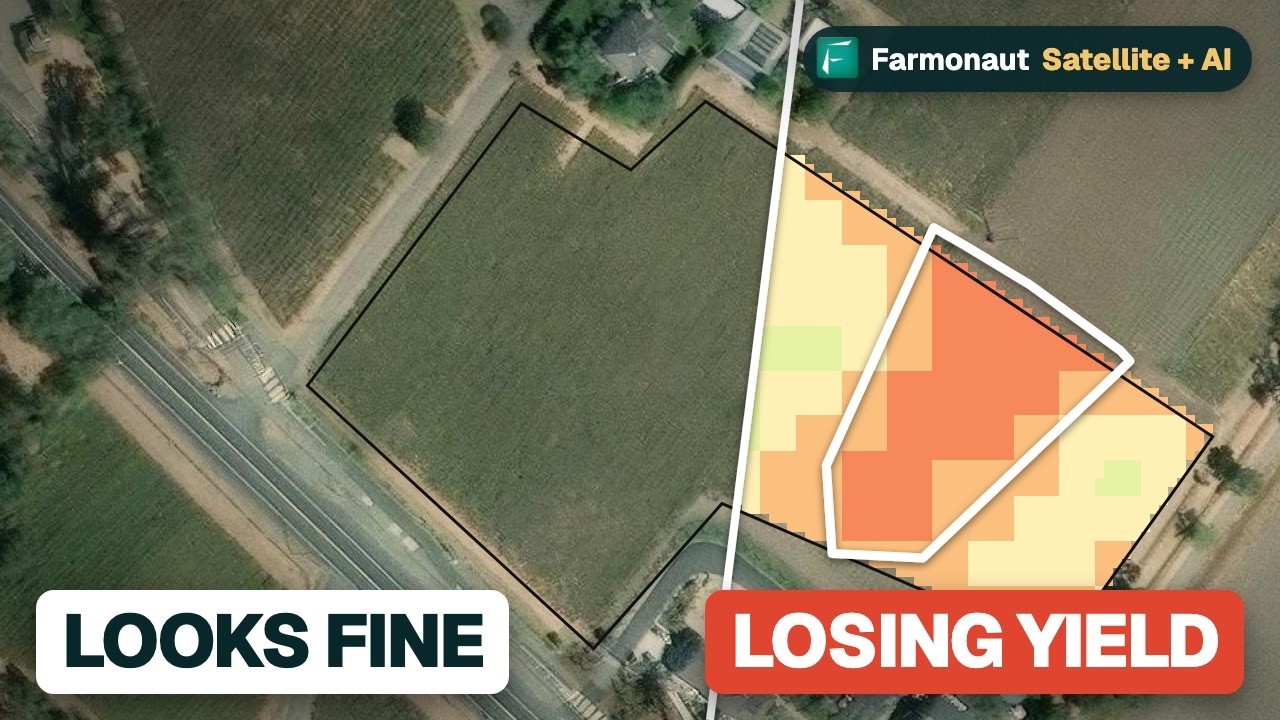
▶ A real demo field where satellite images show a weak strip of crop before it is visible on foot. · 1:42
How we checked the numbers
We read the Yara UK and Yara Ireland product pages for the analysis, and Yara’s brassica advice pages for the rate. For crop needs we used extension guides from Oregon State, Delaware, Florida, Iowa State and Penn State, and the North Carolina Department of Agriculture. The boron per acre figures in the charts are our arithmetic from the 0.3% analysis. Yara is the maker, so its claims on crop response are the maker’s own. Prices are not given because they differ by dealer, country and date.
FAQ
What is YaraLiva Nitrabor?
It is a granular calcium nitrate fertiliser with added boron. Yara UK lists 15.4% nitrogen, 25.6% CaO and 0.3% boron, with no chloride.
What is the YaraLiva Nitrabor content in calcium?
Yara UK gives 25.6% CaO and Yara Ireland gives 18.3% elemental calcium. They describe the same analysis in two units.
Is Nitrabor a liquid or a foliar fertiliser?
No. Yara lists it as a granular product for dry application. Do not dissolve it in a sprayer unless the label for your product says that is allowed.
Which crops is it used on?
Yara names brassicas first, which are prone to calcium and boron shortages, and also lists high-value crops on boron-poor soils. Match use to a soil or leaf test.
How much boron does one bag give?
At 0.3%, 25 kg of product holds 75 g of boron. A rate of 300 kg per hectare supplies 0.9 kg of boron per hectare (about 0.8 lb per acre), which is less than the 1.5 to 3 lb per acre (about 1.7 to 3.4 kg per hectare) Delaware advises for broccoli before planting.
How is Nitrabor different from Tropicote or Calcinit?
Tropicote has about the same N and calcium but no boron. Calcinit is water soluble for irrigation systems. Nitrabor is the granular grade with boron added.
Can too much boron hurt the crop?
Yes. Oregon State warns that high boron can be toxic, and Delaware lists scorch on older leaf edges as a toxicity sign in cole crops. Stay within the rate your test and adviser support.
Farmonaut crop monitoring
See your own fields from space
Outline your fields once and Farmonaut shows satellite vegetation maps through the season, on web, Android or iOS.




Keep reading

Sources
- Yara UK, YaraLiva Nitrabor product page: yara.co.uk
- Yara Ireland, YaraLiva Nitrabor product page: yara.ie
- Yara UK, Boost boron and calcium levels in late season brassicas (2020): yara.co.uk
- Yara UK, How to prevent hollow stem in vegetable brassica: yara.co.uk
- University of Delaware, Calcium and Boron Deficiencies in Brassica Crops: sites.udel.edu
- Oregon State University Extension, EC 1478 Soil Test Interpretation Guide: extension.oregonstate.edu
- Iowa State University, Micronutrients for Crop Production: agronext.iastate.edu
- UF/IFAS, Blossom-End Rot in Bell Pepper: ask.ifas.ufl.edu
- Penn State, Controlling bitter pit in Honeycrisp apples: pure.psu.edu
- NC Department of Agriculture, Soil calcium, magnesium and potassium ratios (2023): ncagr.gov
Discussion
Questions, corrections or field experience? Share them below. First-time comments are reviewed before they appear, and your email is never published.
No comments yet. Be the first to add a question or your experience.

 Click2Cloud
 TVS Electronics
 BW Pipelines
 WICO
 Gen Chayat
 Chimera Innovation
 SkyHarvest
 Polaris Digitech
 Teledarbas
 Wild Oak Farm
 SFX
 BACF Africa
 Doodlakine
 Exurbia Geospatial
 FieldZero
 Indico Company

 Licence holder · Niger · Gold










