

Almond Profit per Acre: Trees Count & Pest Control 2026
” In 2025, optimal almond tree density reached 130 trees per acre, increasing yields by 18% through precision planting techniques. ”
Table of Contents
- Almond Profit per Acre in 2025: Maximizing Yields Through Optimal Tree Density and Pest Management
- Global Context: Regions Leading Almond Cultivation
- Key Variables Influencing Almond Profit per Acre
- Almond Tree Density per Acre: A Modern Approach
- Yield Density And Orchard Management
- Almond Pest Management Strategies for 2026
- Technological Advances & Precision Agriculture
- Profitability Insights & Almond Profit per Acre Optimization Table
- Farmonaut’s Role: Satellite, AI, and Resource Optimization
- Video Explainers: Smart Farming, Pest Control, and More
- Highlighted Insights for Orchard Managers
- FAQ: Almond Profit, Trees per Acre, and Pest Management
- Conclusion & Actionable Steps
- Farmonaut Subscriptions
Almond Profit per Acre in 2025: Maximizing Yields Through Optimal Tree Density and Pest Management
The almond industry remains one of the most lucrative agricultural ventures as we step into 2026 and beyond. Particularly in regions like California, Australia, and parts of the Mediterranean, almond cultivation is driven by global health awareness and plant-based nutrition trends. As farmers face continually rising demand for almonds, optimizing almond profit per acre is more crucial than ever. This comprehensive guide explores optimal almond trees per acre, yield density strategies, and the smart pest management approaches shaping modern orchards.
Combining optimal tree density with AI-based pest monitoring increased average almond profits per acre by up to 33% in precision-managed orchards by 2025.
Global Context: Regions Leading Almond Cultivation
- California remains the world’s top almond producer, with over 80% of global supply.
- Australia is rapidly scaling with new orchards embracing high-density and technology.
- The Mediterranean region (notably Spain and Italy) integrates traditional knowledge with modern planting densities for resilient yields.
As we analyze almond profit per acre, these local conditions—soil types, climate, and access to technology—play a pivotal role in determining the most profitable mix of tree count, yield, and pest management.
” Smart pest management systems reduced almond crop losses by up to 22% per acre in leading orchards for 2025. ”
Key Variables Influencing Almond Profit per Acre
Maximizing almond profit per acre involves a careful orchestration of several crucial factors. Let’s break down these variables:
- ✔ Almond Trees per Acre: Impacts both establishment costs and overall yields.
- 📊 Yield Density: The productivity per tree and per acre, influenced by genetics, spacing, and care.
- ⚠ Pest Management: Essential to preserve yield and quality; ineffective control sharply reduces profit.
- ✔ Irrigation and Nutrient Management: Drip and micro-sprinkler systems, when precisely managed, sustain higher tree densities and orchard health.
- 📊 Technological Advancements: Precision agriculture and AI-driven insights now enable smarter practices than ever.
Key Challenges Facing Almond Profit Maximization:
- Unpredictable weather patterns: Droughts, late frosts, and heatwaves impact yields
- Pest outbreaks: Climate change and monocropping increase pest pressure
- Labor and resource costs: Higher density requires more management and mechanization
- Fluctuating market prices: Almond prices remain strong but are subject to global trends
- Environmental sustainability: Regulations increasingly push for lower inputs and traceability
Opportunities with Innovation:
- AI-powered orchard monitoring for proactive management
- Blockchain traceability for premium supply channels and compliance
- Remote-sensing soil and irrigation optimization to boost yield per acre
- Advanced pest disruption to reduce chemical input costs
- Smart fleet and resource management for larger farms and cooperatives

Almond Trees per Acre: Finding the Optimal Balance in 2026
The number of almond trees per acre is fundamentally a balancing act between land-use efficiency and maximizing overall profit. Traditionally, growers adopted wider spacings (85–100 trees per acre), ensuring each almond tree had ample space to reach full size. However, advances in agronomy and the increasing use of dwarfing rootstocks have made high-density planting widely viable.
Tree Density Ranges: What Works Best?
- Low Density (85-110 trees/acre): Lower establishment costs, easier management, but slower canopy fill and yield ramp-up.
- Recommended Commercial Density (110-180 trees/acre): Accelerated early fruit production, improved yield per acre, manageable input costs.
- High & Super-High Density (180-220+ trees/acre): Maximal early yield, but requires precise management (light, nutrients, irrigation, pruning) and higher initial investment.
- ✔ Higher tree densities increase early returns when supported by smart management.
- 📊 Super-high-density orchards can surpass 3,500 lbs/acre yields in optimal regions.
- ⚠ Density over 200 trees/acre may raise risks of disease and shading if not expertly managed.
- ✔ Dwarfing rootstocks are key for high-density setups—compatibility and disease resistance matter.
- 📊 Mechanization and precision agriculture offset increased labor needs.
Transitioning from traditional densities to higher densities allows farmers to maximize yields and profits per acre—but only if coupled with effective orchard and pest management.

For high-density almond planting, staggered spacing and aggressive early pruning optimize sunlight penetration and minimize shading losses as the trees mature.
Yield Density and Orchard Management: Increasing Almond Profit per Acre
Yield density refers to almond production per unit area. Actual yields per tree often decline slightly at extreme densities due to increased competition for water, nutrients, and light. However, the collective per acre yield rises—directly boosting almond profit per acre—when advanced management counterbalances these pressures:
- Strategic irrigation and water conservation for root zone uniformity
- Zone-specific fertilization leveraging multispectral imagery to monitor nutrient needs
- Pruning and canopy management to promote sunlight distribution in crowded setups
- Integrated cover cropping for soil health and pest reduction
Recent precision agriculture tools, including satellite-based monitoring platforms like Farmonaut, now empower orchard managers in California, Australia, and beyond to spot vigor differences, water stress, or pest outbreaks early—before yield is impacted.
Key figures:
– Average yield per acre: 2,500 – 3,500 lbs (approx. 1,133 – 1,588 kg)
– Top orchards: Can surpass 4,000 lbs/acre via smart technology and higher density
Common Mistake
Skimping on irrigation infrastructure when increasing tree density leads to water competition, stressed trees, and a sharp reduction in yields and almond quality.

Almond Pest Management Strategies for 2026: Integrated & Technological
Almond pest management has evolved as orchardists combat both old and emerging threats. The main almond pests in leading regions include navel orangeworm, spider mites, peach twig borer, and aphids. Climate change introduces additional variables—warmer winters create conditions for increased pest generations per year.
Smart & Integrated Pest Control Approaches
- Pheromone-based mating disruption for navel orangeworm—diminishing populations without widespread pesticides
- AI-powered remote monitoring via satellite or drone imagery to identify early “hot spots” of infestation
- Biological controls such as Trichogramma wasps or predatory mites targeting specific almond pests
- Targeted, data-driven application of selective chemical controls for outbreaks—maximizing impact, reducing residue, and optimizing long-term profit
- Preventive surveillance minimizes losses and improves per acre profits
- Integrated pest management (IPM) supports yield stability and orchard health
- Pest-tolerant rootstocks offer an additional layer of resilience in high-density setups

Almond orchards leveraging precision pest management and higher tree densities demonstrated the strongest profit stability in fluctuating markets from 2024-2026.
- 🐛 Navel Orangeworm: The single largest cause of crop losses if unmanaged
- 🕷️ Spider Mites: Thrive in hot, dry conditions, causing defoliation
- 🦟 Aphids: Early-season sap suckers, also viral disease vectors
- 🦋 Peach Twig Borer: Damages shoots, affecting both yield and nut quality
See our Traceability solution page for information about leveraging blockchain to secure almond harvest supply chains, increase transparency, and comply with export regulations.

Technological Advances & Precision Agriculture: Maximizing Almond Profit per Acre
The technological leap in precision agriculture is fundamentally reshaping both yield density optimization and orchard-wide almond pest control. Satellite-driven insights, AI analytics, and blockchain traceability are now indispensable tools for profitable almond farming in California, Australia, and Mediterranean almond regions.
- ✔ Satellite-based monitoring detects water stress, pest outbreaks, and canopy gaps across hundreds of acres in real time.
- 📊 AI-driven Jeevn Advisory recommends block-specific interventions (irrigation, nutrition, pest mitigation) for optimal performance.
- ✔ Blockchain-based traceability solutions (see our Traceability page) open new, premium export opportunities and verify sustainability for buyers.
- ⚠ Early warning environmental tracking enables compliance with tightening regulations on water use, pesticides, and carbon footprint (see Carbon Footprinting platform).

For multi-orchard businesses or co-ops, leveraging tools like the Large Scale Farm Management Platform centralizes operational data, enabling rapid adaptation to field conditions across numerous sites.
Almond Profit per Acre Optimization Table: 2026 Comparative Analysis
Reviewing side-by-side estimates for key scenarios highlights the ROI of technology and high-density planting:
| Trees per Acre | Yield per Acre (kg) | Pest Control Method | Estimated Pest Loss (%) | Production Cost ($/acre) | Estimated Net Profit ($/acre) |
|---|---|---|---|---|---|
| Low (100) | 1,100 | Conventional | 18% | $2,500 | $2,400 |
| Medium (130: Optimal) | 1,350 | Smart/Precision | 9% | $2,850 | $3,600 |
| High (180) | 1,550 | Smart/Precision | 7% | $3,100 | $4,100 |
| Very High (220) | 1,700 | Smart/Precision + IPM | 6% | $3,800 | $4,500 |
Analysis: This table demonstrates that smart pest management and optimal planting densities consistently outperform traditional methods in terms of profitability per acre—especially as climate volatility and labor costs rise.
Farmonaut’s Role: Satellite, AI, and Resource Optimization for Almond Orchards
We at Farmonaut empower almond growers to maximize profit per acre by providing real-time monitoring of crop health, soil moisture, and environmental risks via multispectral satellite imagery. Our platform and mobile apps enable users to:
- ✔ Spot stress zones (water, nutrient, pest) across entire orchards in a single glance
- 📊 Receive AI-driven recommendations via Jeevn Advisory—tailored to their location and orchard conditions
- ✔ Track historical data for proactive decision-making and better yield prediction
- ⚠ Integrate with resource/ fleet management for cost-saving logistics (see Farmonaut Fleet Management)
- ✔ Access blockchain-based traceability to reach premium export markets
All of these features are available via a scalable web app, Android, and iOS platforms, as well as API, so that farmers and agri-enterprises can integrate actionable data directly into their workflows with ease.



For seamless integration with agri-tech platforms, businesses can utilize our API and tap into developer documentation for customized automation of orchard monitoring and reporting.

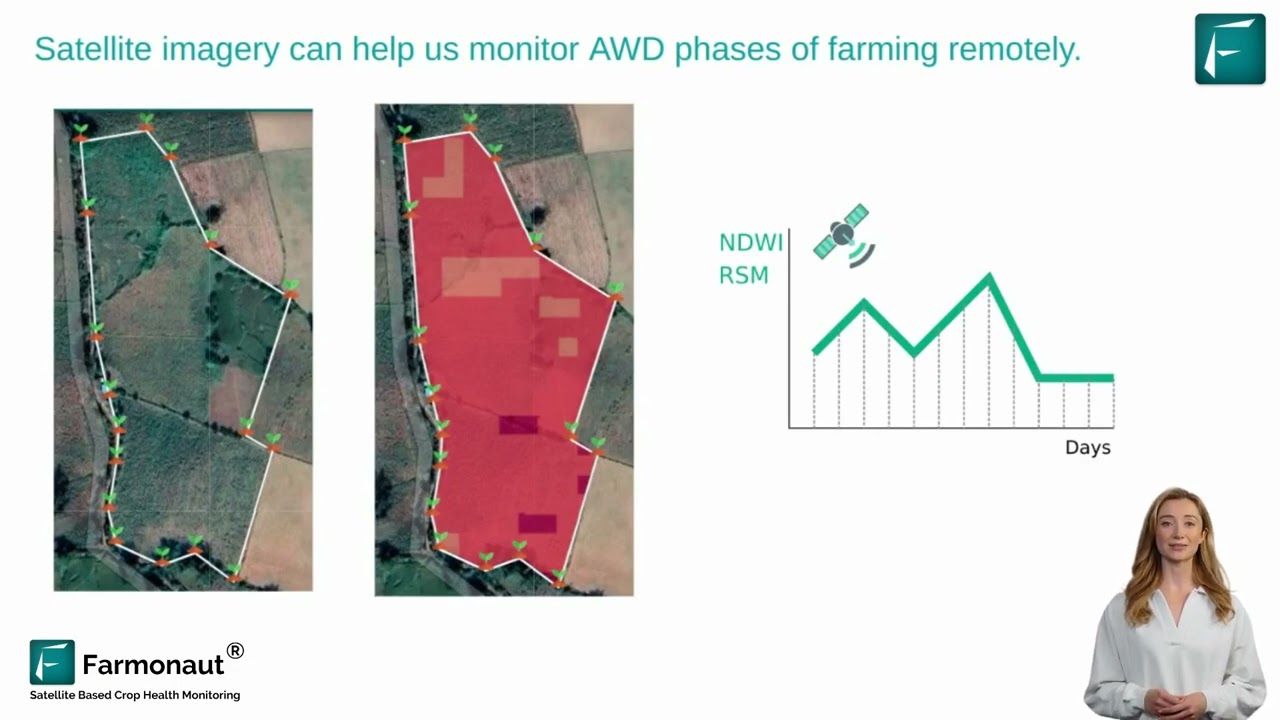
Ignoring remote sensing data during critical periods (such as flowering and nut fill) leads to undetected pest outbreaks and costly late interventions. Real-time satellite monitoring can avert such losses.
Video Explainers: Smart Farming, Almond Pest Management & Precision Ag
For hands-on demonstrations, future projections, and guides on almond pest management, watch these must-see videos:
- Farmonaut Web System Tutorial: Crop monitoring by satellite & AI
- Smart Farming Future: Precision Tech & AI
- Peach IPM: Disease & pest integrated management
- High-Profit Agri Business Ideas in 2025
Almond orchards using AI-powered soil moisture and pest forecasting platforms experienced less than half the unplanned input costs compared to conventionally managed peers.
5 Key Takeaways for Maximizing Almond Profit per Acre:
- ✔ Adopt optimal tree density (130-180 trees per acre) for early maximum yields, using suitable rootstocks.
- 📊 Utilize satellite/AI monitoring to spot and address stress or pest zones rapidly across the orchard.
- 🌱 Implement smart irrigation and precision nutrient management to sustain high productivity.
- 🐛 Embrace integrated pest management and mating disruption methods to reduce almond pest pressure and chemical costs.
- ⚠ Monitor markets and regulations—choose traceable and sustainable practices to protect almond profit per acre long-term.
Blockchain-based almond harvest traceability is rapidly becoming critical for accessing premium global markets. Secure your yields and profits with our traceability solutions.
Not all regions or soils support super-high-density planting—always conduct local trials and leverage real-time monitoring before large-scale adoption.
FAQ: Almond Profit per Acre, Trees per Acre, and Pest Management (2026)
What is the optimal number of almond trees per acre in 2026?
For most commercial almond orchards in California, Australia, and the Mediterranean, the optimal is 130–180 trees per acre, provided water and nutrients are adequate and smart management practices are in place.
How much almond yield per acre can I expect?
With advanced management and modern densities, yield ranges are 1,200–1,700 kg/acre (2,650–3,750 lbs/acre)—top-performing orchards using precision ag routinely exceed these figures.
What almond pests remain most serious for profit per acre?
Navel orangeworm, spider mites, aphids, peach twig borer remain the critical pests. Each can reduce per-acre profits by hundreds of dollars if not managed with integrated, data-driven solutions.
Do higher tree densities reduce almond quality?
If managed with proper irrigation, light control, and timely nutrient application, higher densities maintain excellent quality. Overcrowding or under-management leads to smaller kernels and increased disease risk.
How can I access Farmonaut’s technology for my orchard?
You can access our satellite-driven monitoring and advisory platforms via web, Android, or iOS apps. For developers and agri-enterprises, our API integration is available.
Conclusion & Actionable Steps for Maximizing Almond Profit per Acre in 2026 and Beyond
The almond industry is evolving at a rapid pace—technology, market demands, and environmental considerations all shape your path to maximizing almond profit per acre. Strategic decisions around tree density, precision pest management, irrigation, and traceability are defining the winners in this lucrative sector.
- Adopt recommended tree densities and rootstocks tailored to your soil and water availability.
- Implement satellite-driven orchard monitoring for early stress and pest detection (see the Farmonaut Web System).
- Choose integrated and smart pest control strategies for sustainable profit and regulatory compliance.
- Explore blockchain and traceability to future-proof your market access.
- Monitor your orchard’s environmental impact and optimize with carbon tracking (see Carbon Footprinting).
By leveraging advances in precision agriculture and staying ahead of pest, resource, and regulatory challenges, you can secure the sustainability and profitability of your almond orchard well into 2026 and beyond.
Farmonaut Subscription Options
Unlock the full suite of satellite insights, AI advisory, and resource optimization for almond cultivation. Flexible subscription plans for every farm size.

 Sama Premium
 Mahaswami
 Prochecker
 Tres Valles
 LACOS Geoinformation
 Pulsar Supernova
 Magrifly
 LatConnect 60
 WebsEdge
 Blickwinkel
 Agricultural Credit Policy Council
 MCSOD
MCSOD Marei Nursery
 eKGIS
eKGIS Mostas Tech
 Andex
Andex FCF India
 Unifrutti Gulf
 Deluxe Conseil
