

Reviewed September 2026 against USDA-NASS Census of Agriculture data and Honolulu Civil Beat’s reporting on the 2022 Census results.
Try it: Enter your acreage to see the projection. →
The Hawaii Agricultural Declaration Form — officially the Plants and Animals Declaration Form, issued by the Hawaii Department of Agriculture (renamed the Department of Agriculture and Biosecurity in July 2025, per Hawaii News Now) — is the card every incoming traveler completes to declare fruits, plants, animals, soil, and other agricultural items before they clear arrival at a Hawaii airport. It exists to keep invasive pests and diseases from reaching an island ecosystem that has no natural predators for most of them, and since March 2025 it has also been available as a digital form through the state’s “Akamai Arrival” pilot, alongside the traditional paper card. This guide covers exactly what the form asks, who has to file it, how the digital version differs from paper, and — because this same declaration process sits on top of an agricultural economy that is measurably shrinking — what the underlying numbers say about why the state polices its farm and plant borders so closely.
What the Hawaii Agricultural Declaration Form Actually Is
Every commercial flight landing in Hawaii from outside the state carries passengers who must complete an agricultural declaration before they leave the airport. The form asks travelers to state whether they are carrying fruits, vegetables, plants, seeds, soil, live animals, insects, or other biological material. It is a biosecurity checkpoint, not a farm-registration document — it has nothing to do with land use, zoning, or property tax eligibility, despite that being the framing of most articles that come up when you search for it. If you searched “hawaii agriculture form,” “hawaii ag form,” or “state of hawaii agriculture form” expecting a permit or license for running a farm, this is the wrong document: The declaration is filled out by arriving passengers, not by landowners, and it is issued fresh on every trip rather than filed annually.
The form’s legal basis sits in Hawaii’s plant and animal quarantine statutes, enforced jointly by the Hawaii Department of Agriculture’s Plant Quarantine Branch and the airlines that distribute the cards. Historically it was a paper card handed out on the plane or at a kiosk before baggage claim; as of March 2025, a digital version rolled out under the “Akamai Arrival” program, letting travelers complete the declaration on a phone before landing rather than filling out a paper card by hand.
Who Has to File It, and When
All passengers, officers and crew arriving in Hawaii from outside the state file the declaration, with one adult allowed to cover their family — this includes residents returning from the mainland, not just first-time visitors. It is completed on arrival, before leaving the secured area of the airport, either on paper or through the digital form. There is no annual deadline and no renewal: each arriving flight requires its own declaration, because the risk being managed is what is physically in your bags on that trip, not an ongoing land-use status.
This is a separate requirement from Hawaii’s actual agricultural land-use and tax-classification paperwork, which is filed by landowners with their county real property tax office, not with an arriving-passenger form. If your search brought you here because you are trying to register agricultural land for a tax classification, the document you want is your county’s agricultural dedication or use-classification application — contact your county’s Real Property Assessment Division directly, since forms and deadlines differ by county and are not part of the C-6 arrival process described here.
One form per family, and the penalties for skipping it
The paper card is headed “Plants and Animals Declaration Form” and states that it is for all passengers, officers and crew members. One adult may complete the declaration for other members of the same family, so a family of four needs one card, not four (State of Hawaii declaration form).
The form lists what must be declared: fresh fruit and vegetables, cut flowers and foliage, rooted plants and cuttings or algae, raw or propagative seeds and bulbs, soil, growing media and sand, live seafood, cultures of bacteria, fungi or viruses, insects and live fishes or amphibians, and any live animals such as dogs, cats, birds and reptiles. Travellers also write the origin of the items.
The penalties are printed on the card. Giving false information or failing to declare restricted items breaks Chapter 150A of the Hawaii Revised Statutes and can be a misdemeanour with a maximum fine of $25,000 and up to one year in prison. Intentionally smuggling a snake or other prohibited item can be a Class C felony with a maximum of $200,000 and five years.
Anyone travelling with a live animal must tell a cabin attendant before leaving the plane. The airline, not the passenger, hands the animal to the Honolulu Airport Animal Quarantine Holding Facility.
What the Form Asks and Why
The form’s core purpose is prevention, not paperwork for its own sake. Hawaii’s isolation is precisely what makes its native species vulnerable — a fruit fly larva, a snail, or contaminated soil that would be a minor nuisance on the mainland can establish itself with no natural check in the islands. The declaration works as an early warning and interception layer: travelers who declare an item are directed to an inspection station, where agricultural inspectors examine it and either clear it, treat it, or confiscate it.
The form typically asks the traveler to confirm or deny whether they are carrying:
- Fresh fruits, vegetables, or plant cuttings
- Seeds, bulbs, or soil
- Live animals, birds, or insects
- Cut flowers, live seafood, microbial cultures, and any live pets such as dogs, cats, birds or reptiles
The printed card lists the declarable categories (see the section on penalties above); travelers with a specific item in question should check directly with the Hawaii Department of Agriculture’s Plant Quarantine Branch or ask the inspection agent at arrival, since restrictions can differ by item and by the traveler’s point of origin.
The Digital Declaration Form: How It Works
Hawaii’s digital declaration form launched under the “Akamai Arrival” name in March 2025, giving travelers on select domestic flights of six airlines, including Alaska, American, Delta, Hawaiian, Southwest and United, the option to complete the agricultural declaration on a smartphone (Office of the Governor) rather than filling out the paper card by hand mid-flight. The digital form asks the same substantive questions as the paper version — it is a format change, not a policy change, and it exists alongside paper cards rather than replacing them outright. Travelers who prefer paper, or who cannot complete the digital form before landing, can still use the physical card.
The practical advantage of the digital form is speed and legibility: no more deciphering hand-written entries at the inspection counter, and less chance of a form being incomplete or illegible when submitted. For the current status of the pilot, participating airlines, and any expansion beyond the initial rollout, Spectrum Local News Hawaii’s coverage of the program is the most direct public reporting available: Spectrum Local News Hawaii, February 2025.
Step-by-Step: Completing the Form
The process is short by design — inspectors need the information fast, at a checkpoint most travelers are moving through with luggage in hand.
| Step | What Happens | Where | Typical Duration |
|---|---|---|---|
| 1. Receive or open the form | Paper card distributed on the plane, or digital form opened on a personal device before landing | In-flight or pre-arrival | 1–2 minutes |
| 2. Answer declaration questions | Confirm or deny carrying fruit, plants, soil, animals, or other listed items | In-flight or pre-arrival | 1–2 minutes |
| 3. Present at arrival | Hand paper card to an agent, or show the digital confirmation | Airport arrival area | Under 1 minute |
| 4. Inspection (if declared) | Declared items examined; cleared, treated, or confiscated | Agricultural inspection station | Varies by item and queue length |
| 5. Clearance | Traveler proceeds to baggage claim / exit | Airport arrival area | Immediate once cleared |
Only step 4 has an unpredictable duration — a traveler with nothing to declare typically clears the whole process in a few minutes, while someone flagged for inspection may wait longer depending on how busy the station is when their flight lands.
What Is Hawaii Agriculture, in Numbers
The declaration form exists to protect an agricultural base that is real but under sustained pressure. The most recent complete count, the USDA’s 2022 Census of Agriculture, put Hawaii at 1.053 million acres of total land in farms, worked by 6,569 farms, generating $673.8 million in total agricultural product sales. That works out to an average market value of roughly $103,000 per farm — a figure that spans everything from small diversified plots to large ranching operations, so it understates how uneven farm sizes and revenues actually are across the islands. Of that total farmland, 158,053 acres was cropland; the rest is predominantly pasture and rangeland. These are the last confirmed figures, all from USDA-NASS’s 2022 Census of Agriculture release for Hawaii.
The trend line is the part that matters more than any single-year snapshot: Hawaii lost roughly 82,000 acres of agricultural land between the 2017 and 2022 Census counts — a five-year decline, not an annual one — according to Honolulu Civil Beat’s analysis of the same Census data, “Federal Farm Census Shows Hawaii’s Agriculture Is Still In Decline,” March 2024. Farmland lost to development, subdivision, or non-agricultural conversion does not come back within a normal planning horizon, which is a core reason the state treats land-use declarations and border biosecurity as connected priorities rather than separate bureaucracies.
Hawaii’s largest agricultural county by farm count is the Big Island (Hawaii County), with 3,638 farms recorded in the 2022 Census — more than half of the state’s total — reflecting its larger land area and diversity of growing conditions from coffee belts to cattle ranches, per USDA-NASS’s county-level 2022 Census report for Hawaii. Coffee is one of the state’s signature crops: the 2022–2023 season produced 24.8 million pounds on a cherry basis, according to USDA-NASS’s Hawaii coffee production report.
None of these figures are static, and the Census itself will not be current again until the next full count. The 2022 Census of Agriculture is a five-year cycle — the next full release is due in 2027 — but USDA-NASS’s Quick Stats database is updated more frequently and lets you pull current Hawaii figures by commodity and year directly: quickstats.nass.usda.gov, filtered to Hawaii. For crop-specific production numbers like coffee or macadamia between Census years, USDA-NASS publishes standalone reports on its own schedule, indexed at nass.usda.gov/Statistics_by_State/Hawaii/Publications/.
Some figures relevant to Hawaii’s farming conditions are not published anywhere USDA or state sources currently disclose. There is no published breakdown of organic certification rates among Hawaii farms, no county-level soil organic matter or erosion data, and no farm-operator demographic or hired-labor wage data specific to the state in the sources checked for this article. If your work depends on any of those, the Census of Agriculture’s full data tables (released alongside the state press releases) are the place to check for a future cycle, and NASS’s Quick Stats tool is the place to check whether a narrower figure has since been published.
Videos: Land Use and Satellite Monitoring in Practice
These walk through how satellite-based land monitoring and classification actually work in practice — relevant background whether you are managing declared farmland or just trying to understand how modern agricultural verification happens.


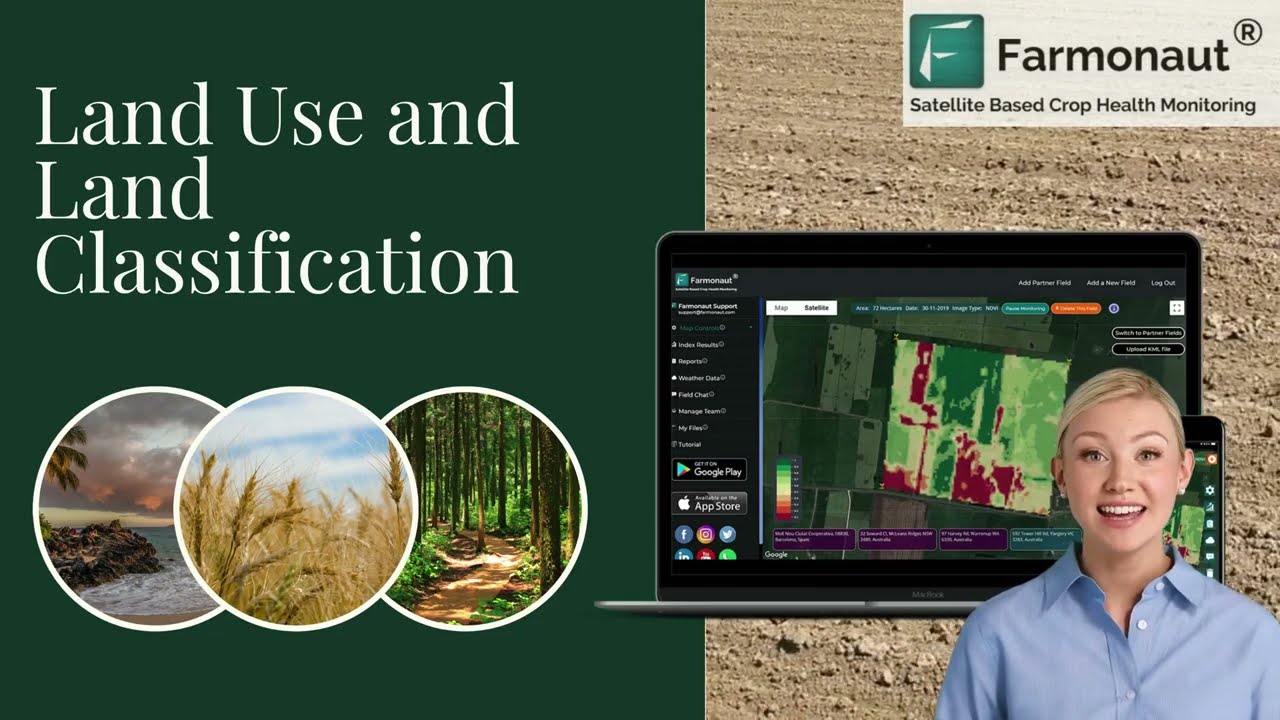


How Farmonaut Supports Hawaii’s Land-Based Agriculture
The declaration form protects Hawaii’s agricultural base at the border; what happens on the 1.053 million acres of farmland itself is a separate, ongoing management problem — one satellite monitoring is well suited to. Farmonaut provides subscription-based satellite crop health, soil moisture, and land-boundary tracking across Android, iOS, web, and API access, letting farmers and landowners keep an eye on declared agricultural parcels remotely rather than relying only on periodic site visits.
- Track real-time crop health, soil moisture, and land boundary changes via satellite imagery
- Use AI-based advisory to guide input timing and farming decisions
- Apply blockchain-based traceability for supply chain transparency on exported crops like coffee
- Manage fleet and large-scale operations from a single dashboard
- Track environmental impact, including carbon footprint



Developers and agricultural agencies building their own monitoring workflows can integrate directly through the Farmonaut API, documented at the API Developer Docs.
Start with real-time monitoring and environmental tracking — open the web app to see declared parcels from a satellite view.
For agricultural exporters, especially coffee and specialty crop operations shipping off-island, product traceability tools document the chain of custody from farm to buyer, and carbon footprinting supports sustainability reporting increasingly requested by export markets.


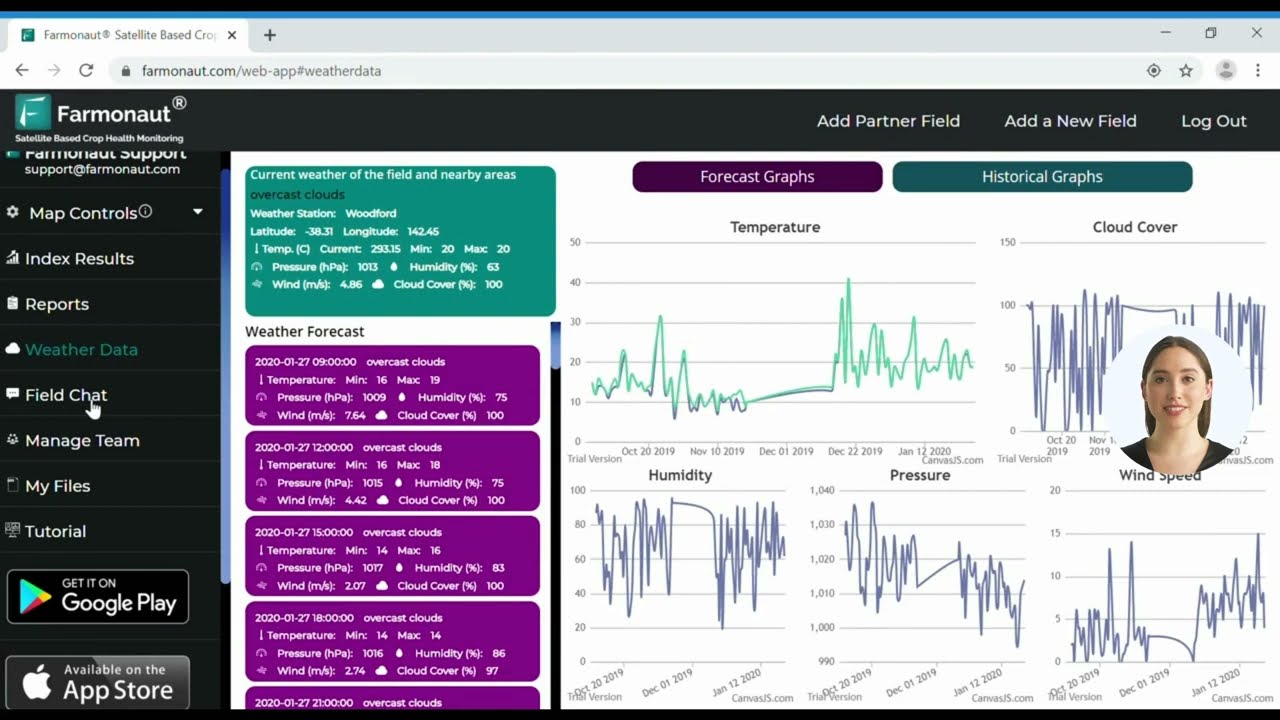
Ranches and multi-parcel operations spanning several Hawaii counties can manage compliance and field operations at scale with Large Scale Farm Management Tools and Fleet Management.
Common Mistakes That Delay a Declaration
- Leaving items undeclared “just in case.” Failing to declare a fruit or plant item and having it found in a bag search can bring a fine of up to $25,000 and up to a year in prison under Chapter 150A; declaring it and having it inspected almost never does.
- Assuming the digital form skips inspection. The digital form changes how you answer the questions, not whether declared items get inspected — it still routes you to the same inspection station if you declare something.
- Confusing the arrival form with a land-use or tax filing. These are different documents handled by different offices; conflating them is the single most common confusion behind this page’s search traffic.
- Not checking county-specific rules for actual farmland classification. If you are a landowner seeking agricultural tax classification rather than filling out an arrival card, your county’s Real Property Assessment office — not the Department of Agriculture’s Plant Quarantine Branch — is the correct contact.
For the current list of declarable items, inspection procedures, or digital form access, the Hawaii Department of Agriculture’s Plant Quarantine Branch is the authoritative source — form specifics can be updated between article revisions, and a phone call or visit to their published contact channels resolves edge cases faster than any guide can.
Calculator: Estimate Your Farm’s Land-Loss Exposure
Hawaii lost about 82,000 acres of farmland over the five years between the 2017 and 2022 Census counts — roughly 1.56% of the 2022 total of 1.053 million acres, per year, on a state-wide average. Enter your own farm’s acreage below to see what that statewide average rate would mean for your operation if it followed the same trend, purely as a planning reference against the state benchmark.
Enter your acreage to see the projection.
Assumptions: applies the statewide 2017–2022 Census average land-loss rate uniformly and compounds it annually; it does not account for conservation easements, agricultural dedication programs, individual lease terms, or county-specific development pressure, all of which can make an individual parcel’s real risk very different from the state average.
FAQ
- Q1: What is the Hawaii agricultural declaration form, and what’s its purpose?
- The Plants and Animals Declaration Form is Hawaii’s agricultural declaration card, completed by arriving travelers to disclose fruits, plants, animals, soil, or other agricultural items in their possession. Its purpose is biosecurity — intercepting invasive species before they reach Hawaii’s ecosystems — not land registration or tax classification.
- Q2: Who has to fill out the Hawaii agricultural declaration form?
- Every traveler arriving in Hawaii on a commercial flight from outside the state, including returning residents, completes the declaration — it is required per arrival, not per person annually.
- Q3: Is there a digital version of the Hawaii arrival form?
- Yes. The “Akamai Arrival” digital declaration form launched in March 2025, letting travelers complete the same declaration questions on a smartphone instead of a paper card. Paper cards remain available. See Spectrum Local News Hawaii’s coverage for program details.
- Q4: What happens if I declare an item on the form?
- You’re directed to an agricultural inspection station, where the item is examined and cleared, treated, or confiscated depending on what it is. Declaring an item honestly is treated very differently from having an undeclared item discovered in a search.
- Q5: Is the agricultural declaration form the same as a farmland tax or zoning filing?
- No. The arrival form is a biosecurity checkpoint document handled by the Department of Agriculture’s Plant Quarantine Branch. Agricultural land-use classification and property tax dedication are separate filings handled by each county’s Real Property Assessment office — contact your county directly for those forms and deadlines.
- Q6: How big is Hawaii’s agricultural sector today?
- The 2022 Census of Agriculture counted 6,569 farms working 1.053 million acres, generating $673.8 million in product sales — the most recent complete figures, from USDA-NASS. The next full Census is due in 2027; USDA’s Quick Stats tool carries more current figures between Census years.
Conclusion
The Hawaii Agricultural Declaration Form is a short document with a specific, narrow job: stop invasive plants, pests, and animals from entering an island ecosystem at the point of arrival. Whether completed on paper or through the digital Akamai Arrival pilot launched in March 2025, the substance of the questions hasn’t changed — declare what you’re carrying, let inspectors do their job, and you clear the airport in minutes. That border control sits in front of an agricultural base — 6,569 farms across 1.053 million acres as of the 2022 Census — that has already lost roughly 82,000 acres in five years, which is exactly why the state treats what crosses its borders and what happens on its remaining farmland as connected problems rather than separate ones.
For landowners and farm operators looking to actively track and protect what’s left of that base, Farmonaut’s web and mobile applications bring satellite-based monitoring to the parcel level — a different tool than the arrival declaration, aimed at the same underlying goal of keeping Hawaii’s agricultural land productive and accounted for.

 Vizexec Transformation
 GalaxEye Space
 Sun Palm Australia
 Grandstream Algérie
 XOS Realty
 Geospatial Lab Africa
 Agro La Gándara
 HIPSAC
 ZOL Zimbabwe
 Juligerm
 AdBio
AdBio MISE Maroc
 NWNS
NWNS Red August Group
 Farm Inc
 WeMe Global
 Agrotoken
 Blue BearX
 Insignito
 DnCubed
