

Cotton technology · Data guide
How Technology Impacts US Cotton Production: Texas Data
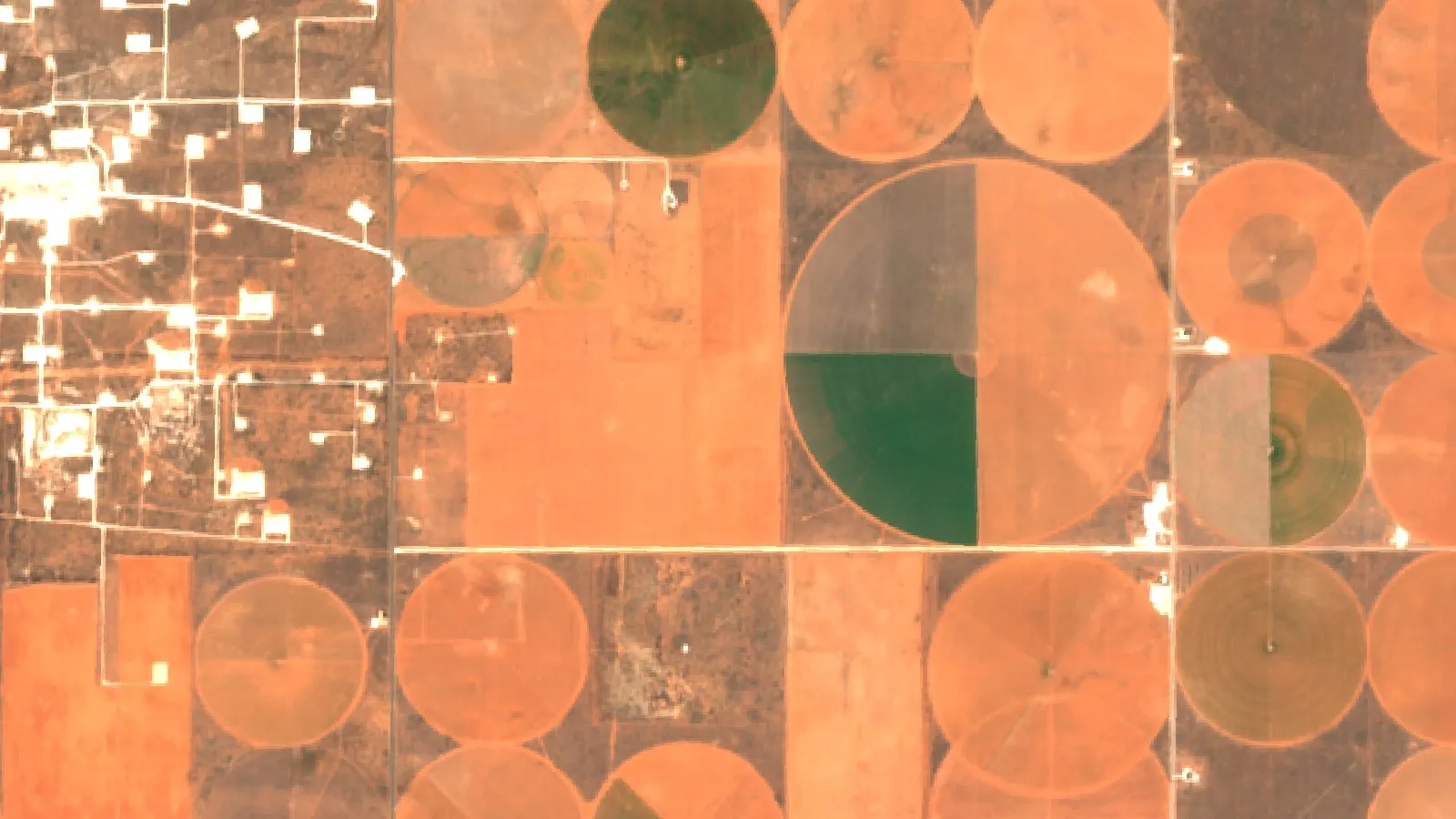
Technology changed US cotton mostly by cutting labour and crop losses: 93% of upland acres used herbicide-tolerant seed in 2025 and guidance steered 64.5% of acres in 2019 (USDA ERS). In Texas, the share of planted acres harvested swings widely, from 38% of planted acres in 2023 to 76% in 2025 (USDA NASS).
Key takeaways
- In 2019, guidance was used on 64.5% of US cotton acres, section control on 41%, variable rate on 22.7%, yield maps on 15.2% and drone or satellite imagery on 2.8% (USDA ERS).
- Herbicide-tolerant seed covered 93% of US upland cotton acres in 2025, up from about 10% in 1997; Bt seed covered about 91% (USDA ERS).
- Texas harvested 38% of its planted cotton acres in 2023, 50% in 2024 and 76% in 2025; the rest was abandoned (USDA NASS).
- Gin labour per bale in the Southwest fell from 2.78 man-hours in 1962 to 0.42 in 2010 (USDA-ARS researchers).
- AgriLife’s 2026 South Plains dryland budget breaks even at $0.54 per pound of lint on variable costs and $0.80 on total costs.
In this article
- How technology impacts cotton production: the short answer
- Labour: from hand picking to module builders
- Pests and genetics: boll weevil eradication and GE seed
- Precision tools on US cotton acres
- Remote sensing and AI in Texas cotton fields
- Water: where technology meets the Ogallala
- Yields and acres: what technology cannot fix
- Costs: does cotton technology pay?
- What this means for agtech startups
- How we checked the numbers
- FAQ
How does technology impact cotton production in the US? Mostly by cutting labour and protecting the crop rather than by changing the weather. In 2025, 93% of US upland cotton acres were planted with herbicide-tolerant seed and about 91% with insect-resistant (Bt) seed, according to USDA ERS data on genetically engineered crops, and guidance systems steered 64.5% of cotton acres in 2019. Yet in Texas, which grows the largest share of the US crop, the share of planted acres that gets harvested swings widely: only 38% of planted cotton acres were harvested in 2023, against 76% in 2025.
This page looks at how technology impacts cotton production from the field to the gin, using dated numbers from USDA, Texas A&M AgriLife and cotton research groups. You get five charts, a short history of how machines changed Texas cotton labour, and a calculator that shows what a new tool must deliver per acre before it pays. It is written for growers, consultants and the agtech teams that build tools for them. For a wider view of AI across all Texas crops and regions, see our separate page on AI farms in Texas; this page stays with cotton.
How technology impacts cotton production: the short answer
Each wave of technology attacked a different cost. Machines replaced hand labour. Eradication and GE seed cut insect and weed losses. GPS guidance and section control cut overlap and operator fatigue. Sensors, drones and satellites are the newest layer, and they are still used on a small share of acres. The table sums up what each technology changed and what the evidence says.
| Technology | What it changed | Evidence (dated) |
|---|---|---|
| Mechanical harvest | Replaced hand picking and the tenant system | Texas crop: 74% strippers, 26% spindle pickers (1990, TSHA) |
| Module builder | Stores seed cotton in the field, no trailers | Invented 1971 in College Station; holds 15,000 lb (TSHA) |
| Gin automation | Fewer worker hours per bale | Southwest gins: 2.78 man-hours per bale (1962) vs 0.42 (2010) |
| Boll weevil eradication | Cleared West Texas of a pest present since the 1890s | All 11 West Texas zones functionally eradicated (2011 report) |
| GE seed | Simpler weed and caterpillar control | 93% HT (upland acres) and about 91% Bt of US cotton acres (2025) |
| Guidance | Straight passes, less overlap and fatigue | 64.5% of US cotton acres (2019) |
| Section control | Shuts off rows already covered | 41% of US cotton acres (2019) |
| Variable rate | Different input rates by zone | 22.7% of US cotton acres (2019) |
| Yield maps | Shows where a field makes money | 15.2% of US cotton acres (2019), from 0.7% in 2000 |
| Drones and satellites | Crop vigour maps and yield estimates | 2.8% of US cotton acres (2019) |
The rest of the page explains where each number comes from and what it does, and does not, prove.
A note on scope: the adoption shares in the table are national, because USDA’s precision-agriculture survey does not publish them for Texas alone. The Texas data on this page cover acres, yields, costs, water and the research projects running in Texas fields.
Labour: from hand picking to module builders
Technology had its biggest social effect on cotton through labour. The Texas State Historical Association’s Handbook of Texas entry on cotton culture describes how, from 1872, most newcomers to the Blackland Prairie worked as tenant farmers or sharecroppers. Sharecroppers supplied only their labour and received half the value of the crop, and after settling their accounts at the landowner’s store they often had little cash left.
▶ What farm technology means for rural towns: money, jobs and internet access. · 3:50
The Handbook links the end of that system to machines. After the war, farmers mechanised planting, cultivating and harvesting, which removed the need for tenants and sharecroppers, many of whom had already moved to city jobs. It describes modern Texas cotton as fewer but larger farms, fewer farmworkers, more machines, widespread irrigation and better pest and weed control.
Strippers, pickers and the module builder
West Texas built its own harvest tools. Short on labour and exposed to sudden storms, growers near Lubbock began rough-harvesting cotton in the 1920s, first by dragging fence posts between rows, then with mechanical strippers that pull the whole boll off the plant. Spindle pickers suit wetter areas where plants grow taller. By 1990, 74% of the Texas crop was gathered by strippers and 26% by spindle pickers.
The module builder, devised in 1971 by Lambert Wilkes of College Station with the Texas Agricultural Extension Service and Cotton Incorporated, changed the step after harvest. It packs about 15,000 pounds of seed cotton (ten to twelve bales) into a block that waits in the field until the gin is ready. In 1990, 70% of the Texas crop was ginned from modules. Large operations that run many harvesters and trucks now also track machinery with farm fleet management tools.
Fewer worker hours at the gin
Labour savings did not stop at the farm gate. A 2013 study by USDA Agricultural Research Service ginning labs, presented at the Beltwide Cotton Conferences, compared gin surveys from 1962 and 2010. Labour per bale fell to as little as 15% to 25% of the 1962 level, depending on region, and the authors put the gain in labour productivity at four to six times. They also note that the switch from trailers to module builders cut on-farm labour.
The chart below shows the regional figures. The 2010 numbers come from a sample of 126 gins and the 1962 numbers from 32 gins, so treat them as averages, not as figures for any single gin.
Chart
Gin labour per bale of cotton, 1962 vs 2010
Man-hours per bale by US region; 1962 from 32 gins, 2010 from 126 gins (regions with 1962 data)
Pests and genetics: boll weevil eradication and GE seed
For most of the twentieth century the boll weevil cost Texas cotton growers more in control costs and crop losses than any other pest. The Handbook of Texas records that the weevil spread north from Mexico and was first seen near Corpus Christi in the 1890s, that its damage soon reached the whole Cotton Belt, and that calcium arsenate dust was one of the early controls.
▶ The main hurdles in cotton growing, from pests to water, and how technology helps manage them. · 7:38
Eradication relied on technology too: the programme mapped cotton acres, counted weevils caught in traps and treated fields with ultra-low-volume malathion where weevils were still present. In its 2012 status report on boll weevil eradication in Texas, the Texas Boll Weevil Eradication Foundation said the programme covered about 7.7 million certified cotton acres in Texas and eastern New Mexico in 2011, that 15 of 16 zones reported no captures or fewer captures than in 2010, and that all 11 West Texas zones had been declared functionally eradicated. The same report notes that Texas set record yields with the 2004 and 2005 crops, while the weevil was being removed, although it reports the two side by side rather than measuring how much of the gain came from eradication.
Herbicide-tolerant and Bt cotton
Genetic engineering came next. USDA ERS figures (page updated December 2025) show herbicide-tolerant cotton rising from about 10% of acres in 1997 to 56% in 2001 and 93% of upland acres in 2025. Bt cotton, which carries a gene that produces its own insecticidal protein, rose from 15% of US cotton acres in 1997 to 37% in 2001 and about 91% by the latest ERS figure. About 87% of cotton acres were planted with stacked seed carrying both traits in 2025. ERS notes that Bt use can rise and fall with the pressure from tobacco budworm, bollworm and pink bollworm.
For a grower, HT seed meant fewer hand-hoeing hours and simpler weed programmes. It did not end the need for scouting. Herbicide and insecticide decisions still depend on what is in the field, and every product must be used according to its label and local rules.
Chart
GE cotton seed: share of US cotton acres
Percent of acres, selected years; HT = herbicide-tolerant (upland acres in 2025), Bt = insect-resistant (latest ERS figure, page updated Dec 2025)
Precision tools on US cotton acres
The most complete national data on precision tools in cotton come from the USDA Agricultural Resource Management Survey, summarised in Precision Agriculture in the Digital Era (USDA ERS, 2023). The cotton survey year is 2019. Guidance, often called auto-steer, was used on 64.5% of planted cotton acres, and automated section control on 41%. Variable-rate technology was used on 22.7%, yield maps on 15.2% and drones, aircraft or satellite imagery on 2.8%.
Chart
Share of US cotton acres using each precision tool
Percent of planted US cotton acres, 2019 ARMS cotton survey
Cotton stands out in one way. In a separate ERS Amber Waves analysis of auto-steer and guidance, about half of even the smallest cotton farms used guidance in 2019, against 67% of the largest. For corn, the gap between small and large farms was much wider. One reason may be scale: ERS’s smallest cotton group covers farms of up to 1,150 acres, against 200 acres or fewer for corn.
The other tools are used far less. Yield maps on cotton rose from 0.7% of acres in 2000 to 15.2% in 2019. ERS also found that only 7% of cotton acres combined maps with guidance in 2019, and only 2% to 5% of acres across the crops surveyed in 2016 to 2019 used all four technology groups together. Field sensors are part of the same picture; our guide to IoT in cotton farming covers soil moisture probes and weather stations in more detail.
Remote sensing and AI in Texas cotton fields
AI in cotton is mostly about turning images into decisions. In April 2026, the Texas A&M AgriLife Research and Extension Center at Corpus Christi reported that its digital agriculture team was working with 11 cotton producers across the Coastal Bend. Their tools combine drone and satellite images to estimate crop biomass and lint yield early in the season. The AgriLife Today report on digital tools tested in Texas fields says the aim is to support decisions on plant growth regulator timing and rates, defoliation timing and lint yield forecasts.
Growers in that project get a data hub with near-daily heat maps of canopy cover and canopy health. After mid-season it adds crop termination timing and lint yield estimates. Planned features include irrigation needs, biomass build-up over time and economic risk.
The drone platform behind this work started earlier. A 2021 AgriLife article on digital agriculture says a drone can map a 100-acre field and build 3D plant models in as little as half an hour of flight, and that Cotton Incorporated funding supported its initial development.
What satellites can and cannot see
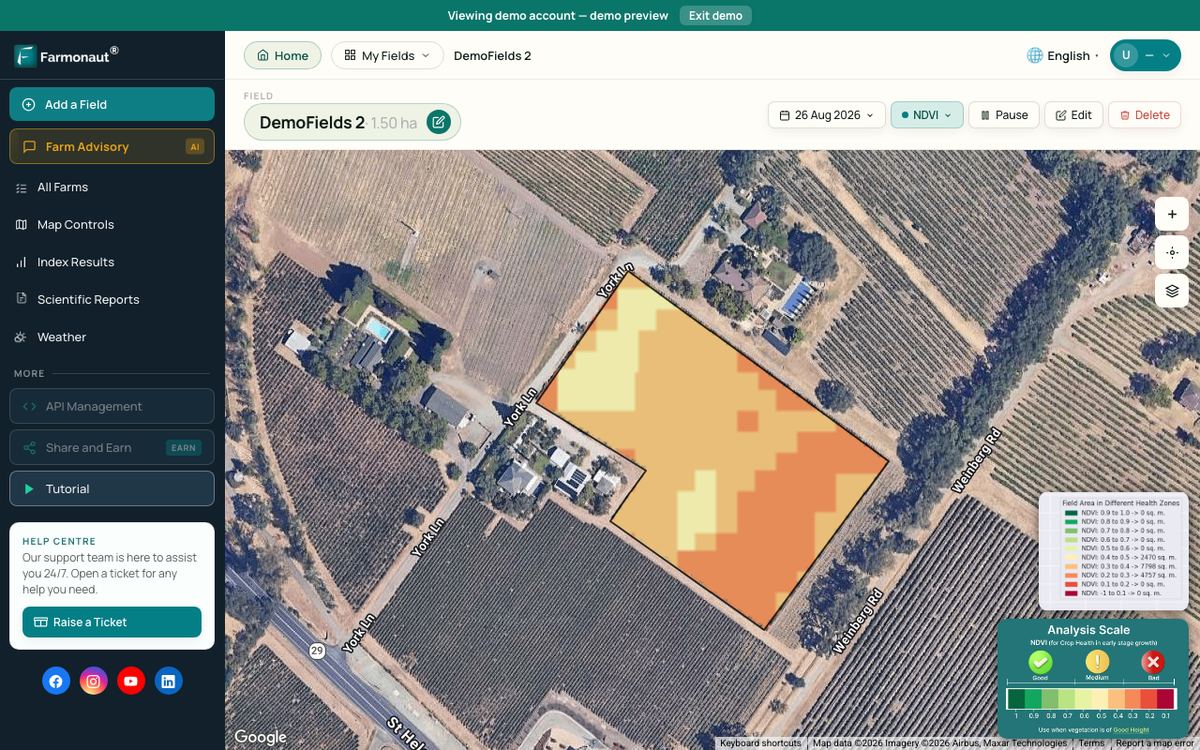
Satellite images show where the canopy is weaker or stronger than the rest of the field, week by week, across every field at once. They do not name the cause. A low-vigour patch may be water stress, root rot, hail, a nozzle problem or a pest, so it still needs a visit. The value is in sending the scout to the right corner first. Farmonaut’s satellite crop monitoring, for example, can be opened in the Farmonaut web app to compare vigour maps across a farm.
▶ How satellite images are used to monitor cotton fields through the season. · 9:57
Water: where technology meets the Ogallala
On the High Plains, water is the limit that no seed or machine removes. In a 2024 AgriLife Today profile of the new Lubbock cotton specialist, Ken Lege called water the No. 1 concern in West Texas as the Ogallala aquifer declines. His programme centres on water-use efficiency, row spacing, seeding rates and variety trials, with weather stations helping collect in-season data from on-farm trials.
Sensor-based irrigation scheduling
Sensors can stretch limited water. A two-year study at the USDA-ARS laboratory in Bushland, published in Frontiers in Plant Science (2023), tested an automated system called ISSCADA that uses canopy temperature to decide when cotton needs water. At the 75% irrigation level, plots scheduled by the system kept seed cotton yield similar to fully irrigated plots while using 22% to 39% less irrigation water in 2021 and 18% to 20% less in 2022. Results from the automated methods were statistically similar to a manual method based on weekly neutron probe readings, which is costly and labour-heavy.
The study covers one site and two seasons, so the savings are not a statewide figure. It does show the direction: sensors and software that replace manual readings make deficit irrigation easier to run. Some growers also track water and fuel use as part of farm carbon footprinting, although that is a reporting task, not an irrigation tool.
Yields and acres: what technology cannot fix
Technology has raised the ceiling on Texas cotton yields, but the weather still sets the floor. According to the USDA NASS Crop Production 2025 Summary, Texas farmers planted 5.58 million acres of cotton in 2023 but harvested only 2.12 million. In 2024 they planted 5.98 million and harvested 2.98 million. In 2025 they planted 5.32 million and harvested 4.02 million. The share harvested rose from 38% to 50% to 76%. The rest was abandoned. NASS does not record the cause; the boll weevil foundation’s 2012 report links earlier large abandonments, in 2008, 2009 and 2011, to dry weather and drought.
Chart
Texas cotton acres planted vs harvested
All cotton, thousand acres, 2023 to 2025
County data show how sharp the swings can be. In Lubbock County, farmers planted 281,000 acres of upland cotton in 2022 and harvested only 65,200, according to NASS county estimates for 2021 to 2023. In 2021 they had harvested 240,500 of 261,000 planted acres.
Texas share of the US crop
Because Texas swings so much, its share of US production does too. USDA ERS’s cotton sector overview (updated January 2025) says Texas contributed about 40% of US cotton production in recent years (its state chart covers 2018 to 2020), mostly from the High Plains. Our calculation from NASS reports gives 22.7% in 2023, 28.3% in 2024, 37.9% in 2025 and 32.7% for the 2026 forecast. The October 2026 NASS Crop Production report puts the 2025 Texas crop at 5.27 million bales and forecasts 4.40 million bales for 2026, with yield falling from 629 to 537 pounds per harvested acre.
Two lessons follow for anyone selling technology to cotton growers. First, a tool that only adds yield on harvested acres earns nothing on an abandoned field. Second, tools that help decide early whether to keep spending on a failing field, or that support crop insurance claims with dated imagery, solve a real Texas problem. Lenders and insurers also use field records; see our page on satellite data for crop loans and insurance.
Chart
Texas share of US cotton production
Percent of US all-cotton bales; 2026 is the October forecast; our calculation from NASS bale estimates
Costs: does cotton technology pay?
Costs set the bar any new tool has to clear. The Texas A&M AgriLife Extension economists’ post on cotton costs and returns in 2026 uses the District 2 (South Plains) dryland budget as an example: 400 pounds of lint per acre, breaking even on variable costs at $0.54 per pound and on total costs at $0.80 per pound. The budget itself puts variable costs at $285.91 per acre. Its break-even prices are net of cottonseed income, so lint has to cover about $216 per acre of variable costs and $320 per acre of total costs (our calculation: 400 lb times each break-even price).
The same post says the drip-irrigated District 2 budget no longer shows a positive return on total costs in 2026. In a stress case with fuel 50% higher and fertilizer 25% higher, break-even prices rise by about $0.03 per pound in all budgets except District 2 dryland, which assumes no fertilizer. For comparison, NASS put the 2025 Texas upland cotton price at $0.598 per pound in its 2025 Texas agriculture overview.
At those margins, a tool has to save inputs or add lint worth more than its yearly cost per acre. A $3,000-a-year subscription spread over 500 acres costs $6 per acre, which is 10 pounds of lint at $0.60. Use the calculator below with your own numbers.
Try the numbers for your own farm below.
Calculator
Will a new cotton tool pay on your acres?
Enter your own acres, yield, price, costs and the gain you expect from the tool.
- Tool cost per acre: $6
- Benefit per acre: $8
- Break-even price on variable cost, without the tool: 0.54 $/lb
- Break-even price on variable cost, with the tool: 0.54 $/lb
- Yield gain needed to cover the tool: 1.2 %
Example values only, not a benchmark or forecast. Defaults for yield (400 lb lint per acre) and variable cost minus cottonseed income ($216 per acre) come from the Texas A&M AgriLife Extension 2026 District 2 dryland budget: its variable costs are $285.91 per acre, and its $0.54/lb break-even after cottonseed income leaves about $216 for lint to cover (400 lb times $0.54); the price default ($0.60/lb) is rounded from the USDA NASS 2025 Texas upland price of $0.598/lb. Tool cost, yield gain and input saving are round examples. The sum ignores abandoned acres, where a yield gain earns nothing, and the extra harvest and ginning cost of any added lint.
What this means for agtech startups
The adoption data point to where cotton growers have already paid for technology and where they have not. GE seed is close to saturation, and guidance was on nearly two-thirds of cotton acres by 2019. Yield maps, variable rate and imagery are far behind. For a startup building for cotton, a few practical points follow from the sources above:
- Sell time and risk, not only yield. The tools with the widest use, guidance and HT seed, saved labour and simplified work. Yield gains are hard for a grower to prove on one farm.
- Fit the dryland economy. With South Plains dryland break-evens of $0.54 (variable costs) and $0.80 (total costs) per pound (AgriLife, 2026), a tool priced per acre has to be cheap enough to keep on abandoned fields too.
- Work with what is already on the farm. Most cotton acres already use guidance (64.5% in 2019), and section control was on 41%. Data that plug into them, or into records growers already keep, lower the barrier.
- Plan for weak signal and connectivity. Remote fields and large farms favour satellite imagery and tools that work with delayed uploads.
- Fill the decision gaps AgriLife is testing: defoliation timing, growth regulator timing, early yield estimates and irrigation needs.
Teams that would rather not build their own image pipeline can pull satellite crop indices and weather into their product through the Farmonaut agriculture API; the satellite and weather API developer docs list the endpoints, and keys are managed from the API dashboard. Agronomy firms and large operators that manage many fields can use the multi-farm admin dashboard. Buyers increasingly ask where cotton was grown and how; product traceability tools answer part of that question, but they do not replace the field data growers keep themselves. For a broader list of what is changing on cotton farms, see our post on cotton farm trends.
How we checked the numbers
Every figure on this page comes from a document we opened in October 2026: USDA ERS and NASS reports, Texas A&M AgriLife Extension and Research publications, a peer-reviewed irrigation study, Beltwide Cotton Conferences papers and the Handbook of Texas. National adoption shares are percentages of planted acres in the survey year shown; we did not find Texas-only adoption shares for these tools in the ERS data. Where we derived a number, such as the share of acres harvested, the Texas share of US production or cost per acre from a break-even price, we say so and the inputs are on this page. Older versions of this article included figures we could not trace to a source, such as the number of Texas acres using AI and general water savings claims; we removed them.
FAQ
How does technology impact U.S. cotton production?
Mainly by cutting labour and crop losses. Machines replaced hand picking after the Second World War, boll weevil eradication and Bt seed reduced insect losses, herbicide-tolerant seed simplified weed control, and guidance steered 64.5% of US cotton acres in 2019 (USDA ERS). Newer tools such as yield maps and imagery were used on 15.2% and 2.8% of acres in 2019.
Is AI used on Texas cotton farms?
Yes, mostly in research projects on commercial farms. In 2026, AgriLife’s Corpus Christi centre was testing drone and satellite tools with 11 Coastal Bend producers to estimate biomass and lint yield and to time growth regulators and defoliation. At Bushland, a USDA-ARS sensor system scheduled deficit irrigation and used 18% to 39% less irrigation water than full irrigation, with similar seed cotton yield, in a two-year study at one site.
Why do Texas farmers abandon so many cotton acres?
Mainly drought, in the years the sources describe. NASS data show Texas harvested 38% of planted cotton acres in 2023, 50% in 2024 and 76% in 2025. In 2011, the boll weevil foundation’s report says 4.35 million acres were abandoned, leaving the lowest harvested area since 1885.
What does it cost to grow dryland cotton in Texas?
AgriLife’s 2026 District 2 dryland budget assumes 400 pounds of lint per acre and breaks even at $0.54 per pound on variable costs and $0.80 on total costs, after cottonseed income. Its variable costs are $285.91 per acre; lint has to cover about $216 of that, and about $320 of total costs. Your own costs will differ; the calculator on this page uses your numbers.
How much cotton does Texas produce?
NASS estimated the 2025 Texas crop at 5.27 million 480-pound bales, 37.9% of the US total by our calculation, and forecast 4.40 million bales for 2026 (October 2026 report). ERS puts Texas at about 40% of US production, using state data for 2018 to 2020; the share was lower in 2023 to 2025.
Did mechanisation change rural Texas?
Yes. The Handbook of Texas says post-war mechanisation removed the need for tenant farmers and sharecroppers and left a cotton economy of fewer but larger farms and fewer farmworkers. At gins, labour per bale fell to 15% to 25% of the 1962 level by 2010, according to USDA-ARS researchers.
Farmonaut agriculture API
Add satellite crop data to your cotton product
Pull field-level satellite crop indices and weather into your own app through the Farmonaut agriculture API.



Keep reading
Sources
- USDA ERS, Precision Agriculture in the Digital Era: Recent Adoption on U.S. Farms, EIB-248 (2023): ers.usda.gov
- USDA ERS Amber Waves, Most Row Crop Acreage Managed Using Auto-steer and Guidance Systems (April 2023): ers.usda.gov
- USDA ERS, Adoption of Genetically Engineered Crops in the United States: Recent Trends in GE Adoption (updated December 2025): ers.usda.gov
- USDA ERS, Cotton Sector at a Glance (updated January 2025): ers.usda.gov
- USDA NASS, Crop Production 2025 Summary (January 2026): release.nass.usda.gov
- USDA NASS, Crop Production (October 2026): release.nass.usda.gov
- USDA NASS, 2025 State Agriculture Overview: Texas: nass.usda.gov
- USDA NASS Texas, County Estimates for Lubbock County, 2021 to 2023: nass.usda.gov
- Texas A&M AgriLife Extension, Ag Economics on the Plains: Cotton Costs and Returns in 2026: agrilife.org
- AgriLife Today, Cotton precision: Digital tools tested in Texas fields (April 2026): agrilifetoday.tamu.edu
- AgriLife Today, Digital agriculture connects dots for crop improvement (January 2021): agrilifetoday.tamu.edu
- AgriLife Today, New AgriLife Extension specialist tackles water issues in the nation’s cotton patch (March 2024): agrilifetoday.tamu.edu
- O’Shaughnessy et al., Sensor feedback system enables automated deficit irrigation scheduling for cotton, Frontiers in Plant Science (2023): frontiersin.org
- Texas State Historical Association, Handbook of Texas: Cotton Culture: tshaonline.org
- Smith, Burson and Patton (Texas Boll Weevil Eradication Foundation), Status of Boll Weevil Eradication in Texas, Beltwide Cotton Conferences 2012: cotton.org
- Funk et al. (USDA-ARS), Changes in Cotton Gin Energy Use over the Past 50 Years, Beltwide Cotton Conferences 2013: cotton.org
Discussion
Questions, corrections or field experience? Share them below. First-time comments are reviewed before they appear, and your email is never published.
No comments yet. Be the first to add a question or your experience.

 Farmitopia
 TVS Electronics
 BW Pipelines
 WICO
WICO Gen Chayat
 Chimera Innovation
 SkyHarvest
 Polaris Digitech
 Teledarbas
 Wild Oak Farm
 SFX
SFX BACF Africa
 Doodlakine
 Exurbia Geospatial
 FieldZero
 Indico Company
 Licence holder · Niger · Gold










