

Illinois · Membership and land guide
Farm Bureau Advantage: Illinois Membership Dues and Perks
In Illinois the Farm Bureau advantage means a vote on farm policy, 300,000+ member savings and eligibility for COUNTRY Financial farm insurance. Counties set dues: McLean County charges $20 (associate) and $56 (voting) a year.
Key takeaways
- County Farm Bureaus set dues; McLean County lists $20 a year for associates and $56 for regular voting members (November 2026).
- IFB members get access to more than 300,000 local and national savings, and IFB says its voting members are three out of four Illinois farmers.
- Membership belongs to the person, so it does not pass to the buyer when you sell farmland.
- Illinois farm real estate averaged $9,250 an acre in 2026, up 3.6% from 2025 (USDA NASS).
- In the ISPFMRA survey, 61% of farm managers expected Illinois land prices to dip in 2026, none by more than 10%.
In this article
- The Farm Bureau Advantage at a Glance
- What the Farm Bureau Advantage Means in Illinois
- What Illinois Farm Bureau Membership Costs
- Who Can Join and Who Can Vote
- How to Join: Step by Step
- Is Farm Bureau Membership Worth It?
- Farm Bureau Membership When You Sell Farmland
- Illinois Farmland Values Before You Sell
- How to Sell a Farm in Illinois: Step by Step
- Estimate What You Will Net From a Farm Sale
- Satellite Field Records and the Farm Bureau Advantage
- Farm Bureaus Beyond Illinois
- Current Issues Farm Bureaus Work On
- How to Get the Most From Your Membership
The Farm Bureau advantage in Illinois is a bundle of three things: a vote on farm policy, access to more than 300,000 member savings, and, for farm insurance, eligibility with COUNTRY Financial, which Illinois Farm Bureau (IFB) helped form. Dues are set by each county. McLean County, for example, charges $20 a year for an associate member and $56 for a regular voting member (McLean County Farm Bureau application, checked November 2026). This guide explains what the dues buy, who can vote, how to join, and what happens to a membership when you sell Illinois farmland, with land value charts and a sale calculator.
The Farm Bureau Advantage at a Glance
| Question | Short answer |
|---|---|
| Yearly cost | Set by your county. McLean County lists $20 (associate) and $56 (regular voting). |
| Who can join | Anyone. Farmers and farmland owners can vote; other members join as associates. |
| Voting reach | IFB says its voting members are three out of every four Illinois farmers. |
| Savings | More than 300,000 local and national offers, per the IFB membership page. |
| Insurance | Since 2025, COUNTRY Financial requires membership only for its farm (agribusiness) products and farm-rated vehicles. |
| Land value | Illinois farm real estate averaged $9,250 an acre in 2026 (USDA NASS). |
| After a sale | Membership stays with the person, not the land. |
What the Farm Bureau Advantage Means in Illinois
IFB uses the phrase itself. Its membership page describes the IFB Advantage as advocacy, trusted information and member development, plus savings on products and services. The words matter less than what you can use. For most members, that comes down to five things.
1. A voice on farm policy
Farm Bureau is a grassroots group. Members write and vote on resolutions at county meetings. Those resolutions move up to the state policy session and then to the national level. IFB says its voting membership represents three out of every four Illinois farmers, which gives its positions weight in Springfield and Washington. Recent topics include trade and tariffs; see our page on US tariffs and their impact on farmers for the background.
Best for: farmers who want a say on property taxes, drainage, roads, trade and farm programs.
2. Member savings
The IFB page lists access to more than 300,000 local and national savings. The categories it names are hotels and travel, vehicle rentals, health and wellness, farm and lawn equipment, financial services and everyday purchases. For the Travel Sherlock hotel offer, you must book through the IFB travel site with the member discount code. If you do not have your discount code, IFB says to contact your county office or sign in at myifb.org.
Best for: households that travel, rent vehicles or buy equipment each year. Check the portal before each purchase, because offers and certificate values change.
3. Insurance and financial services
IFB says it helped form COUNTRY Financial, GROWMARK and FS, Prairie Farms Dairy and other companies. A COUNTRY Financial FAQ for county Farm Bureaus (December 2024) explains that from 1 January 2025 membership is no longer required for non-farm clients, but is still required for agribusiness products and rates, including farm-rated vehicles. The same FAQ says combined billing of dues with COUNTRY premiums ended at the close of 2024, so dues are now billed separately, and it mentions a three-month grace period for dues payment.
Best for: farm families who insure farm property, farm-rated vehicles or other agribusiness cover with COUNTRY, or plan to.
4. Information and news
Dues include a subscription to FarmWeek and/or the Partners publication, valued at $3.00 within the dues, and to the county newsletter where one exists (McLean County application). IFB also shares market news, policy updates and guidance through its county offices.
Best for: owners who rent land out and want to follow rents, prices and rules without farming themselves.
5. Local events and youth programs
County Farm Bureaus run events, young leader programs and volunteer days. IFB supports Illinois Agriculture in the Classroom, which gives teachers and students resources about where food, fiber and fuel come from.
Best for: young farmers, retired farmers and families who want to stay connected to the farm community.
What Illinois Farm Bureau Membership Costs
There is no single statewide price. IFB is a federation of county Farm Bureaus, and each county sets its own dues under the bylaws of the county and the state organization. The McLean County Farm Bureau application shows $20 a year for an associate membership and $56 a year for a regular voting membership. The membership year there starts on 1 December, and dues are prorated by quarter for people who join later in the year.
The same application says dues may change from year to year, are not refundable once the application is accepted, and are not tax-deductible as a charitable gift. Part of each payment goes to the state body. The COUNTRY Financial FAQ (December 2024) says the IFB bylaws then set the associate member share at $10 to IFB and $10 to the county. That is why $20 is a common associate rate across counties.
Voting dues vary more, because each county adds its own budget for staff, events and local work. If you are comparing farm bureau membership cost across counties or states, ask three questions:
- What is the yearly rate for my class (voting or associate)?
- When does the membership year start, and are dues prorated?
- Do I need membership for the insurance I buy, such as farm cover?
Outside Illinois, the national body says the same thing: the American Farm Bureau Federation tells people to find their state Farm Bureau to join and to learn about savings. Rates are set by state and county groups, not by one national price list.
Who Can Join and Who Can Vote
Anyone can join a county Farm Bureau. The question is which class you join. On the McLean County form, the applicant picks one of four lines: farmer or farmland owner with $2,500 or more in farm income; full-time farm worker; worker in an agriculture-related job; or none of these. Farmers and farmland owners join as voting members. People with no farm link join as associates. Associates can use savings and attend events, but they do not vote on policy.
| Class | Typical applicant | Votes on policy? | McLean County dues |
|---|---|---|---|
| Regular voting | Farmer or farmland owner with $2,500+ in farm income | Yes | $56 a year |
| Associate | Non-farming resident, supporter or customer | No | $20 a year |
The $2,500 line is a county membership rule, not a federal farm definition. For context, the USDA Economic Research Service farm typology groups farms by gross cash farm income. Small family farms have under $350,000 a year. Many small landowners who rent out cropland qualify as farmland owners on the form. Ask your county office how it treats landlords who receive cash rent.
Class rules can change, and the McLean County form says the county may change a member’s category based on eligibility, so check the current form for your county before you apply.
How to Join: Step by Step
- Find your county Farm Bureau. The IFB membership page links to a county finder. Some offices serve more than one county.
- Pick your class. Choose voting if you farm or own farmland with farm income at or above your county’s line; otherwise choose associate.
- Gather details. Name, home and mailing address, phone, email and date of birth. Voting applicants may be asked about acres, crops or livestock.
- Add household members. Ask whether a spouse is covered under one membership in your county.
- Pay the dues. Apply online, by mail or at the county office.
- Get your member number and code. You need them for savings and some insurance discounts.
- Renew each year. In McLean County the year starts on 1 December. Check your own county’s date.
Is Farm Bureau Membership Worth It?
The answer depends on how you will use it. Use this simple test:
- Yes, likely: you farm or own farmland, want a vote on policy, and buy farm insurance from COUNTRY Financial.
- Maybe: you do not farm but travel, rent vehicles or buy lawn equipment often enough for the savings to cover $20.
- Probably not: you will not use the savings, do not need the insurance link and have no interest in farm policy.
A short calculation helps. Add the yearly value of the savings you expect to use. Compare it with your county’s dues. Advocacy and information are harder to price, so treat them as a bonus, not as the main reason, unless you plan to take part in county meetings.
Farm Bureau Membership When You Sell Farmland
Membership belongs to a person, not to a parcel. If you sell your farm, your membership and any savings stay with you until the year ends or you stop paying. The buyer does not inherit your class or your dues rate. If the buyer wants the Farm Bureau advantage, they apply to their own county.
After a sale, your class may change. A seller who no longer owns farmland or earns farm income may move from voting to associate at renewal. Ask your county office how it handles a former farmer, because the rules are set locally.
Insurance needs a review too. Farm property cover ends when the land changes hands, so speak with your agent about the closing date. If you plan to pass land to family instead of selling, talk with an attorney and a tax adviser early. Succession plans work best when they start well before a contract is on the table.
Chart
Farm real estate value per acre, Corn Belt and nearby
US$ per acre, 2026 survey averages, selected states and US
Illinois Farmland Values Before You Sell
Illinois farm real estate, which means land and buildings, averaged $9,250 an acre in 2026, up 3.6% from $8,930 in 2025. Cropland averaged $10,200 an acre and pasture $4,300 an acre. These are survey averages from the USDA NASS Land Values 2026 Summary (August 2026). They are not sale prices for any one farm. The US average was $4,500 an acre.
Chart
Illinois farm real estate value per acre
US$ per acre, land and buildings, survey average as of January 1
Illinois sits in the middle of the Corn Belt. Iowa averaged $10,100 an acre in 2026, Ohio $9,650 and Indiana $9,150 (same NASS report). Soil quality, drainage, location and buyer demand explain most of the gap between one farm and the state average.
Sale prices spread far wider than the state figure. The Illinois Extension Farm Coach review of 2026 land values, based on the Illinois Society of Professional Farm Managers and Rural Appraisers (ISPFMRA) survey, reports excellent ground in northern Illinois at $14,000 to $16,500 an acre and central Illinois excellent ground at $13,000 to $18,500. Some sales near livestock areas passed $20,000 an acre.
Rents give another clue to value. USDA NASS reported an average Illinois cropland cash rent of $261 an acre for 2026, down from $264 in 2025 and $269 in 2024, according to farmdoc daily’s review of Illinois cash rents (September 2026). Four central counties averaged more than $330 an acre.
Regional value bands
The Farm Coach review breaks Illinois into regions. Western Illinois reported excellent soils near $15,400 an acre, good soils near $11,300 and average soils near $7,900. Southeast Illinois, outside a strong livestock area, showed good soils near $12,000 and fair soils near $7,800. Far southern Illinois was steady, with good soils near $12,034. These are survey bands reported by farm managers and appraisers, not guaranteed prices.
The same review found that selling land to pay off debt made up 11% of 2025 sales, more than double the year before. Farmers selling their own land were 9% of sales. Non-local investors stayed at 12% of buyers, while local farmers bought 57%. Sales volume kept falling. Fewer sales mean fewer comparable prices, so a good appraisal matters more.
What drives the price of one farm
- Soil productivity: higher productivity ground earns higher rent and sells for more, as the county rent map in farmdoc daily shows.
- Drainage: pattern tile and good outlets raise value; poor drainage lowers it.
- Location: nearness to grain markets, livestock areas and cities can lift prices.
- Size and shape: square, open fields are easier to farm with large equipment.
- Lease status: a lease that runs past closing limits what the buyer can do in year one.
- Buildings: bins and sheds add value only if a buyer needs them.
Where the market may go next
Professional farm managers expect a soft but stable market. In the ISPFMRA survey summarized by farmdoc daily (April 2026), 61% of respondents expected Illinois farmland prices to decline in 2026, but no respondent expected a drop of more than 10%. Half expected a fall of 0 to 5%. Over five years, 77% expected higher prices.
The same survey found that local farmers bought 56% of farmland sold. Non-farming individual investors made up about a third of buyers. Of purchases, 62% used some debt, with the loan averaging 54% of the price. The NASS figures for the next year are released each August, so check the new report before you set an asking price.
Chart
What farm managers expected for Illinois land prices in 2026
% of ISPFMRA survey respondents
How to Sell a Farm in Illinois: Step by Step
A farm sale follows the same legal path in every Illinois county. The details differ with the buyer, the lease and the land. For a deeper look at prices by region, see our guide to selling farmland in Illinois.
Chart
Cropland value per acre, 2025 vs 2026
US$ per acre, selected states
- Prepare documents. Gather the deed, title history, property tax bills, survey, tile maps, yield records and any farm lease. A lease in place affects when the buyer can farm the ground, so disclose it in writing.
- Get a farmland appraisal. Use an appraiser who values Illinois cropland. Soil productivity, drainage tile and grain storage all affect value.
- Choose a sale method. Private sale, listing with a farmland broker, or public auction.
- Sign a purchase agreement. It sets price, payment terms, included items (bins, tile maps, irrigation), contingencies, closing date and tax prorations.
- Clear the title. A title company or attorney checks liens, unpaid taxes, easements and boundaries, and issues title insurance.
- Close and record. Both sides sign, funds move, and the deed is recorded with the county recorder.
Auction or private sale?
Both are common. In the ISPFMRA data reported by Illinois Extension, 41% of 2025 sales were by auction and 42% by private non-auction sale. Farmdoc daily notes that auctions peaked at 53% of transactions in 2023 and that private sales edged ahead in 2025. Estate sales made up 57% of farmland transfers in 2025, the same share as in 2024. Auctions can help when several heirs need a clear, public price. Private sales give more control over timing and buyer.
This is general information. Tax, title and contract rules vary, so get advice from an Illinois farm-sale attorney and a tax professional before you sign.
Estimate What You Will Net From a Farm Sale
Enter your own acres, price and costs. The calculator follows the basic arithmetic of a closing statement: gross price, minus commission, transfer tax, other closing costs and any loan payoff. It does not include income or capital gains tax. Look up your own county’s transfer tax rate; the default is an example only.
Try the numbers for your own farm below.
Calculator
What could you net from selling your farm?
Enter your own acres, price and costs.
- Gross sale price: $740,000
- Commission: $22,200
- Transfer tax: $1,110
- Net per acre: $8,884
Example values only, not a forecast or an appraisal. The price default is close to the 2026 USDA NASS Illinois farm real estate average; use your own appraisal or today’s offer. The transfer tax and commission rates are example inputs: check your county’s rate and your broker’s agreement. Income and capital gains tax are not included; ask a tax professional.
Satellite Field Records and the Farm Bureau Advantage
Farm Bureau membership covers advocacy, savings and insurance access. It does not include field-level crop maps. Satellite tools fill that gap for members who want a record of how their fields have grown. A buyer or tenant may ask for yield history; a few seasons of vegetation maps can support those records.
The Farmonaut Satellite + AI Farm Monitoring System shows vegetation maps of each field you draw, on the web and in the mobile app for Android and iOS. Developers can pull the same data through the satellite API and its developer docs.
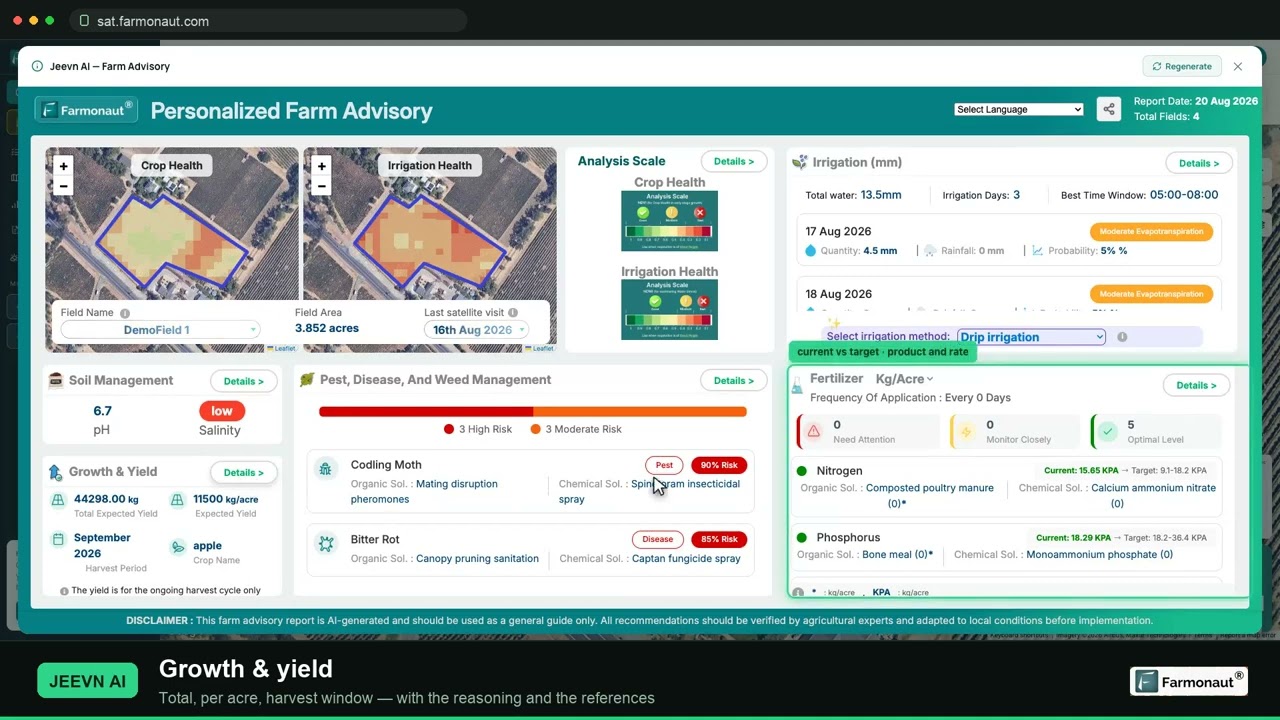
▶ A full walkthrough of satellite crop monitoring: reading NDVI maps and pulling a field report. · 19:36
Farm Bureaus Beyond Illinois
The American Farm Bureau Federation was organized in 1919, according to IFB’s own history. IFB began as the Illinois Agricultural Association in DeKalb in 1912 and became the Illinois Farm Bureau at state level in 1916. Every state has its own Farm Bureau, and each sets its own dues and benefits. Focus areas differ:
- Corn Belt states focus on grain markets, drainage and land values.
- Western states give more time to water rights and grazing.
- Dairy states work on milk pricing and labor.
- Fruit and vegetable states focus on farm labor and food safety.
The American Farm Bureau also publishes market research. For example, its economists track farm finances, such as Chapter 12 farm bankruptcies, which continued to climb in 2025. Members can use that research when they talk to lenders or lawmakers.
Current Issues Farm Bureaus Work On
County and state Farm Bureaus give members a standing channel on issues that move faster than one farm can follow:
- Weather and climate risk: conservation programs and practical climate resilience strategies for farms.
- Trade: tariffs and export markets that move grain prices.
- Labor: farm worker programs and rural workforce rules.
- Technology: broadband, data privacy and precision farming tools.
- Farm income: margins, credit and federal support payments.
For a wider list of topics, read our roundup of current agricultural issues.

▶ Six plain steps to start precision farming without buying a robot. · 4:18
How to Get the Most From Your Membership
- Go to at least one county meeting a year, so you see resolutions before they reach the state floor.
- Check the savings portal before each big purchase, because offers change.
- If you insure farm property or farm-rated vehicles with COUNTRY, keep your membership current.
- Vote on resolutions if you hold voting status.
- Start succession talks early if you plan to sell, gift or pass on land.
- Keep your member number at hand for discounts and events.
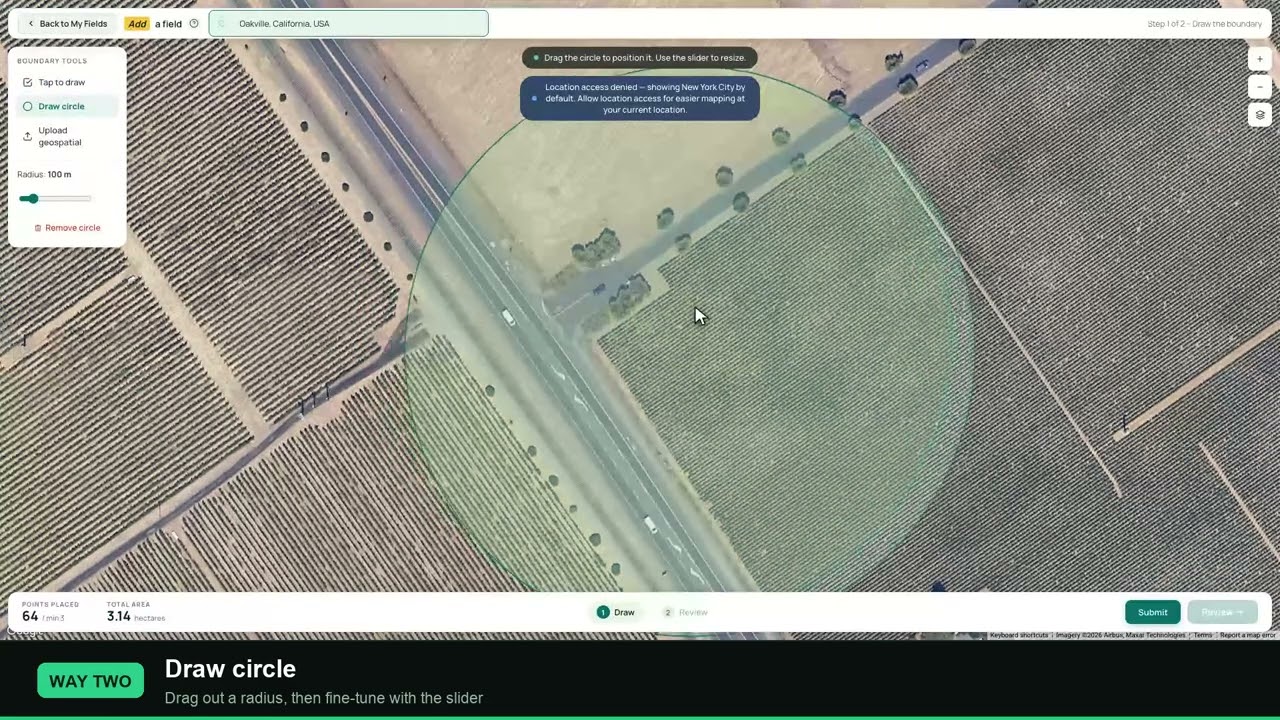
▶ How to add a field boundary in Farmonaut, all three ways. · 3:50
FAQ
How much is a Farm Bureau membership in Illinois?
Each county sets its rate. McLean County lists $20 a year for associate members and $56 for regular voting members (checked November 2026). Check your own county’s join page.
Do you have to pay Farm Bureau membership dues every year?
Yes. Membership runs for one year and must be renewed. In McLean County the year starts on 1 December, with quarterly proration for new members. COUNTRY Financial’s FAQ notes a three-month grace period for IFB dues.
What is the Farm Bureau advantage?
It is IFB’s name for what members get: advocacy, trusted information, member development, and access to more than 300,000 savings, plus eligibility for COUNTRY Financial farm insurance.
Can a non-farmer join Farm Bureau?
Yes. Non-farmers join as associate members. They can use the savings and attend events but do not vote on policy.
Does membership transfer when I sell my farm?
No. Membership belongs to the person. The buyer must join their own county Farm Bureau.
What is Illinois farmland worth per acre?
USDA NASS put Illinois farm real estate at $9,250 an acre and cropland at $10,200 an acre in 2026. Single sales of excellent ground can reach well above that.
Farmonaut crop monitoring
See your own fields from space
Draw your fields once and Farmonaut shows satellite vegetation maps for them through the season, on web, Android or iOS.




Keep reading

Sources
- Illinois Farm Bureau, Membership page (accessed November 2026): ilfb.org
- Illinois Farm Bureau, About us (accessed November 2026): ilfb.org
- McLean County Farm Bureau, membership application (accessed November 2026): form.jotform.com
- COUNTRY Financial, County Farm Bureau FAQ (December 2024): countryfinancial.com
- American Farm Bureau Federation, Join (accessed November 2026): fb.org
- American Farm Bureau Federation, Farm Bankruptcies Continued to Climb in 2025: fb.org
- USDA ERS, Farm Structure and Contracting (farm typology): ers.usda.gov
- USDA NASS, Land Values 2026 Summary (August 2026): release.nass.usda.gov
- Illinois Extension Farm Coach, Illinois Farmland Values in 2026: Volatile Signals (May 2026): extension.illinois.edu
- farmdoc daily, Illinois Cash Rents in 2026 and Outlook for 2027 (September 2026): farmdocdaily.illinois.edu
- farmdoc daily, 2026 Illinois Farmland Price Expectations (April 2026): farmdocdaily.illinois.edu
- Android: play.google.com
- iOS: apps.apple.com
Discussion
Questions, corrections or field experience? Share them below. First-time comments are reviewed before they appear, and your email is never published.
No comments yet. Be the first to add a question or your experience.

 Aadyah Aerospace
 Kubota
 FFBS
 Jontra
 Kalustyan
 Tucor
 Geno
 Hayleys Agriculture
 Linx Agritech
 Adinet
 Save Your Soils
 Grandstream Algérie
 XOS Realty
 Geospatial Lab Africa
 Agro La Gándara
 HIPSAC
 ZOL Zimbabwe

 Licence holder · Niger · Gold
 Client · Tanzania · Gold
 Client · Somalia · Gold
 Client & affiliate partner · Ghana · Gold










