

Reviewed August 2026 against USDA NASS and the Texas Department of State Health Services (DSHS).
Yes, it is legal to grow hemp in Texas. Texas legalized hemp cultivation under House Bill 1325, signed in June 2019, which authorizes production, processing, and sale of hemp containing no more than 0.3% THC on a dry-weight basis. You need a license from the Texas Department of Agriculture (TDA) to grow it, a separate registration if you manufacture or sell consumable hemp products, and your crop must test under the THC threshold or it is legally reclassified as marijuana and destroyed. That’s the short answer. The longer answer — what a license actually costs, what changed for retailers in 2025 and 2026, and where the rules are still moving — is below.
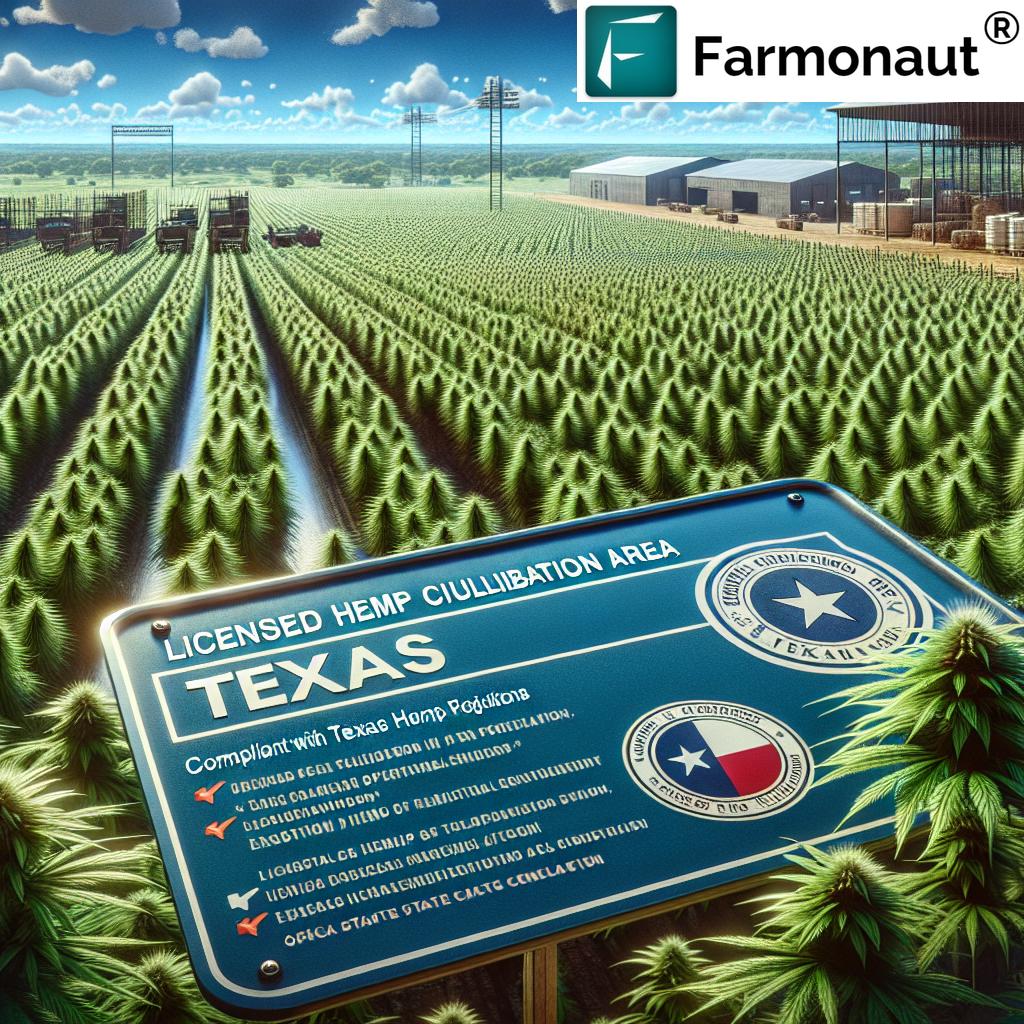



Federal and Texas Hemp Law: How We Got Here
Hemp’s legal status in Texas rests on two layers of law that you need to hold in your head at the same time: the federal definition of hemp, and the state licensing and retail regime Texas built on top of it. Neither layer is static, and the gap between “growing hemp is legal” and “selling what you grow is legal” is exactly where most confusion — and most of the 2025-2026 legislative fights — has happened.
The 2018 Farm Bill Set the Federal Floor
The Agriculture Improvement Act of 2018 (the Farm Bill) removed hemp from the federal Controlled Substances Act and defined it as cannabis containing no more than 0.3% THC by dry weight. That single threshold — 0.3% — is the line every state hemp program, including Texas’s, is built around. The Farm Bill required states that wanted their own hemp programs to submit a plan to USDA for approval, which is exactly what Texas did.
Texas Response: HB 1325 and the Birth of Legal Hemp Production
Texas enacted House Bill 1325 in June 2019, authorizing the production, cultivation, manufacture, inspection, and retail sale of industrial hemp crops and products statewide (Texas Department of Agriculture, Regulatory Programs: Hemp). That single bill:
- Gave the Texas Department of Agriculture (TDA) full authority over the industrial hemp cultivation program — licensing growers, handlers, and processors.
- Made the Texas Department of State Health Services (DSHS) responsible for the consumable hemp product side — manufacturing, retail, and labeling of anything people ingest or inhale.
- Set the state THC threshold to match the federal 0.3% dry-weight limit, so a Texas-legal hemp plant and a federally-legal hemp plant are the same plant.
That split — TDA regulates the plant in the field, DSHS regulates the product on the shelf — is the detail most articles skip, and it’s the reason “is hemp legal in Texas” and “can I sell hemp-derived THC products in Texas” now have different, and diverging, answers.
Defining Hemp: The 0.3% THC Line
Both federal and Texas law define hemp as cannabis containing no more than 0.3% THC by dry weight. Anything above that line is legally marijuana in Texas, regardless of how it was grown or intended to be used. Licensed producers must test every lot before harvest, and the consequence of testing over the line is not a fine — it’s mandatory destruction of the crop. That threshold has not moved since 2018, but what Texas allows to be sold from hemp that meets it — specifically Delta-8 and other hemp-derived intoxicating cannabinoids — is the part currently in flux, covered in detail further down.
Texas Hemp Licensing: Who Can Grow, and What It Costs
To legally cultivate hemp in Texas, you need a hemp producer license from the TDA before you put a seed in the ground. Separately, if you plan to manufacture or sell consumable hemp products — anything meant to be eaten, drunk, smoked, or applied — you also need a DSHS registration, and that registration now carries a defined annual fee.
Who Is Eligible for a Hemp Producer License?
- Applicants must be at least 18 years old at the time of application.
- No felony drug convictions in the past ten years are permitted for licensees.
- Applicants undergo a criminal background check as part of TDA review.
Step-by-Step: TDA Cultivation Licensing
- Apply for a hemp producer license via the Texas Department of Agriculture.
- Submit personal, business, and location details, including facility registration if you’ll also process hemp.
- Complete background checks for all key individuals and business owners on the license.
- Pay the applicable TDA application and renewal fees, which are set by rule and reviewed periodically — confirm the current schedule on the TDA hemp program page before you budget, since it is not the same fee schedule as the DSHS consumable-product side below.
- Obtain a Lot Crop Permit for each distinct planting area within your operation.
- Register each processing facility separately if you operate more than one location under a single license.
DSHS Consumable Hemp Program: Fees and Age Limits (2025 update)
If your hemp is headed toward a consumable product — oils, edibles, tinctures, or anything sold at retail — you fall under the DSHS Consumable Hemp Program, and its cost structure is now explicit. As of the 2025 program update, DSHS lists an annual license fee of $10,000 for hemp product manufacturers and producers, and a separate $5,000 annual registration fee for hemp retailers (Texas DSHS, Consumable Hemp Program). Effective October 2, 2025, DSHS also set a minimum purchase age of 21 for consumable hemp products statewide. These are materially different numbers from the TDA cultivation-license fees above, and conflating the two is the single most common mistake first-time applicants make — budget for both if you intend to grow and sell finished product under one operation.
Licenses and permits are mandatory for every producer, processor, and handler in the Texas hemp supply chain. Skipping either the TDA or DSHS layer — because you assumed one covered both — is a compliance gap, not a legal gray area.
Texas Hemp Law Timeline: What Changed and When
Texas hemp law didn’t arrive as one rule — it’s been built in layers since 2018, and the most consequential layer is still being added. Here’s the sequence, with the durable facts separated from the parts still moving.
| Date | Change | THC Limit | License Required | What It Means |
|---|---|---|---|---|
| 2018 | Federal Farm Bill legalizes hemp under 0.3% THC dry weight; states may build their own programs | 0.3% | Federal/state, varies | Establishes the national floor every state program, including Texas’s, is built on |
| June 2019 | HB 1325 signed: authorizes hemp production, manufacture, sale, and inspection statewide | 0.3% | Yes (TDA) | Texas hemp cultivation becomes legal; TDA licensing program launches |
| May 2020 | TDA adopts rules on hemp seed sale, purchase, labeling, and facility registration | 0.3% | Yes (seed sellers & handlers) | Establishes traceability and certification requirements for seed (Texas A&M Agrilife, Texas Ag Law Blog) |
| April 2025 | Texas Legislature advances THC ban legislation targeting hemp-derived consumables | 0.3% (cultivation unaffected) | Yes, plus DSHS registration for consumables | Legislative fight begins over Delta-8 and similar hemp-derived products (Axios Austin) |
| May 2025 | Texas House passes Senate Bill 3, proposing a ban on consumable hemp-derived THC products | 0.3% (cultivation unaffected) | Yes | Bill later vetoed by Gov. Abbott; special-session activity follows (Axios Houston) |
| October 2, 2025 | DSHS sets $10,000 manufacturer/producer fee, $5,000 retail fee, age 21 minimum | 0.3% | Yes (DSHS registration) | First explicit statewide fee schedule and purchase-age floor for consumable hemp (Texas DSHS) |
| March 31, 2026 | Smokable hemp products (flower, pre-rolls) banned from Texas retail | 0.3% (cultivation unaffected) | Yes | Retail category eliminated; cultivation and non-smokable product sale continue (Texas legislation) |
Notice the pattern: every restriction since 2025 has hit the retail consumable side of the business — manufacturing, selling, smoking — not the right to grow hemp itself. Cultivation under a TDA license, at 0.3% THC, has not been banned or narrowed at any point in this sequence.
THC Limits, Testing, and What Happens If You Fail
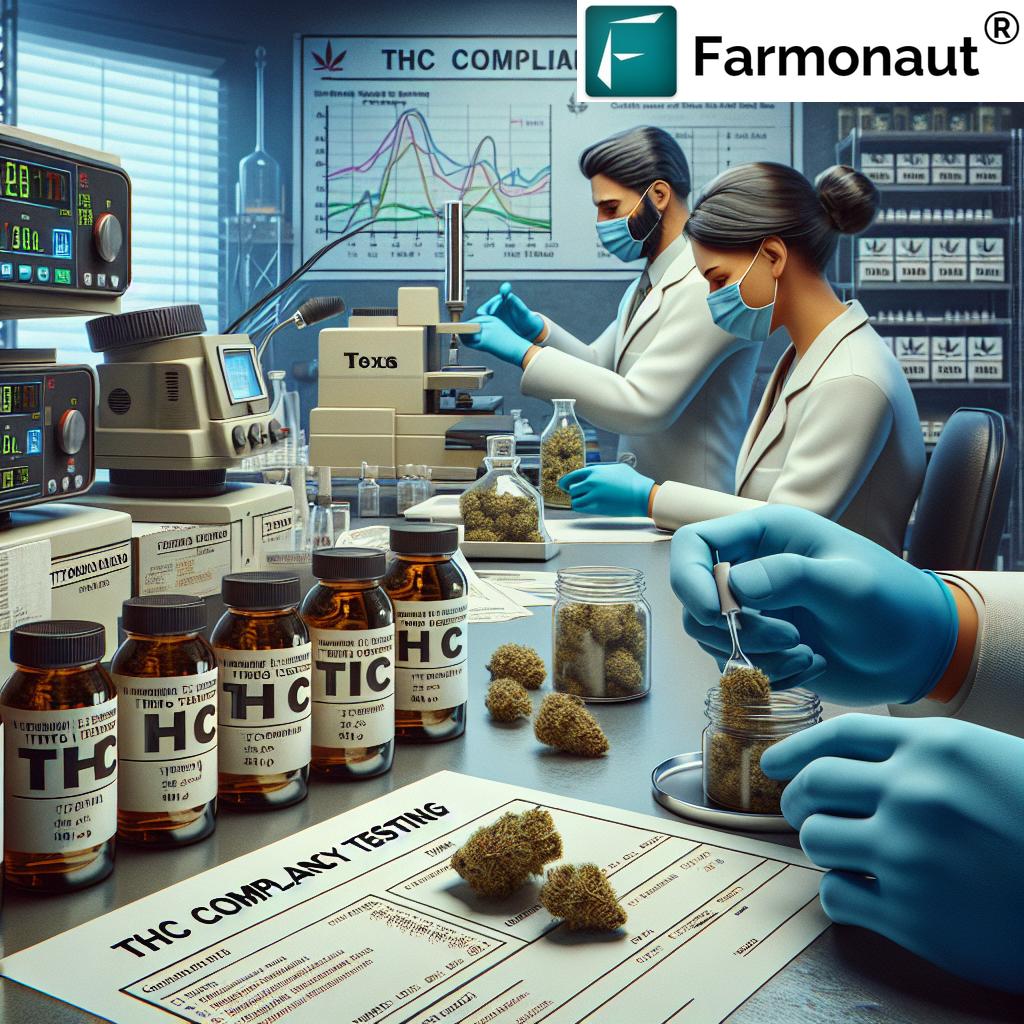
The 0.3% THC dry-weight threshold is not a guideline — it’s the enforcement line the entire legal status of your crop hangs on. Maintaining it requires laboratory testing before harvest, and the consequence of exceeding it is destruction, not a warning.
Key Rules for Compliance
- Certified lab testing required: Every hemp crop must be tested by a TDA-certified laboratory before harvest (THCA Texas, Industrial Hemp THC Content Regulations).
- Over the line means destruction: If THC content exceeds 0.3% dry weight, the crop is legally reclassified as marijuana and must be destroyed under state law — there is no remediation step that lets you sell it as hemp.
- Per-lot testing: Each planting lot is tested individually before harvest, with THC measured on a dry-weight basis, so a farm with multiple lots can pass on some and fail on others.
- Recordkeeping: Test results and compliance records must be retained and made available for TDA inspection — this is your paper trail if a lot is ever disputed.
The practical risk here isn’t intentional non-compliance — it’s genetic drift and environmental stress. THC concentration in hemp can rise under heat and drought stress even in a certified low-THC cultivar, which is exactly the kind of field-level variation that’s worth monitoring before your pre-harvest test date, not after.
Growing and Processing Hemp Legally in Texas
Industrial hemp production in Texas is a tightly regulated process end to end, from the seed you plant to the facility that processes the harvest. Here’s what governs each stage.
Key Cultivation Regulations
- Seed certification and sourcing: Only TDA-registered and certified hemp seed may be planted. Since May 2020, sale, handling, or possession of hemp seed has been tightly regulated (Texas A&M Agrilife Texas Ag Law Blog).
- Lot Crop Permits: Each planting area (“lot”) requires its own permit. An unpermitted or unregistered lot risks fines or crop destruction regardless of THC compliance.
- Facility registration: Processors and manufacturers must register each processing facility with TDA separately from the cultivation license.
- Routine and random inspection: Farms and facilities are subject to TDA inspection on both a scheduled and random basis.
- Destruction protocol: A lot that fails THC compliance must be destroyed in full — there is no partial-harvest exception.
What Growers Actually Produce: Floral vs. Fiber Hemp
Nationally, USDA’s National Agricultural Statistics Service (NASS) tracks two very different hemp categories, and the economics differ sharply between them. In 2024, US floral hemp — the CBD- and cannabinoid-oriented crop — was harvested on 11,827 acres and produced 20.8 million pounds, worth $386 million, which NASS reports as 93% of total US open-field hemp production value. Fiber hemp, grown for industrial and textile use, was harvested on 18,855 acres and produced 60.4 million pounds in the same year (USDA NASS, 2025 Hemp Report). Fiber hemp covers more acreage nationally but generates a fraction of the revenue per acre that floral hemp does — a distinction that matters enormously when you’re deciding what to plant, since Texas issues the same cultivation license regardless of which type you grow.
NASS does not publish a state-level breakdown of Texas acreage or production separately from the national total — hemp production data is reported at the US aggregate level only, not by state. If you need Texas-specific acreage or yield figures, TDA’s own licensing records are the closest available proxy; NASS’s National Hemp Report is republished annually, typically each April, at nass.usda.gov.
Related Tool:
If you’re managing multiple lots or facilities under one license, our Fleet Management tool helps track farm machinery, coordinate field operations, and reduce logistics costs across a multi-lot hemp operation.
Hemp Seeds, Local Bans, and State Preemption
Two questions come up constantly alongside “can I grow hemp in Texas”: can I buy seed freely, and can my county or city ban hemp locally? The answers are both governed by state-level rules that override local discretion.
Hemp Seed Laws
- Licensed sale only, since May 2020: Hemp seed cannot be sold or transferred without a TDA license — this applies to both commercial and personal-use quantities.
- Certification standards: Seed sold and planted must meet certification requirements for quality and labeling under Texas and federal law.
- Purchasing restricted to licensees: Only licensed producers and handlers may legally purchase or possess hemp seed for planting.
- Traceability: Documentation must show the legal origin and certified status of every seed lot.
Local Government Preemption
Texas cities and counties cannot prohibit or create additional barriers to hemp cultivation, production, sale, or transportation within their jurisdictions — this is a state preemption written into the framework HB 1325 established (Mondaq, Hemp Revisited: Texas Cautiously Legalizes Consumable and Non-Consumable Hemp Products). Practically, this means: if you’re licensed by TDA and compliant with the 0.3% THC standard, no local ordinance can stop you from growing, and no city can require a separate local permit for cultivation itself. This uniformity is one of the more durable features of Texas hemp law — it hasn’t been challenged or narrowed by any of the 2025-2026 retail-side legislation, because that legislation targets consumable products, not the preemption structure itself.
For full supply chain transparency, we recommend Farmonaut’s Traceability Solution. It supports blockchain-based tracking for crops including hemp — helping producers document compliant seed origin and prove chain of custody during a TDA inspection.
The 2025-2026 THC Crackdown: What Actually Passed
This is the part of Texas hemp law that’s genuinely still moving, and it’s worth being precise about what changed versus what was proposed and didn’t survive.
Senate Bill 3: Passed the House, Then Vetoed
In May 2025, the Texas House passed Senate Bill 3, which proposed banning consumable hemp-derived THC products outright — including Delta-8 edibles, tinctures, and vape cartridges (Axios Houston, May 2025). The bill moved through the legislature with backing from Lieutenant Governor Dan Patrick, but Governor Greg Abbott did not sign it into law in its full-ban form — the legislative push instead redirected toward the narrower, staged restrictions that followed: the DSHS fee and age-limit rules effective October 2025, and the smokable-product ban set for March 2026. The earlier legislative momentum toward SB3 is documented in reporting from April 2025 as the bill moved through committee (Axios Austin, April 2025).
What Actually Took Effect
- October 2, 2025: DSHS’s $10,000 manufacturer/producer fee, $5,000 retail fee, and age-21 purchase minimum for consumable hemp products took effect statewide.
- March 31, 2026: Smokable hemp products — flower and pre-rolls specifically — are banned from Texas retail shelves under the current legislative timeline.
- Cultivation itself: Growing hemp under a TDA producer license, at or below 0.3% THC, remains legal throughout this entire sequence. None of the 2025-2026 restrictions touch the right to plant, cultivate, or hold a TDA license.
The distinction that matters for anyone searching “is hemp legal in Texas”: cultivation law has been stable since 2019. Retail law for hemp-derived intoxicating products is what’s been rewritten twice in twelve months, and it’s reasonable to expect further legislative action — Texas’s regular legislative session cycles every two years, so watch for the next session for any further changes to the smokable-product ban or DSHS fee structure.
If you’re considering the environmental impact of your operation, our Carbon Footprinting Tool helps Texas hemp growers measure and reduce emissions — increasingly relevant as buyers and processors add sustainability documentation requirements alongside THC compliance paperwork.
How Big Is the Hemp Market, in Real Numbers
National figures give the clearest picture available, since NASS does not break hemp acreage or value down by state. In 2024, US hemp planted acreage across all purposes totaled 45,294 acres, with 32,694 acres actually harvested — meaning roughly 28% of planted acreage was not harvested, which is typical for a crop still working through THC-compliance testing and market uncertainty at the field level (USDA NASS, April 2024 Executive Briefing). Total US hemp production value across outdoor and protected (greenhouse) cultivation reached $445 million in 2024 (USDA NASS, 2025 Hemp Report).
The 2024 National Numbers
- 45,294 acres planted nationally, all hemp purposes, 2024 (USDA NASS).
- 32,694 acres harvested nationally, 2024 — about 72% of planted acreage (USDA NASS).
- $445 million total US hemp production value, outdoor plus protected cultivation, 2024 (USDA NASS).
- $386 million of that total came from floral hemp alone — 93% of open-field production value, from just 11,827 harvested acres (USDA NASS).
What this tells a Texas grower: floral hemp generates far more revenue per acre nationally than fiber hemp does, even though fiber hemp occupies more harvested acreage (18,855 acres versus 11,827). That ratio is worth checking against current-year NASS data before you commit acreage to one type over the other — the report refreshes annually each April.
Texas-specific production and acreage figures are not separately published by NASS — hemp is one of the crops where USDA reports only the national aggregate, not a state-by-state breakdown. If you need a Texas-specific estimate of market size, the closest available proxy is TDA’s own count of active hemp producer licenses, which TDA publishes directly rather than through NASS; contact TDA’s Regulatory Programs office or check the hemp program page linked above for current licensee counts.
On the retail-restriction side: DSHS’s new fee schedule ($10,000 manufacturer/producer, $5,000 retailer, both effective October 2025) functions as a real barrier to entry for smaller operators compared to the pre-2025 regime, where no comparable statewide consumable-hemp fee existed. Combined with the March 2026 smokable-product ban, the practical effect is a market that’s consolidating around larger, better-capitalized manufacturers and away from small-batch retail — even though cultivation licensing costs have not changed.
Managing operations at scale? Our Large Scale Farm Management Suite helps agribusinesses coordinate planting through compliance recordkeeping as license and fee structures shift.
Why Texas Is Restricting Hemp-Derived THC
The DSHS fee increases, age restrictions, and smokable-product ban are grounded in public health arguments Texas policymakers have raised consistently since the SB3 debate — unregulated potency, inconsistent labeling, and access by minors (Associated Press).
The Case for Restriction
- Potency and testing gaps: Hemp-derived intoxicating cannabinoid products — particularly Delta-8 — were sold at retail for years with far less consistent testing than TDA-licensed raw hemp, since DSHS’s fee and registration regime for consumables only took full effect in October 2025.
- Youth access: Flavored vapes and edibles derived from hemp were cited repeatedly in legislative debate as easily accessible to minors, which is part of why the age-21 purchase minimum was set specifically for consumable hemp products.
- Consistency with combustible-product policy: The smokable-hemp ban taking effect March 31, 2026 brings hemp flower and pre-rolls in line with how Texas already restricts other smokable products at retail.
The Case Against
- Market disruption: A $10,000 annual manufacturer fee and $5,000 retailer fee are real costs that smaller operators absorb less easily than larger, established processors — critics argue this consolidates the market rather than making it safer.
- Consumer access: Removing smokable hemp products from retail from March 2026 onward doesn’t eliminate demand — it shifts where consumers source those products from, which is the central argument opponents made against the original SB3 full-ban proposal.
Both sides agree on one thing: this is a live legislative area, and the next Texas legislative session is the next point where either the fee schedule, the age limit, or the smokable-product ban could be revised. There is no fixed review date published by DSHS — check dshs.texas.gov/consumable-hemp-program directly, since updates happen through legislative action or executive order rather than a routine schedule.
Did you know? Farmonaut helps farmers secure crop loans and insurance with satellite-based crop health verification — useful for hemp farmers who need to document crop condition ahead of a THC compliance test or prove losses if a lot is ordered destroyed.
Calculator: What Will Your Texas Hemp License Actually Cost?
Enter your operation’s plans below to estimate first-year Texas hemp licensing costs based on the DSHS consumable hemp fee schedule.
Enter your details above.
Assumptions: uses only the DSHS consumable hemp fees published for 2025 ($10,000 manufacturer/producer, $5,000 retailer). Does not include TDA cultivation license or Lot Crop Permit fees, which are set separately by TDA rule and not published as a fixed schedule in this article — confirm current TDA fees directly at texasagriculture.gov before budgeting. Does not include lab testing costs, facility registration fees, legal fees, or bonding. This is a planning estimate, not a quote.
Staying Compliant as the Rules Keep Moving
Texas hemp regulation changes through two channels: TDA rulemaking on the cultivation side, and legislative or executive action on the consumable-product side. Neither moves on a fixed calendar, so the practical approach is to check the primary source directly rather than relying on any single article’s snapshot.
How to Stay Current
- TDA hemp program page: texasagriculture.gov/Regulatory-Programs/Hemp is the authoritative source for cultivation license requirements and fees.
- DSHS Consumable Hemp Program page: dshs.texas.gov/consumable-hemp-program is updated whenever the fee schedule, age limits, or allowed product categories change — there’s no fixed review cycle, so bookmark it rather than a fee figure.
- USDA NASS National Hemp Report: published annually, typically each April, at nass.usda.gov — this is where 2025 harvest-year figures will appear starting around April 2026, updating the 2024 figures cited throughout this article.
- Federal hemp definition: changes to the 0.3% THC threshold itself would require Congressional action amending 7 U.S.C. § 1639o, or a Federal Register notice from USDA — monitor Congress.gov if you want to track that possibility directly.
Operational Habits That Reduce Risk
- Renew before deadlines, not after: license lapses create gaps that complicate sale and transport documentation.
- Keep per-lot records: test results, planting dates, and seed source documentation by lot, not just by farm.
- Monitor crop stress before your pre-harvest THC test: heat and drought stress can push THC concentration upward even in certified low-THC cultivars — field-level monitoring ahead of the test date gives you time to adjust harvest timing.
- Separate your cultivation and consumable-product compliance tracking: TDA and DSHS are different agencies with different fee schedules and different renewal calendars.
How Farmonaut Helps Texas Hemp Growers
Texas hemp compliance runs on documentation and timing — per-lot THC testing before harvest, facility registration, and recordkeeping for TDA inspection. Farmonaut’s satellite-based farm management tools support the field-level side of that compliance work.
Our Solutions for the Texas Hemp Sector
- Real-Time Crop Monitoring: Track crop health, soil moisture, and vegetation indices (NDVI) by lot from planting to harvest, helping flag stress conditions before your pre-harvest THC test date.
- Precision Agriculture: Optimize irrigation and fertilizer input per lot, supporting consistent crop condition across a multi-lot license.
- Blockchain Traceability: Document seed origin and chain of custody from seed to sale, supporting the certified-seed and traceability requirements TDA enforces.
- Regulatory Recordkeeping: Organize compliance data by lot, ready for TDA inspection at any time.
- Fleet and Resource Management: Coordinate equipment across multiple planting lots or facilities under a single license.
- Carbon Footprinting: Quantify emissions ahead of any future sustainability documentation requirements from buyers or processors.
For enterprise solutions or integration needs, our secure Farmonaut API and comprehensive API Developer Docs are available for seamless data-driven integration.
FAQ: Texas Hemp Law
Is it legal to grow hemp in Texas?
Yes. Under HB 1325 (2019), growing hemp is legal in Texas with a Texas Department of Agriculture producer license, provided the crop tests at or below 0.3% THC by dry weight. This has not changed under any of the 2025-2026 legislation, which affects retail sale of consumable hemp products, not cultivation.
Can I grow hemp in Texas for personal use, without a license?
No. Texas law does not carve out a personal-use exemption from licensing. Anyone growing hemp — regardless of scale or intended use — needs a TDA hemp producer license and must comply with THC testing and Lot Crop Permit requirements.
What is the THC limit for legal hemp in Texas?
0.3% THC by dry weight, matching the federal Farm Bill definition. Crops testing above this threshold are legally reclassified as marijuana and must be destroyed.
Is growing cannabis in Texas legal if it’s not hemp?
No. Cannabis above 0.3% THC by dry weight is classified as marijuana under Texas law and remains illegal to cultivate outside the state’s limited medical cannabis program. Only cannabis at or below the 0.3% threshold qualifies as legal hemp.
How much does a Texas hemp license cost?
TDA cultivation license fees are set by rule and should be confirmed directly at texasagriculture.gov. Separately, DSHS charges $10,000/year for consumable hemp product manufacturers and producers, and $5,000/year for retail registration, both effective as of the October 2025 fee update.
Are there local restrictions on hemp cultivation in Texas?
No. State preemption law prevents Texas cities and counties from banning or restricting legal hemp cultivation, handling, or sale within their jurisdictions.
What changed with Texas hemp law in 2025 and 2026?
Senate Bill 3 passed the Texas House in May 2025 proposing a full ban on hemp-derived THC consumables but was not enacted in that form. DSHS instead implemented a $10,000 manufacturer fee, $5,000 retail fee, and age-21 purchase minimum effective October 2, 2025, followed by a ban on smokable hemp products (flower and pre-rolls) taking effect March 31, 2026. Cultivation licensing was not changed by any of these actions.
Further reading:
Where This Goes Next
Hemp cultivation in Texas is legal, licensed, and has been stable law since HB 1325 in 2019 — that part of the answer isn’t going to change with the next legislative session. What is still moving is the retail side: DSHS’s fee schedule, the age-21 purchase minimum, and the smokable-product ban taking effect March 31, 2026 are all recent, and Texas’s biennial legislative cycle means the next opportunity for further amendment arrives with the next regular session.
If you’re evaluating whether to enter Texas hemp cultivation, the durable checklist is this: confirm your TDA producer license and per-lot permits are current, budget separately for DSHS consumable-product fees if you’ll manufacture or sell finished product, test every lot before harvest against the 0.3% THC line, and check both agency pages directly — texasagriculture.gov for cultivation, dshs.texas.gov/consumable-hemp-program for consumables — before relying on any fee or deadline figure that isn’t dated to the current year.
At Farmonaut, we help Texas hemp growers manage the field-level side of that compliance — crop monitoring by lot, traceability documentation, and recordkeeping — so THC testing and TDA inspection don’t catch you unprepared.

 AgroRangers
 FCF India
 Unifrutti Gulf
 Deluxe Conseil
 TVS Electronics
 BW Pipelines
 WICO
WICO Gen Chayat
 Chimera Innovation
 SkyHarvest
 Polaris Digitech
 Teledarbas
 Wild Oak Farm
 SFX
SFX
