

Reviewed August 2026 against USDA Farm Service Agency, the Texas Department of Agriculture, and the Texas Agricultural Finance Authority.
Try it: Run your own numbers →
Land Loans in Texas: The Short Answer
Land loans in Texas run from a 5% cash down payment under the USDA Farm Service Agency’s beginning-farmer Down Payment Program to 20-50% at a conventional Farm Credit lender for raw or recreational acreage. There is no single “10% down” rule — that number is a marketing shorthand, not a program. If you’re growing hemp on the land you’re financing, the Texas Department of Agriculture’s licensing and THC-testing requirements sit alongside the loan underwriting, because most lenders will ask for proof of a valid producer license before they release funds for hemp ground.
This guide walks through the real down payment ranges, the two Texas/federal programs that actually go below 20% down, the hemp compliance timeline a lender will check, and where hemp-specific financing fits. Every figure below comes from the agency or lender page that publishes it, with the month it was checked, so you can confirm it hasn’t moved before you apply.
“The USDA Farm Service Agency’s Down Payment Program requires as little as 5% down for a beginning farmer, and the Texas Agricultural Finance Authority’s loan guarantee requires 15% borrower equity — both well below the 20-50% a conventional Texas land lender quotes for raw acreage.”

How Do Land Loans Work in Texas?
Mechanically, land loans in Texas follow the same four steps as any real estate loan, but the underwriting leans harder on land use than a home mortgage does:
- Pre-qualification: the lender checks credit score, existing debt, and — for agricultural lenders like Farm Credit associations — farm income or a business plan if the land will be actively farmed.
- Appraisal and land-use classification: raw land, cropland, ranchland, and land with an agricultural exemption on file with the county appraisal district are underwritten differently, because resale value and cash-flow potential differ.
- Title and water-rights review: Texas separates surface and mineral/water rights more often than buyers expect; a lender will confirm what’s actually being pledged as collateral.
- Down payment and closing: the borrower’s cash contribution — the figure everyone searches for — is set by loan type, not by state law. Texas has no statute mandating a specific down payment percentage for land loans.
That last point is worth repeating: nothing in Texas law sets a 10% minimum. It’s a number that shows up because it’s the low end of what FSA’s beginning-farmer program can require in combination with other financing — not a guarantee every lender in the state offers it. For a deeper breakdown of the seven main routes to financing Texas farmland, see Farmonaut’s guide to farm land loan options in Texas.
Texas Land Loans at a Glance: Who Actually Offers 10% Down
Down payment requirements vary by lender type, not by a fixed statewide rule, and the spread is wide. Texas Farm Credit’s own borrower guidance states that “down payments for a tract of land could be between 20 and 50 percent of the total land value,” and recommends buyers keep the monthly land payment to 25-30% of income, per Texas Farm Credit’s land-affordability guidance (checked August 2026). That’s the conventional end of the market — the one most raw land loans texas searches are actually pricing.
At the other end, USDA’s Down Payment Farm Ownership Loan program requires a minimum cash down payment of just 5% of the purchase price from a beginning farmer or rancher, with FSA financing up to 45% of the purchase price or appraised value directly, and the remaining balance covered by a commercial, cooperative, or private lender — per the FSA Farm Ownership Loans program page (checked August 2026). The chart below plots the three routes side by side.

Raw Land Loans Texas: What Changes Without a House on the Property
“Raw land” means unimproved acreage with no structure, utilities hookup, or driveway — and it’s the category lenders treat most conservatively, because there’s no building to fall back on if the borrower defaults. That’s exactly why Texas Farm Credit’s 20-50% down payment range skews toward the high end for raw acreage rather than land with an existing operation and improvements already on it.
- Access and utilities: lenders confirm legal road access and note whether water, electricity, and septic capacity exist or would need to be built — an added cost that affects both the appraisal and the loan-to-value ratio.
- Water rights: Texas groundwater is generally owned by the surface estate under the rule of capture, but surface water rights are permitted separately by the Texas Commission on Environmental Quality; a lender’s title review will flag which rights transfer with the sale.
- Agricultural exemption status: land carrying a county open-space (1-d-1) valuation for active agricultural use often appraises and finances differently than idle acreage, since it signals ongoing productive use.
- Term length: raw land loans commonly carry shorter amortization and balloon structures than loans on land with a home or income-producing improvement already in place, because the lender wants to shorten its exposure window.
None of this is unique to hemp ground, but it compounds with hemp’s regulatory layer: raw land being converted to hemp production for the first time will need both the land-use underwriting above and the licensing steps covered next.

FSA and TAFA: The Two Programs That Beat Conventional Down Payments
Two programs actually undercut the 20-50% conventional range, and both come with trade-offs worth knowing before you apply.
USDA FSA Down Payment Program
Beyond the 5% down payment and 45% FSA-financed share described above, the FSA page lists a Direct Farm Ownership Loan cap of $600,000 and repayment terms of up to 40 years for real estate. As of August 1, 2026, FSA’s published rate sheet lists the standard Direct Farm Ownership Loan rate at 6.000% and the reduced Down Payment Loan rate at 2.000% — per the FSA current loan interest rates page. FSA republishes this rate sheet on a rolling basis, so check that same page for the figure in effect when you apply rather than relying on this one.
Texas Agricultural Finance Authority (TAFA) Loan Guarantee
TAFA doesn’t lend directly — it guarantees a portion of a loan made by a participating Texas bank, which lets that bank offer terms it otherwise couldn’t. Per the TAFA Agricultural Loan Guarantee Program page (checked August 2026), the guarantee is tiered:
- Tier 1: guarantees up to $500,000 or 90% of the loan amount, whichever is less.
- Tier 2: guarantees up to $750,000 or 80% of the loan amount, whichever is less.
- Tier 3: guarantees up to $1,000,000 or 70% of the loan amount, whichever is less.
Borrowers must bring at least 15% equity, keep a debt-to-equity ratio of 2:1 or better, show debt service coverage of 1.25 or higher, and carry a credit score of 650 or above. The guarantee term runs no longer than the useful life of the financed asset or 10 years, whichever is shorter. Real estate acquisition is an eligible use, which makes this the closest thing Texas has to a state-backed land-loan down payment reducer outside the federal FSA program.



Texas Law on Hemp: Licensing, THC Testing, and Deadlines
Texas hemp law rests on the same federal definition every state uses: hemp is cannabis with no more than 0.3% delta-9 THC on a dry-weight basis, consistent with Texas Health and Safety Code Chapter 443’s consumable hemp THC limit. Growing it commercially requires a producer license from the Texas Department of Agriculture (TDA), and the licensing and harvest process runs on fixed clocks that a lender’s due-diligence checklist will also ask about.
Per the TDA’s hemp program materials (checked August 2026), the process runs in six steps: watch the required orientation video, apply online for a Producer License, apply for a Lot Crop Permit, request an official sample once the crop nears maturity, apply for a transport manifest, and file a lot crop report. Two deadlines matter most for planning a harvest:
- Harvest window: the crop must be harvested within 30 days of the official THC sample being taken, or a second sample is required before harvest can proceed.
- Lot report deadline: the final report is due no later than 30 days after the final sample is collected, or 180 days from the lot permit’s issue date — whichever comes first.
Review the current fee schedule and rule text directly on the Texas Department of Agriculture Hemp Program page before applying, since license fees and consumable-hemp rules have been under active revision — a Texas Health and Safety Code Chapter 443 fee increase that took effect March 31, 2026 was temporarily blocked by a Travis County court order, with a trial date set for review; check the TDA page for the rule currently in force rather than relying on any fee figure printed elsewhere.

Hemp Loans: Financing a Federally Regulated Crop
There’s no separate loan product called a “hemp loan” at most lenders — hemp financing runs through the same USDA Farm Service Agency programs available to any licensed producer, plus crop insurance built specifically around hemp’s risk profile. Per USDA’s farmers.gov hemp eligibility page (checked August 2026), licensed hemp producers can apply for FSA operating loans, ownership loans, beginning farmer loans, and farm storage facility loans on the same terms as any other row crop, provided the producer reports the license number and planted acreage to their local FSA office.
On the insurance side, USDA’s Risk Management Agency runs a Multi-Peril Crop Insurance pilot for hemp grown for fiber, grain, or CBD oil, available in select counties across 27 states including Texas. Where that pilot isn’t offered in a given county, the Noninsured Crop Disaster Assistance Program (NAP) — also run through FSA — covers yield loss where no permanent federal crop insurance product exists yet. For a lender, proof that a borrower has either coverage in place materially changes the risk on a land loan tied to hemp production, since it backstops the crop that’s supposed to generate the cash flow to repay the note.
In practice, a lender financing land for hemp will ask for three things beyond the standard loan file: the current TDA Producer License number, the Lot Crop Permit for the specific acreage, and — if applying for FSA credit — confirmation that the license and acreage are on file with the local FSA office. Skipping any one of those is the single most common reason a hemp-related land loan stalls in underwriting.

Financing Comparison Table
| Financing Route | Minimum Down Payment / Equity | Maximum Loan or Guarantee | Rate (as published Aug. 2026) | Term |
|---|---|---|---|---|
| Conventional / Farm Credit land loan | 20% – 50% of land value | Set by lender; no federal cap | Set by lender; not centrally published | Set by lender agreement |
| FSA Direct Farm Ownership Loan | Case-by-case; no fixed % published | $600,000 | 6.000% | Up to 40 years |
| FSA Down Payment Program (beginning farmer) | 5% cash from borrower | FSA finances up to 45% of price/value | 2.000% | Set by FSA note terms |
| TAFA Agricultural Loan Guarantee (via a bank) | 15% minimum borrower equity | $500,000 (90%) to $1,000,000 (70%), tiered | Set by participating lender | ≤10 years or asset’s useful life |
Rates and caps in this table move; the FSA figures alone are republished on the agency’s own schedule, so treat this table as a comparison of structure, not a locked-in quote.
Land Loan Down Payment Calculator
Plug in a real price and rate to see your own down payment and monthly payment before you talk to a lender.
Run your own numbers
Estimates only. Uses a standard fixed-rate amortization formula on the amount financed after your down payment. It excludes closing costs, appraisal and survey fees, property taxes, any TAFA guarantee fee, and any FSA-specific repayment structure. Confirm exact terms with your lender or local FSA office before relying on this figure.
Satellite Tools for Land Buyers, Hemp Growers, and Lenders
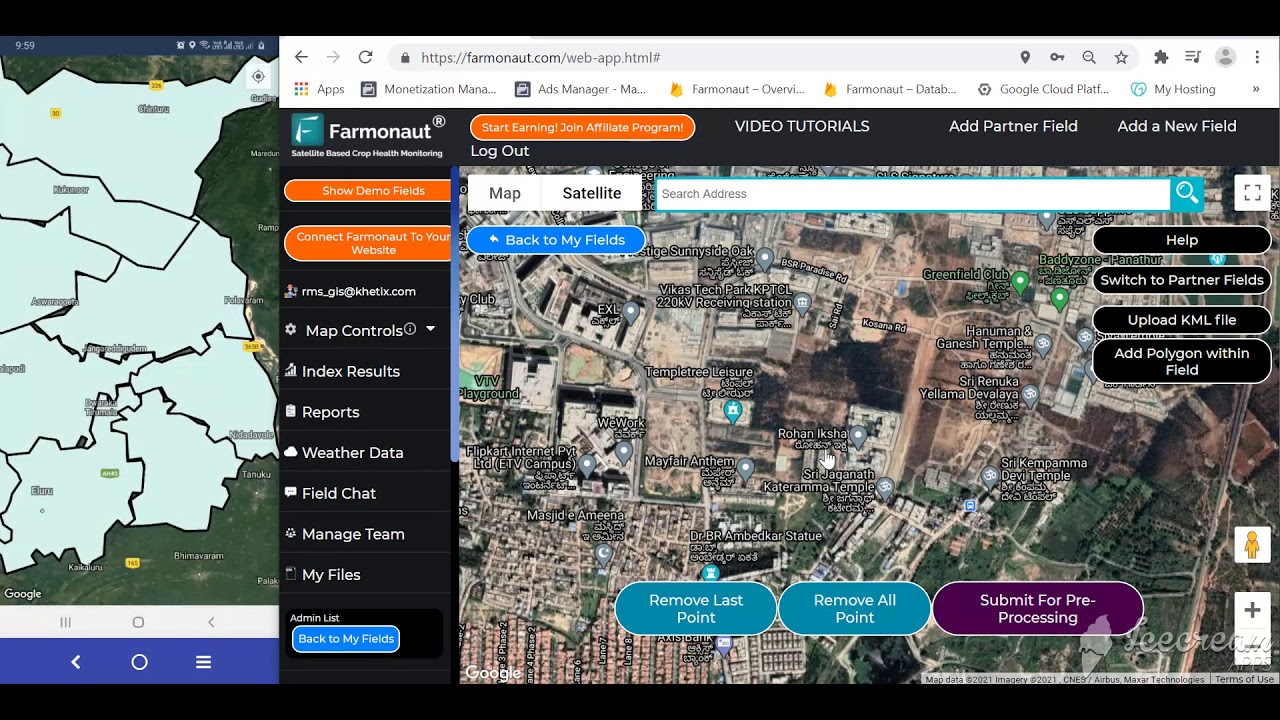
Whatever financing route you use, a lender’s confidence in the loan rises with independent, verifiable evidence of what’s actually happening on the acreage. Farmonaut’s satellite monitoring platform gives buyers, hemp producers, and lenders a way to document that without a site visit for every check-in:
- Field and soil monitoring: multispectral satellite imagery tracks crop health, soil moisture, and field boundaries over time — useful evidence for both hemp compliance records and loan-servicing check-ins. See Farmonaut’s carbon footprinting tools for the sustainability side of that monitoring.
- Loan and insurance documentation: satellite-verified acreage and crop status can support the paperwork a lender or insurer requests. Learn more via Farmonaut’s crop loan and insurance page.
- Traceability records: Farmonaut’s blockchain-based traceability platform and product traceability tools support the record-keeping a hemp license renewal or a lender’s compliance audit will ask for.
- Large-scale operations: the Farmonaut Large Scale Farm Management App consolidates monitoring across multiple tracts for buyers assembling several parcels under one loan.
- Fleet and equipment tracking: lower operating costs strengthen a loan application’s cash-flow projection; see Farmonaut fleet management.
- Developer access: lenders and insurers building their own underwriting tools can pull real-time satellite and weather data through the Farmonaut API, documented at the API developer docs.
None of this replaces a TDA license, an FSA loan officer, or a title company — it supplements the paper trail all three eventually ask for.


Farmonaut Subscription Plans
Choose a Farmonaut subscription plan that matches your scale — individual, business, or institutional. Pricing is scaled so you pay for the monitoring capacity you actually use, whether that’s a single tract or a multi-parcel loan portfolio.
FAQs: Land Loans Texas and Texas Hemp Law
-
Q: How do land loans work in Texas?
A: A lender pre-qualifies the borrower on credit and income, orders an appraisal that classifies the land use, reviews title and water rights, then sets a down payment based on loan type — 20-50% for conventional Farm Credit financing, 5% under the FSA Down Payment Program, or 15% equity under a TAFA-guaranteed loan. -
Q: Is there really a 10% down payment option for land loans in Texas?
A: No single program guarantees exactly 10% down. FSA’s Down Payment Program can require as little as 5%, while conventional lenders like Texas Farm Credit typically require 20-50% for raw or rural land. “10% down” is a rounded reference point, not a fixed Texas rule. -
Q: What changes for a raw land loan in Texas?
A: Raw, unimproved land carries no structure as collateral, so lenders confirm access, utilities, and water rights separately, and often shorten the amortization or require the higher end of the down payment range compared with land that already has improvements. -
Q: What is a hemp loan?
A: There’s no distinct “hemp loan” product at most banks. Licensed hemp producers use the same FSA operating, ownership, beginning-farmer, and storage facility loans available to any row-crop farmer, plus USDA’s hemp crop insurance pilot or NAP disaster coverage where the pilot isn’t offered. -
Q: Do I need a hemp license before a lender will approve a land loan for hemp?
A: Most lenders and FSA offices ask for the current TDA Producer License number and Lot Crop Permit before releasing funds tied to hemp acreage, since it confirms the crop is legally being grown under the state’s THC-testing framework. -
Q: What THC level makes a crop legally hemp in Texas?
A: No more than 0.3% delta-9 THC on a dry-weight basis, consistent with Texas Health and Safety Code Chapter 443. Crops sampled above that threshold are subject to destruction under TDA rules. -
Q: Where can I check the current interest rate for FSA farm loans?
A: FSA republishes its rate sheet, including the Direct Farm Ownership and Down Payment Loan rates, on its own current-rates page — check that page directly rather than any figure printed in an article, since it updates on a rolling basis.
Conclusion
Land loans in Texas don’t run on a single down payment number — they run on a spread from 5% (FSA’s beginning-farmer program) through 15% equity (TAFA’s guarantee) to 20-50% (conventional Farm Credit financing for raw acreage), and the right one depends on whether you qualify as a beginning farmer, whether a participating bank will use the TAFA guarantee, and how the land itself is classified. Layer hemp cultivation on top, and a valid TDA Producer License, a current Lot Crop Permit, and proof of THC-compliant sampling become part of the loan file, not a separate process.
The figures in this guide carry their source and check-date for a reason: FSA rates, TAFA tiers, and TDA fee schedules are all revised on their own timelines. Before you sign anything, pull the current numbers from the FSA rates page, the TAFA program page, and the TDA Hemp Program page linked above, then run them through the calculator to see what actually applies to your purchase.
Explore more Texas agriculture context at Farmonaut’s Texas agriculture trends guide, and visit Farmonaut.com for the full range of satellite monitoring tools referenced throughout this guide.

 Godrej Agrovet
 Hayleys Agriculture
 Linx Agritech
 Adinet
 Save Your Soils
 GalaxEye Space
 Grandstream Algérie
 XOS Realty
 Geospatial Lab Africa
 Agro La Gándara
 HIPSAC
 ZOL Zimbabwe
 Juligerm
 AdBio
AdBio MISE Maroc
 NWNS
NWNS Red August Group
 Farm Inc
 WeMe Global
 Agrotoken
 Blue BearX
 Insignito
 DnCubed
 Indosistim Teknologi
 Liquify Digital
 CU Foods
 BeyondTech Global
 Rouge VC
 AgroRisk
 Oath Inc
 Esri North East Africa
 MDCV UK
 Etech Consulting Madagascar
 Vestlandsforsking
 WB Dev
 Sama Premium
 Tres Valles
 Blickwinkel
 Agricultural Credit Policy Council
 eKGIS
eKGIS Mostas Tech
 Andex
Andex Deluxe Conseil
 WICO
WICO Chimera Innovation
 SkyHarvest
 Teledarbas
 Exurbia Geospatial
 FieldZero
