

Irrigated Farmland in Tennessee: Preservation Act & 2025 Data
Reviewed February 2025 against USDA NASS Quick Stats, the Tennessee Governor’s Office, and the Tennessee Department of Agriculture.
Try it: Enter your numbers above to see an estimate. →
Tennessee farmland is being converted to non-agricultural use at roughly 240 acres a day, and the state’s new Farmland Preservation Act now offers a $25 million fund to pay eligible farmers to keep land in agriculture permanently. If you searched for irrigated farmland in Tennessee, Tennessee farm land, or a conservation easement in TN, this article covers what the land base actually looks like today, what the Act does, who qualifies, and how to check whether your county or your specific parcel is a fit.

Table of Contents
- Tennessee’s Farmland, By the Numbers
- Why Tennessee Is Losing Farmland
- What the Farmland Preservation Act Actually Does
- Conservation Easements in Tennessee: How They Work
- How This Fits the National “Farmland Preservation Act” Conversation
- Irrigated Farmland in Tennessee
- TN Farm Link and Other Land-Access Programs
- Calculator: Estimate Your Easement Payment Range
- Where Satellite Monitoring Fits
- FAQ
- Try it: Enter your numbers above to see an estimate.
Tennessee’s Farmland, By the Numbers
USDA’s National Agricultural Statistics Service (NASS) counted 62,500 farm operations in Tennessee in 2025, working a combined 10,700,000 acres, for an average farm size of 171 acres. That land base underpins commodity production worth hundreds of millions of dollars a year: soybeans at $683 million, corn at $616 million, and hay at $552 million in the 2025 marketing year, according to NASS’s state overview. These three crops alone account for close to $1.85 billion in production value, which is the economic argument behind every acre the state is trying to keep in agriculture rather than losing to development.
These figures update monthly in NASS Quick Stats as preliminary marketing-year estimates come in, then get finalized annually after harvest. The next full agricultural census lands in 2027. For the current farm count, acreage, and commodity values whenever you’re reading this, go straight to the source: USDA NASS Tennessee State Overview.
Why Tennessee Is Losing Farmland
The Tennessee Department of Agriculture puts the current loss rate at 240 acres of agricultural and forest land per day. Over the 30 years from 1994 to 2024, that added up to 1.2 million acres converted out of farming — roughly 11% of the state’s present-day farmland base gone in three decades. Left unchecked, the department projects the state could lose 2 million acres by 2027, which is why the loss-rate figure, not a single year’s snapshot, is the number to track.
Development pressure concentrates around Tennessee’s growth corridors — the Nashville metro’s outward expansion, the Knoxville-to-Chattanooga I-75 corridor, and the fringes of Memphis — where farmland sits closest to subdivisions, warehouses, and highway interchanges. That’s also where conservation easements do the most good, because land near a growth boundary is exactly the land at the highest near-term risk of conversion. The department’s page on preservation options lays out the full menu of tools counties and landowners can use: Tennessee Department of Agriculture: farmland preservation options.
What the Farmland Preservation Act Actually Does
Governor Bill Lee signed the Tennessee Farmland Preservation Act into law on May 12, 2025. The Act’s centerpiece is a $25 million appropriation in the state’s FY25-26 budget for a farmland preservation fund, administered by the Tennessee Department of Agriculture, that pays farmers who volunteer to place permanent conservation easements on their property. The signing announcement and the fund amount are documented directly by the Governor’s office: Governor Lee signs Farmland Preservation Act into law.
Four provisions define the law:
- $25 million grant fund for farmers who voluntarily place conservation easements on their land, funded in the FY25-26 state budget.
- Permanent easements. Earlier drafts of the bill considered term-limited easements; the enacted version makes them permanent, so protection doesn’t lapse after a set number of years.
- Qualified easement holders — organizations with 501(c)(3) tax-exempt status can hold easements acquired by purchase, donation, or transfer, and are barred from selling or divesting them once held.
- Lending assurances. The lending industry provided assurances that farmers can still borrow against mortgages on land placed under a permanent easement, which was the main sticking point that had stalled earlier versions of the bill.

What the Act does not yet specify publicly is the per-easement grant amount — how the $25 million gets divided among applicants, whether it’s a flat per-acre rate or a competitive scoring process, and what the application cycle looks like. Because the law was only signed in May 2025, program design details of that kind may not be published yet. If you’re evaluating whether to apply, the Tennessee Department of Agriculture’s farmland heritage page is the place to check for the current program rules rather than relying on a rewritten article to have kept pace: Tennessee Department of Agriculture: options page.

Conservation Easements in Tennessee: How They Work
A conservation easement is a voluntary, legally recorded agreement between a landowner and a qualified holder — a land trust, a government agency, or another 501(c)(3) — that permanently restricts non-agricultural development on the property while ownership stays with the farmer. The land can still be farmed, sold, or passed to heirs; what changes is that future owners inherit the same restriction.
Under the new Act, three features distinguish Tennessee’s approach from a generic easement program:
| Feature | Before the Act | Under the Farmland Preservation Act |
|---|---|---|
| State grant funding for easements | $0 dedicated state fund | $25 million (FY25-26 budget) |
| Easement duration | Varied by holder; not standardized | Permanent, by statute |
| Eligible easement holders | Ad hoc, no statutory definition | Defined “qualified easement holders” with 501(c)(3) status |
| Mortgage lending on eased land | Uncertain, case-by-case with lenders | Formal assurances from the lending industry |
| Statewide loss rate the program targets | 240 acres/day, unaddressed by state policy | 240 acres/day, now with a funded countermeasure |
What’s genuinely not known yet at the state level — and worth naming plainly rather than guessing — is how many acres are currently under conservation easement in Tennessee and how many easements the state’s land trusts collectively hold. National aggregate figures exist through federal programs like ACEP, but a Tennessee-specific count of enrolled acreage or number of easements held by nonprofits hasn’t been compiled into one public source. If that number matters to your decision, the most reliable path is contacting the Tennessee Department of Agriculture or a Tennessee-based land trust directly and asking for their current enrollment figures, rather than trusting a statewide estimate that may be out of date by the time you read it.
Qualified Easement Holders: What “501(c)(3)” Means Here
The Act restricts who can legally hold a permanent easement to organizations with federal 501(c)(3) tax-exempt status — typically land trusts, agricultural heritage nonprofits, or government conservation agencies. Once such an organization holds an easement, it’s prohibited from selling or divesting it, which is the legal mechanism that makes “permanent” actually permanent: the restriction can’t be undone by a future change in the holder’s priorities or finances.
How This Fits the National “Farmland Preservation Act” Conversation
Searches for “land preservation act,” “farm preservation act,” and “farmland preservation act” often aren’t Tennessee-specific — several states have passed similarly named laws, and there have been federal proposals using close variants of the name. Tennessee’s version, signed May 12, 2025, is distinct in three ways worth checking against any other state or federal bill you’re comparing it to: the $25 million dedicated fund size, the permanence of the easement (not time-limited), and the explicit lending-industry assurance clause that resolved the mortgage-borrowing concern that had stalled the bill in earlier sessions.
If you landed here searching for a different state’s farmland or land preservation act, the mechanism — permanent conservation easement, administered grant fund, qualified nonprofit holders — is common across most state programs, but the dollar amounts, eligibility rules, and administering agency are state-specific. Confirm you’re looking at Tennessee’s Department of Agriculture program, not a similarly named bill elsewhere, before applying.
Irrigated Farmland in Tennessee
Tennessee’s irrigated acreage has historically been small relative to states in the arid West, because the state’s row crops — soybeans, corn, hay — are grown predominantly under rainfed conditions on the strength of the Mid-South’s average annual precipitation. The USGS’s national irrigation water-use dataset, the most complete cross-state source for this figure, stops at 2017, and NASS’s more recent special surveys on irrigation don’t appear to have a published Tennessee-specific update since then. That’s a genuine gap rather than a number we can round to: if you need current irrigated-acreage figures for Tennessee — for a land purchase, a water-rights filing, or a grant application — the most reliable path is a direct data request to USDA NASS’s Tennessee field office or the state’s most recent Census of Agriculture irrigation survey (next full census in 2027), rather than a recycled 2017 estimate.
What is verifiable now is the acreage context irrigation sits inside: 10,700,000 total farmland acres across 62,500 operations averaging 171 acres each, per NASS’s 2025 state overview. Most of that land supports the soybean, corn, and hay production valued at $683 million, $616 million, and $552 million respectively — production that in Tennessee’s climate is overwhelmingly rain-fed, with irrigation concentrated on higher-value specialty acreage rather than row-crop staples. For farmers evaluating whether investing in irrigation infrastructure makes sense on land that may also be a candidate for a conservation easement, it’s worth noting the easement itself doesn’t prohibit irrigation improvements — the restriction targets non-agricultural development, not on-farm infrastructure that supports continued farming.
Explore Farmonaut’s API for advanced agricultural data integration
TN Farm Link and Other Land-Access Programs
Separate from the easement fund, Tennessee also runs land-access and farm-transition programs aimed at connecting retiring farmers or landowners with new or expanding farm operators — a different problem from conversion loss, but one that intersects with preservation goals, since land that transitions to a new farmer stays in agriculture rather than being sold for development. If you’re searching for how to find farmland to lease or buy in Tennessee, or how to list land you want to keep in production, the Tennessee Department of Agriculture’s heritage and farmland legacy page is the starting point for both the easement program and land-linking resources: Tennessee Department of Agriculture farmland legacy options.

The Economic Case for Keeping Land in Production
Agriculture is Tennessee’s largest industry by land footprint, and the commodity values above make the stakes concrete: $683 million in soybeans, $616 million in corn, and $552 million in hay in the 2025 marketing year, per NASS. Every acre converted to a subdivision or a distribution center removes that acre permanently from the production base — unlike a bad growing season, conversion doesn’t come back. The economic argument for the $25 million fund is straightforward: an easement payment is a one-time cost against a permanent loss, while the 1.2 million acres already lost between 1994 and 2024 represent lost production capacity the state can’t recover through any policy.
Beyond direct production value, preserved farmland carries knock-on benefits that don’t show up in a commodity report: rural property tax base stability, continued demand for farm inputs and services in small towns, and — as referenced in ecosystem-services research — watershed and soil functions that intact agricultural land provides relative to paved development.
Calculator: Estimate Your Easement Payment Range
The state hasn’t published a per-acre grant formula yet, so this tool doesn’t predict an official number — it lets you model a plausible payment range using your own acreage and a per-acre rate you set, so you can see how sensitive your total is to the assumption once the Department of Agriculture publishes actual terms.
Enter your numbers above to see an estimate.
Assumptions and limits: the per-acre rate and fund-share percentage are user-set placeholders, not published state figures — the Tennessee Department of Agriculture has not yet released the fund’s per-easement formula. This tool excludes application scoring, appraisal-based valuation, and any local or federal cost-share stacking. Use it to compare scenarios, not to estimate an actual award; confirm current terms with the Department of Agriculture before applying.
Where Satellite Monitoring Fits
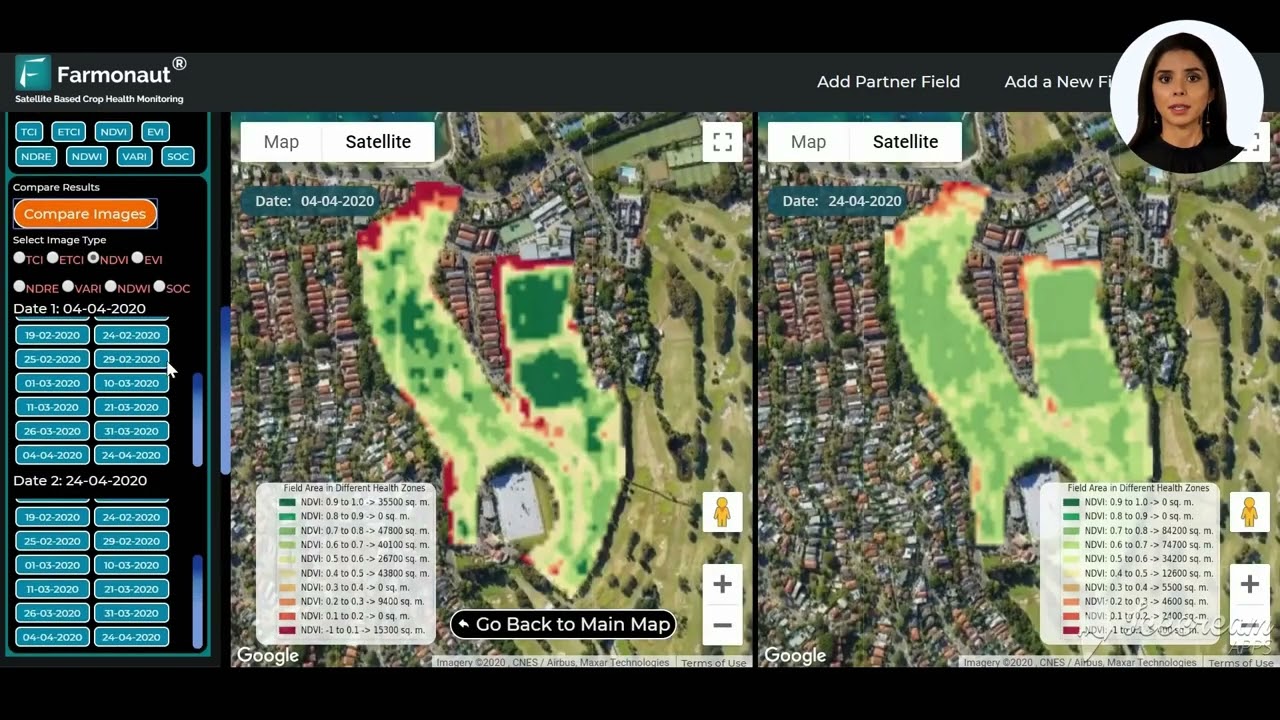
Placing land under a permanent easement changes its legal status, not its need to be farmed productively — the Act protects the acreage from conversion, but the economic case for preservation still depends on that land staying viable to farm. Satellite-based crop monitoring is one tool for maintaining that viability on land that’s now committed for the long term:
- Crop health monitoring: Vegetation-index imagery flags stress from drought, pests, or nutrient deficiency early enough to act on it, which matters more, not less, once land can no longer be sold off and replaced with a different parcel.
- Resource-use tracking: Monitoring water and fertilizer application against actual crop need helps hold input costs down on land that’s now a permanent fixture of the operation.
- Land-use change detection: The same satellite imagery used for crop monitoring can also verify, over time, that an eased parcel hasn’t been converted — useful both for easement holders doing compliance checks and for the state tracking whether the 240-acre-a-day loss rate is actually slowing.

How to Check Whether You Qualify — A Durable Checklist
Because program specifics will be finalized and updated after this article is written, use this sequence to verify your own eligibility rather than relying on any single year’s summary:
- Confirm your land is in active agricultural use. The easement program targets working farmland, not idle or already-developed parcels.
- Check current fund status and application windows directly on the Tennessee Department of Agriculture’s site, since a $25 million fund can close to new applications once allocated.
- Identify a qualified easement holder — a 501(c)(3) land trust or eligible agency operating in your county — since the state fund works through these intermediaries, not as a direct-to-farmer payment in most models.
- Talk to your lender before signing anything. The Act includes lending-industry assurances, but confirm in writing with your specific mortgage holder how a permanent easement affects your existing loan terms.
- Get an independent easement valuation. Grant amounts typically relate to the appraised value of the development rights being extinguished, not a flat statewide rate — treat any per-acre number you see quoted, including the one in the calculator above, as illustrative until your own appraisal comes back.
Re-run this checklist whenever you’re evaluating an offer, rather than trusting that whatever dollar figures or fund status you read here still hold — the source pages linked throughout this article are built to be checked directly, and the department’s rules are what govern, not this summary of them.
FAQ: Tennessee Farmland Preservation
Q1: What is the Tennessee Farmland Preservation Act?
A1: A law signed by Governor Bill Lee on May 12, 2025, that creates a $25 million grant fund for farmers who place permanent conservation easements on their land, administered by the Tennessee Department of Agriculture.
Q2: How much farmland is Tennessee losing?
A2: The Tennessee Department of Agriculture reports a current loss rate of 240 acres of agricultural and forest land per day, totaling 1.2 million acres lost between 1994 and 2024, with a projected 2 million acres lost by 2027 if the trend continues.
Q3: How much irrigated farmland does Tennessee have?
A3: There isn’t a current published figure — the USGS national irrigation dataset stops at 2017 and hasn’t been superseded by a Tennessee-specific update since. Tennessee row-crop production is predominantly rainfed; for a current number, request data directly from USDA NASS’s Tennessee field office.
Q4: Are Tennessee’s conservation easements permanent?
A4: Yes. Unlike earlier draft versions of the bill that considered term-limited easements, the enacted Act makes easements permanent by statute.
Q5: Who can hold a conservation easement under the Act?
A5: “Qualified easement holders” — organizations with 501(c)(3) tax-exempt status that acquire easements by purchase, donation, or transfer, and that are legally barred from selling or divesting them.
Q6: Can I still borrow against a mortgage on land under easement?
A6: The Act incorporates assurances from the lending industry addressing this specifically, since it was the main concern that had stalled earlier versions of the bill. Confirm current terms with your own lender before signing.
Q7: How big is Tennessee’s farm sector?
A7: 62,500 farm operations working 10,700,000 acres in 2025, averaging 171 acres per farm, per USDA NASS.
Q8: What crops drive Tennessee’s farm economy?
A8: Soybeans ($683 million), corn ($616 million), and hay ($552 million) were the top production values in the 2025 marketing year, per NASS.
Q9: What is TN Farm Link?
A9: A land-access resource connecting landowners and new or transitioning farm operators, separate from the easement fund but listed alongside it on the Tennessee Department of Agriculture’s farmland legacy page.
Q10: Where do I check the current status of the $25 million fund?
A10: Directly on the Tennessee Department of Agriculture’s website, since application windows and remaining fund balance change after this article is published.
Earn With Farmonaut
Earn 20% recurring commission with Farmonaut’s affiliate program by sharing your promo code and helping farmers save 10%. Onboard 10 Elite farmers monthly to earn a minimum of $148,000 annually—start now and grow your income!
Learn more about our affiliate program
Farmonaut Subscriptions
Access our API Developer Docs for detailed integration guides

 Krishi GK
 Geno
Geno Hayleys Agriculture
 Linx Agritech
 Adinet
 Save Your Soils
 Grandstream Algérie
 XOS Realty
 Geospatial Lab Africa
 Agro La Gándara
 HIPSAC
 ZOL Zimbabwe
 Juligerm
 AdBio
AdBio MISE Maroc
 NWNS
NWNS

What kind of program do you offer to help purchase farmland in order to preserve it?