

Farm finance · USDA programs
Beginning Farmer Grants and Loans: 7 USDA Programs
USDA treats anyone farming for 10 years or less as a beginning farmer. In fiscal year 2025, FSA made 15,552 loans worth US$3.53 billion to beginning farmers (Farm Bureau). Here are the seven programs that help most, with 2026 limits and how to apply.
Key takeaways
- Beginning farmers received about 56% of FSA farm loans and 52% of loan dollars in fiscal year 2025 (American Farm Bureau Federation).
- FSA microloans go up to US$50,000; direct ownership loans up to US$600,000 and direct operating loans up to US$400,000 (FSA fact sheet, 2026).
- The Down Payment Program needs 5% down; FSA lends up to 45% of the price, capped at US$300,150, at a rate 4 points below the direct rate with a 1.5% floor.
- Beginning farmers can get an EQIP advance of at least 50% of the payment before starting a practice (NRCS).
- The FY2026 Value-Added Producer Grant round offered about US$25 million, with grants up to US$200,000 and a dollar-for-dollar match.
In this article
- Beginning farmer grants and loans at a glance
- Who counts as a beginning farmer
- The 7 USDA programs for beginning farmers, ranked
- Down payment calculator for a first farm
- How to apply for beginning farmer grants, step by step
- Loans or grants: where the money for new farmers goes
- Using farm records and field data in applications
- How we checked the numbers
- FAQ
Beginning farmer grants in 2026 come mainly from the USDA, but most of the money a new farmer can use directly comes as low-interest loans and conservation cost-share, not as cash grants. USDA counts anyone who has run a farm or ranch for 10 years or less as a beginning farmer, according to farmers.gov. In fiscal year 2025 the Farm Service Agency (FSA) made 15,552 loans worth US$3.53 billion to beginning farmers, about 56% of all its farm loans, as reported by the American Farm Bureau Federation.
This guide ranks the seven USDA programs a first-time farmer can apply for, shows which ones pay cash and which ones lend, and explains how to apply step by step. It also has a down payment calculator for the FSA program that lets a beginning farmer buy land with 5% down.
Beginning farmer grants and loans at a glance
The table sums up the seven programs. “Pays” shows whether you get a grant, a cost-share payment or a loan. Amounts are the limits USDA published for 2026; your award depends on your plan, your state and the funding left in each round.
| Program | Pays | Limit (2026) | Best for |
|---|---|---|---|
| FSA Microloan | Loan | US$50,000 operating, US$50,000 ownership | Small and starting farms |
| FSA beginning loans | Loan | US$600,000 direct ownership, US$400,000 direct operating | Buying land or a bigger start |
| EQIP | Cost-share | Set per practice by each state | Fencing, water, cover crops, high tunnels |
| CSP | Annual payment | Five-year contracts | Farms that already conserve |
| VAPG | Grant | US$200,000 working capital, US$50,000 planning | Selling a processed or branded product |
| REAP | Grant and loan guarantee | Share of project cost | Solar, efficient dryers, pumps |
| BFRDP training | Grant to trainers | Paid to organizations | Low-cost courses and mentoring |
Two points surprise many new farmers. First, the USDA’s best-known “beginning farmer grant”, the Beginning Farmer and Rancher Development Program, pays organizations that train farmers, not farmers themselves. Second, a grant almost always needs matching money or a loan behind it, so the loan programs matter as much as the grants.
Who counts as a beginning farmer
USDA uses one simple test across agencies: you have operated a farm or ranch for no more than 10 years. Each program then adds its own rules. FSA, for example, says in its beginning farmer loan fact sheet that for farm ownership loans you cannot already own a farm larger than 30% of the average farm size in your county, and you must take part in running the farm.
▶ Ten small agriculture business ideas for people starting without a farm. · 6:03
You are not alone. The 2022 Census of Agriculture counted 1,011,715 new and beginning producers, up from 908,274 in 2017. Their average age was 47.1 years, and nearly one in four was under 35, as Investigate Midwest summarised from the census in July 2026. The same report says 72% of beginning producers had a main job other than farming. That matters for applications: off-farm income can help you qualify for a loan, and many programs accept part-time farmers.
Women made up 41% of beginning producers in 2022, compared with 36% of all producers. Military veterans who are starting out can use the same programs and, in some cases, extra set-asides.
Chart
New and beginning producers in the US
Number of producers farming 10 years or less, Census of Agriculture
The 7 USDA programs for beginning farmers, ranked
We ranked the programs by how directly a first-time farmer can use the money for their own farm, then by the size of the support. The method is explained in the “How we checked the numbers” section further down.
Chart
Beginning farmers’ share of FSA lending
Percent going to beginning farmers, fiscal year 2025
1. FSA Microloans
Best for: small farms, market gardens and first-year operations that need under US$50,000.
Operating Microloans lend up to US$50,000 per loan for seed, livestock, small equipment, fencing and other start-up costs, according to the FSA microloan page. Repayment terms run from one to seven years, depending on the purpose. A separate farm ownership microloan of up to US$50,000 can help buy land or pay for buildings. The application is shorter than for a standard FSA loan, and the agency accepts some non-traditional farm experience, such as a mentorship or a small business you ran before.
Microloans suit people who cannot get enough credit from a bank yet. They are loans, so you repay them with interest, with rates set by FSA each month.
2. FSA beginning farmer loans and the Down Payment Program
Best for: buying your first farm or financing a larger start.
Each year Congress sets aside part of FSA’s loan money for beginning farmers. The limits in the FSA fact sheet are US$600,000 for a direct farm ownership loan and US$400,000 for a direct operating loan. Guaranteed loans, made by a bank with FSA backing, go up to US$2,343,000 combined, and FSA can guarantee up to 95% of the loan for some beginning farmers instead of the usual 90%.
The Down Payment Program is the strongest tool for buying land. You pay at least 5% of the price in cash. FSA lends up to 45% of the lesser of the price, the appraised value or US$667,000, so its share is capped at US$300,150. The FSA loan runs for 20 years at 4 percentage points below the direct farm ownership rate, but never below 1.5%. A bank or the seller finances the rest. In a joint financing plan, FSA lends up to 50% of the amount financed at 2 percentage points below the direct rate, but not below 2.5%.
Beginning farmers received about 65% of FSA’s direct farm ownership loans and 55% of its direct operating loans in fiscal year 2025, according to the Farm Bureau analysis. The chart shows how large that share is.
Congress is debating higher limits. The farm bill draft called the Agricultural Act of 2026 would raise the direct farm ownership limit to US$850,000, the direct operating limit to US$750,000 and microloans to US$100,000, the Farm Bureau reports. Until a new law passes and FSA updates its rules, the current limits apply.
Down payment calculator for a first farm
Use this calculator to test the FSA Down Payment Program on a farm you are looking at. Put in the price, today’s FSA direct farm ownership rate and the rate your bank offers. The example numbers are set close to break-even on purpose; they are not a forecast. Compare the yearly loan payments with the cash your farm and off-farm jobs can spare after living costs.
The calculator follows the FSA fact sheet: 5% down, an FSA share of 45% of the price up to US$667,000, a 20-year FSA term and an FSA rate 4 points below the direct rate with a 1.5% floor. Check current rates with your local FSA office, and get professional financial advice before you sign.
3. Environmental Quality Incentives Program (EQIP)
Best for: paying part of the cost of fencing, water lines, cover crops, high tunnels and other conservation work.
EQIP is run by the Natural Resources Conservation Service (NRCS). It pays a set rate for each conservation practice you install. Applications are accepted all year and ranked in batches. Beginning farmers count as “historically underserved”, which brings two benefits. You can get a higher payment rate, and you can ask for an advance of at least 50% of the payment before you start the work, according to the NRCS advance payment guide. The advance must be spent within 90 days.
NRCS gives an example: a beginning farmer plants cover crops on 40 acres at US$56.81 per acre, a contract worth US$2,272.40, and can take US$1,136.20 up front. Payment rates differ by state. Pennsylvania’s FY2026 list, for instance, caps cover crop payments at US$40,000 per contract and fencing at US$75,000, according to the NRCS Pennsylvania bulletin. Ask your local NRCS office for your state’s list.
4. Conservation Stewardship Program (CSP)
Best for: farms that already use good conservation practices and want to add more.
CSP pays you each year to keep up the conservation you already do and to add new practices. Contracts last five years, and you can compete to renew, according to the NRCS CSP page. You need control of the land for the full contract term, so a short lease may not qualify. CSP fits a new farmer who has run the land for a season or two and can show what is already in place.
5. Value-Added Producer Grant (VAPG)
Best for: turning your crop or livestock into a product you sell yourself, such as cheese, flour, jam or packaged meat.
VAPG is a true cash grant from USDA Rural Development. For FY2026, about US$25 million was available, with a maximum of US$200,000 for working capital and US$50,000 for planning, according to the VAPG fact sheet. At least 10% of funds are reserved for groups that include beginning farmers and ranchers. You must match the grant at least dollar for dollar, so half of the project cost comes from you. The FY2026 round closed on 22 April 2026; watch for the next round early in the calendar year.
6. Rural Energy for America Program (REAP)
Best for: cutting energy bills with solar panels, efficient grain dryers, pumps or lighting.
REAP, also run by USDA Rural Development, combines grants with loan guarantees for renewable energy systems and energy efficiency upgrades on farms and rural small businesses. The grant pays only part of the project cost, so plan to fund the rest. Because funding rounds open and close, check the current window with your state Rural Development energy coordinator before you get quotes.
7. Training funded by the Beginning Farmer and Rancher Development Program
Best for: low-cost courses, mentoring and business planning help in your first years.
The National Institute of Food and Agriculture runs BFRDP. It funds universities, extension services and non-profits that train beginning farmers. NIFA notes that over one-third of the 3.4 million US farmers are over 65, which is why the program exists. You cannot apply for BFRDP money as an individual farmer, but you can join the courses it pays for. Ask your extension office which BFRDP projects run in your state.
If you want to test a new idea on your farm, the USDA-funded SARE program offers farmer and rancher grants for research and education projects. SARE says its grants cannot be used to start a farm or to buy land or large equipment.
Try the numbers for your own farm below.
Calculator
FSA Down Payment Program: yearly payments
Enter a farm price, today’s rates and the cash your farm can spare each year.
- Your 5% cash down payment: $20,000
- FSA loan amount: $180,000
- FSA interest rate: 1.50 %
- FSA yearly payment: $10,484
- Bank or seller loan amount: $200,000
- Bank or seller yearly payment: $16,117
Rates are examples, use today’s rate. Example values only, set near break-even; not a quote or forecast. FSA share = 45% of the price up to US$667,000, 20-year term, rate = direct farm ownership rate minus 4 points (floor 1.5%), per the FSA fact sheet (January 2026). The rest is a bank or seller loan at your rate and term. Get professional financial advice and confirm rates with your FSA office.
How to apply for beginning farmer grants, step by step
Most programs share the same first steps. Doing them early saves weeks when a funding round opens.
- Get a farm number. Visit your local USDA Service Center and register with FSA. You need a farm number for FSA loans, EQIP and CSP.
- Call your Beginning Farmer and Rancher Coordinator. Every state has one, listed on farmers.gov. They tell you which programs fit your plan and when rounds open.
- Write a short business plan. Show what you will grow or raise, expected sales, costs and how you will repay any loan. FSA loans need a plan; VAPG asks for a plan that shows how the new product will sell.
- Show your experience. List farm jobs, training, mentoring and any business you have run. FSA looks at your management experience when it reviews a loan.
- Secure land access. A deed, a written lease or a purchase contract. CSP and EQIP need control of the land for the contract term.
- Ask NRCS for a conservation plan. NRCS staff visit the farm and plan practices with you at no charge. This plan is the basis of an EQIP or CSP application.
- Line up matching money. VAPG needs a cash match. REAP and EQIP pay part of the cost, so you fund the rest or borrow it.
- Track deadlines. EQIP and CSP rank applications in batches; VAPG and REAP have fixed windows.

▶ Six plain steps to start precision farming on a new farm, no robot needed. · 4:18
Loans or grants: where the money for new farmers goes
FSA obligated US$6.74 billion across 27,792 farm loans in fiscal year 2025, up 25% in dollars from the year before, the Farm Bureau analysis shows. Beginning farmers received more than half of the loans and dollars. By comparison, the whole FY2026 VAPG round, open to all eligible producers, had about US$25 million. Grants are worth applying for, but loans and cost-share do most of the work of starting a farm.
Chart
FSA direct loan limits: now vs proposed
Thousand US$ per borrower; proposal from the Agricultural Act of 2026 draft, not law
The number of beginning producers also grew between the last two censuses, so competition for grants is real. A clear plan, an NRCS conservation plan and early contact with your coordinator give a new application the best chance.
Using farm records and field data in applications
Grant and loan officers want proof that your plan is realistic. Good records help: yields by field, input costs, sales, and photos or maps of the work you did. For conservation contracts, NRCS checks that practices are installed and kept up, so dated records of cover crops, grazing and irrigation are useful.

▶ How satellite indices such as NDVI and EVI track crop health field by field. · 10:49
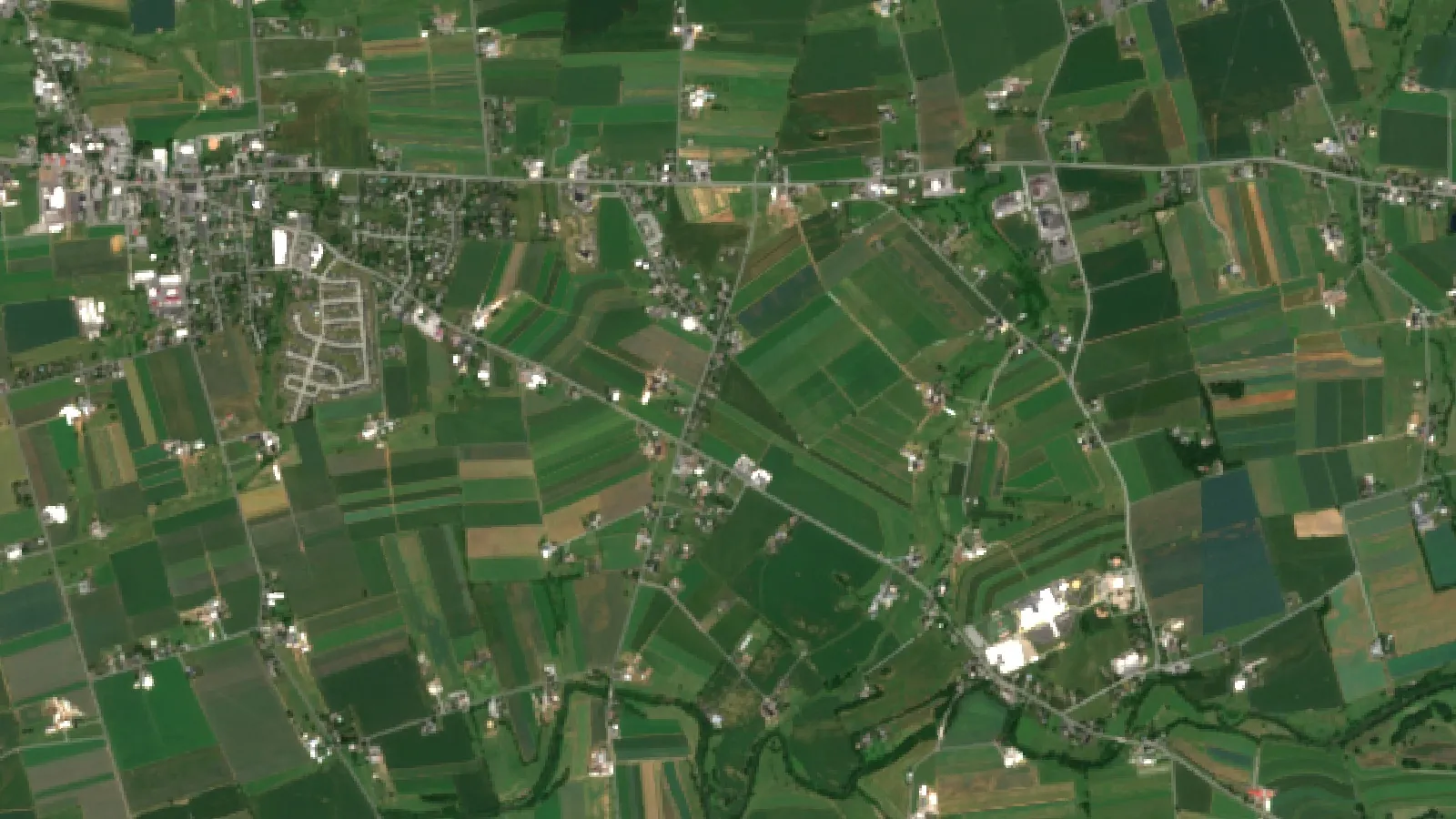
Satellite crop maps can add a season-long record of each field. Farmonaut’s Satellite + AI Farm Monitoring System shows vegetation maps of your own fields on web and phone apps, which some farmers use to keep a dated log of crop health. It does not replace the records USDA asks for, but it can support them.
Related pages on our site: satellite data for crop loans and insurance, carbon footprint tracking, farm product traceability, farm fleet management, large-farm admin dashboard, satellite and weather API docs, API access, mobile app download, wider guide to USDA grants and loans.
How we checked the numbers
We used USDA’s own pages and fact sheets for each program limit: FSA’s beginning farmer and microloan pages, the NRCS EQIP advance payment guide and Pennsylvania FY2026 payment list, the NRCS CSP page, the FY2026 VAPG fact sheet and the NIFA BFRDP page. Lending totals come from the American Farm Bureau Federation’s analysis of FSA data for fiscal year 2025. Census figures come from the 2022 Census of Agriculture, with the age, occupation and gender shares as reported by Investigate Midwest. Proposed new loan limits come from the farm bill draft and are not law. The Congressional Research Service’s comparison of the House and Senate farm bills tracks the draft. Programs were ranked by how directly a beginning farmer can use the money on their own farm, then by the size of the support.
The older version of this page listed the Agricultural Conservation Easement Program. We removed it because it pays to protect land, not to start a farm. We also removed grant ranges that USDA does not publish.
FAQ
Are there USDA grants to start a farm?
Few USDA grants pay start-up costs directly. Most help for a new farm comes as FSA loans, EQIP cost-share and grants for specific projects such as value-added products (VAPG) or energy upgrades (REAP). SARE farmer grants fund on-farm research, not start-up costs.
Who is a beginning farmer for USDA programs?
Anyone who has operated a farm or ranch for 10 years or less. Some programs add rules, such as FSA’s limit on how much land you already own.
How much can a first-time farmer borrow from FSA?
Up to US$50,000 per microloan, US$400,000 as a direct operating loan and US$600,000 as a direct farm ownership loan. Under the Down Payment Program, FSA’s share is capped at US$300,150. These are the limits FSA published for 2026.
Can I get an EQIP payment before I do the work?
Yes. Beginning farmers can ask for an advance of at least 50% of the payment for each practice and must spend it within 90 days.
Do part-time farmers qualify?
Often yes. Many beginning producers have an off-farm job. FSA loans need you to take part in running the farm, and each grant program sets its own income and eligibility rules.
When do the next funding rounds open?
EQIP and CSP accept applications all year and rank them in batches. VAPG’s FY2026 round ran from January to April 2026. REAP windows vary, so ask your state Rural Development office.
Farmonaut crop monitoring
Keep a season-long record of every field
Draw your fields once and Farmonaut shows satellite crop health maps for them through the season, on web, Android or iOS.




Sources
- USDA farmers.gov, Beginning Farmers and Ranchers: farmers.gov
- American Farm Bureau Federation, Financing the Farm: A Look at USDA Farm Loan Programs (2026): fb.org
- USDA FSA, Farm Loans for Beginning Farmers and Ranchers fact sheet (January 2026): fsa.usda.gov
- Investigate Midwest, Most of America’s beginning farmers don’t farm full time (July 2026): investigatemidwest.org
- USDA FSA, Microloans: fsa.usda.gov
- USDA NRCS, EQIP Advance Payment Option: nrcs-prod.azureedge.us
- USDA NRCS Pennsylvania, Bulletin 440-26-06: FY2026 EQIP and CSP cost list and payment caps: nrcs-prod.azureedge.us
- USDA NRCS, Conservation Stewardship Program: nrcs-prod.azureedge.us
- USDA Rural Development, Value-Added Producer Grant FY2026 fact sheet: farmers.gov
- USDA NIFA, Beginning Farmer and Rancher Development Program: nifa.usda.gov
- SARE, Grants: sare.org
- Congressional Research Service, The 2026 Farm Bill: Comparison of the House and Senate Bills with Current Law (R48918): everycrsreport.com
- 2022 Census of Agriculture: nass.usda.gov
Discussion
Questions, corrections or field experience? Share them below. First-time comments are reviewed before they appear, and your email is never published.
No comments yet. Be the first to add a question or your experience.

 Nale Network
 Exurbia Geospatial
 FieldZero
 Indico Company
 Kubota
 FFBS
 Jontra
 Kalustyan
 Tucor
 Geno
 Hayleys Agriculture
 Linx Agritech
 Adinet
 Save Your Soils

 Licence holder · Niger · Gold
 Client · Tanzania · Gold
 Client · Somalia · Gold
 Client & affiliate partner · Ghana · Gold










