

Urban farming · Funding guide
USDA Urban Agriculture Grants: Status and Alternatives
The most recent USDA urban agriculture (UAIP) grant awards we found were in 2024. Congress set aside $7 million for fiscal 2025 and $5 million for 2026, but none had been offered by late September 2026. Below: what changed, which grants, loans and cost-share still open, and how to apply.
Key takeaways
- OUAIP has awarded nearly 200 UAIP grants since 2020; USDA counted $53.7 million in UAIP grant projects by January 2025 (USDA, Jan 2025; NSAC, Oct 2026).
- The fiscal 2025 call was withdrawn in spring 2025, and the $12 million appropriated for fiscal 2025 and 2026 had not been released as of 29 September 2026 (Civil Eats).
- Only local governments, schools, tribes, public housing authorities and nonprofits can apply for UAIP; individual and for-profit farms cannot (USDA FAQ, fiscal 2025).
- Farmers can still use FSA microloans of up to $50,000 (5.375% operating rate on 1 October 2026), NRCS EQIP high tunnel cost-share and SARE farmer grants.
- NIFA’s urban agriculture ($50,000-$500,000) and Community Food Projects ($25,000-$400,000) rounds ran in 2026 and closed in July.
In this article
- USDA urban agriculture grants and other routes at a glance
- What the USDA urban agriculture grant program paid for
- What changed for urban farm funding, date by date
- Other grants for urban farming that still open
- USDA loans and cost-share for urban farms
- How to apply for grants for urban farming
- Funding-gap calculator for an urban farm project
- Where farm records and satellite data fit
- How we checked the numbers
- FAQ
USDA urban agriculture grants come mainly from the Urban Agriculture and Innovative Production (UAIP) program, run by the Office of Urban Agriculture and Innovative Production (OUAIP). USDA said in January 2025 that it had put $53.7 million into UAIP grant projects since 2020. The most recent awards we found were in 2024. Congress set aside $7 million for fiscal 2025 and $5 million for fiscal 2026, but as of late September 2026 none of it had been offered to applicants. We found no fiscal 2026 round.
So where can urban growers find money now? This guide covers what the program paid for and what changed in 2025 and 2026, with a date on each change. It then lists the grants for urban farming that still open each year, plus USDA loans and cost-share for hoop houses. It ends with how to apply and a calculator that shows the gap between your project budget and the money you can raise.
USDA urban agriculture grants and other routes at a glance
The table shows the main federal, state and farmer-led options. Status is as of mid-October 2026. Check each program’s own page before you plan around it, because dates and amounts change every year.
| Program | Who can apply | Size of award | Status, October 2026 |
|---|---|---|---|
| UAIP grants (USDA OUAIP) | Local governments, schools, tribes, nonprofits; not individuals or for-profit farms | $100,000 to $250,000 in the fiscal 2025 call | No round open; fiscal 2025 and 2026 money not released |
| Urban, Indoor, and Emerging Agriculture (USDA NIFA) | Universities, research groups, nonprofits, companies, individuals | $50,000 to $500,000 | Fiscal 2026 round closed 27 July 2026 |
| Community Food Projects (USDA NIFA) | Private nonprofits, tribal groups, public food program providers | $25,000 to $400,000, with a 1:1 match | Fiscal 2026 round closed 16 July 2026 |
| FSA microloans | Farmers who cannot get credit elsewhere at fair terms | Up to $50,000 operating plus $50,000 ownership | Open all year (a loan, not a grant) |
| NRCS EQIP high tunnels | Farmers who control eligible land | Set by state; Pennsylvania caps it at $10,000 | Continuous sign-up with state cutoff dates |
| SARE farmer grants | Farmers and ranchers in the region | Up to $15,000 (individual) or $30,000 (team) in the North Central region | 2026 calls closed December 2025 |
| State urban farm grants | Set by each state | Minnesota: $5,000 to $75,000, 25% cash match | Minnesota’s 2026 round closed 26 February 2026 |
What the USDA urban agriculture grant program paid for
The 2018 farm bill created OUAIP. The office sits inside the Natural Resources Conservation Service (NRCS) and works across several USDA agencies. Its best-known tool is the UAIP competitive grant. According to a National Sustainable Agriculture Coalition review published on 1 October 2026, OUAIP has awarded nearly 200 grants and 146 cooperative agreements across 43 states and Puerto Rico.
The grants came in two types. Planning projects start or expand urban farming efforts led by growers, residents, schools and local officials. Implementation projects scale up working models that serve several farmers or gardeners. Funded work has included farm incubators, school and community gardens, tool-lending libraries, youth job training in indoor growing and compost sites. One 2024 grant, for example, expanded a growers’ tool-lending library in New Orleans run by the nonprofit Sprout.
Demand was far higher than the money. In July 2023, USDA announced $7.4 million for 25 UAIP grants. It said it received more than 300 applications, twice the year before, and had funds for only the top-scoring 10%.
Who could apply
This point surprises many growers: an individual urban farmer cannot apply for a UAIP grant. The USDA FAQ for the fiscal 2025 call limits eligibility to city, county and special district governments, school districts, tribal governments and organizations, public housing authorities, and nonprofits with or without 501(c)(3) status. For-profit farms, small businesses, individuals, state governments and colleges cannot apply, though they can be partners on a project. USDA’s FY2025 UAIP FAQ gave an estimated award of $100,000 to $250,000 and a deadline of 10 April 2025; Ohio State reported about $2.5 million in total.
If you farm on your own, your realistic routes are a partnership with a nonprofit or city that applies, or the farmer-level programs further down this page.

▶ Twenty jobs in agriculture and what they pay in the US, useful context for farm training and workforce projects. · 7:04
What changed for urban farm funding, date by date
The changes came in steps. Each line below gives the date and the source that reported it.
- January 2025. USDA opened a UAIP call worth $2.5 million (per Ohio State) and added $11.9 million through NIFA to hire urban conservation educators at land-grant universities.
- 14 February 2025. A three-year, $165,000 Farmers Market Promotion Program grant for the Ivanhoe Farmers Market in Kansas City was terminated. The letter said it no longer matched agency priorities on diversity, equity and inclusion (Ambrook Offrange, 19 July 2025).
- March 2025. USDA cancelled about $1 billion of fiscal 2025 funding for the Local Food Purchase Assistance (LFPA) and Local Food for Schools programs. In 2023, LFPA awards totalled $837 million and bought food from more than 10,900 farmers, DTN reported. Many of these were small growers who sold to food banks and schools.
- 13 March 2025. Secretary Brooke Rollins announced that USDA had cancelled a $397,000 grant in the Bay Area. Civil Eats identified it as a 2023 award to Agroecology Commons, a beginning-farmer training nonprofit (Civil Eats, 13 March 2025).
- Spring 2025. OUAIP withdrew its open grant call, and its director retired in April. Some Pittsburgh growers lost small climate-smart grants, one of them $7,000 for a farm water line.
- Fiscal 2025 and 2026. Congress appropriated $7 million and $5 million for UAIP grants. On 28 September 2026, about two dozen House members led by Rep. Alma Adams asked USDA to release the $12 million with a 60-day application window before the end of 2026. None had been offered by then (Civil Eats, 29 September 2026).
- 2026. FSA told members of its 27 urban county committees that it would not hold elections for open seats this year because the pilot had expired, NSAC reported.
Two points matter for planning. First, the UAIP program still exists in law and has money appropriated to it. It is the release of that money that is stalled. Second, no fiscal 2026 UAIP notice of funding has been published as of mid-October 2026. If USDA opens a round, it may be short, so have your partners and budget ready.
What Congress may change
The House farm bill (H.R. 7567) and the Senate’s Agricultural Act of 2026 contain almost the same OUAIP changes. Both would add a grant category that passes money to farmers, make the technical-assistance agreements permanent and end the pilot status of the urban county committees, according to NSAC. Both bills would also raise the FSA microloan limit from $50,000 to $100,000, the Congressional Research Service comparison shows. None of this is law yet. The Senate Agriculture Committee markup failed by 10 votes to 11 on 7 August 2026.
Chart
UAIP grant money awarded vs held back
$ million; fiscal 2023 awards vs fiscal 2025 and 2026 appropriations
Other grants for urban farming that still open
Several programs outside OUAIP fund urban projects, and most run every year. The chart compares their award ranges. Note that most are for organizations, not single farms.
Chart
Award ranges of grants that fund urban projects
$ thousand per award, latest call of each program
NIFA Urban, Indoor, and Emerging Agriculture
This program pays for research, education and extension work on urban, indoor and new farming systems, from growing to packing and selling. The fiscal 2026 UIE notice was posted on 12 June 2026, closed on 27 July 2026 and offered about $4 million in total. Awards ranged from $50,000 to $500,000 with no match required. Individuals and private companies are among the eligible applicants, but a farm will usually need a university or research partner to compete.
Community Food Projects
Community Food Projects fund long-term local food work rather than short-term food relief. The fiscal 2026 Community Food Projects notice made about $4.8 million available, closing on 16 July 2026. Planning projects could get $25,000 to $50,000 and full projects $125,000 to $400,000 over up to four years. Both need a dollar-for-dollar match. Applicants must be private nonprofits, tribal organizations or public food program providers.
SARE farmer and rancher grants
SARE is one of the few federal sources that pays farmers directly for on-farm trials. In the North Central region, the 2026 North Central call offered up to $15,000 for one farm or $30,000 for a team of farms. It cannot pay for day-to-day farm costs, land or business startup. The Northeast region offered up to $30,000, Rutgers Cooperative Extension noted. Both 2026 calls closed in December 2025; the next calls follow the same yearly cycle, so check your region’s SARE site.
State and city programs
Some states fund urban growers directly. Minnesota’s AGRI Urban Agriculture grants offered up to $1.93 million in total in 2026, with awards of $5,000 to $75,000 and a 25% cash match. Money can buy equipment, pay for building work and develop curriculum. Applications closed on 26 February 2026. Massachusetts and Maryland have also run urban agriculture grant rounds through their agriculture departments, so check your own state’s department for similar programs.
Big cities mostly offer land, data and support rather than cash. New York City’s Mayor’s Office of Urban Agriculture mapped 2,830 urban agriculture sites in its 2024 report. The city’s GreenThumb program licenses and supports community gardens. In Chicago, the Botanic Garden’s Windy City Harvest runs 10 urban farms and gardens and delivers over 240,000 pounds of produce a year, with paid training for new growers.
Foundations and local funders
Community foundations, food banks, hospital systems and local businesses fund many small garden and farm projects. Their grants are often smaller and have simpler forms than federal ones. Search your community foundation’s site, ask your county extension office which funders back local growers, and keep a one-page project summary ready to send.
▶ Ten small farm businesses you can start without owning a farm, from microgreens to worms. · 6:03
USDA loans and cost-share for urban farms
When grant money is scarce, USDA loans and conservation payments are the steadiest options. They are open to individual farmers, and they run all year.
FSA microloans
The FSA microloan fact sheet describes loans of up to $50,000 for operating costs and up to $50,000 to buy or improve a farm, up to $100,000 combined. Operating microloans can pay for seed, rent, utilities, tools, irrigation, delivery vehicles and hoop houses. They are repaid within seven years, or within 12 months for annual costs. The rate is the regular FSA rate; for operating microloans it is capped at 5% for beginning and veteran farmers. Microloans need 100% security and less paperwork than standard farm loans.
On 1 October 2026 the FSA direct and microloan operating rate was 5.375% and the ownership rate 6.250%. Rates change each month, so check on the day you apply.
NRCS high tunnel cost-share
NRCS pays part of the cost of a high tunnel, or hoop house, through the Environmental Quality Incentives Program (EQIP). Applicants must farm land they control for the contract term and meet farm bill income and conservation rules. NRCS takes EQIP applications at any time and sets cutoff dates for each funding round. In Iowa, the first fiscal 2027 cutoff was 25 September 2026. Crops must grow in the natural soil or in raised beds no deeper than 12 inches, a New Mexico NRCS fact sheet notes, so rooftop and container farms usually do not qualify.
Payment rates differ by state. Pennsylvania’s fiscal 2026 EQIP cost list priced an enclosed high tunnel at a base of $5,524 plus $4.89 per square foot, with a payment cap of $10,000 per operation. For scale, the University of Florida estimated that a 2,520-square-foot high tunnel cost $16,929 to build with all parts, or $6.72 per square foot.
Other USDA help
The farmers.gov urban growers page also lists Farm Storage Facility Loans for coolers and wash-pack buildings, a crop insurance policy for small farms, Farmers Market Promotion Program grants for market groups, and Conservation Innovation Grants. Your local USDA Service Center is the first stop for all of them.
Chart
FSA direct loan rates in 2026
% interest, selected months; microloans use the same rates
How to apply for grants for urban farming
Grant reviewers look for a clear need, a realistic budget and a team that can deliver. These steps work for federal, state and foundation programs.
- Check that you are eligible. Read the eligible-applicant list first. If you are a for-profit farm, look for a nonprofit, school or city partner to apply with you.
- Register early. Federal grants need an active SAM.gov registration and a Grants.gov or agency account. Do this before a call opens.
- Visit your USDA Service Center. Ask for an FSA farm number and a talk with NRCS about a conservation plan. Ask whether your state has an urban conservationist.
- Write down the project. State the problem, who benefits, what you will build or teach, and how you will measure it: pounds grown, people trained, households served.
- Build the budget. Use real quotes. Show the match in cash or in kind where the program asks for one, and list any loan you will use.
- Collect letters of support. Minnesota’s program, for example, asks for a letter that shows community support.
- Submit before the deadline and keep records. Most programs pay by reimbursement, so you will need receipts, photos and yield or sales records for reports.
Many programs also ask for proof that you already grow and sell or donate food. Keep simple harvest and sales logs from your first season.
▶ Seven simple practices that protect soil and water, the kind of work conservation programs pay for. · 4:34
Funding-gap calculator for an urban farm project
Enter your project’s total cost, the grants or cost-share you expect, your own cash and any loan. The calculator shows what is still missing and what a loan would cost each year. The defaults are round examples that balance exactly, not a typical project.
Try the numbers for your own farm below.
Calculator
How big is your urban farm funding gap?
Enter your own project cost, expected grants, cash and loan.
- Share of the cost covered by grants: 33.3%
- Yearly loan payment: $2,628
- Total interest over the term: $3,393
- Loan above the $50,000 microloan limit: $0
Example values only, not a benchmark or a forecast. The $50,000 line uses the FSA operating microloan limit (FSA microloan fact sheet, October 2024). The loan payment assumes equal yearly payments at a fixed rate; FSA sets real terms and rates (5.375% for operating loans on 1 October 2026). Grants are often paid as reimbursement, so you may need cash to cover costs first. Get professional advice before you borrow.
Where farm records and satellite data fit
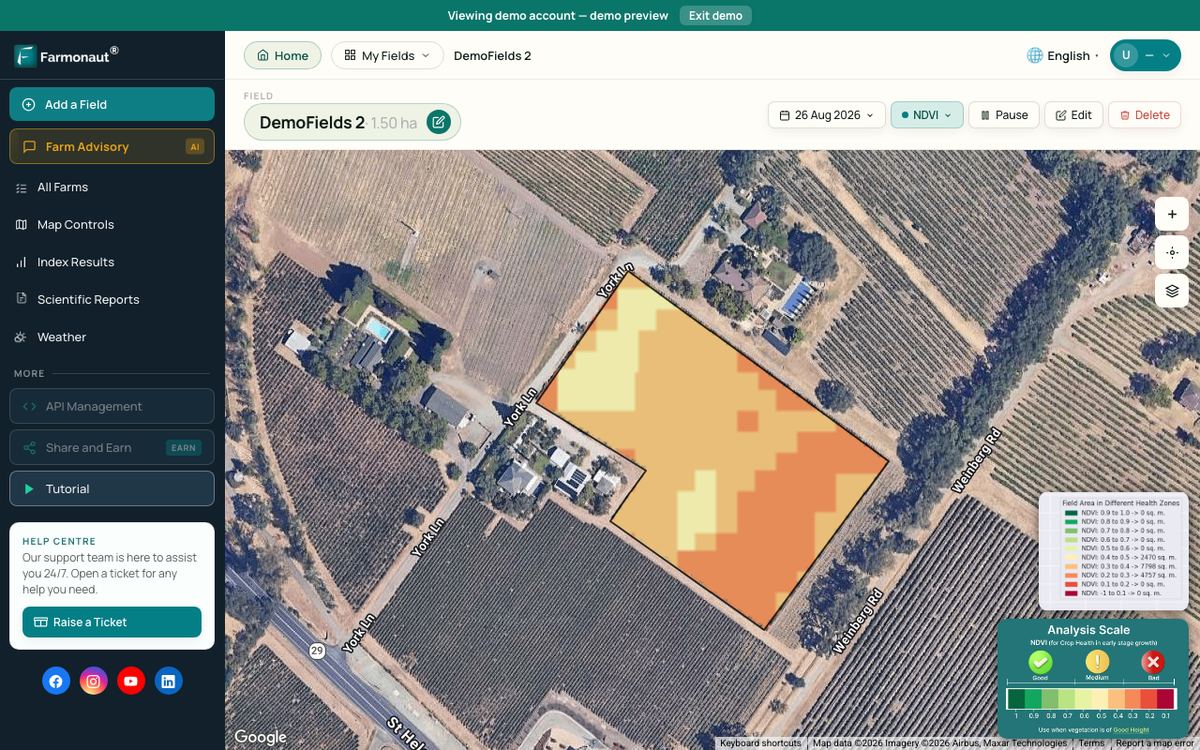
Lenders and grant officers ask what you grew and where. Good records make reports quicker and the next application stronger. For peri-urban farms of several acres, satellite crop maps from a tool such as the Farmonaut Satellite + AI Farm Monitoring System can add a season-long view of each field. Sentinel-2 pixels are 10 meters wide, so a rooftop or a small community garden is too small to track this way; hand logs and photos work better there.
How we checked the numbers
We used USDA, FSA, NRCS and NIFA notices and fact sheets for program terms, award sizes and rates. For 2025 and 2026 changes we used dated reports from Civil Eats, NSAC, DTN and Ambrook Offrange, and the Congressional Research Service for the farm bills. We left out older claims we could not trace to a source, such as total contract counts and savings from the 2025 cuts, and we give a date for every status line. Grant rules change each year, so treat this page as a starting point and confirm the details with each program. For legal or tax questions on a grant or loan, get professional advice.
If this topic matters to you, read USDA: Dept of Agriculture Grants & Loans next.
FAQ
Is a USDA urban agriculture grant round open now?
No, not as of mid-October 2026. Congress appropriated $7 million for fiscal 2025 and $5 million for fiscal 2026, but USDA had not opened a round to award it. The most recent UAIP awards we found were in 2024.
Can an individual urban farmer get a USDA grant?
Not a UAIP grant; it is limited to local governments, schools, tribes, public housing authorities and nonprofits. Individual farmers can apply for FSA microloans, NRCS EQIP cost-share, and SARE farmer grants in their region.
How much is an FSA microloan, and what rate does it carry?
Up to $50,000 for operating costs and up to $50,000 for ownership. On 1 October 2026 the rate was 5.375% for operating and 6.250% for ownership microloans. Beginning and veteran farmers have a 5% cap on operating microloans.
Does NRCS pay for high tunnels on urban farms?
Yes, if the tunnel is on land you control and crops grow in the soil or in raised beds no deeper than 12 inches. Rates and caps are set by each state. Pennsylvania caps the payment at $10,000 per operation for fiscal 2026.
What happened to the Local Food Purchase Assistance program?
USDA cancelled about $1 billion of fiscal 2025 funding for LFPA and Local Food for Schools in March 2025. Ask your state department of agriculture whether it runs its own local food purchasing program.
Related pages on our site: open the Farmonaut web app, see the satellite data API and its API developer docs, or read about the Farmonaut affiliate program. Also see USDA financing programs, crop loans and insurance, Montreal rooftop farms, product traceability, carbon footprinting, the Agro Admin app and fleet management.
Farmonaut crop monitoring
Keep a season-long record of your fields
For farms of a few acres or more, Farmonaut shows satellite vegetation maps of each field through the season, on web, Android or iOS.



Keep reading
Sources
- Ohio State University Urban Extension, USDA announces grants and technical assistance funding for urban agriculture (13 January 2025): urban-extension.cfaes.ohio-state.edu
- USDA, FY 2025 UAIP Competitive Grants Program FAQs (2025): usda.gov
- USDA Farm Service Agency, USDA invests $7.4 million in 25 urban agriculture and innovative production efforts (18 July 2023): old.fsa.usda.gov
- National Sustainable Agriculture Coalition, The uncertain future of urban agriculture at USDA (1 October 2026): sustainableagriculture.net
- Civil Eats, Lawmakers press USDA on funding for urban ag (29 September 2026): civileats.com
- Civil Eats, USDA publicizes canceling a grant to an organization that trains young farmers (13 March 2025): civileats.com
- Ambrook Offrange, The urban farming comedown (19 July 2025): ambrook.com
- DTN Progressive Farmer, How does cutting local food programs help Make America Healthy Again? (17 March 2025): dtnpf.com
- Congressional Research Service, The 2026 farm bill: comparison of the House and Senate bills with current law (R48918): everycrsreport.com
- Fertilizer Daily, Senate farm bill markup fails 10-11 (15 September 2026): fertilizerdaily.com
- USDA NIFA, Urban, Indoor, and Emerging Agriculture funding opportunity (posted 12 June 2026): nifa.usda.gov
- USDA NIFA, Community Food Projects Competitive Grants Program, fiscal year 2026 notice of funding opportunity: files.simpler.grants.gov
- North Central SARE, 2026 Call for Proposals, Farmer Rancher Grant Program: sare.org
- Rutgers Cooperative Extension, Northeast SARE farmer grant applications available, due 9 December 2025 (31 October 2025): cumberland.njaes.rutgers.edu
- Minnesota Department of Agriculture, MDA opens grants for urban agriculture projects (8 January 2026): mda.state.mn.us
- NYC Mayor’s Office of Urban Agriculture, 2024 progress report: nyc.gov
- Chicago Botanic Garden, Windy City Harvest: chicagobotanic.org
- USDA Farm Service Agency, Microloans fact sheet (October 2024): dts.fsa.usda.gov
- USDA Farm Service Agency, Current FSA loan interest rates (effective 1 October 2026): fsa.usda.gov
- USDA Farm Service Agency, March 2026 lending rates: fsa.usda.gov
- USDA Farm Service Agency, April 2026 lending rates: fsa.usda.gov
- USDA Farm Service Agency, July 2026 lending rates: fsa.usda.gov
- USDA Farm Service Agency, September 2026 lending rates: fsa.usda.gov
- USDA NRCS, High Tunnel Initiative – Iowa: nrcs-prod.azureedge.us
- USDA NRCS New Mexico, High Tunnel fact sheet (2018): efotg.sc.egov.usda.gov
- USDA NRCS Pennsylvania, Bulletin PA 440-26-06, FY 2026 EQIP and CSP cost list and payment caps (11 March 2026): nrcs-prod.azureedge.us
- University of Florida IFAS, FE1135: The cost of high tunnel and caterpillar tunnel establishment for vegetable production: ask.ifas.ufl.edu
- USDA farmers.gov, Urban grower resources from USDA: farmers.gov
Discussion
Questions, corrections or field experience? Share them below. First-time comments are reviewed before they appear, and your email is never published.
No comments yet. Be the first to add a question or your experience.

 Consulthink Global
 Rouge VC
 Yutz Automation
 AgroGreen Dynamics
 AgroRisk
 Oath Inc
 Reddane Farming
 Esri North East Africa
 Cresol
 Atur Kuliner
 MDCV UK
 Zerella Group
 Etech Consulting Madagascar
 Vestlandsforsking
 Delicio
 WB Dev
 Sama Premium
 Prochecker
 Tres Valles
 LACOS Geoinformation
 Magrifly
 LatConnect 60
 Blickwinkel
 Exploration consultancy · South Africa · Gold
 Licence holder · Niger · Gold










