

Cotton · Growing conditions guide
Cotton Growing Conditions: Heat, Soil and Water Targets
Cotton needs steady heat (about 2,200 to 2,600 DD60s from planting to harvest-ready), well-drained soil near pH 6, and 0.2 to 0.3 inch of water a day at bloom, according to US extension guides.
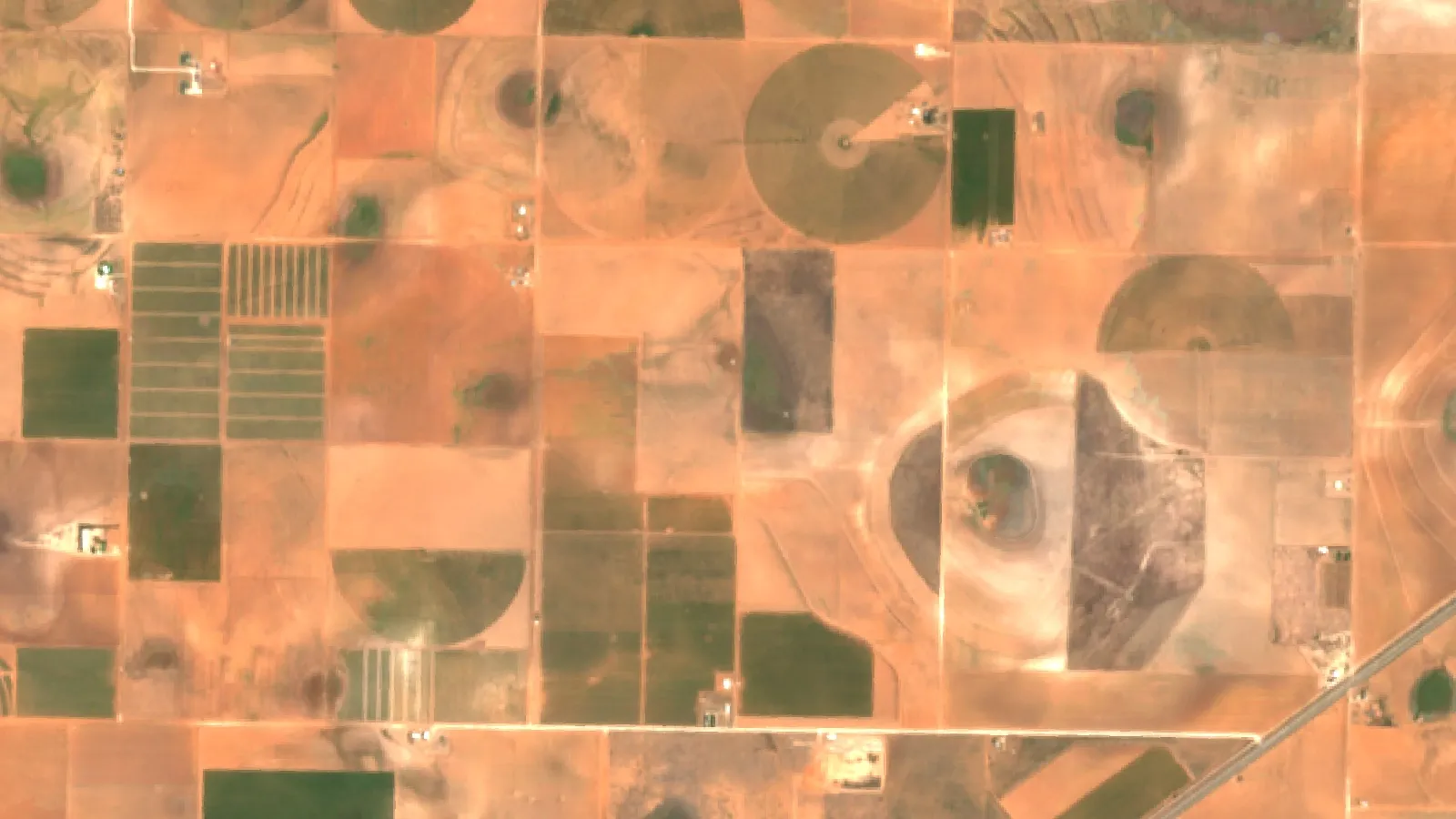
Key takeaways
- Plant when the soil is 65°F or warmer at 4 inches at 8 a.m. for three days in a row (LSU AgCenter).
- The crop needs 775 to 850 DD60s to first flower and 2,200 to 2,600 to harvest-ready, over 130 to 160 days (Oklahoma State, Mid-South averages).
- Water use peaks at about 0.3 inch per day at peak bloom in Texas and about 0.2 inch per day in South Georgia (Texas A&M; UGA).
- NC State gives a pH range of 5.8 to 6.5 for cotton on mineral soils, with a lab target of 6.2.
- The 2025 US yield estimate was 856 lb per harvested acre; Texas averaged 602 lb and Arkansas 1,398 lb (USDA NASS, January 2026).
In this article
- Cotton growing conditions at a glance
- 1. Climate: heat units decide the season
- Heat units by growth stage
- Too cold, too hot
- 2. Soil: drainage and pH first
- 3. Water: how much cotton uses and when
- The critical window for water
- 4. Sunlight, humidity and wind
- 5. Planting date, depth and spacing
- 6. Nutrients: test, then feed by stage
- 7. Pests and disease: scout the conditions that favor them
- 8. Harvest timing
- Yield by state: what the conditions add up to
- What do these conditions mean for your return per acre?
Good cotton growing conditions come down to three things: steady heat, well-drained soil near pH 6, and enough water at bloom. Cotton needs about 2,600 heat units (DD60s) from planting to full maturity, according to the Texas A&M cotton production guide, and its daily water use peaks at about 0.3 inch per day at peak bloom.
This page sets out each condition as a number you can check in your own field: soil temperature at planting, heat units by growth stage, water use by stage, soil pH, spacing and harvest timing. It also has charts built from extension and USDA data and a calculator that shows how yield and price change your return per acre.
Cotton growing conditions at a glance
The table sums up the targets used by US extension services. Each row has its own section below with the source behind it.
| Condition | Target | Source |
|---|---|---|
| Soil at planting | 65°F or warmer at 4 inches, 8 a.m., three days in a row | LSU AgCenter |
| Heat to maturity | About 2,200 to 2,600 DD60s | Oklahoma State, Texas A&M |
| Base temperature | 60°F; little extra growth above about 95°F | Texas A&M |
| Peak water use | About 0.2 to 0.3 inch per day at bloom | UGA, Texas A&M |
| Soil pH | 5.8 to 6.5 on mineral soils; 6.2 target in North Carolina | NC State |
| Season length | 130 to 160 days, planting to harvest-ready | Oklahoma State |
| Planting window (US) | March to June; harvest August to December | USDA ERS |
1. Climate: heat units decide the season
Best for: choosing a planting date and judging if your area has a long enough season.
Cotton is a warm-season plant. It does not grow much below 60°F, so growers track heat with DD60s. To get the day’s DD60s, add the high and low temperatures in °F, divide by two, and take away 60. A day with a high of 90°F and a low of 75°F gives 22.5 DD60s. The Texas A&M guide caps the high at 95°F in this sum, because growth does not rise much above that.
Each growth stage needs a known amount of heat. Oklahoma State lists Mid-South averages in its fact sheet on heat units in cotton: 50 to 60 DD60s from planting to emergence, 775 to 850 to first flower, and 2,200 to 2,600 to a crop ready for harvest. That takes 130 to 160 days. The same fact sheet warns that these Mid-South numbers do not fit every region, and that water or heat stress delays each stage whatever the heat total says.
So the first climate test is simple. Add up the DD60s your area gets in a normal season, from a safe planting date to the first fall freeze. If the total falls well short of about 2,200, the crop may not open its top bolls before cold weather. In the US cotton is grown mainly in the 17 southern Cotton Belt states, from Virginia to California, according to the USDA Economic Research Service. The ERS also notes that Upland cotton makes up 97% of US output and Pima cotton, which needs hot, dry conditions, the other 3%.
Chart
Heat units needed for each cotton stage
DD60s, range of Mid-South averages
Heat units by growth stage
The National Cotton Council gives the same stage targets in its guide to cotton growth and development. First-position flowers on fruiting branches next to each other open about three days apart, which the Texas A&M guide puts at 50 to 60 DD60s, so counting flowering branches is a quick field check on the heat a crop has had.
A simple way to use this is to keep a running DD60 total from your planting date, using the nearest weather station. Compare it with the stage targets above. If the crop is behind the heat it has received, look for a cause in the field: dry soil, a hardpan, waterlogging, seedling disease or an early pest problem. If it is on track, you can plan later steps, such as growth regulator and harvest-aid timing, with more confidence.
Chart
Heat builds up through the season
Cumulative DD60s at each stage, midpoints of the Mid-South ranges
Too cold, too hot
Cool, wet weather slows emergence and gives seedling disease a chance. Very hot spells cause another problem: bolls and squares can drop when the plant is under heat and water stress at the same time. Heat units do not count sunlight, so a run of cloudy days can also slow growth and lead to fruit shed, the Oklahoma State fact sheet notes. For more on regional climate, see our older guide on optimal climatic conditions for growing cotton.

▶ How climate shapes cotton farming and how satellite data helps growers adapt. · 9:17
2. Soil: drainage and pH first
Best for: picking fields and planning lime and fertilizer.
Cotton has a deep taproot. The National Cotton Council guide says the roots may reach 3 feet in some soils while the plant above ground is only about 14 inches tall. That is why loose, well-drained soil matters. Hardpans and waterlogged clay stop the taproot and leave the plant short of water later in the season.
Soil pH is the second check. The NC State fertilization chapter for cotton says cotton tolerates pH 5.8 to 6.5 on mineral soils and that the state lab uses a target of 6.2. It also reports that in fiscal year 2020, 23% of the state lab’s cotton soil tests were below pH 5.8. Low pH cuts the supply of phosphorus, potassium, calcium and magnesium. A soil test every few years tells you how much lime you need; follow your state lab’s rate.
Signs of poor soil conditions
- Yellow, stunted plants in low spots after rain point to poor drainage.
- Roots that turn sideways a few inches down point to a hardpan.
- Patchy stands on sandy knolls often mean low water-holding capacity.
Organic matter, cover crops and less tillage help soil hold water and resist crusting. Our guide to the ideal soil types for cotton covers soil texture in more depth, and our post on soil and water management practices covers the general methods.
3. Water: how much cotton uses and when
Best for: irrigation scheduling and dryland risk.
Cotton can survive dry spells, but yield depends on water at bloom. The Texas A&M guide on crop needs by stage puts water use at about 0.3 inch per day at peak bloom, falling below 0.1 inch per day by harvest. In humid South Georgia, the UGA Tift County extension office says water use from first flower to first open boll may approach 1.5 inches per week, or about 0.2 inch per day.
The gap between those two numbers is the climate. Dry, hot, windy air pulls more water from the leaves. That means a rule from one state does not move cleanly to another. Use local evapotranspiration data from your state extension service or weather network where it exists.
Chart
Cotton water use cited by extension services
Inches per day
The critical window for water
The highest-risk period runs from first flower to first open boll. A shortage then sheds squares and young bolls. Too much water at the same stage brings its own risks: rank growth, boll rot and a later crop. On sandy soils, which hold less water, short and frequent irrigation is safer than large, rare ones.
Rainfed growers have fewer levers. They can pick fields with deeper soil, plant at a density that suits the rainfall, and keep weeds out early so the crop has the soil water to itself. For a regional view of water needs from Arizona to the US Southeast, see our post on cotton agronomy and water requirements.
Dryland or irrigated?
Water supply changes the whole plan for a field. Mississippi State builds separate budgets for dryland, furrow-irrigated and pivot-irrigated cotton, with 10.5 acre-inches of water planned for furrow systems and 7.5 acre-inches for center pivots in the Delta. Those are planning figures for one region, but they show how much extra water a humid-area crop may still need in a normal year. In drier regions the gap between rainfall and crop demand is larger, and the choice of seeding rate, variety and planting date should match the water you can count on.

▶ Common hurdles in cotton production, from water management to pests, and ways to tackle them. · 7:38
4. Sunlight, humidity and wind
Best for: understanding fruit shed and disease pressure.
Cotton wants full sun. Shade and long cloudy spells cut the sugar supply to young bolls, and the plant sheds what it cannot feed. Humid weather late in the season favors boll rot, mainly in dense, rank canopies. Strong wind can sandblast seedlings on light soils in spring and can knock seed cotton out of open bolls in fall.
You cannot change the weather, but you can change the canopy. A growth regulator on rank cotton, sensible plant density and good weed control keep air moving through the rows and help the lower bolls dry out.
5. Planting date, depth and spacing
Best for: getting an even stand.
Soil temperature, not the calendar, should start the planter. LSU AgCenter advice on soil temperature is to wait for a mean of 65°F or more at the 4-inch seed depth, measured at 8 a.m., for at least three days in a row, with a good five-day forecast after planting. In the US, cotton is planted from March to June and harvested from August to December, according to the ERS.
- Seed depth: plant shallow enough for a quick, even emergence; ask your extension office for the right depth in your soil type.
- Row spacing: many US budgets use 38-inch rows; Mississippi State’s 2026 budgets are built on 12-row, 38-inch planters.
- Seeding rate: set it by seed size, field history and the stand your seed company and extension office suggest.
An even stand matters more than a high one. Gaps let weeds in and make later decisions, like growth regulator timing, harder across the field.
Practical checks before planting
- Measure soil temperature at seed depth for several mornings, not once.
- Check the five-day forecast for cold nights and heavy rain.
- Make sure there is moisture at seed depth, or plan to water.
- Calibrate the planter so seed spacing and depth are even across all rows.
Replanting is costly in seed, fuel and lost season length, so a few days of patience at planting often pays back. Late planting has its own cost, because the crop then has fewer heat units before the fall freeze.
6. Nutrients: test, then feed by stage
Best for: matching fertilizer to the crop’s needs.
Nitrogen drives growth, but too much makes a tall, late crop that is hard to defoliate. Potassium supports boll fill and fiber quality. Phosphorus helps early roots. Demand rises sharply once squaring starts, so many growers split nitrogen between planting and early squaring rather than putting it all on at once.
Base all rates on a soil test and your state’s recommendations. Check the product label and local rules before any fertilizer or manure application, and get advice from your extension agent or a certified crop adviser on rates. Our post on crop management strategies covers rotation and soil-health basics.
7. Pests and disease: scout the conditions that favor them
Best for: timing scouting, not replacing it.
Growing conditions shape pest pressure. Cool, wet soil at planting slows emergence and gives seedling disease time to take hold. Humid weather late in the season favors boll rot. Heat units help here too: the Oklahoma State fact sheet notes that some insecticide and harvest-aid decisions are timed by DD60s.
- Scout weekly from emergence and more often from first square.
- Use your state’s economic thresholds before you spray.
- Plant resistant varieties where they exist, and rotate chemical modes of action.
- Destroy stalks after harvest where your state’s boll weevil and pink bollworm rules require it.
Pesticide use must follow the product label and local rules. Ask your extension office for current thresholds and approved products.
Satellite crop maps can show where a field’s canopy is weaker than the rest, which tells you where to scout first. Farmonaut provides these vegetation maps for your own fields; they show where the crop changed, not the pest or the cause, so a field visit is still needed.
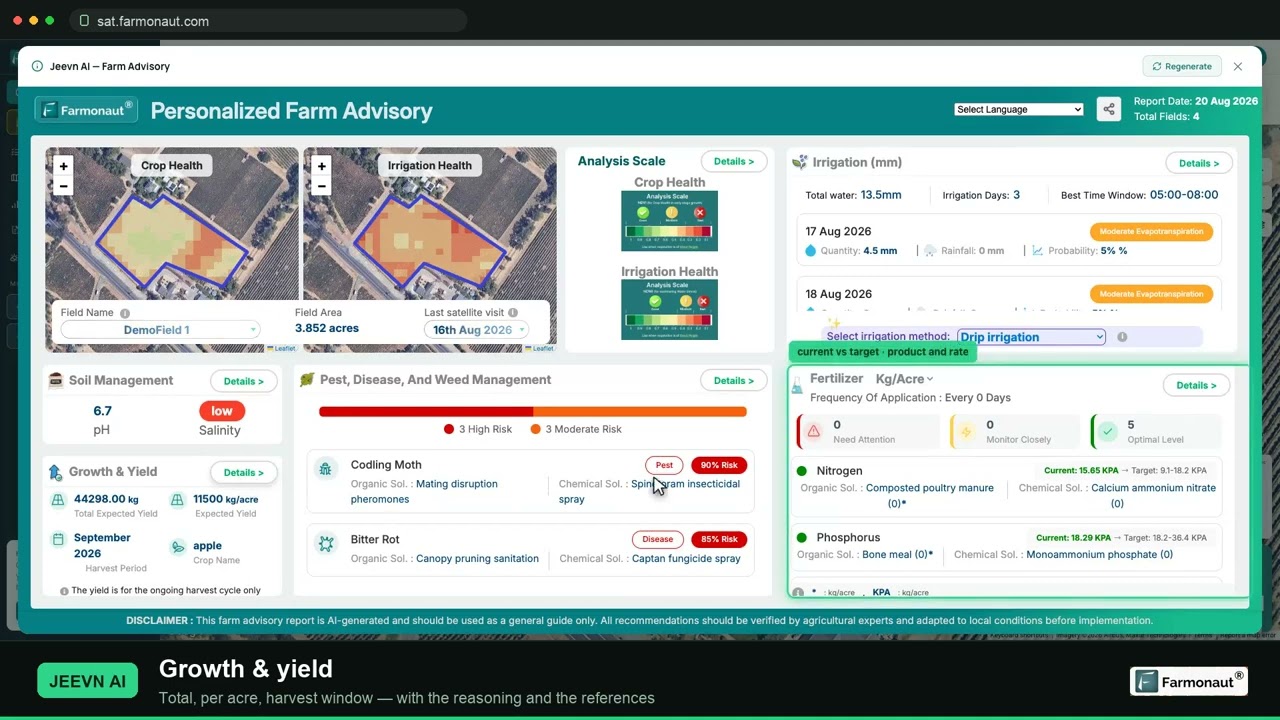
▶ A full walkthrough of satellite crop monitoring: reading NDVI maps to find stressed parts of a field. · 19:36
8. Harvest timing
Best for: protecting yield and grade at the end of the season.
Bolls need about 850 to 950 DD60s from flower to open boll, according to the Oklahoma State table, which is 45 to 65 days. Harvest aids are timed when enough bolls are open and the rest are mature. Rain on open cotton lowers grade, so a dry fall is part of good cotton growing conditions. Pick as soon as the crop is ready and conditions are dry.
Yield by state: what the conditions add up to
State averages show how climate and water shape yield. In the USDA NASS January 2026 executive briefing, the 2025 US cotton yield was 856 pounds per harvested acre. Texas, the largest producer, averaged 602 pounds, while Arkansas averaged 1,398 pounds. Texas harvested 4.0 million of the 5.3 million acres it planted. Most Texas production is concentrated in the High Plains, according to the ERS. These are estimates from January 2026 and NASS may revise them.
Chart
Cotton yield in the top five producing states
Pounds of lint per harvested acre, 2025 crop, January 2026 estimates
What do these conditions mean for your return per acre?
Yield and price decide whether a field pays its costs. Mississippi State University’s 2026 cotton planning budgets show how thin the margin can be. For dryland, conservation-tillage cotton in the Delta, the budget uses 1,200 pounds of lint at a planning price of $0.67 per pound, plus cottonseed worth $178.20 per acre. Direct expenses are $951.77 per acre, leaving $36.43 per acre above direct costs before fixed costs of $217.06. These are planning numbers published in November 2025, not market quotes. Enter your own numbers in the calculator below.
Try the numbers for your own farm below.
Calculator
What does your cotton field return above direct costs?
Enter your own yield, price, seed value, costs and acres.
- Income per acre: $982
- Return per acre: $30
- Break-even lint yield: 1,155 lb/acre
- Break-even lint price: 0.65 $/lb
Example values only, not a benchmark or a forecast. Defaults follow Mississippi State University’s 2026 planning budget for dryland Delta cotton (1,200 lb lint at a $0.67/lb planning price, $178.20 seed income, $951.77 direct costs), which are planning figures published in November 2025, not market quotes. Fixed costs are not included.
How we checked the numbers
We used extension guides from Texas A&M, Oklahoma State, LSU, UGA, NC State and Mississippi State, the National Cotton Council, and USDA data. Where sources differ, as with peak water use, we show both and name the region. Stage targets are averages from Mid-South research; your variety and region may differ.
FAQ
What are the ideal cotton growing conditions?
Warm weather with about 2,200 to 2,600 DD60s from planting to harvest-ready, well-drained soil with a pH of about 5.8 to 6.5, full sun, and enough water at bloom, about 0.2 to 0.3 inch per day depending on the climate.
What soil temperature does cotton need for planting?
LSU AgCenter suggests waiting for a mean of 65°F or more at a 4-inch depth at 8 a.m. for three days in a row, with a good five-day forecast.
How much water does cotton need?
Use peaks at bloom. Texas A&M puts it at about 0.3 inch per day at peak bloom. UGA gives about 0.2 inch per day in South Georgia. Total seasonal need depends on climate, soil and season length.
What is the best soil pH for cotton?
NC State says cotton tolerates pH 5.8 to 6.5 on mineral soils and its lab uses a target of 6.2. Lime based on a soil test.
How long does cotton take to grow?
About 130 to 160 days from planting to a crop ready for harvest in the Mid-South, according to Oklahoma State. Cooler areas take longer.
Summary
Cotton rewards warm, steady weather, deep and well-drained soil, a pH near 6 and water when the crop flowers. Check soil temperature before planting, track DD60s through the season, and watch water closely from first flower to first open boll. Compare your yield and price with your costs using the calculator above.
Related pages on our site: sustainable resource management steps, carbon footprinting, product traceability, fleet management, crop loan and insurance tools, large-scale farm management and satellite and weather API docs.
Farmonaut crop monitoring
See your cotton fields from space
Draw your fields once and Farmonaut shows satellite vegetation maps for them through the season, on web, Android or iOS.




Keep reading

Sources
- Texas A&M AgriLife Extension, Texas cotton production guide, chapter 2: growth and development: cotton.tamu.edu
- Texas A&M AgriLife Extension, Texas cotton production guide, chapter 7: crop needs by stage: cotton.tamu.edu
- Oklahoma State University Extension, PSS-3002 Utilizing Heat Units in Cotton Production: pods.okstate.edu
- National Cotton Council, Cotton growth and development (Cotton Physiology Today): cotton.org
- USDA Economic Research Service, Cotton Sector at a Glance (updated January 2025): ers.usda.gov
- NC State Extension, Cotton Information: Fertilization chapter (2026): content.ces.ncsu.edu
- UGA Extension Tift County, crop update on cotton irrigation: site.extension.uga.edu
- LSU AgCenter, Soil temperature important for cotton planting: lsuagcenter.com
- USDA NASS, Executive Briefing, 12 January 2026: data.nass.usda.gov
- Mississippi State University, Cotton 2026 Planning Budgets: agecon.msstate.edu
Discussion
Questions, corrections or field experience? Share them below. First-time comments are reviewed before they appear, and your email is never published.
No comments yet. Be the first to add a question or your experience.

 Exurbia Geospatial
 MWS Research Centre
 FieldZero
 Indico Company
 Kubota
 FFBS
 Jontra
 Kalustyan
 Tucor
 Geno
 Hayleys Agriculture
 Linx Agritech
 Adinet
 Save Your Soils

 Licence holder · Niger · Gold










