

Best Mining Safety Consulting Firms in Australia: Guide
Reviewed February 2026 against the NSW Resources Regulator’s mine safety performance report and Persistence Market Research’s Australia mining consulting services market analysis.
Try it: Run your own numbers →
The best mining safety consulting companies in Australia combine deep regulatory knowledge of state-based Work Health and Safety (WHS) law with digital risk-monitoring tools, and they typically bill AUD$400–$750 per hour for specialist mining safety and automation expertise, according to BizbellConsultancy’s 2026 consulting rates benchmark. There is no single national licensing body that ranks firms, so “best” depends on what you need: a Big Four-style multinational for enterprise-wide compliance across every state, or a boutique South Australian practice that knows your regulator’s inspectors by name. This guide compares the leading firms by service scope, region, and typical engagement type, and shows you how to check whether a firm’s claims hold up before you sign a contract.
For what consultants actually do, how Competent and Qualified Person rules apply, and fees, see our guide to mining consultants.
Table of Contents
- Quick Answer: Who to Call for What
- The Australian Mining Consulting Market: Size and Growth
- What Mining Safety Consulting Firms Actually Do
- Australian Regulatory Standards Firms Must Work Within
- Why This Matters: NSW Mine Safety Incident Data
- Leading Mining Safety Consulting Companies in Australia
- Comparison Table: Leading Firms by Region and Service
- Mining Safety Consultants in South Australia
- Safety Consulting for Energy Companies in Australia
- Calculator: Estimate Your Consulting Engagement Cost
- How to Evaluate a Firm Before You Sign
- Digital Tools Reshaping Mining Safety Management
- Mining Safety Culture in Australia: What the Data Shows
- Where Satellite Monitoring Fits Alongside Safety Consulting
- Frequently Asked Questions
- Conclusion
- Try it: Run your own numbers
Quick Answer: Who to Call for What
If you need one line before you read further: for enterprise-wide risk management and hazard modelling across multiple states, the multinational engineering-consulting groups (Golder Associates, ERM) have the broadest bench. For ISO 45001 auditing and structured compliance documentation, Bureau Veritas and similar certification bodies specialise in that exact deliverable. For hands-on training and onsite protocol design at a single operation, a regional or boutique firm such as Mineral Resources Safety Services (MRSS) is usually cheaper and faster to mobilise than a national firm’s overhead structure allows. For automation and remote-hazard monitoring specifically, firms like Simbotics Consulting focus on that niche rather than general OHS compliance.
None of this is an endorsement or a ranked league table — no public regulator publishes one. What follows is a service-and-region breakdown so you can shortlist the two or three firms actually suited to your operation, plus the verification steps in How to Evaluate a Firm to confirm a shortlisted firm’s claims before you commit budget.




The Australian Mining Consulting Market: Size and Growth
The Australia mining consulting services market — which spans safety, environmental, engineering and technical consulting — was valued at US$997.2 million in 2025, according to Persistence Market Research, and is projected to reach US$1,388.8 million by 2032, a compound annual growth rate of 4.9% over that period. Safety-specific consulting is a subset of that figure rather than a separately published number, but the overall trajectory tells you the category is expanding steadily rather than booming or contracting, which matters if you’re evaluating whether a boutique firm has the growth capacity to take on a multi-site contract or whether you need a firm with existing national scale.
That growth is being pulled by two forces at once: tightening WHS regulation (see the next section) and the rising cost of a serious incident, both in direct liability and in the harder-to-quantify cost of lost production during a regulator-mandated shutdown. Firms that can demonstrate measurable incident reduction, not just compliance paperwork, are capturing a growing share of that spend.
What Mining Safety Consulting Firms Actually Do
“Safety consulting” covers a wide range of deliverables, and the firms that do it well are specific about which of these they provide rather than claiming all of them:
- Hazard identification and risk assessment — site walkovers, geotechnical risk modelling, and documented risk registers specific to the operation’s machinery and geology
- Safety management system (SMS) design — building or overhauling the documented system that governs how hazards are controlled, typically aligned to ISO 45001, the international standard for occupational health and safety management systems
- Regulatory compliance support — interpreting and implementing the requirements of Safe Work Australia’s model WHS laws as adopted (with variations) by each state and territory regulator
- Training and emergency preparedness — operator training, emergency response simulations, and incident investigation methodology
- Digital and automation integration — deploying monitoring sensors, wearables, and remote-hazard detection to reduce worker exposure to dangerous zones
A firm that tries to be excellent at all five is rare; most have a genuine specialism in two or three, and the “who to call for what” breakdown above reflects that.
Australian Regulatory Standards Firms Must Work Within
Australian mining safety consulting operates inside a layered regulatory structure, not a single national mining-safety law. Safe Work Australia sets model WHS legislation; each state and territory (WorkSafe Victoria, Resources Regulator in NSW, Queensland’s Resources Safety & Health, DMIRS in Western Australia, and equivalents elsewhere) adopts and enforces its own version, with mining-specific regulations layered on top of general workplace law.
One concrete example of how these standards move: the national crystalline silica exposure standard was tightened from 0.1 mg/m³ to 0.05 mg/m³ across Australian state regulators including DMIRS, Queensland, and NSW, as part of the 2024-25 round of WHS regulatory updates. A firm that hasn’t updated its exposure-monitoring protocols to the current 0.05 mg/m³ threshold is working from an outdated baseline — this is a specific, checkable fact to ask about in any vendor conversation, not a generic “are you compliant” question.
ISO 45001 certification is not legally mandated in Australia but is increasingly expected by insurers, institutional investors, and multinational mining clients as a baseline signal of a functioning safety management system. Ask any shortlisted firm whether they design to ISO 45001 or merely reference it in marketing copy — the difference shows up in whether they can produce a documented management-review cycle, not just a policy statement.
Regulatory standards change. Because exposure limits, reporting thresholds and licensing requirements are revised at state level on an ongoing basis, check DMIRS (Western Australia), Queensland Resources Safety & Health, and the NSW WHS regulator directly for the current state-specific limits that apply to your operation before finalising an SMS built around any figure in this article.

Why This Matters: NSW Mine Safety Incident Data
The clearest public evidence of what safety consulting is trying to prevent comes from the NSW Resources Regulator’s mine safety performance report, published in February 2026 covering the 2024-25 reporting period. Across NSW mines in that period: 106 serious injuries, 260 lost-time injuries, 841 recordable injuries, 2,168 incident notifications lodged, and 1 work-related fatality in coal mining specifically.
Those five figures are only for NSW — the report does not aggregate national totals, and Queensland, Western Australia and South Australia publish their own separate mine safety statistics through their respective regulators. If your operation sits outside NSW, treat these numbers as a reference point for the scale of incident reporting in one major mining state, not a national figure, and pull the equivalent report from your own state regulator for a like-for-like comparison. NSW Resources Regulator republishes this report annually, so for the current reporting period visit their site directly rather than relying on this snapshot.
What these numbers are useful for in a vendor conversation: ask a prospective consulting firm how they measure success against incident-rate reduction, and whether they can show a client’s recordable-injury or lost-time-injury trend before and after their engagement. A firm that can’t produce that comparison is selling process, not outcomes.
Leading Mining Safety Consulting Companies in Australia
These firms represent the range of specialisms described above — enterprise risk management, ISO 45001 auditing, automation, and onsite training. Evaluate each against the specific deliverable you need, not against a generic “best overall” standard, since no independent body publishes a ranked comparison of Australian mining safety consultancies.
Golder Associates
- Global engineering and environmental consulting firm with a dedicated mining safety specialisation
- Provides risk management, hazard simulation modelling, environmental impact monitoring, and SMS optimisation
- Works across major Australian mining regions with tailored risk-reduction programmes for large-scale operators
Bureau Veritas
- International certification and auditing body with a long track record in safety auditing and compliance assurance
- Specialises in implementing ISO 45001-aligned systems and occupational health and safety governance frameworks
- Uses digital reporting and compliance dashboards to support ongoing audit cycles rather than one-off assessments
Simbotics Consulting
- Australian-based consultancy focused specifically on automation and robotics integration for mining safety
- Offers digital workflow solutions, AI-assisted monitoring, and remote site hazard detection
- Best suited to operators looking to reduce human exposure to hazardous zones through technology rather than procedural controls alone
Mineral Resources Safety Services (MRSS)
- Specialises in hands-on training modules, safety system design, and incident prevention programmes
- Experience across both underground and surface mining operations
- Focused on practical, onsite protocols rather than enterprise-wide digital transformation — a good fit for single-site operators who need boots-on-the-ground training over a multinational’s overhead

Other Firms Worth Shortlisting
- ERM (Environmental Resources Management) — mining safety, environmental compliance and integrated risk management for large-scale operators spanning the east coast and Western Australia
- DuPont Sustainable Solutions — safety training and culture-change programmes for mining companies benchmarking against global best practice rather than Australia-specific regulation alone
Comparison Table: Leading Firms by Region and Service
| Company | Primary Specialism | Best Fit For | Australian Coverage | Framework Used |
|---|---|---|---|---|
| Golder Associates | Enterprise risk management, hazard modelling | Large multi-site operators needing national programme consistency | National — all key mining regions | ISO 45001, predictive hazard modelling |
| Bureau Veritas | Auditing, ISO 45001 certification | Operators needing formal certification and audit trail | Australia-wide | ISO 45001, cloud audit dashboards |
| Simbotics Consulting | Automation, robotics, remote monitoring | Operators reducing exposure via technology over procedure | Pilbara, Hunter Valley, Bowen Basin | AI-driven alerts, sensor networks |
| MRSS | Onsite training, SMS design | Single-site operators wanting hands-on protocol design | WA, QLD, SA | Practical SMS, wearable tech |
| ERM | Safety/environmental compliance integration | Operators needing combined safety and environmental strategy | East Coast and WA | Digitised environmental-risk tools |
Coverage and specialism drawn from each firm’s public service descriptions; verify current scope and regional offices directly with the firm before engaging, as consulting firms adjust regional presence over time.

Mining Safety Consultants in South Australia
South Australia’s mining safety regulation sits with SafeWork SA and the state’s mining-specific inspectorate, layered under the same Safe Work Australia model laws that apply nationally. Among the firms profiled above, MRSS lists South Australia within its coverage area alongside Western Australia and Queensland, making it one of the more accessible options for SA-based operators seeking onsite training and SMS design without engaging a national firm’s Adelaide office overhead.
For SA-specific engagements, two practical checks matter more than firm size: whether the consultant has current experience with South Australia’s specific mining licence conditions (which differ from WA’s DMIRS framework and Queensland’s Resources Safety & Health rules), and whether their exposure-monitoring protocols already reflect the 0.05 mg/m³ crystalline silica standard referenced above. A firm quoting the old 0.1 mg/m³ threshold in a proposal is a signal to ask more questions before proceeding.
Safety Consulting for Energy Companies in Australia
Several of the firms above — notably ERM and Bureau Veritas — extend their mining safety practice into the broader energy sector, where the underlying WHS obligations overlap substantially with mining: hazardous materials handling, confined-space work, and heavy-plant operation are regulated under the same Safe Work Australia model framework regardless of whether the site produces ore or power. ERM’s combined safety-and-environmental-compliance offering is a common fit for energy operators who need both occupational safety and environmental impact reporting under one engagement rather than two separate vendor relationships.
If your operation spans both mining and energy generation or transmission assets (common among diversified resources companies), the firm-selection logic from the “Quick Answer” section above still applies: pick for the specific deliverable — auditing, training, or automation — rather than for a firm’s brand recognition alone.
Calculator: Estimate Your Consulting Engagement Cost
Mining safety and automation consulting in Australia runs AUD$400–$750 per hour for specialist rates, per BizbellConsultancy’s 2026 benchmark — use the calculator below with your own expected hours and team size to get a working budget range before you request formal quotes.
Run your own numbers
Assumptions: uses the AUD$400–$750/hour specialist rate range reported by BizbellConsultancy for 2026 mining safety and automation consulting. Excludes GST, report-writing time beyond the stated hours, equipment or sensor procurement, and any state-specific mobilisation fees. Multi-site figures assume the same hourly rate applies per site — in practice, larger firms often discount per-site rates on multi-site contracts, so treat this as an upper-bound estimate.
How to Evaluate a Firm Before You Sign
Because there is no regulator-published ranking of mining safety consultancies in Australia, due diligence falls on the buyer. Five checks worth running on any shortlisted firm:
- Ask for a before/after incident-rate comparison from a comparable past client — recordable injuries, lost-time injuries, or the equivalent metric your own state regulator tracks (NSW’s categories above are one model to ask for).
- Confirm their exposure-monitoring baseline is current — specifically, whether their crystalline silica protocols use the 0.05 mg/m³ standard now in force across DMIRS, Queensland and NSW, not the superseded 0.1 mg/m³ figure.
- Check ISO 45001 alignment is substantive — ask to see a sample management-review cycle or internal audit schedule, not just a logo on their website.
- Match specialism to need — a firm strong in automation (like the robotics-focused practices) is not automatically the right choice for a documentation-heavy compliance audit, and vice versa.
- Verify regional presence directly — firm websites and marketing materials can lag actual office footprint; a phone call to confirm current coverage in your state avoids a costly mismatch mid-engagement.
Digital Tools Reshaping Mining Safety Management
Regardless of which consulting firm an operator engages, the underlying toolset those firms deploy has shifted from paper-based compliance checklists toward continuous digital monitoring:
- IoT sensors and wearables — smart helmets, fatigue detectors, and gas/chemical exposure alerts that feed data continuously rather than at scheduled inspection intervals
- Cloud-based SMS platforms — centralising safety protocols, document control, and incident reporting so remote-site data reaches head office and regulators without manual transcription
- Predictive risk analytics — modelling incident trends and near-miss patterns to flag developing hazards before they cause harm, rather than analysing incidents only after they occur
- Satellite monitoring — tracking terrain change, vegetation health, and water contamination risk around a site, which supports both safety and environmental compliance reporting simultaneously
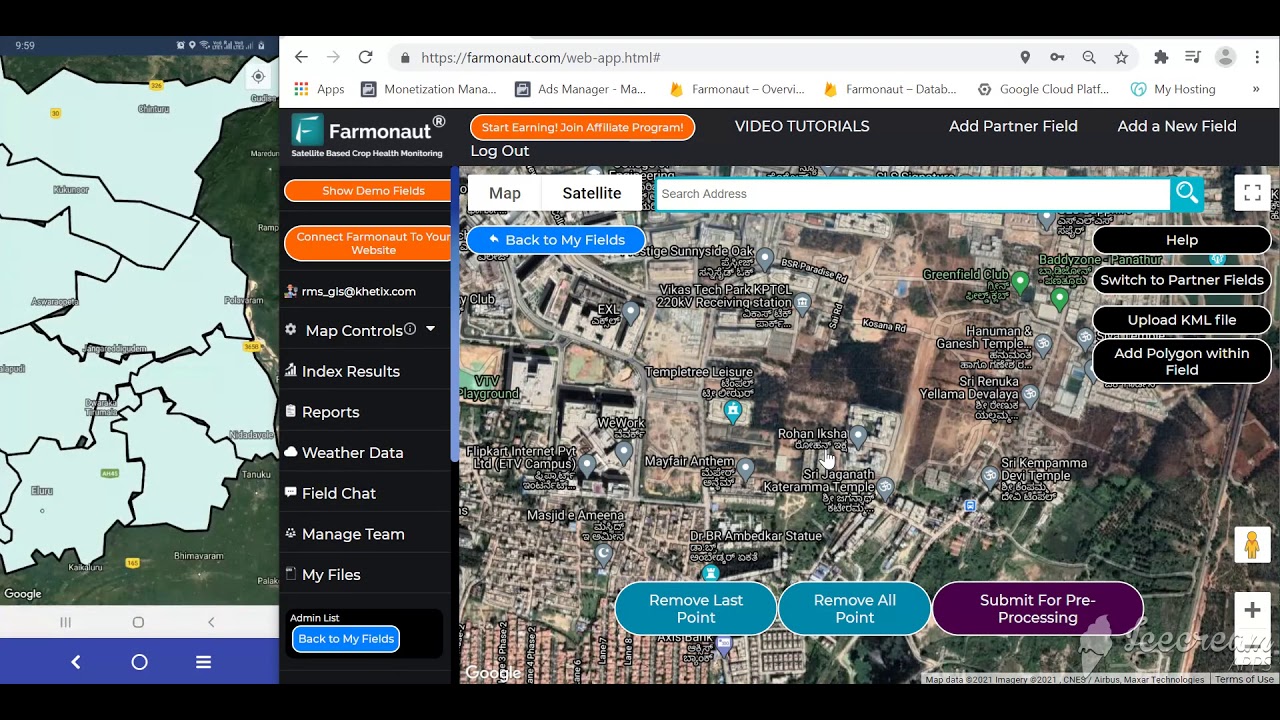
One example of accessible geospatial tooling: the Farmonaut Satellite API gives mining, resource, and environmental managers access to real-time geospatial data for site-condition monitoring. For teams wanting to build this into an existing safety or compliance app, Farmonaut’s API Developer Docs cover integration guidelines and use cases.

Mining Safety Culture in Australia: What the Data Shows
“Safety culture” is often discussed qualitatively, but NSW’s 2024-25 incident data gives one concrete way to measure it over time: the ratio between total recordable injuries (841) and the more severe lost-time injury category (260) indicates that roughly two-thirds of recorded incidents in that period did not result in lost time, meaning most were caught and managed before escalating — a pattern consistent with active near-miss reporting rather than under-reporting, though only a multi-year trend from the same regulator can confirm whether that ratio is improving or holding steady.
A genuine safety-culture assessment requires comparing this year-over-year once the regulator publishes its next annual report, and comparing NSW’s ratio against equivalent figures from Queensland, WA and SA regulators — those states publish separately and are not aggregated in the NSW report. Treat any consultant’s claim of “strong safety culture” as unverifiable marketing language unless they can point you to the specific trend data behind it.

Where Satellite Monitoring Fits Alongside Safety Consulting
Safety consulting firms design the management system and train the people who run it; satellite and sensor data give that system something continuous to monitor between site visits. We at Farmonaut provide satellite-based monitoring that mining operators and their safety consultants can use alongside — not instead of — the human expertise covered above.
- Site condition monitoring: multispectral satellite imaging tracks terrain change, vegetation health, and water contamination risk, feeding data into the day-to-day risk picture a consulting firm’s SMS is built around.
- AI-driven advisory (“Jeevn”): delivers site-specific insights, alerts, and weather forecasts so operators can make faster, data-backed decisions between formal consultant reviews.
- Traceability for compliance: our blockchain-based traceability platform documents resource movement end-to-end, supporting the audit trail a firm like Bureau Veritas would review during an ISO 45001 assessment.
- Fleet and resource management: our fleet management tools support safer, better-maintained vehicle and machinery deployment, reducing one common category of mining incident.
- Environmental monitoring: from carbon footprint tracking to disturbance and rehabilitation monitoring, supporting compliance with the environmental side of Australian WHS-adjacent obligations.
These tools are available on Android, iOS and the web, and operate on a subscription model designed to be accessible for operators of any size — from large multi-site miners already working with a national consulting firm, to smaller operations building their first digital safety layer. Explore our large-scale management solutions for multi-site administration.
Frequently Asked Questions
The strongest firms specialise rather than generalise: enterprise risk management and hazard modelling (Golder Associates), ISO 45001 auditing and certification (Bureau Veritas), automation and remote-hazard monitoring (Simbotics Consulting), or hands-on onsite training (MRSS). Match the firm to the specific deliverable you need — see the comparison table above.
Q2: How much do mining safety consultants charge in Australia?
Specialist mining safety and automation consultants bill AUD$400–$750 per hour, per BizbellConsultancy’s 2026 consulting rates benchmark. Total engagement cost depends on hours, number of sites, and travel loading for regional or remote locations — use the calculator above to estimate a range for your situation.
Q3: Are there mining safety consultants specifically in South Australia?
Yes — MRSS lists South Australia within its coverage alongside WA and QLD. SA operators should confirm any prospective firm’s current experience with SafeWork SA’s specific licence conditions and check their exposure-monitoring protocols reflect the current 0.05 mg/m³ crystalline silica standard. See Mining Safety Consultants in South Australia above.
Q4: What’s the difference between a mining safety consultant and a general mining consulting company?
“Mining consulting companies” is a broader category covering technical, geological, financial and engineering advisory alongside safety. Safety consulting is a specialism within that market, which Persistence Market Research values at US$997.2 million for 2025 across all consulting types in Australia. If you need safety specifically, shortlist against the firms and specialisms in this article rather than a general mining-consulting directory.
Q5: What regulatory standards do mining safety consultants in Australia work to?
Safe Work Australia’s model WHS laws form the base, adopted with state variation by WorkSafe Victoria, NSW’s Resources Regulator, Queensland’s Resources Safety & Health, DMIRS in WA, and equivalent SA bodies. ISO 45001 is the internationally recognised occupational health and safety management standard most firms design toward, though it isn’t a legal mandate. See Regulatory Standards above.
Q6: How is mining safety culture measured in Australia?
There’s no single national safety-culture index. The closest public proxy is incident-rate data published by state regulators — NSW’s Resources Regulator reported 841 recordable injuries, 260 lost-time injuries, and 106 serious injuries across its mines for the 2024-25 period. Comparing that ratio year-over-year, once new data is published, is a more reliable signal than any consultant’s self-reported culture claims.
Q7: Do these firms also serve energy companies, not just mining?
Several do — ERM and Bureau Veritas both extend mining-safety practices into the energy sector, where WHS obligations around hazardous materials and heavy-plant operation overlap substantially with mining. See Safety Consulting for Energy Companies above.
Q8: Which regions in Australia do the major firms cover?
Golder Associates and Bureau Veritas maintain national reach across all key mining regions, including the Pilbara and the Bowen Basin. Specialist and regional firms like Simbotics Consulting and MRSS concentrate on specific high-activity states — WA, QLD and SA — rather than national coverage.
Conclusion
There’s no regulator-ranked “best” mining safety consulting firm in Australia — the right choice depends on whether you need enterprise-wide risk management, ISO 45001 certification, automation integration, or onsite training, and on which state’s specific regulatory framework and exposure standards apply to your site. Use the comparison table and evaluation checklist above to shortlist two or three firms against your actual deliverable, verify their claims against current NSW, WA, QLD or SA regulator data rather than marketing copy, and confirm their technical protocols — starting with the 0.05 mg/m³ crystalline silica standard — are current before you sign.
Whichever consulting firm you engage, satellite and sensor monitoring gives that firm’s safety management system something to watch continuously between formal reviews. We at Farmonaut invite you to explore our tools for mining, agriculture and infrastructure management as one part of that broader safety and compliance picture — useful alongside a consulting engagement, for any mining business looking to reduce risk and improve reporting.

Sources cited in this article: Persistence Market Research, NSW Resources Regulator, BizbellConsultancy, and Sustainable Mining Community.
Discussion
Questions, corrections or field experience? Share them below. First-time comments are reviewed before they appear, and your email is never published.
No comments yet. Be the first to add a question or your experience.

 GKY Mining
 Alkimy SARL
 Double A Trading
 GemSprout Metals Limited
 Qader Group
 Ileys General Trading
 SG Gold Mining LLC
 VRV Global Pte Ltd
 Omsri International FZE
 G.I.T.T.
 Jaunita Erss Ltd
 Almosi SARL
 SRK Consulting
 Berks Gold Limited
 Mwerezi Minerals Company Limited
 Mining SARL
 SenGold Invest SAS
 Sean Mining Limited
 NTS Group (Pty) Ltd











