
Farming history · Evidence guide
Terrace Farming in Ancient China: Definition and Benefits
Terrace farming turns a steep slope into level steps that hold soil and water. In ancient China it gave farmers rice land on mountains; the Hani people have lived in the terraced landscape for over 1,300 years (FAO).
Key takeaways
- Terrace farming means building level steps on a slope; the Hani people have lived in the terraced landscape of Yunnan for over 1,300 years (FAO).
- A global review of terrace studies found a mean erosion-control ratio of 11.46 on terraced versus non-terraced slopes (Wei et al., 2016).
- Terraces can fail when poorly built or abandoned, and no single soil-saving percentage fits every site.
- Iowa State and USDA NRCS guidance covers terraces on US cropland, with upkeep to keep outlets clear.
- USDA records show Chinese filers held 247,659 US agricultural acres at 31 December 2024, slightly under 1% of foreign-held acres.
In this article
- What terrace farming is and how it helped ancient China
- Where and when Chinese terraces were built
- How ancient farmers built and watered the terraces
- Types of terraces and what each one is for
- Benefits of terrace farming: what the evidence shows
- Limits and risks of terraces
- Terraces on US and European farms today
- Compare ancient Chinese terraces with modern US conservation
- Test soil savings from terracing on your own slope
- Chinese-held US farmland: what the USDA records show
- How satellites help monitor sloping and terraced land
- FAQ
- Key takeaways and related pages
Terrace farming means cutting steep hillsides into flat steps so that crops can grow and rain does not wash the soil away. In ancient China it gave farmers level fields for rice on mountain slopes, held water and soil on the hill, and fed whole villages. The Hani people have lived in the rice-terrace landscape of Yunnan for over 1,300 years, according to the UN Food and Agriculture Organization (FAO).
This guide gives a short answer you can use in your own words, then the evidence behind it: how old the terraces are, how they were built and watered, and how much erosion they cut. It also shows what the same idea does on US farms, and what USDA records show about Chinese-held US farmland. A calculator partway down the page lets you test soil savings on your own slope.
What terrace farming is and how it helped ancient China
A model answer, if you need one: terrace farming is a way of farming a slope by building level steps, held by earth or stone walls, so that water soaks in and soil stays put. It helped the ancient Chinese in four ways.
- More farmland. Steep mountain land that could not be ploughed became level fields for rice and other crops.
- Less soil loss. Each step breaks the slope, so rain runs off more slowly and carries less soil. A global review of terrace studies found erosion control was the biggest benefit measured (Wei et al., Earth-Science Reviews, 2016).
- Better water use. Flat paddies hold water for rice, and channels carry mountain water from step to step.
- Steady food. The Hani terraces grow rice, beans and vegetables, and fish and ducks are raised in the paddies (FAO).
For a plain-language definition of terrace types, see our page on the farm terraces definition. This page focuses on China, the evidence and US use.
Where and when Chinese terraces were built
Nobody can give one start date for terracing in China. The global review by Wei and colleagues says paddy terracing was largely developed in the Yangtze River basin and spread to parts of Southeast Asia more than 5,000 years ago (this date is debated), and that the earliest terraces recorded anywhere date to about 5,000 years ago in Yemen and the Middle East (Wei et al., 2016). The surviving Chinese examples in its table are younger: the Ziquejie rice terraces are listed at about 2,000 years old and the Hani terraces at about 1,300 years.
The Hani terraces sit in the Honghe Hani and Yi Autonomous Prefecture in southeast Yunnan. FAO says they cover about 70,000 hectares across four counties (Honghe, Yuanyang, Lvchun and Jinping), while the review lists 16,603 hectares for the Hani terraces and marks them as a UNESCO World Heritage Site (2013). The two figures probably cover different areas; the review does not explain the gap.
On a national scale, a 2025 mapping study found that terraces in China are mostly in the Loess Plateau, the southwest and the southeast, and that total terrace area grew by 41,594 km² between 2000 and 2020 (Zhang et al., Earth System Science Data, 2025). The dataset maps soil and water conservation terraces, so it is not a count of ancient rice terraces. The sources above document Yunnan in detail.
Chart
Age and area of ancient terrace systems
Approximate age in years (x) and area in hectares (y), selected sites listed in one review
How ancient farmers built and watered the terraces
The method is simple in idea and heavy in labour. Farmers cut a platform into the slope, raised a bank of earth or stone on the downhill edge, levelled the step, and brought water to it by channel. The Hani system links forest, village, terrace and river in one flow, and FAO notes that there are no reservoirs yet the water supply is abundant.
Infographic
How the Hani forest-to-river system works
- 1Forest aboveForest above the village holds rain and feeds streams.
- 2ChannelsAn irrigation network carries water to the village.
- 3Terrace stepsWater and manure flow down to the paddies.
- 4Rice and fishRice grows, with fish and ducks in the paddies.
- 5River valleyWater runs on to the river valley below.
Rain also moves manure and forest humus from the village down to the fields, which is how the terraces are fertilised (FAO). FAO says 48 varieties of local rice are grown in these terraces.
Types of terraces and what each one is for
There is no single standard design. The review by Wei and colleagues says terracing reflects its purpose, the builders’ culture and experience, available labour and the economy, and lists wave-like, slope-separated, level bench, level ditch, zig, sloping, half-moon and broad-base terraces. For a farmer or student, three families are enough to remember.
- Bench terraces are flat steps with a raised edge. They suit rice paddies and orchards, and they are the classic picture of Chinese terraces.
- Sloping or graded terraces keep a gentle fall so that extra water drains away. US cropland terraces often work this way, with grassed ridges and outlet pipes.
- Half-moon pits and small basins catch water around single trees on steep ground.
The China meta-analysis covered six terrace structures across slopes from 3 to 35 degrees, and found that efficiency was higher on the steeper slope band than on the gentler one (Chen and Wei, 2017). In plain terms, the study found terraces helped more on the steeper slope band.
Benefits of terrace farming: what the evidence shows
Wei and colleagues compared terraced and non-terraced slopes using a ratio, where 1 means no difference and higher means a bigger benefit. Their averages were 11.46 for erosion control, 2.60 for runoff reduction, 1.94 for biomass, and 1.20 for both soil water and nutrients (Wei et al., 2016). The review says terracing could also raise crop yields, though less strongly.
A separate meta-analysis of terracing in China used 46 studies, with 593 runoff and 636 sediment observations. It found a significant effect on water erosion, with slope-separated terraces working best, and trees and forest cover giving the strongest protection (Chen and Wei, EGU abstract, 2017). No single percentage fits every site, because results depend on slope, crop and design.
At national scale, the 2025 dataset modelled that terraces cut soil erosion on Chinese cropland by about 1,390 million tons in 2020 (Zhang et al., 2025). This is a model result, not a measurement.
One more point from the Hani record is worth noting for any reader who wants to copy the idea. The village sits above the terraces, and the forest sits above the village. Forest holds rain, the village channels it, and the paddies receive it last. The design starts with land use on the whole hill, not with the terrace wall alone. That is also the lesson of the review, which links terrace success to management and the people who keep the terraces going over time.
Chart
Benefit ratio, terraced vs non-terraced slopes
Mean ratio from published studies; 1 means no difference, higher means more benefit
Limits and risks of terraces
Terraces are not automatic winners. The review warns that poorly designed or poorly managed terraces can have negative effects, and that abandonment grows when laws are weak, local ways of life change or crop prices fall (Wei et al., 2016).
FAO lists the Hani risks plainly: steep slopes and heavy rain bring soil loss, landslides and terrace collapse, droughts are hard without upper reservoirs, and fewer young people are learning the traditional methods. Terraces also cost labour to build and repair. In a brief mention in the same review, a Brazilian study found land levelling lowered some soil-quality measures, which is a reminder that cutting a step moves soil around.
Terraces on US and European farms today
The same idea is used on sloping fields in the US Midwest. Iowa State University Extension says terraces slow runoff, reduce its energy and so cut erosion, and that Iowa terraces are usually engineered to handle a 10-year storm without overtopping (Iowa State Extension). Extension advice also says terraces need upkeep: check the ridge height, clear sediment from the channel and keep inlets clear. If a terrace does not drain within two days after a normal rain, look for a blocked outlet.
The USDA Natural Resources Conservation Service (NRCS) notes that terraces help control sheet and rill erosion and ephemeral gully erosion, and, in its Iowa chapter, that the steep-front, farmable-backslope design is generally limited to about 6% slope (up to 8% is allowed) (USDA NRCS, Chapter 8 Terraces). For design on your own land, speak to your local NRCS office or conservation district; this guide is not an engineering design.
In Europe, a modelling study of support practices cites typical P-factor values, the share of soil loss that remains, of about 0.2 for reverse-slope bench terraces up to 1.0 where no practice is used (a range it takes from older US work). It cites field work in which stone-wall terraces cut soil loss to 0.75 of the control plots on average, and 0.35 at the median (Panagos et al., Environmental Science and Policy, 2015). The wide spread shows why results differ site to site.
For other ways to protect slopes, see our guide to agriculture and water management, and the land-use background in our types of land use guide.
▶ Seven easy sustainable farming practices, from our own channel. · 4:34
Compare ancient Chinese terraces with modern US conservation
| Feature | Hani rice terraces | US conservation terraces |
|---|---|---|
| Main crop | Rice, with fish and ducks | Corn, soybeans, small grains |
| Water source | Mountain streams and channels from forest | Rainfall, drained by outlets |
| Main aim | Level fields and water for paddies | Slow runoff and cut erosion |
| Build method | Hand-built earth or stone banks | Machine-built ridges and channels |
| Main risk | Collapse, landslide, drought | Overtopping and sediment in channel |
| Source | FAO | Iowa State, NRCS |
Test soil savings from terracing on your own slope
The calculator below uses the P-factor idea from the European study. Enter your own area, your soil loss estimate and the share of loss you expect to remain after terracing. The values shown are examples, not benchmarks, and are not a forecast for any field.
Try the numbers for your own farm below.
Calculator
How much soil could terraces save on my slope?
Enter your own area, soil loss estimate and expected remaining share.
- Soil saved over the period: 2,400 tons
- Build cost for the field: $20,000
- Build cost per ton saved: $8
Example values only, not benchmarks or forecasts. The remaining-share idea (P-factor, about 0.2 to 1.0) comes from Panagos et al., Environmental Science and Policy, 2015. Cost is an example, use today’s price from a local contractor quote.
Chinese-held US farmland: what the USDA records show
Foreign persons held an interest in nearly 46 million acres of US agricultural land at 31 December 2024, which is 3.6% of privately held agricultural land (USDA Farm Service Agency, AFIDA report). Canadian investors held 34%. Chinese primary-investor filers reported 247,659 acres, slightly under 1% of foreign-held acres; five companies made up 92% of that total, and no filings came directly from the government of China.
The reports cover purchases and leases of ten years or more. A Cornell economist’s 2024 slides say long-term wind and solar leases drove much of the rise in foreign holdings (Zhang, C-FARE webinar, 2024). About twenty-nine states limit foreign ownership of farmland to some degree (National Agricultural Law Center). Laws change, so get advice from a qualified lawyer; this is not legal or investment advice.
Chart
Share of foreign-held US agricultural acres by owner country
Percent of foreign-held acres, 31 December 2024 (China value is our rounding)
How satellites help monitor sloping and terraced land
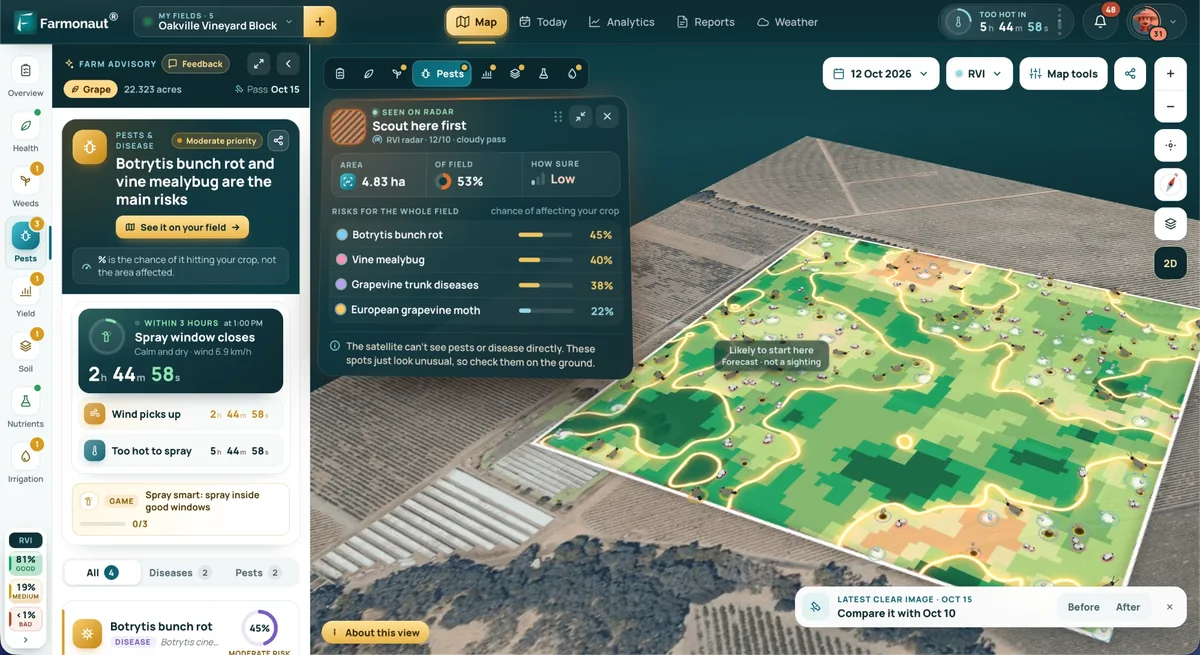
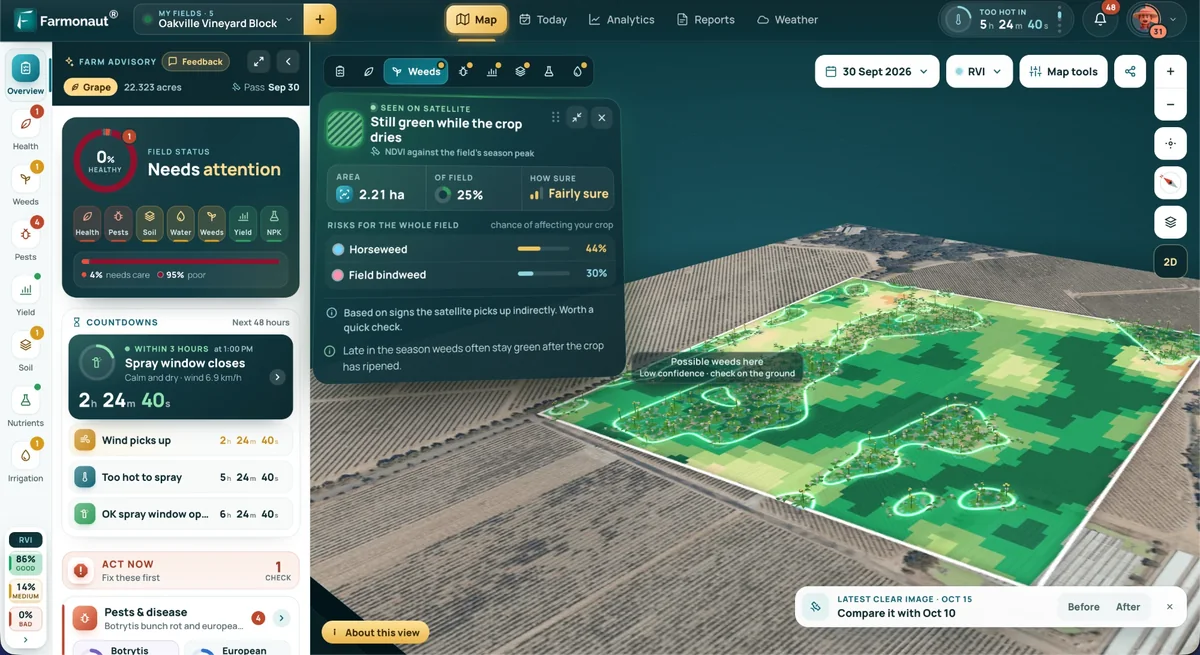
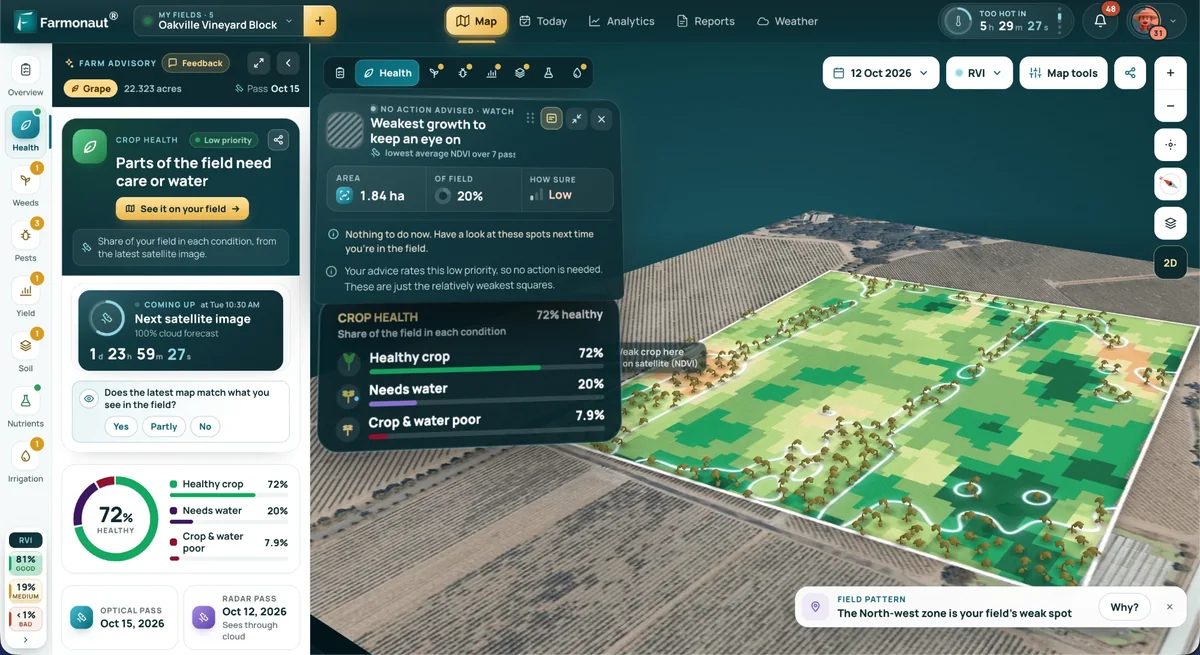
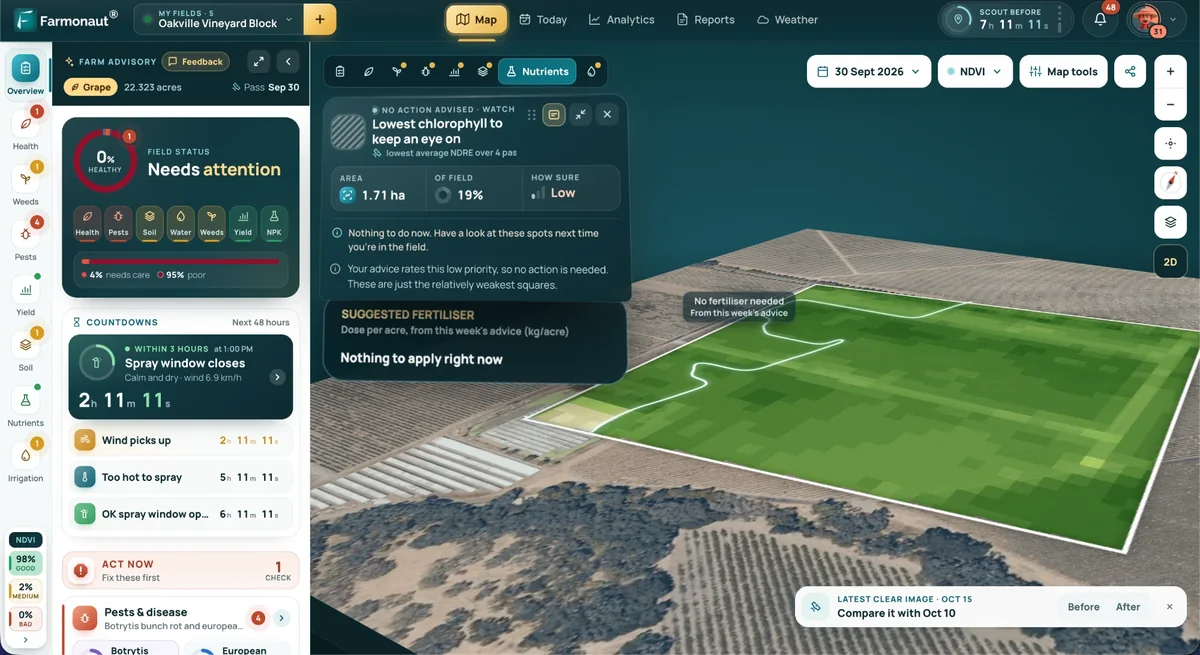
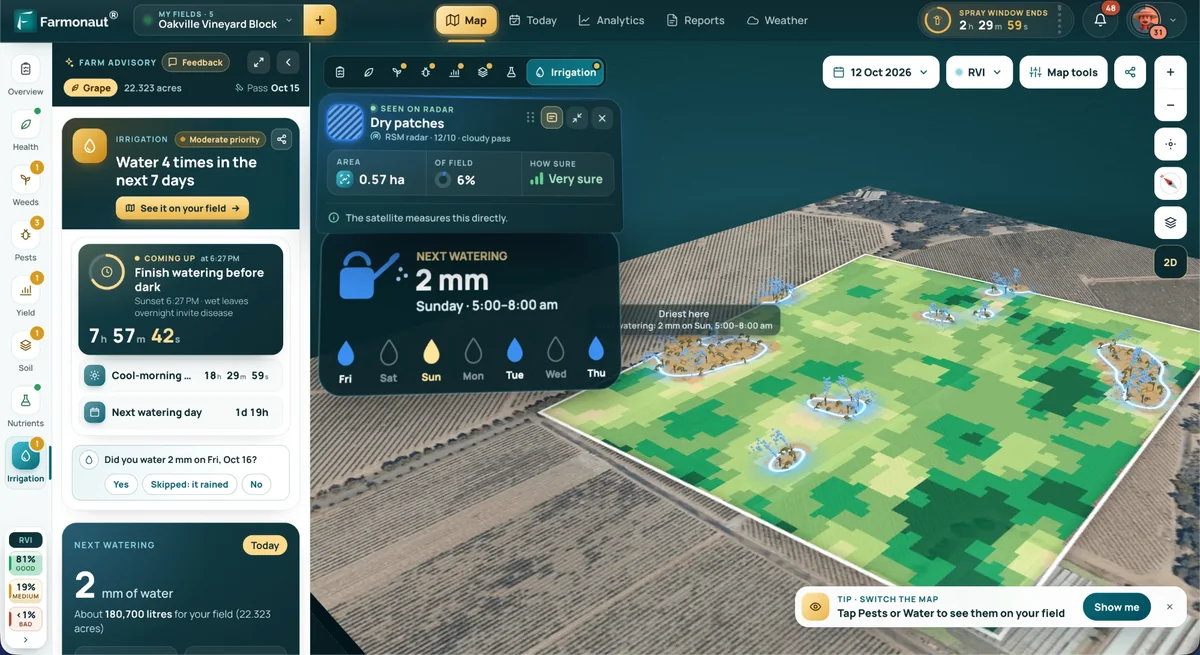
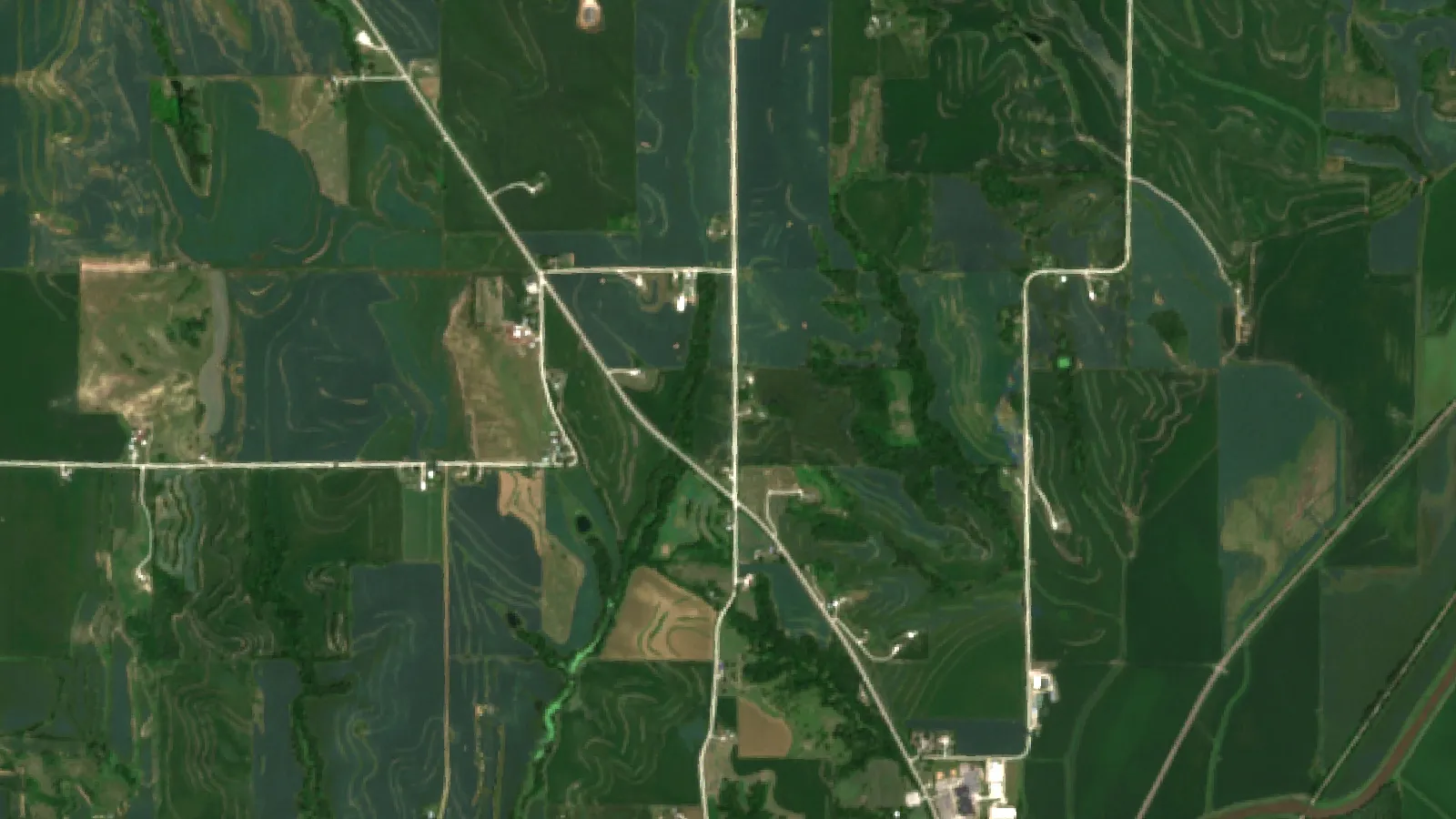
Satellite images show how green a field is and how that changes through the season. Farmonaut Satellite + AI Farm Monitoring System can track those changes across many fields, which helps a manager spot a weak patch on a terraced hillside and then check it on foot. Satellites show a change in plant vigour, not the cause, so field checks still matter.
▶ How satellite crop-health maps show stress before you can see it. · 4:09
FAQ
What is terrace farming in simple words?
It is farming on a hillside that has been cut into flat steps. The steps hold soil and water, so crops can grow on land that would otherwise be too steep.
How did terrace farming benefit the ancient Chinese?
It gave them level land for rice on mountain slopes, kept soil and water on the hill, and supported mixed food supplies. The Hani people have lived in their terraced landscape for over 1,300 years (FAO).
Where did terrace farming begin?
The earliest recorded terraces date to about 5,000 years ago in Yemen and the Middle East, says a global review. The same review says paddy terracing developed in the Yangtze basin and spread to Southeast Asia more than 5,000 years ago, but this date is debated.
Do terraces really reduce erosion?
Yes, on average. A global review found a mean erosion-control ratio of 11.46, and a China meta-analysis found a significant effect. Results vary by slope, crop and design, and poorly kept terraces can fail.
Are terraces used in the US?
Yes. Iowa and other Midwest states use them on sloping cropland. Follow NRCS or extension design advice and local rules before building one.
How much US farmland do Chinese investors hold?
Chinese primary-investor filers reported 247,659 acres at 31 December 2024, slightly under 1% of foreign-held acres (USDA AFIDA report).
Key takeaways and related pages
Terraces turn steep land into usable fields, and the best evidence points to large cuts in erosion with good design and upkeep.
Related pages on our site: farmland investors, historical farmland returns, Chinese-owned US farmland, land management and sustainability, carbon footprint tools, crop loan and insurance checks, farm traceability, fleet management, weather API docs, farm admin app.
Farmonaut agriculture API
Add satellite crop data to your own app
Developers can pull satellite crop-health data into their own tools through the Farmonaut <a href="https://sat.farmonaut.com/api">agriculture API</a>.



Keep reading
Sources
- FAO, Hani Rice Terraces, China (GIAHS): fao.org
- Wei et al., Global synthesis of the classifications, distributions, benefits and issues of terracing, Earth-Science Reviews (2016): research.fs.usda.gov
- Zhang et al., 30 m terrace dataset for China, Earth System Science Data (2025): essd.copernicus.org
- Chen and Wei, Effects of terracing in China: a meta-analysis, EGU abstract (2017): meetingorganizer.copernicus.org
- Iowa State University Extension, Install and maintain terraces: crops.extension.iastate.edu
- USDA NRCS, Chapter 8 Terraces: directives.nrcs.usda.gov
- Panagos et al., P-factor for Europe, Environmental Science and Policy (2015): research.vu.nl
- USDA FSA, Foreign Holdings of U.S. Agricultural Land through December 31, 2024: fsa.usda.gov
- National Agricultural Law Center, Foreign ownership of agricultural land FAQ: nationalaglawcenter.org
- Zhang, Chinese Ownership of U.S. Agricultural Land, C-FARE webinar (2024): wendongzhang.weebly.com
Discussion
Questions, corrections or field experience? Share them below. First-time comments are reviewed before they appear, and your email is never published.
No comments yet. Be the first to add a question or your experience.

 Gen Chayat
 Chimera Innovation
 Hiteshi Infotech
 Clubhouse OS
 SkyHarvest
 Polaris Digitech
 Teledarbas
 Wild Oak Farm
 SFX
 BACF Africa
 Doodlakine
 Exurbia Geospatial
 FieldZero
 Indico Company

 Licence holder · Niger · Gold