

Reviewed August 2026 against the Department of Agriculture (Sri Lanka), the World Bank, and IFAD’s SARP project documentation.
Try it: Run your own numbers →
Agriculture in Sri Lanka: Crops, Yields, and the SARP Program
Agriculture in Sri Lanka contributed 8.3% of GDP in 2024, according to World Bank data, and roughly 1.65 million smallholder farmers working plots under 2 hectares produce about 80% of the country’s annual food supply. Paddy, tea, rubber, coconut, and export fruit remain the backbone crops, while a $82 million donor-funded program (SARP) is now rebuilding irrigation tanks and farmer incomes across six climate-vulnerable districts. This page walks through the current production data, where the sector is investing, and how satellite monitoring tools fit into that picture — with links to the primary sources so you can check the numbers yourself as new seasons and reports come in.
Agriculture of Sri Lanka: Scale and Structure
The agriculture sector in Sri Lanka is defined less by large commercial estates than by its smallholder base. The World Bank’s Sri Lanka Poverty Assessment background report puts the number of smallholder farmers cultivating under 2 hectares at 1.65 million, and finds they generate about 80% of total annual food production nationally (World Bank). That structure — millions of small plots rather than a handful of large farms — shapes almost every policy and technology question in this sector, from why mechanization adoption is uneven to why aggregation and market access are recurring bottlenecks (covered below in the challenges section).
At the macro level, agriculture, forestry, and fishing together contributed 8.3% of Sri Lanka’s GDP in 2024, per World Bank national accounts data (World Bank Open Data). That figure is published annually and moves with both agricultural output and the size of the wider economy, so the percentage share can shift even in years when farm output itself is flat — check the World Bank indicator page above for the year you need rather than relying on any single snapshot.
Land under cereal production nationally stood at 1,247,195 hectares in 2023, per World Bank data compiled by Trading Economics (Trading Economics / World Bank). Paddy — rice — is the single largest component of that cereal footprint, and it is also the most closely tracked, since the Department of Agriculture publishes season-by-season figures rather than a single annual number.
Paddy Production Data: Yala Season Figures
Rice remains the staple crop and the most data-rich part of Sri Lankan agriculture, because the Department of Agriculture reports separately on the country’s two growing seasons — Maha (the main, wetter season) and Yala (the secondary, drier season). For the 2024 Yala season, the department recorded 481,316 hectares under paddy cultivation, with an average yield of 3,893 kg per hectare (Department of Agriculture, Sri Lanka).
FAO’s AQUASTAT country profile puts total paddy cultivation area — combining both seasons — at 983,550 hectares, which it describes as 43% of all agricultural land in the country (FAO AQUASTAT). That AQUASTAT figure is a broader, multi-season estimate rather than a single-season snapshot, so it will not match the Department of Agriculture’s Yala-only number directly — treat the two as answering different questions (total footprint vs. one season’s actual planted area) rather than as a discrepancy.
Because paddy statistics are refiled after each harvest, the numbers above are a point-in-time reading, not a fixed fact. The Department of Agriculture updates its Paddy Statistics page after every Maha and Yala harvest closes — bookmark the statistics portal directly if you need the current season’s figures rather than the 2024 Yala numbers cited here.

Key Crops: Tea, Rubber, Coconut, and Fruit
Tea
Tea grown in Sri Lanka’s central highlands remains the country’s best-known export crop, though this article’s research brief does not carry a current export-volume or price figure for tea specifically — the Department of Agriculture’s statistics portal and the Sri Lanka Tea Board are the primary sources to check for the current season’s production and export data.
Rubber and Coconut
Rubber cultivation is concentrated in the southwestern lowlands and coconut is grown across multiple regions for both domestic use (coir, oil) and export. As with tea, no verified current-year production or export figures for rubber or coconut were available in the sourcing for this piece — for up-to-date numbers, the Department of Agriculture statistics portal linked above is the primary source, alongside the Export Development Board’s crop pages referenced below for fruit.
Fruit: Banana, Mango, and Pineapple
Fruit crops occupy roughly 69,800 hectares nationally, with banana alone accounting for about 60,000 hectares — 54% of all fruit-crop land — according to Sri Lanka’s Export Development Board (Export Development Board, Sri Lanka). Mango production runs at approximately 96,500 metric tons per year, per the same source.
Total annual fruit production across all crops is about 590,000 metric tons. Of that, the Export Development Board estimates 50–55% is consumed domestically, 30–40% is lost to waste, and 11% is exported — meaning post-harvest loss is currently a larger share of the fruit crop than exports are. Pineapple growers using high-density planting systems have reported yields up to 55 metric tons per hectare, according to a Fresh Plaza report on Sri Lankan pineapple production (Fresh Plaza) — a useful benchmark for what intensified planting can achieve against the national average, though the brief does not carry a comparable national-average pineapple yield figure to set against it.
On the export side, fruit and nut preparations brought in USD 254.91 million in 2024, per international trade statistics (Trading Economics) — this is the figure to watch if you’re tracking whether the country is closing the gap between the 30–40% waste share above and its still-modest 11% export share.

The SARP Project: What It Funds and Who Benefits
Anyone searching “sarp project” is looking for the Smallholder Agribusiness Partnerships Programme (also referred to as the Smallholder Agribusiness and Resilience Project) — a joint initiative of IFAD and the Government of Sri Lanka running from 2021 to 2027 with total investment of USD 82 million (SARP). It is one of the more concretely documented sustainable-agriculture programs currently active in the country, which is why it surfaces distinctly from the broader “sustainable agriculture Sri Lanka” search intent.
Programme goals only matter if they reach the field, and our guide to the main sustainable farming methods explains what that looks like in practice.
SARP’s stated reach: 40,000 households as direct beneficiaries, covering a total population of 148,000 people, spread across six districts identified as climate-vulnerable. Physical infrastructure work under the project includes rehabilitating 260 village irrigation tanks — traditional small-reservoir systems that are central to Sri Lanka’s rain-fed and supplementary irrigation model (SARP).
Because SARP runs through 2027, its beneficiary counts and tank-rehabilitation totals are more likely to represent a target or a program-to-date figure than a final result — check the SARP About page directly for the current reporting period before citing these numbers as complete.

A separate, complementary effort comes from the World Bank: agricultural productivity projects run between 2022 and 2024 supported the creation of 141 farmer organizations, which the World Bank credits with helping member farmers raise their sales by an average of 44% over that period (World Bank). That 44% figure is specific to farmers who joined one of these 141 organizations — it is not a claim about smallholder incomes nationally, and the World Bank press release is the source to check for any follow-on reporting on the same cohort.
Irrigation Infrastructure and Water Management
Sri Lanka’s irrigation system combines large government-run schemes with the village tank network SARP is now rehabilitating. The Irrigation Department reports that 308 major irrigation schemes plus 12 lift-irrigation schemes together cover 246,700 hectares (Irrigation Department, Sri Lanka). Set against FAO’s 983,550-hectare paddy-area figure cited earlier, that means major schemes and lift irrigation account for roughly a quarter of total paddy land, with the remainder relying on village tanks, minor irrigation works, and rainfall.
This is the structural reason village tank rehabilitation — the 260 tanks under SARP — matters disproportionately: it is targeting the irrigation layer that sits outside the large-scheme network the Irrigation Department tracks directly.
Comparison Table: Sri Lanka’s Major Crop Sectors
| Crop / Sector | Cultivated Area | Production / Yield | Source, Period |
|---|---|---|---|
| Paddy (Yala season) | 481,316 hectares | 3,893 kg/hectare avg. yield | Dept. of Agriculture, 2024 |
| Paddy (total, all seasons) | 983,550 hectares (43% of ag. land) | Not itemized in this source | FAO AQUASTAT, current |
| All cereals (national) | 1,247,195 hectares | — | World Bank, 2023 |
| Fruit crops (all types) | 69,800 hectares | 590,000 MT/year | Export Development Board, current |
| Banana | 60,000 hectares (54% of fruit land) | Not itemized separately | Export Development Board, current |
| Mango | Not itemized separately | 96,500 MT/year | Export Development Board, current |
| Pineapple (high-density systems) | Not itemized separately | Up to 55 MT/hectare | Fresh Plaza, recent |
| Irrigation (major + lift schemes) | 246,700 hectares covered | 308 major + 12 lift schemes | Irrigation Department, current |
Table: Verified production and area figures for Sri Lanka’s major crop sectors. “Current” periods reflect the most recent figure available from each named source as of this review — check the linked source directly for any update since.
Satellite Monitoring Tools for Farming in Sri Lanka
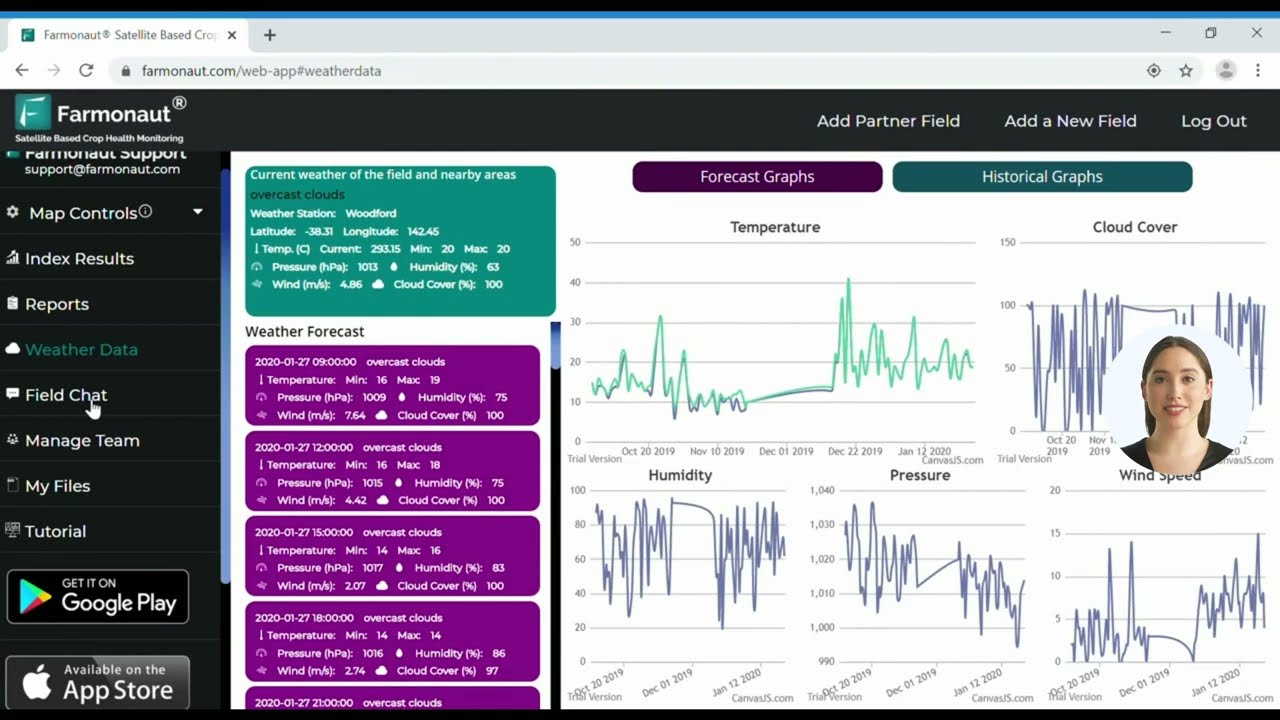
Against that backdrop of season-by-season paddy reporting, scattered tank rehabilitation, and a fruit sector losing 30–40% of its crop to waste, satellite-based monitoring is one of the few tools that can give an individual farmer or an aggregator real-time visibility without waiting for the next government statistical release. Farmonaut’s web and mobile applications, accessible via the Farmonaut web and mobile applications, are built for exactly that gap — available on  and
 .
For a paddy grower deciding when to irrigate ahead of the next Yala or Maha season, or a fruit exporter trying to catch quality problems before the 30–40% waste rate above eats further into margin, the practical toolkit looks like this:
- Real-time, multispectral crop health monitoring (NDVI, NDWI, etc.) to catch stress before it shows up in yield data
- AI-based advisory for customized farming strategies (Jeevn AI Advisory System)
- Blockchain-based traceability for export supply chains — relevant to fruit and spice exporters trying to justify a premium above commodity pricing. See the Product Traceability Page
- Carbon footprinting for buyers or certification bodies asking about sustainability practices — details at Carbon Footprinting
- Satellite-based irrigation monitoring, which matters directly given that roughly three-quarters of Sri Lanka’s paddy area sits outside the 246,700-hectare major-scheme network and depends on tanks or rainfall
- Try it: Run your own numbers

Farmonaut’s platform is also available through  , and for developers or enterprises building on top of the same satellite data, the Developer Documentation and the Farmonaut API provide direct access to the underlying data streams.

For operations managing multiple plots or vehicle fleets rather than a single field, two further tools are relevant: large-scale farm oversight through the Large-Scale Farm Management Solutions, and vehicle or equipment tracking through the Fleet Management Product Page.

Paddy Yield Gap Calculator
Enter your own field’s area and yield against the 2024 Yala-season national average (3,893 kg/hectare) to see the size of your yield gap and what closing it would mean in tonnage.
Run your own numbers
Assumptions: this tool does the arithmetic only — it does not adjust for season (Maha vs. Yala), soil type, irrigation access, or seed variety, all of which affect real-world yield. The default benchmark (3,893 kg/hectare) is the Department of Agriculture’s national average for the 2024 Yala season; swap in a more current figure from the Paddy Statistics portal as new seasons are reported.
Challenges Facing Farming in Sri Lanka
The data above points to several concrete, ongoing pressure points rather than abstract “challenges”:
- Post-harvest loss in fruit: 30–40% of the 590,000-metric-ton annual fruit crop is lost to waste, versus just 11% exported — a gap that points squarely at cold storage, aggregation, and logistics rather than production volume (Export Development Board).
- Irrigation coverage outside major schemes: with only 246,700 hectares covered by the 308 major and 12 lift-irrigation schemes against a total paddy area of 983,550 hectares, a majority of paddy land depends on village tanks or rainfall — which is precisely the gap SARP’s 260-tank rehabilitation program targets.
- Land fragmentation: with 1.65 million smallholders farming under 2 hectares each producing 80% of national food output, scale economies in mechanization and input purchasing are structurally limited — this is also why farmer-organization models like the World Bank-backed 141 groups (44% average sales increase) are being tested as a workaround.
- Climate variability: season-to-season rainfall variation is the primary driver behind why the Department of Agriculture reports Maha and Yala separately rather than as a single annual figure — a Yala shortfall does not necessarily predict the following Maha season’s outcome.
To address financing and risk on the farm-financial side, crop loan and insurance verification with satellite data gives lenders an independent way to confirm crop status, which is particularly relevant for the smallholder majority who may lack other forms of collateral documentation.

New Trends in Agriculture: What’s Actually Changing
Rather than speculative forecasts, three verifiable, ongoing shifts stand out in Sri Lanka’s sector right now:
- Donor-funded tank rehabilitation at scale: SARP’s 260-tank program (2021–2027, $82 million) is the largest currently documented push to restore village-level irrigation infrastructure outside the major-scheme network.
- Farmer-organization models tied to measurable sales gains: the World Bank’s 141 farmer organizations and their reported 44% average sales increase (2022–2024) represent a template that aid agencies are likely to keep replicating if the gains hold up in subsequent reporting — the World Bank press release above is the place to check for any update to that figure.
- High-density planting as a yield lever in fruit: pineapple growers hitting up to 55 metric tons per hectare through high-density systems (Fresh Plaza) suggest intensification, not just area expansion, is where near-term production gains in horticulture are likeliest to come from.
On precision farming and satellite-based monitoring specifically — the subject of the tools described above — no independently published national adoption-rate figure for Sri Lanka was available for this review. If you need that number, the practical path is to check directly with the Department of Agriculture’s extension services or with individual platform providers for their registered-user counts in-country, rather than relying on an industry-wide estimate.
FAQ
-
Q: What percentage of Sri Lanka’s GDP comes from agriculture?
A: 8.3% in 2024, covering agriculture, forestry, and fishing combined, per World Bank data. This is updated annually — check the World Bank indicator page for the current year’s figure.
-
Q: What is the average paddy yield in Sri Lanka?
A: 3,893 kg per hectare for the 2024 Yala season, across 481,316 hectares cultivated, per the Department of Agriculture. Yields differ between the Maha and Yala seasons, so check the Paddy Statistics portal for season-specific current figures.
-
Q: What is the SARP project in Sri Lankan agriculture?
A: The Smallholder Agribusiness and Resilience Project, a $82 million IFAD and Government of Sri Lanka initiative (2021–2027) reaching 40,000 households (148,000 people) across six climate-vulnerable districts, including rehabilitation of 260 village irrigation tanks. Details at sarp.lk.
-
Q: How much of Sri Lanka’s food supply comes from smallholder farmers?
A: About 80%, produced by roughly 1.65 million smallholders farming under 2 hectares each, per World Bank research.
-
Q: Is sustainable agriculture growing in Sri Lanka?
A: Concrete evidence points to donor- and government-backed programs rather than a market-wide organic movement: SARP’s tank rehabilitation and climate-resilience work, and the World Bank’s 141 farmer organizations reporting a 44% average sales increase (2022–2024), are the two most documented current initiatives.
-
Q: What is Sri Lanka’s biggest fruit crop?
A: Banana, occupying about 60,000 of the country’s 69,800 hectares of fruit-crop land — 54% of the total — per the Export Development Board.
-
Q: How is satellite technology used in Sri Lankan farming?
A: Platforms such as Farmonaut provide multispectral crop health monitoring, AI-based advisory, blockchain traceability for exports, carbon footprinting, and irrigation monitoring — relevant given that roughly three-quarters of paddy land sits outside Sri Lanka’s major irrigation-scheme network.
Conclusion and How to Track Updates
The numbers above describe a sector where the fundamentals — smallholder dominance, paddy as the staple, and irrigation as the binding constraint for a majority of that paddy land — are stable, even as year-to-year figures move. What changes fastest are the paddy statistics (every season), the SARP beneficiary and tank-rehabilitation counts (as the 2021–2027 program progresses), and GDP share (annually, with the wider economy). Track the Department of Agriculture’s Paddy Statistics page for season-by-season updates and FAO’s AQUASTAT for irrigation coverage, both of which are refreshed on a recurring schedule rather than as one-off reports.
For farms and agribusinesses that want visibility between those official reporting cycles, satellite-based tools like Farmonaut’s fill the gap with field-level, near-real-time data rather than season-end aggregates.
Explore affordable Farmonaut subscription plans and unlock the full power of satellite-driven agriculture:
Further Reading and Resources
-
Access Farmonaut’s Web and Mobile Platform for Real-Time Satellite-Based Crop Monitoring - Farmonaut API (for enterprises and developers)
- API Developer Docs
- Farmonaut Carbon Footprinting for Sustainable Agri Practices
- Farmonaut Product Traceability for Sri Lankan Crops
- Crop Loan and Insurance Services for Farmers
- Fleet Management Solutions for Large Scale Agri Enterprises
- Large-Scale Farm Management with Satellite Monitoring
Discussion
Questions, corrections or field experience? Share them below. First-time comments are reviewed before they appear, and your email is never published.
No comments yet. Be the first to add a question or your experience.

 MCSOD
 Marei Nursery
 Sayaji Group
 eKGIS
 Mostas Tech
 Native Seeds
 Andex
 FCF India
 Unifrutti Gulf
 Deluxe Conseil
 TVS Electronics
 WICO
 Chimera Innovation
 SkyHarvest
 Polaris Digitech

 Licence holder · Niger · Gold










