

Orchards · Olive care guide
Olive Tree Care: Watering, Pruning, Pests and Frost
Olives need full sun, good drainage, water matched to demand, light pruning and early action on fruit fly, peacock spot and olive knot. A mature California hedgerow orchard used about 26.8 inches of water from April to November (UC Cooperative Extension).
Key takeaways
- In a UC Sacramento Valley example, a mature hedgerow olive used about 3.8 gallons per tree per day in April and 7.8 in July.
- Schedule water as ETo x Kc (x Kr for young trees); UC suggests Kc 0.65 for hedgerow oil orchards and 0.75 for vase-shaped table orchards.
- Avoid fields with a history of cotton, tomato, potato or peppers: Verticillium can survive in soil for at least 30 years (UC IPM).
- Peacock spot infects in fall and winter rain; UC IPM advises preventive protection in late October where it is present.
- A January 2017 freeze with lows of 12 to 19°F cost Texas growers mainly fruit; many trees regrew (Texas A&M AgriLife).
In this article
- Olive tree care at a glance
- Where olive trees grow and why that matters for care
- 1. Pick the right site and prepare the soil
- 2. Plant healthy trees of a suitable cultivar
- 3. Water by demand, not by habit
- 4. Prune to open the canopy
- 5. Feed little and often while trees are young
- 6. Manage pests and diseases early
- 7. Protect trees from frost and check them through the season
- Seasonal olive care calendar
- How we checked the numbers
- FAQ
Good olive tree care comes down to five jobs: a sunny, well-drained site, deep but not frequent watering, light pruning that lets in sun and air, enough nitrogen and potassium, and early action on the few pests and diseases that matter. In California, a mature hedgerow olive orchard used about 26.8 inches of water from April to November, peaking near 7.8 gallons per tree per day in July, according to the University of California young orchards irrigation guide.
This guide covers seven practical steps for orchards and backyard trees in the US, Canada, the UK, Europe and Australia. It includes a monthly water chart, data on where the world’s olive groves are, a pest and disease table, and a calculator that turns your weather data and tree size into gallons per tree per day.
Olive tree care at a glance
The table sums up the seven steps. Each one has its own section below, with the source behind it.
| Step | What to do | When | Main source |
|---|---|---|---|
| 1. Site and soil | Full sun, good drainage, shelter from cold wind; avoid fields with a history of Verticillium hosts | Before planting | UC IPM, RHS |
| 2. Planting | Plant in spring; stake young trees; choose a cultivar suited to your climate and use | Spring | RHS |
| 3. Watering | Water by crop demand (ETo x Kc), more often for young trees | April to November | UC Cooperative Extension |
| 4. Pruning | Thin to open the canopy; remove dead wood and knots | Early spring or dry summer | RHS, UC IPM |
| 5. Feeding | Small, frequent doses for young trees; base mature rates on leaf tests | Growing season | UC Cooperative Extension |
| 6. Pests and diseases | Trap fruit fly, clear old fruit, protect against peacock spot and olive knot | All year, peaks in fall | UC IPM |
| 7. Frost and checks | Protect young and potted trees; watch canopy health over the season | Winter, then monthly | Texas A&M AgriLife, UC |
Where olive trees grow and why that matters for care
The olive (Olea europaea) is an evergreen tree from the Mediterranean. It likes hot, dry summers and mild winters. Most care advice comes from places with that climate, so growers in wetter or colder places need to adjust it.
Europe holds a large share of the world’s groves. Eurostat’s orchard survey counted about 4.6 million hectares of olive trees in the EU in 2023. Spain had 53% of that area and Italy 24%. Greece and Portugal added 14% and 8%. France, Croatia, Cyprus and Slovenia together held about 1%.
Many of those trees are old. Eurostat describes roughly 43% of the EU’s olive trees as old, but it also counted about 246,000 hectares less than five years old in 2023. Old, widely spaced groves and new hedgerow plantings need different care, mainly for water, pruning and harvest.
Demand is steady. The International Olive Council reported world olive oil use of about 3,215,000 tonnes in the 2024/25 crop year, up 15.3% on 2023/24 (provisional data, February 2026). It estimated 3,248,000 tonnes for 2025/26. Table olive use was a little above 3 million tonnes in 2024/25.
Outside Europe, olives grow commercially in California, Texas, Australia, South Africa, Chile, Argentina and North Africa. In Texas, Texas A&M AgriLife reported plantings rising from about 800 documented acres in 2014 to an estimated 4,500 acres by 2017, with growers learning to manage freeze risk. In the UK, the Royal Horticultural Society treats olives mainly as sheltered garden or container trees.
True olives and plants that only share the name
“Black olive” is not a separate kind of tree. Most olive fruit starts green and turns dark purple or black as it ripens; the RHS notes that ripe green fruit turns black and firm on the plant. Black table olives are often just riper fruit, or fruit cured to darken.
The tea olive or sweet olive (Osmanthus fragrans) is a different plant. It is grown for scented flowers, not fruit, and the steps below do not apply to it. The same is true of the “black olive” shade tree sold in Florida (Bucida buceras) and of Russian olive (Elaeagnus angustifolia), which we cover in a separate post.
Chart
Share of EU olive tree area by country
% of about 4.6 million ha, 2023
1. Pick the right site and prepare the soil
Site choice decides most of the work that follows. Olives need full sun and a well-drained soil. The RHS advises a well-drained, sheltered spot, ideally near a sunny wall in cool climates. Wet, heavy soil is the bigger risk for roots than dry soil.
Check the field’s past use. The UC IPM guide to Verticillium wilt says the best protection comes before planting. Avoid land that grew cotton, cucurbits, eggplant, peppers, potato or tomato for several years. The fungus can survive in soil for at least 30 years, and UC advises against soils with more than one microsclerotium per gram. Once trees are in the ground, there is no reliable cure.
- Test the soil before planting for pH, drainage, organic matter and Verticillium if the field had host crops.
- Break up hard pans and fix drainage first. Raised rows or berms help on heavy ground.
- Pick a frost-safe spot. Cold air pools in low ground, so slopes and higher ground are safer.
- Plan the spacing for your system. EU data show 46% of the olive area had fewer than 140 trees per hectare in 2023, 43% had 140 to 399, and 12% had 400 or more.
Chart
EU olive area by planting density
% of EU olive tree area, 2023
2. Plant healthy trees of a suitable cultivar
Buy clean, certified nursery trees. Choose a cultivar for your use (oil or table fruit), your planting density and your disease risk. UC IPM lists Frantoio, Empeltre and, to a lesser degree, Koroneiki as tolerant of Verticillium; it also reports some tolerance in the table cultivars Ascolano and Kalamon (Kalamata).
The RHS advises planting in spring and staking trees until they establish. For containers, it suggests pots of 30 to 35 cm (12 to 14 inches) filled with gritty, loam-based compost, raised on pot feet so excess water drains away.
- Set the tree at the same depth it grew in the nursery.
- Water it in well, then keep the root ball moist while roots spread.
- Keep weeds and grass away from the trunk, since they compete for water and nitrogen.
- Protect trunks from rodents and from mowers or trimmers, because wounds let olive knot bacteria in.
3. Water by demand, not by habit
Mature olives handle drought well, but they still need water to grow and crop well. The best way to schedule it is to match the tree’s water use, not to water on a fixed day. UC Cooperative Extension sets out the method: multiply the reference evapotranspiration (ETo) from a local weather station by a crop coefficient (Kc). For young trees that shade less than 60% of the ground, also multiply by a reduction factor (Kr). UC’s table puts Kr at about 2 x the fraction of ground shaded for small trees, rising more slowly as the canopy grows (about 0.79 at 50% shade and 0.92 at 60%).
Chart
Monthly water use of a mature hedgerow olive orchard
Gallons per tree per day, Sacramento Valley, 12 x 6 ft spacing
The UC guide suggests a Kc of 0.65 for hedgerow oil orchards and 0.75 for vase-shaped table olive orchards in California. Its worked example below is for a mature Sacramento Valley hedgerow orchard at 12 x 6 feet. It uses lower spring Kc values, as UC trials suggest.
Young trees need more care than old ones. The UC guide says irrigation should be frequent in the first year, with more watering events per week, because the root system is small. It also warns against over-irrigation. The RHS gives the same message for pots: keep the compost moist in the growing season, but let excess water drain.
How to tell if a tree is short of water
Weather-based numbers are a starting point. UC advises checking them in the field with soil moisture readings or a pressure chamber. A non-stressed olive has a midday stem water potential of about -11 bars on a 75°F spring day, and about -15 bars on a 100°F, dry August day. UC calls readings below -15 bars mild stress and -20 to -25 bars medium stress. Olives tolerate levels that would shut down almonds or walnuts.
Try the numbers for your own farm below.
Calculator
How much water does each olive tree need per day?
Enter your local ETo, crop coefficient, canopy size and spacing.
- Ground shaded by canopy: 23 %
- Reduction factor Kr: 0.45
- Water per tree per week: 69 gallons
Example values only, not a benchmark or a forecast. Method from UC Cooperative Extension (2024): ETc = ETo x Kc x Kr, with Kr follows UC’s Table 9 (about 2 x the fraction of ground shaded for small trees, then 0.41 at 20%, 0.79 at 50%, 0.92 at 60%), capped at 1. Canopy is treated as a circle. 0.623 converts inches over one square foot to gallons (fixed). Get daily ETo from a local weather network and check the result with soil moisture readings.
4. Prune to open the canopy
Pruning lets sun and air into the tree. That helps fruiting and dries leaves faster after rain, which lowers disease risk. The RHS advises pruning in early spring to keep a good shape and to take out dead, diseased or dying branches. For pot trees, it suggests tip-pruning the main branches back to a good shoot each year.
In orchards where olive knot is present, timing matters more. The UC IPM olive knot guidelines advise pruning out galls during the dry season (July to August in California). The bacteria enter through leaf scars, pruning wounds and freeze cracks, and spread with rain. If you prune at other times, clean your shears often.
- Remove dead wood, crossing branches and suckers at the base.
- Thin dense tops so light reaches the lower and inner shoots.
- Avoid very heavy cuts in one year; spread big changes over two or three seasons.
- Do not prune just before rain in areas with olive knot.
- Chip or compost healthy prunings; remove wood with galls or disease.
5. Feed little and often while trees are young
Young trees need steady nutrition to build a canopy quickly. The UC young orchards guide suggests weekly to fortnightly fertilizing in the first year, for example 4 to 8 grams of urea per plant per dose, alternating with potassium or calcium nitrate. It warns against too much nitrogen as well as too little.
For an intensive mature orchard, the same guide gives annual rates of about 150 kg/ha of nitrogen, 35 kg/ha of phosphorus and 200 kg/ha of potassium. Treat these as a guide for high-density orchards, not a rule for every grove. Base your own rates on leaf analysis, soil tests and yield. Micronutrients such as zinc, manganese and iron go on as foliar sprays only when leaf tests show a need. Check the product label and local rules, and get advice from an agronomist or extension adviser for your site.
For pot trees, the RHS suggests mixing controlled-release fertilizer into the compost and feeding with a balanced liquid fertilizer every month in the growing season.
▶ A plain-English look at simple farming practices that protect soil and water. · 4:34
6. Manage pests and diseases early
Olives have few serious problems, but those few can cost a crop. Integrated pest management (IPM) means checking trees regularly, using traps and clean-up first, and spraying only when needed.
Olive fruit fly
The olive fruit fly causes serious fruit damage in California and is the most damaging olive pest in southern Europe. The UC IPM olive fruit fly guidelines say three or four generations may develop a year, and in warm coastal areas breeding can be continuous. Monitor adults with McPhail, Olipe or yellow sticky traps, hung mid-canopy on the shaded north side and placed by 1 March in warm areas. Count flies weekly.
Sanitation is the base of control. Remove fruit left on trees after harvest and destroy fallen fruit by burying it at least 4 inches deep or taking it to landfill. UC notes that unmanaged landscape trees can be a major source of flies. For oil olives, early harvest and fast processing (within 24 hours, or cold storage) limit the off-flavors caused by rot. Spinosad bait, kaolin clay and mass trapping are acceptable in certified organic orchards; follow the product label and local rules.
Peacock spot
Peacock spot is a leaf disease that causes dark, round spots and early leaf drop. The UC IPM peacock spot guidelines say infection happens mainly in fall, between 35°F and 80°F, with about 48 hours of leaf wetness, or as little as 14 hours near 75°F. Heavy leaf loss weakens the next bloom. Where the disease is present, UC advises a preventive treatment (fixed copper is one listed option) in late October before winter rain, and again in spring if wet weather continues.
Olive knot
Olive knot causes rough galls 0.5 to 2 inches across on twigs and branches. It is worse in wet years and after freezes that crack bark. UC advises a protective spray after harvest in fall and again from March to May, plus dry-season pruning of galls. It also notes that copper may injure trees in low-rainfall areas.
Olive scale, Verticillium and anthracnose
Olive scale is usually held in check by two parasitic wasps. UC IPM’s olive scale guidelines warn that broad-spectrum insecticides can disrupt this control. Pruning to open the canopy helps oil sprays work against the crawler stage.
Verticillium wilt makes branches die back suddenly, often in spring. As noted above, prevention by site choice is the main tool. Olive anthracnose rots fruit, makes it drop or mummify, and lowers oil quality, according to a peer-reviewed review of olive anthracnose. It is worst in wet, warm autumns.
| Problem | Signs | High-risk time | First steps |
|---|---|---|---|
| Olive fruit fly | Stings and tunnels in fruit, maggots | Summer to harvest | Traps, remove old fruit, early harvest |
| Peacock spot | Dark round leaf spots, leaf drop | Fall and winter rain | Open canopy, preventive spray before rain |
| Olive knot | Rough galls on twigs | Wet periods, after freezes | Dry-season pruning, clean tools |
| Olive scale | Small scales, spotted fruit | Late spring and summer | Protect natural enemies, prune |
| Verticillium wilt | Sudden branch dieback | Spring | Avoid infested fields, tolerant cultivars |
| Anthracnose | Fruit rot and mummies | Wet autumns | Timely harvest, canopy airflow |
For all sprays, follow the product label and local rules. Rules on copper and other products differ between the US, the EU, the UK and Australia.
7. Protect trees from frost and check them through the season
Cold is the main limit on where olives grow. A UC Cooperative Extension note by Paul Vossen on olive growing limits says damage depends on how long the cold lasts, how well trees have hardened off, wind and humidity. Cultivar differences are usually only about 5 to 6°F either way. It adds that strong freezes tend to come every 10 to 20 years.
In January 2017, a three-day freeze with lows of about 12 to 19°F hit olive orchards in Central and South Texas, as Texas A&M AgriLife reported. The main loss was fruit. An extension horticulturist said trees frozen to the ground often regrow from roots because the soil stays warm, though growers can lose a couple of years of growth.
- Stop heavy watering and nitrogen in late summer so shoots harden before winter.
- Wrap young trunks and cover canopies with horticultural fleece on cold nights; the RHS says heavier fleece gives about 2°C of protection.
- Move pot trees to a frost-protected place for winter and do not put them out again until frost danger has passed.
- After a freeze, wait for spring growth before cutting back, so you can see what is alive.
Checking a whole orchard
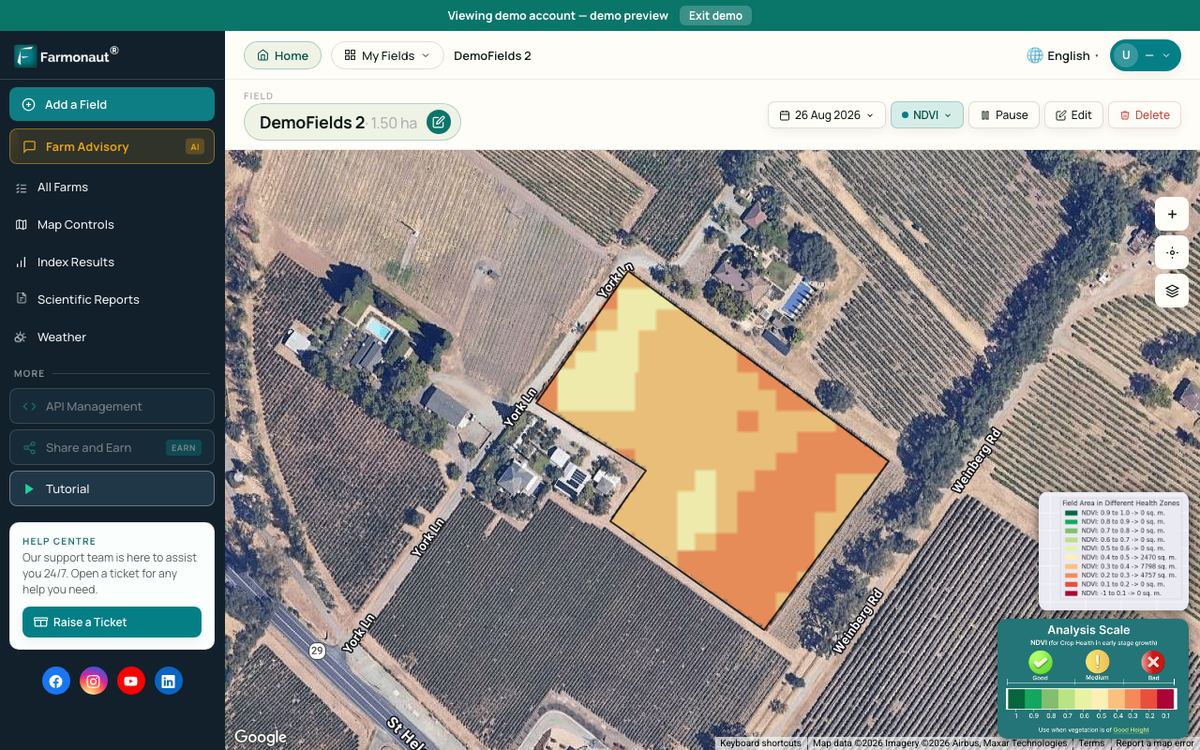
Walking every row each week is hard on larger blocks. Satellite vegetation maps can show which parts of an orchard are greener or weaker than the rest over time. They do not name the cause, but they show where to look first for a leak, a blocked emitter, a disease patch or frost damage. Farmonaut offers this kind of field monitoring from satellite images, and its results should always be checked on the ground.

▶ How to monitor fields with satellite crop health maps in the Farmonaut web app. · 8:43
Seasonal olive care calendar
Dates below follow the Northern Hemisphere and California timing used by UC. In Australia, South Africa and South America, shift them by about six months.
- Winter: protect young and pot trees from frost; check for freeze cracks; plan pruning.
- Early spring: prune in dry weather; place fruit fly traps by 1 March in warm areas; plant new trees.
- Spring: start irrigation as ETo rises; feed young trees often; repeat olive knot and peacock spot protection if wet.
- Summer: peak water use (July in the UC example); watch for scale crawlers and fruit fly; prune out knots in the dry season.
- Fall: harvest at the right ripeness; process fruit quickly; spray against peacock spot and olive knot before rain where needed; clear leftover fruit.
How we checked the numbers
Water figures come from the University of California’s young orchards guide (Chapter 6, olive). Pest and disease timings come from the UC Statewide IPM Program’s olive guidelines, which are written for California and are a good guide for other dry-summer regions. Area data come from Eurostat’s 2023 orchard survey, and consumption data from the International Olive Council’s February 2026 statistics. Garden and container advice comes from the Royal Horticultural Society. Where we give rates or sprays, they are examples from these sources, not a plan for your farm.
Related pages on our site: farm monitoring apps, multi-farm management, satellite and weather API documentation, product traceability, farm carbon footprinting, crop loans and insurance, farm fleet management.
FAQ
How often should I water an olive tree?
It depends on weather, tree size and soil. In UC’s Sacramento Valley example, a mature hedgerow tree used about 3.8 gallons a day in April and 7.8 gallons a day in July. Young trees need water more often in smaller amounts. Use the calculator above with your own weather data, then check soil moisture.
When is the best time to prune an olive tree?
The RHS advises early spring for garden trees. In orchards with olive knot, UC IPM advises pruning galls in the dry season (July to August in California) and cleaning tools often. Avoid pruning just before rain.
How cold can an olive tree survive?
There is no single figure. UC notes that the effect of cold depends on how long it lasts and how hardened the trees are, and that cultivars differ by only about 5 to 6°F. A freeze with lows of 12 to 19°F damaged Texas orchards, mainly the crop, though many trees regrew.
Why are my olive tree’s leaves falling off?
Common causes are peacock spot (dark round spots, mainly on lower leaves), frost damage, waterlogged roots or severe drought. Look at the leaves and the soil before treating. Peacock spot needs protection before fall rains.
Can I grow an olive tree in a pot?
Yes. The RHS suggests a 30 to 35 cm pot with gritty, loam-based compost, monthly liquid feeding in the growing season and a frost-protected place in winter. Raise the pot on feet so it drains.
Is a tea olive the same as an olive tree?
No. Tea olive (Osmanthus fragrans) is a flowering shrub grown for scent. It does not produce olives and needs different care.
Farmonaut crop monitoring
See your olive blocks from space
Compare canopy health across your orchard over the season and know where to check first.



Keep reading

Sources
- University of California Cooperative Extension, Irrigation and Nutrient Management of Young Orchards (2024): ucanr.edu
- Eurostat, Agricultural production – orchards (2023 data): ec.europa.eu
- International Olive Council, Olive sector statistics January/February 2026: internationaloliveoil.org
- Texas A&M AgriLife Today, Freeze stunts Texas olive industry: agrilifetoday.tamu.edu
- Royal Horticultural Society, How to grow olives: rhs.org.uk
- UC IPM, Olive: Verticillium wilt: ipm.ucanr.edu
- UC IPM, Olive: Olive knot: ipm.ucanr.edu
- UC IPM, Olive fruit fly: ipm.ucanr.edu
- UC IPM, Olive: Peacock spot: ipm.ucanr.edu
- UC IPM, Olive: Olive scale: ipm.ucanr.edu
- Talhinhas et al., Olive anthracnose review, Molecular Plant Pathology (PMC): pmc.ncbi.nlm.nih.gov
- Paul Vossen, UC Cooperative Extension, Olive growing limits: ucanr.edu
- UC IPM, Olive pest management guidelines: ipm.ucanr.edu
Discussion
Questions, corrections or field experience? Share them below. First-time comments are reviewed before they appear, and your email is never published.
No comments yet. Be the first to add a question or your experience.

 Adinet
 Save Your Soils
 GalaxEye Space
 Grandstream Algérie
 XOS Realty
 Geospatial Lab Africa
 Agro La Gándara
 HIPSAC
 ZOL Zimbabwe
 Juligerm
 AdBio
 MISE Maroc
 NWNS
 Red August Group
 Farm Inc
 WeMe Global
 Agrotoken
 Blue BearX
 Insignito
 DnCubed
 Indosistim Teknologi
 Liquify Digital
 CU Foods
 BeyondTech Global
 Rouge VC

 Licence holder · Niger · Gold
 Licence holder · Nigeria · Gold + lithium
 Client · Somalia · Gold










