

Farm advice · Examples guide
Agricultural Extension Services Examples: 7 Programs
Agricultural extension services carry research to farmers as advice, training and trials. Seven running examples: US Cooperative Extension, 4-H, SARE, Teagasc in Ireland, AHDB Monitor Farms, Alberta’s 310-FARM line and FAO Farmer Field Schools.
Key takeaways
- US Cooperative Extension has had federal backing since a law of May 8, 1914; Smith-Lever extension capacity funding was $325 million in FY2024 (APLU).
- Teagasc says its advisory programme supports almost 140,000 Irish farmers, with 44,000 under contract each year (Teagasc, 2023).
- Teagasc’s basic Club package costs €225 to €375 a year by farm size (list prices effective January 2026).
- FAO says Farmer Field Schools have reached more than 10 million farmers.
- In ten low- and middle-income countries studied by FAO (2014), no more than 25% of farms used public extension.
In this article
- Agricultural extension services examples at a glance
- What agricultural extension means
- Seven agricultural extension services examples
- How agricultural extension is funded
- What extension advice costs a farmer
- How to choose an extension service
- Is a practice your adviser suggests worth trying?
- Digital tools and satellite data in extension
- Challenges extension services face
- How we chose these examples
- FAQ
Agricultural extension services take research from universities and public agencies to farmers as advice, training and field trials. Clear examples include US Cooperative Extension, which federal law has backed since 1914, the 4-H youth program, Teagasc advisers in Ireland, AHDB Monitor Farms in Britain, the 310-FARM line in Alberta and FAO Farmer Field Schools.
This guide explains seven agricultural extension services examples, what each one does, who pays for it and what it costs a farmer. It adds dated funding and fee charts, a short guide to choosing a service, and a calculator that tests whether a practice an adviser suggests is worth trying on your own acres.
Agricultural extension services examples at a glance
The table sums up the seven programs. Each has its own section below with the source behind it.
| Program | Country | How it works | Best for |
|---|---|---|---|
| Cooperative Extension | United States | County agents and university specialists | Farm owners who want local, research-based advice |
| 4-H | United States | Clubs and hands-on projects for young people | Families and youth learning farm skills |
| SARE | United States | Competitive grants for farmer-led trials | Growers who want to test a new practice |
| Teagasc | Ireland | Paid advisory contracts and discussion groups | Dairy, beef and tillage farms |
| Monitor Farms | United Kingdom | Host farms run trials and open meetings | Arable farmers who learn from peers |
| 310-FARM | Canada (Alberta) | Phone and email help desk | Quick answers and referrals |
| Farmer Field Schools | Worldwide (FAO) | Groups meet through one growing season | Learning by doing, pest and soil topics |
What agricultural extension means
Agricultural extension is the work of carrying research results to the people who farm. In the United States, the law describes the aim as spreading useful and practical information on subjects relating to agriculture and encouraging people to apply it. That law dates from May 8, 1914, and it still sets up extension as a partnership between USDA and the land-grant universities.
Extension is wider than a single visit from an adviser. It can be a meeting on a host farm, a phone line, a soil test explained by a specialist, a grant to run a trial, or a group that meets every week of the season. Some services are paid for by taxes, some by farm levies and some by fees from the farmer.
Extension also works in two directions. Good services take farmers’ questions back to researchers, so the next trials answer real problems. The examples below show both public and levy-funded models, and they come from the markets we write for: North America, the UK and Ireland, plus one global program.

▶ Twenty careers in agriculture and what each one pays in the US, including advisory and science roles. · 7:04
Seven agricultural extension services examples
Each example lists what it does, how it is paid for and who gets the most out of it.
1. US Cooperative Extension
Cooperative Extension is the network of county offices and university specialists linked to the land-grant system. USDA’s National Institute of Food and Agriculture (NIFA) passes federal money to the states through the Smith-Lever Act capacity grant, and states and counties add their own funds.
The money follows a formula written into the law. After a share kept for national work, 20% is split equally among the states, 40% goes by each state’s share of the rural population and the rest by its share of the farm population. So states with larger rural and farm populations get larger shares.
A farmer usually meets extension through a county agent, a field day or a fact sheet. Many university extension services publish guides on sprayer calibration, seed handling, soil fertility and pest control. These guides are written for local soils and weather, which is their main strength.
Best for: farm owners in the US who want local, research-based answers and a person to call.
2. 4-H youth programs
4-H is the youth arm of Cooperative Extension. National 4-H Council says it is delivered by Cooperative Extension through more than 100 public universities and reaches nearly six million young people (4-H, 2026). Members complete hands-on projects in agriculture, science, health and civic life, guided by adult volunteers.
For farm families, 4-H is often the first contact with extension. Livestock, crop and machinery projects teach record keeping and safe handling, and they bring the family into contact with county agents.
Best for: farm families and young people who want to learn farming skills by doing.
3. SARE grants for farmer-led trials
The Sustainable Agriculture Research and Education program, or SARE, is a grants and education program funded by NIFA and run through four regions hosted by land-grant institutions. SARE says that since 1988 it has funded thousands of projects on profit, land stewardship and quality of life for farmers and ranchers.
SARE matters because it lets a farmer, not only a researcher, lead a trial. Its grant lines include research and education grants, professional development grants for extension staff, and grants for producers. Results are shared in bulletins so other growers can learn from them.
Best for: growers who want to test a new practice on their own farm with outside support.
4. Teagasc advisory service in Ireland
Teagasc is Ireland’s Agriculture and Food Development Authority. It describes itself as the national body that provides integrated research, advisory and training services to farming and food. Research farms, colleges and local advisers sit in one organisation, so advice can follow new results quickly.
The scale is large for a small country. A Teagasc regional review says its advisory programme supports almost 140,000 individual farmers, with 44,000 contracted for services each year (Teagasc, 2023). Discussion groups, where a group of farmers meets on each other’s farms with an adviser, are a core method.
Unlike US county extension, Teagasc charges fees. That makes it a useful example of what advice costs when the farmer pays part of the bill. The fee chart further down shows the 2026 rates.
Best for: dairy, beef, sheep and tillage farms in Ireland that want a named adviser and a peer group.
5. AHDB Monitor Farms in Britain
The Agriculture and Horticulture Development Board (AHDB) is funded by levies that farmers and processors pay. Its Cereals and Oilseeds Monitor Farm Network links levy-paying farms that run on-farm trials and host meetings. AHDB says farms can join for just one season or for the traditional three-year programme, and each farm works with a regional Knowledge Exchange Manager who writes yearly reports.
Trial topics come from farmers and from AHDB research. Because the trials run on a working farm, neighbours can see the results in the field rather than on a slide.
Best for: arable farmers in England who learn best from other farmers and want to see trials up close.
6. Alberta’s 310-FARM line in Canada
Many Canadian provinces run their own farm information services. In Alberta, the 310-FARM line, previously known as the Ag-Info Centre, has resource agents who help with inquiries or refer callers to the right department or industry contact (Government of Alberta, 2026). It is open on weekdays.
A phone line is a light form of extension. It does not replace a field visit, but it gets a farmer to the right program, rule or specialist quickly. It shows how extension often works as a referral hub.
Best for: Alberta farmers who need a quick answer or the right contact.
7. FAO Farmer Field Schools
A Farmer Field School is a group of farmers, herders or fishers who meet regularly through one production cycle, set up their own experiments and learn by doing. FAO’s global platform says the approach has reached more than 10 million farmers and links a community of over 3,000 practitioners in 135 countries.
The method began with pest management and now covers soil, livestock, climate and nutrition. Its strength is that farmers test ideas on their own plots and compare results with each other, instead of receiving one-way advice.
Best for: groups of farmers who want to compare practices side by side through a full season.
How agricultural extension is funded
Public extension in the US runs mostly on formula money. In fiscal year 2024, Congress gave $325 million to Smith-Lever sections 3(b) and 3(c), the main extension capacity line, and $72 million to extension at the 1890 land-grant universities, according to the APLU appropriations chart for FY2025. Both were flat on FY2023. The Hatch Act line, which funds state agricultural experiment stations, received $265 million.
Chart
Selected NIFA extension and research lines
US$ million, federal fiscal year 2024 appropriations
The research that extension passes on is under pressure too. USDA’s Economic Research Service reports that public agricultural R&D spending in high-income countries grew from $3.9 billion in 1960 to a peak of $18.6 billion in 2009, then fell to $17.5 billion by 2013, in constant 2011 dollars. ERS also notes that US public agricultural R&D peaked in 2002 and had fallen by about a third by 2019.
ERS cites studies that put annual returns to public agricultural research at 20% to 60%. Extension is one of the ways those returns reach farms, since a trial result only pays off once growers adopt it.
Chart
Public agricultural R&D in high-income countries
US$ billion, constant 2011 dollars, years reported by ERS
What extension advice costs a farmer
In the US, federal, state and county money pays for the core of Cooperative Extension, so much basic advice is publicly funded. In Ireland the farmer pays part of the cost. Teagasc publishes its advisory charges, effective January 2026, by farm size measured in income units.
Chart
Teagasc yearly advisory fees by farm size
€ per year, core contract, by income units (IU); list prices effective January 2026
The basic Club package costs from €225 a year for the smallest farms to €375 for the largest. The Technology package, which adds a farm visit or extra adviser time, runs from €285 to €455. A place in a discussion group alone costs €350 a year. These are Teagasc’s published list prices.
Reach differs by type of farm. In the Tipperary review, Teagasc clients made up 39% of all farmers in the region in 2022, but the share was 61% for dairy farms and 3% for sheep farms.
Chart
Share of farms that are Teagasc clients, Tipperary
% of producers of each type in the region, 2022
How to choose an extension service
Use these steps to find advice that fits your farm.
- Start local. Find your county extension office, provincial ag line or national advisory body. Local advice matches your soils, weather and rules.
- Name the problem. A clear question, such as low yield on one field or a new pest, gets a better answer than a general request.
- Check who pays. Public and levy-funded services carry no direct fee for many tasks. Paid advisers should give a written fee scale, as Teagasc does.
- Look for peer groups. Discussion groups, Monitor Farms and Field Schools let you see results on real farms.
- Ask for evidence. Good advisers can point to the trial or fact sheet behind a recommendation.
- Test on a small area first. Try a new practice on one field and compare it with the rest before you change the whole farm.
Advice on fertilizer, pesticides, grants and tax should always be checked against the product label, local rules and, for money or legal matters, a qualified professional.
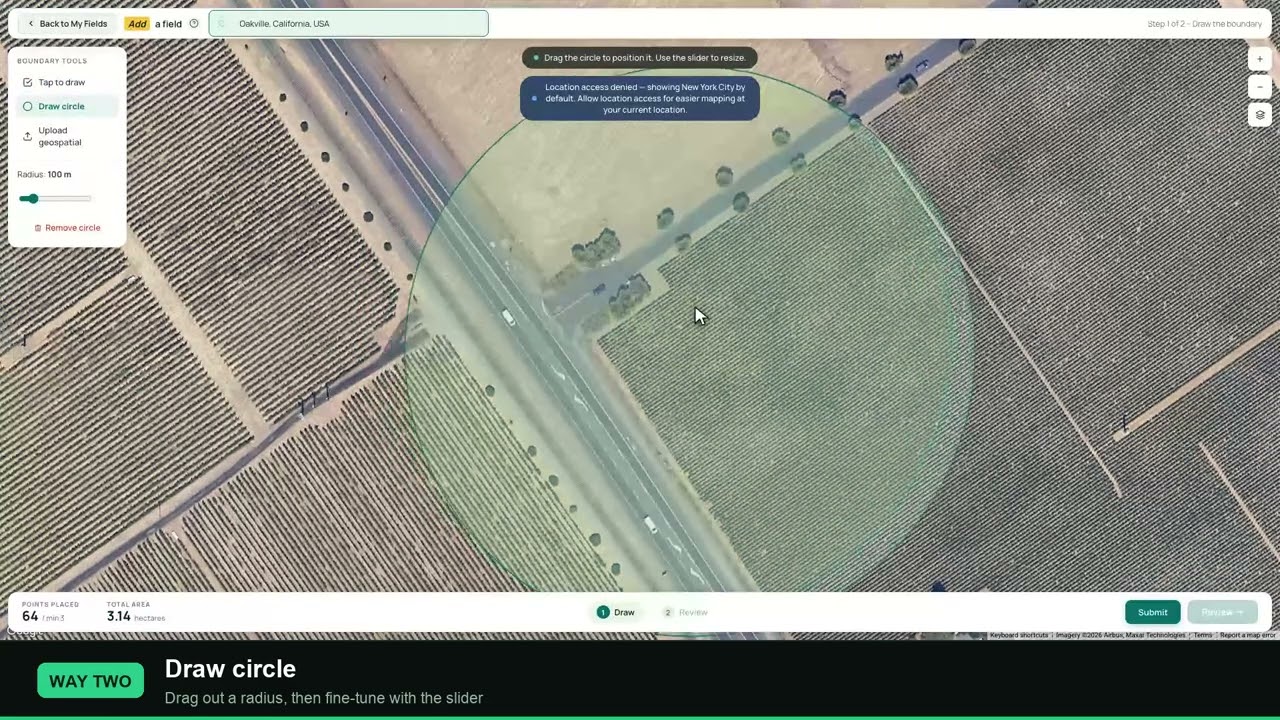
▶ How to add a field boundary in Farmonaut, all three ways, before testing a practice on one field. · 3:50
Is a practice your adviser suggests worth trying?
Extension advice often comes down to one question: will the extra yield pay for the extra cost? Enter your own area, the yield gain you expect, your crop price, the added cost per acre and any one-off fees, such as an adviser visit or a soil test. The example values are set close to break-even on purpose. They are not a forecast.
Try the numbers for your own farm below.
Calculator
Does the extra yield pay for the extra cost?
Enter your own area, yield gain, price and costs.
- Extra income from yield gain (US$): $1,600
- Total added cost (US$): $1,600
- Yield gain needed to break even: 2.00 bu/acre
Example values only, set near break-even; they are not a benchmark or forecast. Every number is your input, so use today’s price for your crop. One year only; it ignores risk, tax and any grant.
Digital tools and satellite data in extension
Extension now reaches many farmers by phone, email, webinar and app as well as in person. The Alberta line and the online fact sheets from US land-grant universities are both examples. Satellite crop maps are another tool: an adviser and a farmer can look at the same vegetation map and decide which part of a field to walk first.
The Farmonaut Satellite + AI Farm Monitoring System is one such tool. It shows satellite vegetation maps of fields that you draw once, on the web or in the Android and iOS apps. Groups and advisers can manage many farms in one place with an admin dashboard for agribusinesses, and developers can connect field data to their own systems through an agriculture data API and its developer documentation. A map shows where plants change; it does not show the cause, so a field visit is still needed.

▶ A tutorial on the Farmonaut web app: satellite crop health maps and indices for your own fields. · 8:43
Challenges extension services face
The biggest challenge is reach. FAO’s report The State of Food and Agriculture 2014 found that in a sample of ten low- and middle-income countries with data, the share of farms that used public extension did not exceed 25% in any country. The same report found that smaller farms were less likely to get extension information than larger ones, and that women farmers had less access than men.
Measuring the effort is also hard. FAO notes that the last global estimate of public extension spending dates from 1988, at about $5 billion, and that private and NGO advice is very hard to count. Funding pressure is a third issue: flat budgets in the US and falling public research in high-income countries mean fewer staff for each farm.
Services have answered with peer groups, paid packages and digital channels. Discussion groups and Monitor Farms spread one adviser’s time across many farms. Phone lines and online guides reach people who cannot attend meetings. Fees, as in Ireland, keep services running but can leave out farms with low incomes.
How we chose these examples
We picked programs that are running in October 2026, that publish facts about how they work, and that serve farmers in North America, the UK and Ireland, plus one global FAO program. We used each program’s own pages, US law, USDA data and FAO reports. We left out programs whose reach or results we could not trace to a primary source. This is not a ranking; each program suits a different kind of farm.
FAQ
What are agricultural extension services?
They are programs that take research results to farmers as advice, training, field trials and information. Examples include US Cooperative Extension, Teagasc in Ireland, AHDB Monitor Farms in Britain and FAO Farmer Field Schools.
What are some examples of extension services in agriculture?
County extension agents, 4-H clubs, SARE farmer grants, adviser-led discussion groups, host-farm trials, farm help lines such as Alberta’s 310-FARM, and Farmer Field Schools are all examples. They differ in who pays and how farmers take part.
What types of extension services are there?
The main types are one-to-one advice, group methods such as discussion groups and field schools, demonstration farms, mass media and online guides, and grants for farmer-led trials. Many services combine several types.
Who pays for agricultural extension?
In the US, federal Smith-Lever money is matched by states and counties. In Britain, AHDB work is paid for by farm levies. In Ireland, Teagasc combines public funding with farmer fees, such as €225 to €375 a year for its basic package (2026 list prices).
How do I contact my local extension service?
In the US, search for your county extension office through your state’s land-grant university. In Canada, contact your provincial agriculture ministry. In Ireland, contact your Teagasc advisory region, and in England, AHDB’s regional Knowledge Exchange Managers.
Related pages on our site: food supply chain traceability, farm carbon footprint tracking, satellite data for crop loans and insurance and farm vehicle fleet management.
Farmonaut crop monitoring
See your own fields from space
Draw your fields once and Farmonaut shows satellite vegetation maps for them through the season, on web, Android or iOS.




Keep reading
Sources
- Cornell LII, 7 U.S. Code § 341 (Smith-Lever Act, 1914): law.cornell.edu
- Cornell LII, 7 U.S. Code § 343 (extension funding formula): law.cornell.edu
- USDA NIFA, Smith-Lever Act Capacity Grant: nifa.usda.gov
- APLU, FY2025 Appropriations Priorities chart (2024): aplu.org
- USDA ERS, Agricultural Research and Productivity: ers.usda.gov
- National 4-H Council, About 4-H (2026): 4-h.org
- SARE, About SARE: sare.org
- Teagasc, About Teagasc: teagasc.ie
- Teagasc, Tipperary Advisory Region Review Report and Action Plan (2023): teagasc.ie
- Teagasc, Advisory Charges (effective January 2026): teagasc.ie
- AHDB, Cereals and Oilseeds Monitor Farm Network: ahdb.org.uk
- Government of Alberta, 310-FARM: alberta.ca
- FAO, Global Farmer Field School Platform: fao.org
- FAO, The State of Food and Agriculture 2014: fao.org
Discussion
Questions, corrections or field experience? Share them below. First-time comments are reviewed before they appear, and your email is never published.
No comments yet. Be the first to add a question or your experience.

 Rashail Infotech
 Unifrutti Gulf
 Deluxe Conseil
 TVS Electronics
 BW Pipelines
 WICO
 Gen Chayat
 Chimera Innovation
 SkyHarvest
 Polaris Digitech
 Teledarbas
 Wild Oak Farm
 SFX
 Doodlakine
 Exurbia Geospatial

 Licence holder · Niger · Gold










