

Reviewed August 2026 against USDA NASS Farm Labor Survey and USDA ERS precision agriculture adoption data.
Try it: Run your own numbers →
Table of Contents
- What Agriculture Ad Agencies and Marketing Agencies Actually Do
- Agriculture Ad Agencies vs. Agriculture Marketing Agencies
- Video: Opportunities in Modern Agri-Business
- Who Hires These Agencies, and Why the Market Is Fragmented
- Video: Regenerative Agriculture & Climate-Smart Solutions
- Selecting an Agency: A Comparison Framework
- The Digital Adoption Numbers Agencies Are Marketing Into
- Where Farmonaut Fits: The Alternative to Hiring an Agency
- Video: JEEVN AI – Smart Farming Insights
- Farm Work in Australia: A Note for the “Apply 2026” Searches
- Video: Web Systems for Satellite Crop Monitoring
- Calculator: Agency Fee vs. In-House Platform Cost
- A Durable Checklist for Vetting Any Agriculture Agency
- Farmonaut Apps, APIs, and Developer Tools
- More Technology Videos
- FAQ
What Agriculture Ad Agencies and Marketing Agencies Actually Do
An agriculture ad agency builds and places advertising—print, broadcast, paid digital, trade-show creative—for seed, equipment, chemical, and farm-service brands. An agriculture marketing agency runs the broader function: brand strategy, content, email, SEO, and often the ad buys too. In practice the two labels overlap heavily, and most firms that call themselves one will happily do the other’s work. The distinction matters mainly when you’re writing a scope of work, not when you’re searching for a vendor.
There is no federal registry, trade census, or market-size figure for “agriculture ad agencies” as a distinct sector. The American Advertising Federation tracks agency membership generally but does not break out an agricultural vertical, and no equivalent to a USDA census exists for marketing-services firms. That gap is real and worth naming up front: any number you see quoted for “the agriculture marketing industry” in the US is somebody’s estimate, not a government figure. What you can verify instead is the market these agencies sell into—US farm employment, wages, and technology adoption—which is documented and cited below.
Agriculture Ad Agencies vs. Agriculture Marketing Agencies
If you’re comparing quotes, ask each firm to state plainly which of these they do, because “full service” often means “we subcontract the parts we don’t do”:
- ✔ Ad agencies typically own: media buying, creative production, campaign placement (print ag titles, radio, paid social, programmatic display), and trade-show collateral.
- 📊 Marketing agencies typically own: brand positioning, website and SEO, email and CRM programs, content (blogs, case studies, video), and market research.
- ⚠ Overlap risk: A firm billing itself as either can lack in-house capability for the other and quietly subcontract it—ask directly who executes each deliverable.
- ✔ Specialist vs. generalist: Agencies with named agricultural clients (seed, equipment, ag-chem, farm finance) understand planting-season timing and commodity-price sensitivity that a generalist agency will not.
- Try it: Run your own numbers
The safest way to compare agencies is by deliverable, not by label. Ask each finalist for three past agricultural campaigns with actual metrics—impressions, cost-per-lead, or sales lift—not case-study prose.
Video: Opportunities in Modern Agri-Business

Who Hires These Agencies, and Why the Market Is Fragmented
The buyers are agribusinesses selling to farmers, not farmers themselves: seed and chemical companies, equipment dealers and manufacturers, farm insurance and lending firms, co-ops, and ag-tech startups. That buyer base is large and dispersed because US agricultural employment itself is dispersed. USDA’s Economic Research Service and Bureau of Labor Statistics put total agricultural employment—all jobs, including self-employed farmers and hired labor—at 1.18 million in 2024, up 10% from 2010 (USDA ERS). Layered on top, USDA NASS’s Farm Labor Survey counted 637,000 hired farm workers employed during the reference week of April 6–12, 2025, at an average gross wage of $19.52 per hour as of April 2025 (USDA NASS Farm Labor Survey).
That employment figure is refiled quarterly by NASS and does not include a national breakdown by region, crop, or agency-placement channel in the currently available release—most hired workers are placed directly by farm operators or by farm labor contractors, not by third-party marketing or staffing agencies, so treat “agriculture work agency” volume claims skeptically unless a source names its data. For a current count, pull the latest release directly from the NASS Farm Labor page linked above rather than relying on any figure printed here.
Video: Regenerative Agriculture & Climate-Smart Solutions

Selecting an Agency: A Comparison Framework
Because no independent ranking of agriculture ad or marketing agencies exists in any federal or trade-association dataset, the table below is a framework for scoring finalists yourself, not a list of vetted vendors. Score each candidate 1–5 on every row and total the columns.
| Evaluation Criterion | What to Ask | Red Flag | Good Sign |
|---|---|---|---|
| Agricultural client history | Name 3 current ag clients and contract length | Vague industry references, no names | 2+ years with named seed/equipment/chem brands |
| Media buying capability | Do they buy directly or subcontract? | Marks up a third-party media buyer silently | Direct relationships with ag trade publications |
| Reporting cadence | What metrics, how often? | “We’ll send a report at the end” | Monthly dashboards with cost-per-lead data |
| Seasonal awareness | How do they plan around planting/harvest windows? | Generic campaign calendar, no ag-season logic | Campaign timing tied to regional planting dates |
| Content/SEO depth | Do they write agronomic content or outsource it? | Templated blog posts with no farm specificity | In-house writer with agronomy or farm background |
| Pricing model | Retainer, project, or performance-based? | No willingness to discuss performance metrics | Transparent retainer plus clear deliverable list |
Run this against at least three finalists before signing. A firm that scores well on client history but poorly on reporting cadence is a common failure mode—strong creative, weak accountability.
The Digital Adoption Numbers Agencies Are Marketing Into
Any agency pitching digital campaigns to farm audiences should be able to speak to the actual connectivity and technology-adoption baseline they’re targeting. USDA’s Economic Research Service reports that, as of 2025, 55% of US farms have a broadband internet connection, 74% have cellular data plan access, and 29% use the internet to market their agricultural activities (USDA, Precision Agriculture in the Digital Era). That 29% figure is the ceiling on how many farm operations are even reachable through farmer-facing digital marketing today—useful context if an agency promises broad digital reach into the farm-operator audience itself, as opposed to the agribusiness audience that buys from farmers.
On the technology side, adoption of automated guidance systems (auto-steer) has passed 50% of acreage on major US row crops in recent USDA survey years, while adoption of yield maps, soil maps, and variable-rate input technology sits at 5–25% of acreage depending on the specific technology and crop (USDA ERS, EIB-248). That spread—guidance systems mainstream, variable-rate tools still a minority practice—is exactly the kind of granular figure an agriculture-tech buyer should demand from any agency claiming to understand “precision ag marketing,” because pitching variable-rate technology as already-standard practice overstates adoption by a wide margin.
None of these figures have a fixed refresh date attached in the source documents reviewed here. USDA ERS updates precision-agriculture adoption estimates periodically as new survey data becomes available; check the EIB-248 publication page and the ERS Precision Agriculture in the Digital Era report directly for the current release before citing these numbers in a pitch deck.
Where Farmonaut Fits: The Alternative to Hiring an Agency
Some of what agriculture marketing agencies sell—demonstrating a farm operation’s environmental performance, tracing product origin for buyers, communicating sustainability claims—can be done directly with data instead of a campaign. Farmonaut builds the underlying satellite and AI tools that let agribusinesses generate their own verifiable claims rather than paying an agency to write unverifiable ones.
- ✔ Satellite-Based Monitoring—real-time farm management at scale, tracking crop health and soil conditions remotely across an operation.
- ✔ Blockchain-Based Traceability—our traceability solution gives agribusinesses a documented, auditable supply chain story instead of a marketing claim.
- ✔ Fleet Management—smart fleet management tools for logistics-heavy agricultural enterprises.
- ✔ Carbon Footprinting—our carbon footprinting tools produce sustainability figures a business can publish and stand behind, rather than paraphrase from an agency deck.
- ✔ Farm Skill & Land Development Resources—see our writeup on agriculture skill development and land development trends for how the workforce side of this is shifting.
This is not a substitute for advertising or brand strategy—it’s a substitute for the parts of “agriculture marketing” that are really data problems wearing marketing language. An agribusiness that can show verified carbon or traceability numbers has a stronger pitch than one that hired an agency to describe sustainability in the abstract.
Before signing an agency retainer for sustainability or traceability messaging, check whether the underlying data already exists via the Farmonaut App. Verified numbers make better marketing than adjectives.
Video: JEEVN AI – Smart Farming with Satellite & AI Insights

Farm Work in Australia: A Note for the “Apply 2026” Searches
If you landed here searching for how to apply for farm work in Australia, this article won’t get you there—it covers US agriculture marketing and advertising agencies, not Australian visa or seasonal-work placement. Australia’s farm work and Working Holiday visa programmes, harvest trail listings, and labour-hire licensing rules are administered by Australian government bodies and are outside the US-focused scope and evidence base of this piece. Search for “Australian government harvest trail” or your relevant visa subclass directly with the Department of Home Affairs and Workforce Australia for current, authoritative guidance rather than relying on a US agriculture-marketing resource for it.
Video: Farmonaut Web System Tutorial – Monitor Crops via Satellite & AI

Calculator: Agency Fee vs. In-House Platform Cost
Estimate whether an agency retainer or a direct data/software platform costs less over a year for a defined marketing task, based on the inputs you enter below.
Run your own numbers
Assumptions: compares only direct fees and staff time you enter; excludes creative quality, campaign performance, opportunity cost, and one-time setup or onboarding fees. Figures are illustrative starting points—replace every input with your own quotes.
A Durable Checklist for Vetting Any Agriculture Agency
Agency rosters, pricing, and case studies change constantly, but the questions that separate a competent agency from a weak one don't. Use this list regardless of what year you're reading it:
- Ask for three references with named agricultural clients and call them. A firm that can't produce three is not primarily an agriculture agency.
- Request their most recent campaign metrics—cost-per-lead, engagement rate, or attributable sales lift—not just creative samples.
- Confirm who actually executes media buys versus who subcontracts them, and at what markup.
- Check their content team's agricultural literacy—can they write correctly about planting windows, input costs, or crop insurance without factual errors?
- Verify their data claims against a primary source. If an agency cites farm connectivity or technology-adoption statistics in a pitch, cross-check the figure against the USDA ERS or NASS page it claims to come from before you approve the campaign angle.
- Get the pricing model in writing—retainer, project-based, or performance-based—before any creative work starts.
Any agency that cannot show you a specific, checkable number from a named agricultural client campaign—not an industry-wide claim, a number from their own work—has not proven anything yet. Insist on it before you sign.
Farmonaut Apps, APIs, and Developer Tools



📲 Farmonaut Apps let agribusinesses, agencies, and individual operations monitor fields, manage fleets, and access AI-based advisories from any device.
API Integrations — for developers and marketing-tech teams building data-driven campaigns, unlock field data, crop insights, and weather predictions via our API. See the API developer docs for integration details.
For a deeper look at yield-boosting practices agencies often reference in farmer-facing content, see our piece on the integrated farming system model. And for how satellite-based finance tools intersect with agribusiness messaging, see our crop loan & insurance solutions.
Video: How AI Drones Are Saving Farms & Millions
Video: Cultivating Innovation in Agriculture
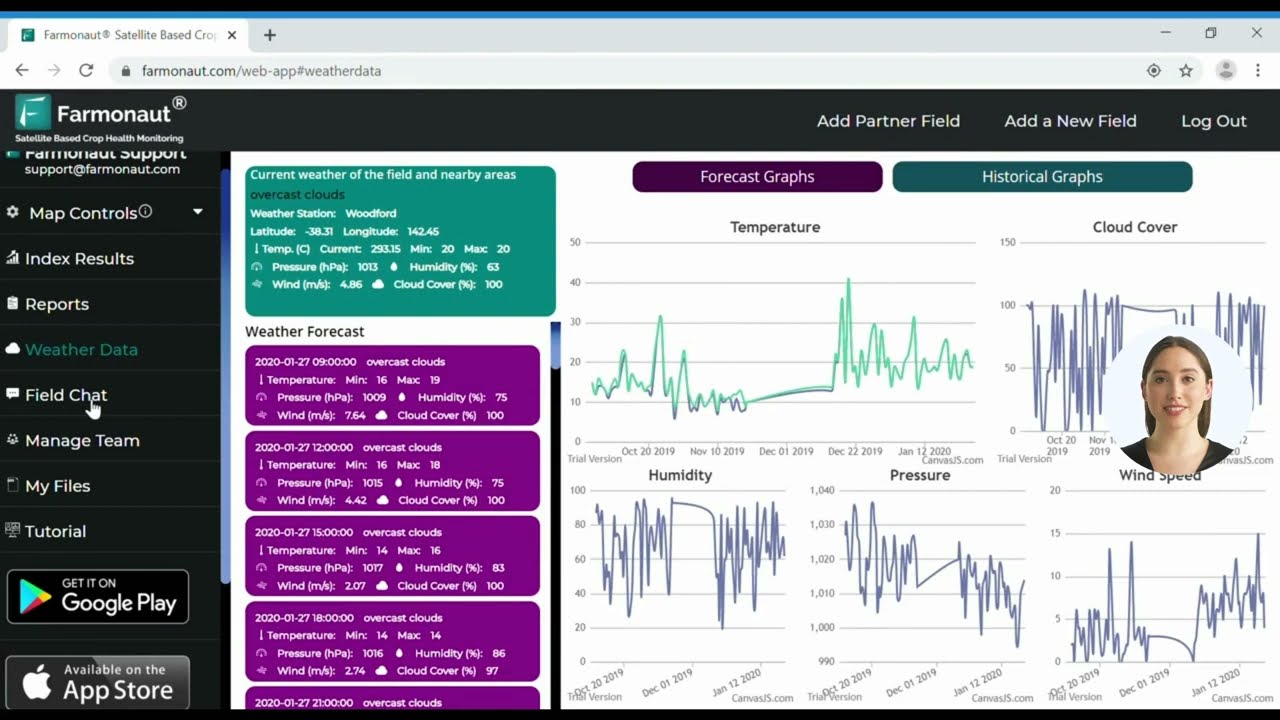
Video: Farmonaut Web App | Satellite-Based Crop Monitoring
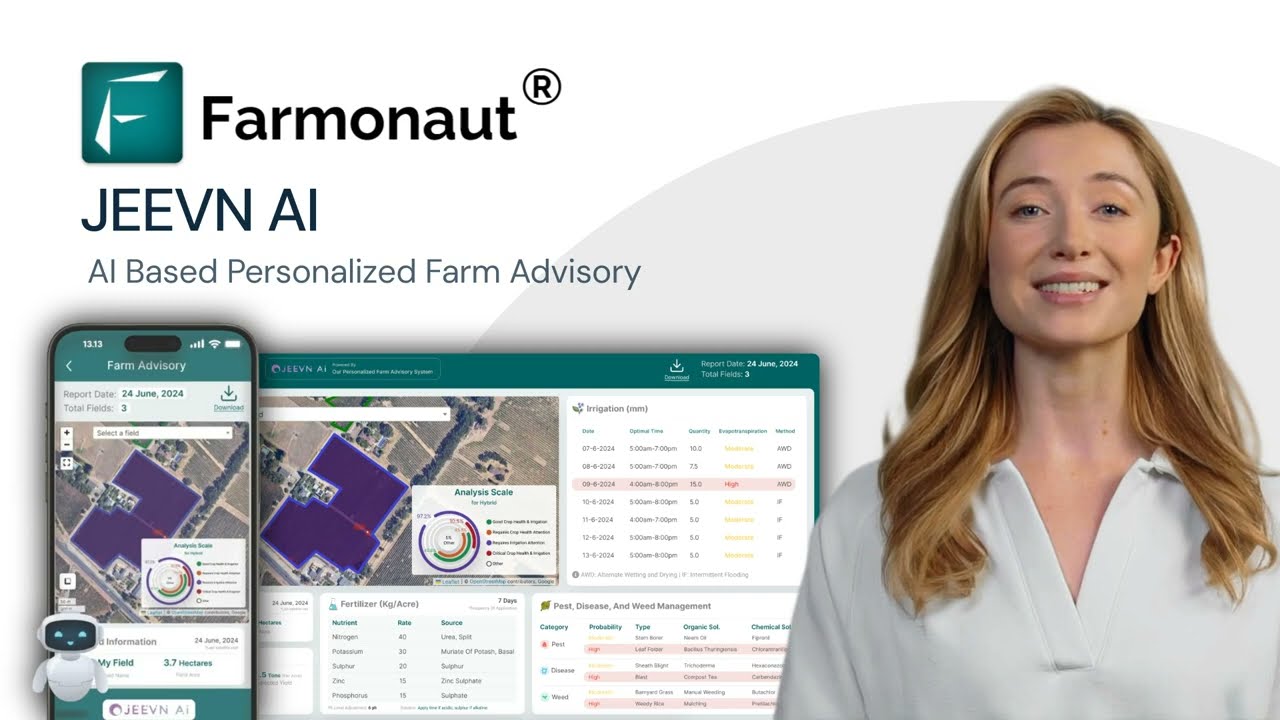
Video: The Future of Farming with JEEVN AI
FAQ
What's the difference between an agriculture ad agency and an agriculture marketing agency?
An ad agency focuses on media buying and creative placement; a marketing agency covers the broader mix of brand, content, SEO, and email in addition to advertising. Most firms in this space do both, so the label matters less than confirming, deliverable by deliverable, what each candidate actually executes in-house versus subcontracts.
Is there a published ranking or market size for agriculture marketing agencies in the US?
No. There is no federal, USDA, or trade-association dataset that sizes this market or ranks firms in it. Any "top agencies" list you see is editorial, not government or census data—treat it as a starting point for research calls, not a verified ranking.
How many people work in US agriculture, and why does that matter to a marketing agency?
USDA ERS and BLS put total agricultural employment at 1.18 million jobs in 2024, up 10% since 2010, while USDA NASS counted 637,000 hired farm workers in the April 6–12, 2025 reference week at an average $19.52 hourly wage. Agencies use figures like these to size farmer-facing campaigns and set realistic reach expectations; ask any agency pitching you a farmer-audience campaign which of these datasets they're using.
What share of US farms can actually be reached through digital marketing?
USDA reports 55% of farms have broadband, 74% have cellular data access, and 29% use the internet to market their own agricultural activities, as of 2025. That 29% figure is a reasonable ceiling estimate for digital reach into the farm-operator segment specifically—reach into agribusiness buyers (dealers, co-ops, distributors) is a separate and typically higher-connectivity audience.
Can I use this article to find farm work in Australia?
No—this article covers US agriculture advertising and marketing agencies. For Australian seasonal farm work or visa questions, go directly to Australian government sources (Department of Home Affairs, Workforce Australia) rather than a US agriculture-marketing resource.
How do I keep the statistics in this article current?
Check USDA NASS's Farm Labor Survey page for the latest hired-worker count and wage data (refiled quarterly), and USDA ERS's Precision Agriculture in the Digital Era publication for updated connectivity and technology-adoption figures. Both are linked above and are the primary sources this article draws from.

 Godrej Agrovet
 Hayleys Agriculture
 Linx Agritech
 Adinet
 Save Your Soils
 GalaxEye Space
 Grandstream Algérie
 XOS Realty
 Geospatial Lab Africa
 Agro La Gándara
 HIPSAC
 ZOL Zimbabwe
 Juligerm
 AdBio
AdBio MISE Maroc
 NWNS
NWNS Red August Group
 Farm Inc
 WeMe Global
 Agrotoken
 Blue BearX
 Insignito
 DnCubed
 Indosistim Teknologi
 Liquify Digital
 CU Foods
 BeyondTech Global
 Rouge VC
 AgroRisk
 Oath Inc
 Esri North East Africa
 MDCV UK
 Etech Consulting Madagascar
 Vestlandsforsking
 WB Dev
 Sama Premium
 Tres Valles
 Blickwinkel
 Agricultural Credit Policy Council
 eKGIS
eKGIS Mostas Tech
 Andex
Andex Deluxe Conseil
 WICO
WICO Chimera Innovation
 SkyHarvest
 Teledarbas
 Exurbia Geospatial
 FieldZero
