

US aluminum · State-by-state guide
Aluminum Mines in USA: Where Bauxite and Smelters Are
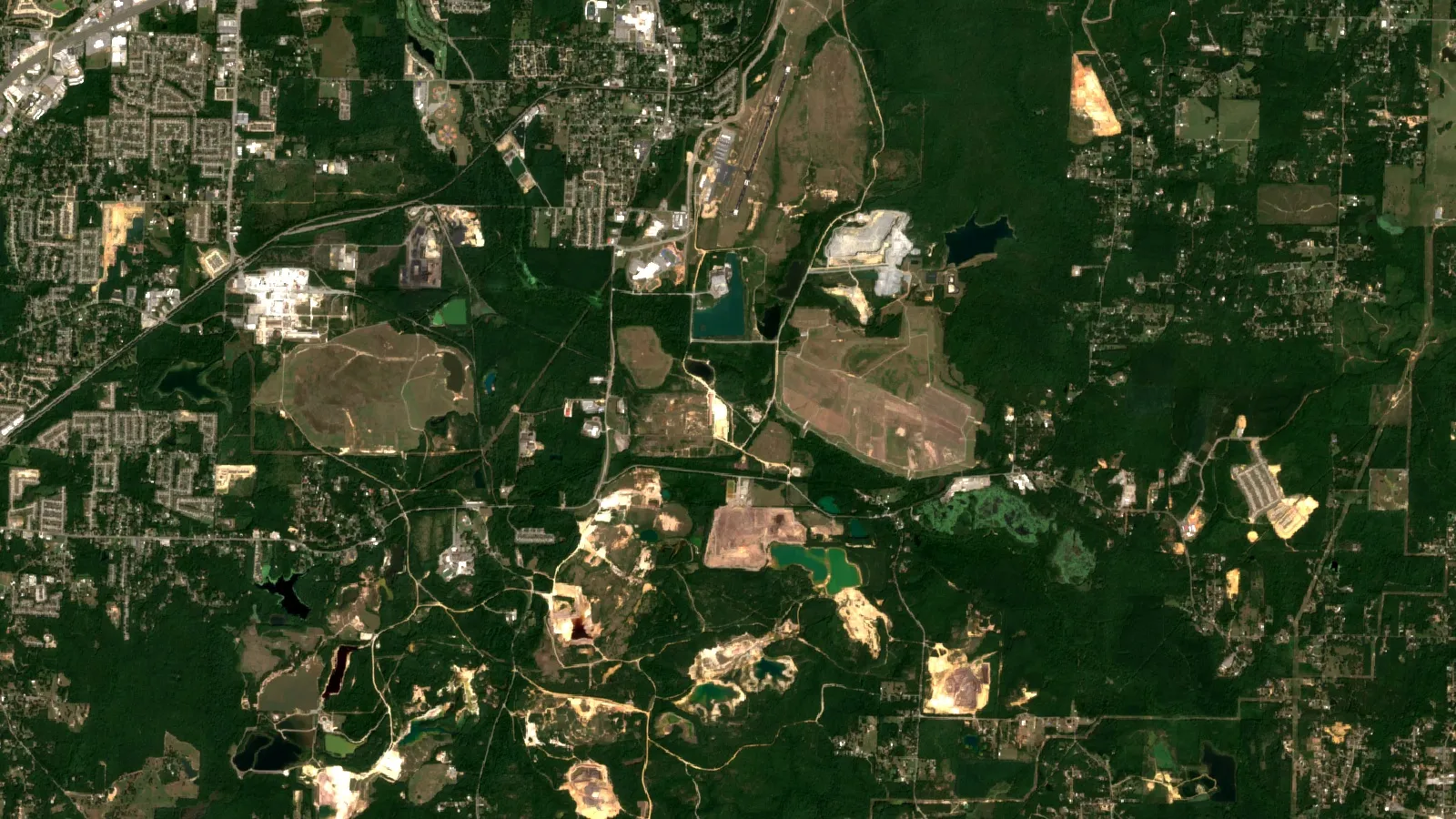
The US has no large aluminum ore mine: in 2025 only small amounts of bauxite were produced in Alabama, Arkansas and Georgia, for non-metal uses (USGS). Metal comes from smelters in a few states, and four were running in October 2026.
Key takeaways
- USGS withholds US bauxite output; limited non-metal production came from Alabama, Arkansas and Georgia in 2025, and net import reliance for bauxite is above 75%.
- US bauxite imports were about 3.0 million tonnes in 2025; Jamaica supplied 60% over 2021 to 2024 (USGS, 2026).
- Three companies ran six primary smelters in five states in 2025; primary output was 660,000 tonnes against 1.31 million tonnes of capacity (USGS, 2026).
- In October 2026 four smelters operate (Mt. Holly SC, Sebree KY, Warrick IN, Massena NY); New Madrid MO plans a one-line restart and Hawesville KY was sold.
- Gramercy, Louisiana holds the only operating US alumina refinery, rated at 1.2 million tonnes a year (USGS, 2026).
In this article
- Where is aluminum mined in the US: bauxite by state
- Where US bauxite and alumina come from
- The alumina step: Gramercy, Louisiana
- Aluminum smelters in the US: state-by-state status
- Which states have no aluminum smelter
- Recycling and imports fill the gap
- What decides whether US smelters restart
- Calculate what a US smelter line is worth
- Checking a bauxite or aluminum site from space
- Frequently asked questions
The United States has no large aluminum ore mine at work today. The USGS reports that in 2025 only a limited amount of bauxite and bauxitic clay was produced, in Alabama, Arkansas and Georgia, and that it went to non-metal uses such as abrasives, chemicals and proppants. Mine output is withheld to protect company data, and more than 75% of the bauxite the country uses is imported (USGS Mineral Commodity Summaries 2026). New aluminum metal is made in a different set of states: three companies ran six primary smelters in five states in 2025, and four smelters were running in October 2026.
This page sorts out the two questions behind most searches for aluminum mines in the USA. First, where bauxite, the ore, has been or is still dug. Second, where the metal is actually smelted, plant by plant, with the status of each in October 2026. Bauxite is the rock that holds aluminum minerals such as gibbsite and boehmite. Alumina is the white powder refined from it, and aluminum is the metal smelted from alumina.
Where is aluminum mined in the US: bauxite by state
All three states on the USGS list have a long history, and the Southeast and Arkansas were once the country’s main bauxite source. The deposits formed from deep tropical weathering of clay and rock in the Paleocene and Eocene, tens of millions of years ago, and survive in small patches (USGS Bulletin 1199-A).
Arkansas: the largest US bauxite district
Arkansas became the leading US bauxite source in 1903, when the Southeast’s share fell (USGS Bulletin 1199-A). The ore sits in Saline and Pulaski counties, near Little Rock, in a region of about 275 square miles. According to the Arkansas Geological Survey, bauxite was mined there from 1898 to 1990, with a record of more than 6 million tons in 1943, during World War II. The main minerals are gibbsite and some boehmite (Arkansas Geological Survey). The state geologist John C. Branner publicly identified the ore in 1891, and the town of Bauxite grew around the mines (Encyclopedia of Arkansas).
Today Saline County deposits are mined only from time to time, mostly for aluminum oxide used in proppant, the sand-like grains that hold open cracks in oil and gas wells. The Survey also lists 33 bauxite mine sites in the two counties as reclaimed or abandoned. Alcoa found it more profitable to mine bauxite overseas after World War II, in places such as British Guiana and Jamaica, and Arkansas mining ended in 1990; the USGS bulletin puts the Arkansas commercial bauxite reserve at about 70.7 million long tons in a 1950s estimate, which is a historical figure and not a current reserve.
Alabama and Georgia: older, smaller districts
The first US bauxite was found near Hermitage, Georgia, in 1883, and shipments started from Georgia in 1889 and Alabama in 1891. Between 1889 and 1960 Georgia produced about 1.23 million long tons and Alabama about 1.23 million, together 96% of the Southeastern total (USGS Bulletin 1199-A). The main districts were Andersonville in Georgia and Eufaula in Alabama, and the Georgia belt also holds kaolin, the white clay used in paper and ceramics, mixed with bauxite. In 2025 these two states still produced a little bauxite and bauxitic clay for non-metal use, but not for smelting.
What the reserve number says
USGS lists US bauxite reserves at 20 million tonnes, against 7.4 billion tonnes in Guinea (USGS, 2026). Reserves are the part of a deposit that can be mined at a profit today, so the gap explains why US smelters buy from abroad. For a country-by-country view, see our guide to the top bauxite producing countries.

▶ Farmonaut video on Arkansas’s 1880s geology reports and what state geologists found. · 6:31
Where US bauxite and alumina come from
The USGS estimates that the US imported 3.0 million tonnes of bauxite in 2025. Over 2021 to 2024, Jamaica supplied 60%, Turkey 16%, Guyana 9% and Australia 8%. The average import price was $32 per tonne of bauxite and $590 per tonne of alumina in 2025 (USGS, 2026). Alumina imports, which come mostly from Brazil (71% over 2021 to 2024), covered about 71% of US alumina use in 2025. Prices for the ore itself are covered in our bauxite price trend guide.
Chart
Where US bauxite imports came from
Share of imports, 2021 to 2024
Of the bauxite that US users consumed in 2025 (a reported 1.7 million tonnes, valued at $54 million), about 63% went through the Bayer process, the caustic-soda method that turns bauxite into alumina. The rest went to abrasives, cement, chemicals, proppants, refractories and steel-mill slag adjusters. If you want to compare the two materials, our short explainer on alumina versus bauxite covers the uses of each.
The alumina step: Gramercy, Louisiana
One alumina refinery produced alumina from imported bauxite in 2025: a 1.2 million tonne a year plant in Gramercy, Louisiana. A second, 500,000 tonne a year plant in Burnside, Louisiana, has been idle since August 2020, and no reopening plan has been announced (USGS, 2026). US alumina output was an estimated 710,000 tonnes in 2025.
The Gramercy plant is run by Atalco (Atlantic Alumina Company). In January 2026 the company announced a $450 million partnership with the US government to secure alumina output and add the first large primary gallium circuit in the country. The stated targets are more than one million tonnes of alumina a year and up to 50 tonnes of gallium a year; they are plans, not current output (Aluminium Today, January 2026). Gallium is a metal recovered from bauxite-processing liquor that goes into chips and radar parts.
Aluminum smelters in the US: state-by-state status
Smelting is the stage that makes new aluminum from alumina. USGS counts six primary smelters in five states for 2025, run by three companies, with total capacity of 1.31 million tonnes a year. Two of the six were fully idle: Hawesville in Kentucky (since 2022) and New Madrid in Missouri (since 2024). Primary output was an estimated 660,000 tonnes in 2025, down from 889,000 tonnes in 2021 (USGS aluminum summary, 2026). The table below uses company pages and trade reports for capacity and status; capacities are nameplate (design) figures, not output.
Chart
US primary smelters by nameplate capacity
Thousand tonnes a year; nameplate, except Warrick (three running lines); New Madrid is idle
| State | Smelter | Owner | Capacity (tonnes a year) | Status, October 2026 |
|---|---|---|---|---|
| South Carolina | Mt. Holly | Century Aluminum | 230,000 | Back at full capacity; ramp-up marked in July 2026 |
| Kentucky | Sebree | Century Aluminum | 220,000 | Operating at capacity, per the company |
| Indiana | Warrick | Alcoa | Up to 156,000 (three lines running) | Operating; a fourth line is under review |
| New York | Massena West | Alcoa | 130,000 | Operating |
| Missouri | New Madrid | Magnitude 7 Metals | 263,000 (nameplate) | Idle since 2024; one line of about 75,000 planned to restart before end of 2026 |
| Kentucky | Hawesville | Sold by Century in February 2026 | Not given (former smelter) | Not a smelter restart; site sold for a data center campus |
South Carolina and Kentucky: Century Aluminum
Century’s Mt. Holly plant in South Carolina has two potlines (rows of smelting cells) and 360 pots, and Century calls it the youngest smelter in the country (Century Aluminum). After a $50 million restart of idled lines, it reached full capacity in 2026; the company says this adds about 50,000 tonnes a year and about 10% to US primary output, and the report says Mt. Holly was already responsible for about 30% of national output (AlCircle, 28 July 2026). At Sebree, Century lists 220,000 tonnes a year from three potlines of 128 pots each (Century Aluminum).
Indiana and New York: Alcoa
Alcoa’s fact sheet says Warrick has three working potlines of 150 pots each, making up to 156,000 tonnes a year, and calls it one of four remaining operating smelters in the country (Alcoa Warrick fact sheet). In April 2026 the chief executive said that restarting a fourth line would cost around $100 million, add roughly 50,000 tonnes, take one to two years and depend on secure power (AlCircle, April 2026). Massena West in New York has 198 cells and 130,000 tonnes a year of capacity, and has smelted since 1902 (Alcoa Massena fact sheet).
Missouri and Kentucky: the idle plants
The New Madrid plant, near Marston, has three potlines and a nameplate of 263,000 tonnes a year. Magnitude 7 Metals announced on 1 July 2026 that it plans to restart potline one, about 75,000 tonnes a year, before the end of 2026. The company has not said whether the other lines will follow or how the plant will be powered, so treat it as a plan until metal is poured (CRU Aluminum Market Update). Century announced the sale of the long-idled Hawesville site on 2 February 2026 to an affiliate of TeraWulf for a data center and computing campus, and kept a 6.8% stake in the development company (Spectrum News 1, 7 February 2026). The USGS summary was written before that sale and still lists Hawesville as temporarily shut.
Which states have no aluminum smelter
Older lists name Texas, Ohio, Tennessee, Oregon and Washington as smelting states. They do not match the 2025 USGS roster. The four smelters running in October 2026 stand in Indiana, Kentucky, New York and South Carolina, and the idle plant in Missouri brings the number of states with a smelter to five. Other states still matter downstream: they roll, extrude, cast and recycle aluminum into sheet, cans, wire and car parts. In 2025 transport took 36% of US aluminum use, packaging 24% and building 13% (USGS, 2026).
Recycling and imports fill the gap
Primary smelting is a minority of the supply. The US recovered about 3.6 million tonnes of aluminum from purchased scrap in 2025, 56% from new scrap made in factories and 44% from discarded products, and old scrap alone equalled about 28% of apparent consumption. The country still relied on imports for 60% of apparent consumption, with Canada supplying 56% of imports over 2021 to 2024 (USGS, 2026). Recycling needs a fraction of the energy of smelting, which is why scrap flows are tracked as closely as ore; the Aluminum Association publishes industry statistics for North America. Our longer guide to aluminum extraction, top mines and processes covers the global picture, and the market side is in our alumina and bauxite market outlook.
Chart
US primary aluminum production
Thousand tonnes, 2021 to 2025 estimate
What decides whether US smelters restart
Three things set the pace: tariffs, power and price. In March 2025 the US put a 25% tariff on aluminum and aluminum products under Section 232, raised it to 50% for most countries by June, and added more than 400 product codes in August. Power is the long-running limit: smelters run all day and pay for electricity throughout, so a power contract can decide whether a plant lives. The Hawesville closure in 2022 followed soaring energy costs, and New Madrid stopped in 2024 when its power agreement was not renewed, and the Warrick restart case turns on power supply as well. The average US market price for ingot was an estimated 180 cents a pound in 2025, 39% higher than in 2024 (USGS, 2026). For trade flows and exporters, see US bauxite and aluminum export trends.
Calculate what a US smelter line is worth
Use the calculator below to test a smelter’s capacity, the share of it that is running and a price per pound. It shows the tonnes made, the metal value and the plant’s share of 2025 US primary output. Prices are inputs and change daily; use today’s LME or Midwest quote.
Calculator
How much metal does a smelter make?
Enter a plant’s capacity, how much is running and a price per pound.
- Metal value a year at your price: $912,712,680
- Share of 2025 US primary output (%): 34.8
Example values only, not a benchmark; use today’s price. The US primary output share uses the USGS 2025 estimate of 660,000 tonnes; 1 tonne equals 2,204.62 pounds.
Checking a bauxite or aluminum site from space
Bauxite forms in weathered, iron-rich laterite surfaces, which carry iron-oxide and clay signatures that satellites can map. Farmonaut maps these spectral clues from multispectral satellite data for licence owners and consultants, as a first screen before ground work; results are exploration targets, not a resource estimate. Learn how satellite-based mineral detection works or send a site through the mining query form.
▶ Farmonaut explains remote sensing for mining in three minutes. · 2:01
If this topic matters to you, read Copper and Aluminum in Nature: Where They Are Found next.
Frequently asked questions
Are there any aluminum mines in the USA?
Not in the usual sense. The USGS reports a limited output of bauxite and bauxitic clay for non-metal uses in Alabama, Arkansas and Georgia in 2025, with production figures withheld. No US mine supplies the smelters at scale.
Where is aluminum mined in the US?
Historically mainly in Saline and Pulaski counties, Arkansas, and in the Eufaula (Alabama) and Andersonville (Georgia) districts. Today the ore for US aluminum comes from abroad, chiefly Jamaica, Turkey, Guyana and Australia.
Which US state produces the most aluminum?
South Carolina, where Mt. Holly produces about 30% of the country’s primary aluminum according to Century Aluminum, followed by Kentucky and Indiana by nameplate capacity at the running plants.
How many aluminum smelters are in the US?
USGS counted six in five states in 2025, two of them idle. In October 2026 four are running, one idle plant has a restart plan, and Hawesville has been sold for other use.
Where does the US get its bauxite?
The USGS lists Jamaica (60%), Turkey (16%), Guyana (9%) and Australia (8%) for 2021 to 2024, from imports of about 3.0 million tonnes in 2025.
Is there an alumina refinery in the US?
One, in Gramercy, Louisiana, rated at 1.2 million tonnes a year. A second at Burnside, Louisiana, has been idle since August 2020.
Why did Arkansas stop mining bauxite?
Mining there ran from 1898 to 1990. After World War II the main operator, Alcoa, found it more profitable to mine bauxite overseas, in places such as British Guiana and Jamaica, and mining in Arkansas ended in 1990.
What is bauxite used for besides aluminum?
About 37% of the bauxite used in the US in 2025 went to abrasives, cement, chemicals, proppants, refractories and steel slag additives rather than the Bayer process (USGS, 2026).
Is aluminum smelting restarting in the US?
Partly. Mt. Holly returned to full capacity in 2026, a restart is planned at New Madrid, and Alcoa is weighing a fourth Warrick line. Output was still only 660,000 tonnes in 2025, against capacity of 1.31 million tonnes.
Does the US recycle more aluminum than it smelts?
Yes. About 3.6 million tonnes was recovered from purchased scrap in 2025, against 660,000 tonnes of primary metal.
Can satellites find bauxite?
They can flag iron-rich laterite surfaces and clay minerals that often sit with bauxite, which helps rank where to sample. Only drilling and assays confirm grade and tonnage.
This page is for information only. It is not investment advice. Capacities are nameplate figures, except Warrick, which is the output of its three running lines. Plant status can change; check company filings. This is not legal advice. Do not enter any mine site or claim without the owner’s permission and the required licences.
Farmonaut mining
Map your mining site from space
Screen a bauxite or other licence area with satellite data before you commit to ground work.

Mining Pro sample view, synthetic data
Keep reading
Sources
- USGS, Mineral Commodity Summaries 2026: Bauxite and alumina: pubs.usgs.gov
- USGS, Mineral Commodity Summaries 2026: Aluminum: pubs.usgs.gov
- USGS Bulletin 1199-A, Geology of the Southeastern Bauxite Deposits (1964): pubs.usgs.gov
- Arkansas Geological Survey, Critical Minerals in Arkansas: geology.arkansas.gov
- Arkansas Geological Survey, History of Bauxite in Arkansas: geology.arkansas.gov
- Encyclopedia of Arkansas, Bauxite (Saline County): encyclopediaofarkansas.net
- Century Aluminum, Mt. Holly plant page: centuryaluminum.com
- Century Aluminum, Sebree plant page: centuryaluminum.com
- Alcoa, Warrick fact sheet: alcoa.com
- Alcoa, Massena fact sheet: alcoa.com
- AlCircle, Century Mt Holly full capacity (28 July 2026): alcircle.com
- AlCircle, Alcoa reviews Warrick revival (April 2026): alcircle.com
- CRU Aluminum Market Update, Magnitude 7 New Madrid restart plan (July 2026): aluminummarketupdate.crugroup.com
- Spectrum News 1, Century sells Hawesville smelter (February 2026): spectrumnews1.com
- Aluminium Today, ATALCO government deal (January 2026): aluminiumtoday.com
- Aluminum Association, industry statistics: aluminum.org
Discussion
Questions, corrections or field experience? Share them below. First-time comments are reviewed before they appear, and your email is never published.
No comments yet. Be the first to add a question or your experience.

 Critica Metals Limited
 Congo Mining Solutions
 Mining SARL
 SenGold Invest SAS
 Sania Corporation
 Sean Mining Limited
 NTS Group (Pty) Ltd
 Mine4Africa
 Lithspo Minerals Limited
 Tintina Mining Group
 Dalgety Minerals Pty Ltd
 Vortex Minerals Pty Ltd
 Faith At Work (Pty) Ltd
 Geotech Mining Solutions plc
 Vulcan International Limited
 Kidepo Associates
 GKY Mining
 Alkimy SARL
 Double A Trading
 GemSprout Metals Limited
 Qader Group
 Ileys General Trading
