

How Many Acres of Farmland Are There in the US? Farmland Acreage & Sustainable Land Management Explained
“The US has over 893 million acres of farmland, supporting diverse crops and sustainable rural economies.”
“Farmland covers about 40% of the US land area, playing a key role in soil health and conservation.”
Across agriculture, forestry, and rural land management, the question of “how many acres of farmland are there in the US?” sits at the intersection of policy, economics, and environmental stewardship. Understanding the true scope of US farmland acres helps farmers plan, lenders assess risk, and policymakers measure the capacity for food security, fiber, and natural resource conservation. In practical terms, acres of farmland reflect not only land under crop production but also land set aside for cover crops, pastures, orchards, and specialty production systems that sustain rural livelihoods and ecological balance.
What Constitutes Farmland in the US?
To accurately answer “How many acres of farmland are there in the US?”, it’s essential to understand what is classified as farmland. The United States Department of Agriculture (USDA) and related agencies define farmland to include a diverse landscape:
- ✔ Cropland: Land cultivated for grains, corn, soybeans, fruits, vegetables, specialty crops, and other annual or perennial crops.
- ✔ Pasture & Rangeland: Areas primarily used for grazing livestock such as cattle, sheep, and other ruminants, along with native forage species.
- ✔ Conservation Land: Acres set aside for soil, water, and wildlife habitat conservation (e.g., through CRP or wetland reserves).
- ✔ Orchards & Vineyards: Permanent plantings of fruit trees, nuts, and grapevines—important specialty crop segments.
- ✔ Forestry & Timberland: Forested lands managed as part of agricultural/rural production, including agroforestry systems—even if not always counted as cropland, these lands are integral for rural economies and ecosystem services.
This broad definition reflects the diversity of rural and agricultural systems across United States’ regions, emphasizing a balance between crop production, animal agriculture, and ecological conservation.

Foundational Concepts: Cropland, Pasture, Rangeland & Forestry
A foundational concept for measuring acres of farmland in the US is distinguishing between cropland and rangeland/pastureland.
- 🌾 Cropland includes land cultivated for grains, corn, soybeans, fruits, vegetables, and annual or perennial crops.
- 🐄 Rangeland & pastureland are primarily used for grazing cattle, sheep, and other ruminants, and for forage and hay crops that sustain livestock through seasonal cycles.
- 🌲 Forestry land, though not always tallied within cropland figures, is essential for timber, agroforestry, carbon sequestration, and soil health, often overlapping with agricultural use in rural landscapes.
Additionally, some lands are specifically set aside for conservation, wetlands protection, or wildlife habitat enhancement—often under federal or state environmental stewardship programs. These overlapping land uses make US farmland complex, dynamic, and rich in ecological and economic function.

How Many Acres of Farmland Are There in the US? Latest Acreage & Trends
So, how many acres of farmland are there in the US? According to the latest USDA Census of Agriculture and reputable government sources:
- 📊 For 2023, total US farmland acres are estimated at about 893 million acres.
- 📉 This represents a long-term decline from more than 940 million acres in 2002, attributed to urbanization, infrastructure expansion, and shifts in rural economies.
- 🌎 Farmland makes up about 40% of all land area in the United States.
While overall acreage has decreased, there have been major advances in soil health, productivity, and the adoption of conservation programs that help sustain both the output and ecological balance of American agricultural landscapes.
US Farmland Acres: Key Data Insights
- 🚜 Cropland typically accounts for about one-third of all US farmland.
- 🌾 Pasture and rangeland—critical for animal agriculture—comprise the largest single use of US agricultural land.
- 🦋 Conservation acreage remains stable or grows each decade as more land is set aside for environmental and wildlife programs.
These trends have crucial implications for soil health, biodiversity, water management, and climate change mitigation.
- 🌱 Cropland: Grain, corn, soybeans, vegetables
- 🐑 Pasture/Rangeland: Grazing, hay and forage
- 🌾 Conservation Land: Wetlands, habitat reserves, riparian buffers
- 🍏 Orchards & Vineyards: Perennial fruits and specialty crops
- 🌲 Forestry/Timberland: Managed woodland, carbon and biodiversity sinks
Types of Farmland: Cropland, Pasture, Rangeland, and Forestry
The distinction between major agricultural land types profoundly shapes US food production and rural livelihoods:
1) Cropland
- 🔬 Includes: Grains, corn, soybeans, fruits, vegetables, annual and perennial specialty crops.
- 🌾 Importance: Drives the bulk of the US food and fiber supply; susceptible to annual market and weather variability.
- ⚡ Management: Focused on rotational cropping, soil organic matter conservation, nutrient management, and sometimes irrigated production systems.
2) Pasture & Rangeland
- 🐄 Used for: Grazing cattle, sheep, goats, and other ruminants; also provides forage for wildlife and pollinators.
- 🌱 Ecosystem Services: Supports biodiversity, carbon sequestration, and often overlays with watershed protection.
- 🌤 Challenges: Subject to drought, overgrazing risk, and invasive species.
3) Conservation & Set-Aside Land
- 🦋 Set Aside: Under federal initiatives like the Conservation Reserve Program.
- 🌊 Protects: Water quality, wetland ecosystems, grassland nesting birds, pollinators, and riparian buffers.
- 🛡 Goal: Reduce erosion, improve soil health, restore habitat, and serve as a carbon sink.
4) Forestry, Timberland, and Agroforestry
- 🌲 Forested: Timber production, wildlife habitat, reforestation areas, and silvicultural plots.
- 🌳 Integral: Even when not classified as cropland, forested lands are vital for watershed protection, carbon sequestration, and supporting biodiversity.
- 🔄 Agroforestry: Combining trees/shrubs with crops or pasture to enhance resilience, productivity, and carbon sequestration in farming systems.
- 🌱 Cover cropping: Improves soil health, increases organic matter, reduces erosion.
- 🐮 Integrated grazing: Synergizes livestock foraging and crop rotations.
- 🍏 Perennial fruit/nut orchards: Boost income diversity, stabilize soil, attract pollinators.
- 🌿 Timber & wildlife corridors: Connect woodlots for carbon, biodiversity, and flood reduction.
- 💧 Wetland buffers: Filter water, control flooding, serve as habitat for wildlife.

Soil Health, Land Stewardship & Conservation on US Farmland
The quality and resilience of US farmland depend on soil health, conservation, and stewardship programs implemented by farmers, landowners, and local agencies:
- 🌱 Soil Health: Practices such as no-till, cover cropping, and organic amendments reduce compaction, prevent nutrient loss, and optimize yields over time.
- 🌿 Land Stewardship: Conservation programs (e.g., EQIP, CSP, CRP) reward efforts to restore habitat, protect wild species, and adopt sustainable management.
- 💧 Water Conservation: Efficient irrigation, buffer zones, and wetland protections reduce runoff and enhance resource availability.
Conservation programs have become increasingly central to US land management strategies, as soil degradation, water scarcity, and climate variability pose risks to the long-term productivity of acres of farmland in the US.

Year-by-Year Farmland Acreage and Land Use Distribution Table
The following table presents a yearly snapshot of total acres of farmland in the US and a percent breakdown by major land use types, while flagging key conservation and sustainability initiatives. Please note, numbers are rounded estimates (Source: USDA, NASS, and land use trend synthesis 2000-2023).
| Year | Total Farmland Acres (millions) | Cropland (%) | Pasture/Rangeland (%) | Conservation Land (%) | Notes on Sustainability Initiatives |
|---|---|---|---|---|---|
| 2000 | 941 | 34 | 58 | 5 | CRP expansion, waterway buffer incentives |
| 2010 | 920 | 33 | 57 | 7 | CSP introduced, no-till adoption up |
| 2020 | 896 | 32 | 56 | 9 | Cover cropping boom, wetland restoration |
| 2023 | 893 | 32 | 55 | 11 | Climate-Smart Conservation; Regenerative ag |
“The US has over 893 million acres of farmland, supporting diverse crops and sustainable rural economies.”
Economic Influences & Policy on Farmland Management
Economic conditions, federal policy, and local markets strongly affect how acres of farmland in the US are managed, conserved, or repurposed:
- 💵 Commodity prices drive land use changes—higher prices may bring idle land or pasture into crop production, while slumps cause idling or diversification into specialty crops.
- 🏦 Access to credit and insurance is linked to the value and productivity of farmland and the ability to mitigate risk (see Farmonaut crop loan & insurance services for satellite-based farm verification).
- 🏞 Policy incentives: Conservation payments and climate-smart programs (Farmonaut carbon footprinting solutions) reward beneficial land stewardship.
- ⚖️ Land tenure & ownership patterns: Influence investments in infrastructure, conservation, and technologies.

Sustainable Land Management, Water, and Irrigation
Maintaining the productivity and ecological value of US farmland acres requires ongoing investment in infrastructure, water resource management, and soil conservation:
- 🚰 Irrigation infrastructure: Critical in arid and semi-arid regions; enables precision water delivery and crop resilience.
- 🔧 Drainage and erosion control systems: Prevent soil loss and sustain crop yields.
- 🔄 Rotational grazing and cover cropping: Conserve forage and organic matter, reduce risk of overgrazing.
- 🌿 Regenerative agriculture and no-till: Promote carbon sequestration and improve soil structure (see how Farmonaut supports carbon management and large-scale farm management).
These activities not only optimize productivity across acres of farmland in the US, but also enhance ecosystem services such as flood mitigation, carbon storage, and wildlife habitat provision.

The Role of Technology in Farmland Management
The digital revolution is transforming how we measure, monitor, and manage acres of farmland in the US. Advanced technologies—particularly satellite remote sensing, artificial intelligence, and blockchain—play a pivotal role in supporting more sustainable and profitable rural systems.
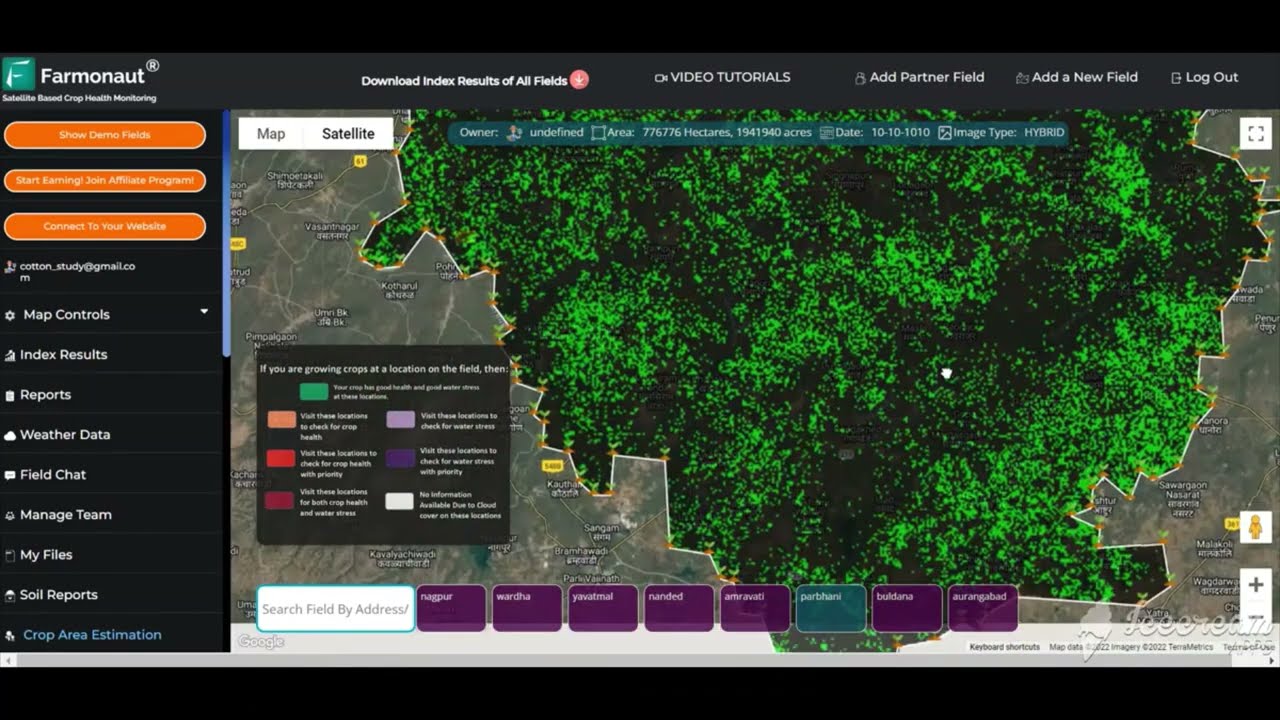
- 🛰 Satellite-based monitoring (Farmonaut’s core strength): Enables precise crop health analysis (NDVI), soil moisture tracking, and early warning for stress or disease—at scale, for any field or farm.
- 🤖 AI-based advisory (Jeevn AI by Farmonaut): Offers real-time cropping suggestions, weather forecasts, and risk minimization for all farm sizes.
- 🔗 Blockchain-based traceability: Ensures product and process validation across supply chains, crucial for specialty crops, organic certification, and food safety.
- 💡 Fleet/Resource management tools: Help optimize equipment use, reduce costs, and enhance sustainability (explore Farmonaut’s fleet management features).

Technology empowers all stakeholders—farmers, lenders, policymakers, and conservationists—to make better decisions about where, how, and why to invest in the future of US farmland.
Access Farmonaut’s Tech Solutions & Apps
For those seeking to monitor or optimize acres of farmland in the US, Farmonaut offers a suite of digital tools and APIs:



- 🧑🎓 Farmonaut Crop Loan & Insurance API for financial institutions and rural banks: Crop Verification & Automated Insurance
- 🛰️ Farmonaut API for developers (real-time spatial and agricultural data):
API Access |
Developer Docs - 🌱 Farmonaut Carbon Footprinting for carbon accounting on agricultural lands:
Carbon Footprinting - 🔗 Traceability & Transparency for supply chain validation:
Product Traceability - 👨🌾 Large-Scale Farm Management Platform (Web/Mobile):
Farm Management Suite
- ✅ Actionable satellite data: Monitor field health and detect problem zones—improves yields across all US farmland acres.
- 🔒 Secure traceability records: Confirm supply chain steps for food safety and compliance.
- 📉 Reduce losses & risk: Identify crop stress, pest outbreaks, or weather impacts early via satellite-based alerts.
- ♻️ Quantify sustainability efforts: Measure carbon impacts, cover crop adoption, and conservation outcomes easily.
- 🕒 Real-time insights: Accessible on any device, anywhere across the US or globally—enables efficient farm planning and execution.
Frequently Asked Questions on US Farmland Acres
Q1. How many acres of farmland are there in the US currently?
The US currently has about 893 million acres of farmland, according to the latest (2023) government and USDA estimates. This includes cropland, pasture/rangeland, conservation acres, orchards, and timberland managed for agricultural purposes.
Q2. Has the total acreage of farmland in the US increased or decreased over the years?
Total US farmland acres have slowly declined since the early 2000s, dropping from about 941 million acres in 2000 to 893 million acres in 2023. However, productivity per acre has grown due to better technology and soil management.
Q3. What percentage of US land is farmland?
Approximately 40% of the US land area is devoted to farmland—this is one of the highest ratios among developed nations and reflects America’s rich agricultural heritage.
Q4. Why is there a difference between cropland and total farmland?
Cropland refers only to land under annual or perennial crops, while total farmland includes pasture, rangeland, conservation, and timberland areas supporting broader agricultural and ecosystem services.
Q5. How do conservation programs affect total US farmland acreage?
Conservation programs typically shift portions of cropland or pasture into protected reserves, wetlands, or wildlife habitat, reducing immediate production area but improving soil health, water quality, and long-term resilience of the landscape.
Farmonaut Subscription Plans
To support US farmland owners, agri-businesses, and related industries, we offer affordable, scalable, subscription-based access to advanced satellite, AI, and data-driven tools. Choose a plan that matches your operation—whether monitoring a single acre of farmland, large-scale estates, or integrated forestry-pasture-cropland systems.
Recap: Why Understanding US Farmland Acres Matters
Counting acres of farmland in the US is not a mere statistic—it’s the key to food security, rural economic vitality, ecological stability, and policy planning for generations to come. Every acre managed wisely pays dividends across:
- 🌽 Food and Fiber Production – Meeting domestic and global needs for grains, fruits, meats, and bio-based products.
- 🌎 Soil & Water Conservation – Maintaining productivity and environmental integrity across rural landscapes.
- 🌲 Climate Resilience – Sequestering carbon, supporting biodiversity, and reducing vulnerability to weather extremes.
- 🏞 Livelihoods & Rural Prosperity – Sustaining jobs, cultural heritage, and regenerative economic models.
- 💡 Data-Driven Planning – Leveraging technology (like Farmonaut) for smarter, greener, and more profitable farm operations.
As we move forward, integrating satellite insights, regenerative practices, robust data, and stakeholder collaboration ensures America’s farmlands sustain the nation—and the planet—in an ever-changing world.
Next Steps for Every Acre:
- 📱 Try Farmonaut’s free trial to monitor your land, regardless of acreage size or crop type.
- 🔗 Integrate large-scale management tools and carbon tracking to enhance your environmental stewardship.
- 💡 Use Fleet and Resource Management for agriculture and mining to streamline rural operations.
- 🛡 Apply traceability for specialty products and compliance with food safety mandates.
- 🌐 API access available: for developers and custom app solutions.

 Prochecker
 Misteo
 Tres Valles
 LACOS Geoinformation
 Pulsar Supernova
 Magrifly
 LatConnect 60
 WebsEdge
 Blickwinkel
 Agricultural Credit Policy Council
 MCSOD
MCSOD Marei Nursery
 eKGIS
eKGIS Mostas Tech
 Andex
Andex FCF India
 Unifrutti Gulf
 Deluxe Conseil
