

Gold exploration · Saskatchewan
Gold deposits in Saskatchewan: the Seabee mine, the northern greenstone belts, and what a MARS claim costs to hold
Gold deposits in Saskatchewan sit mainly in the Precambrian shield of the north, in the La Ronge and Glennie domains, where SSR Mining’s Seabee operation produced 54,986 ounces in 2025 and claims are registered online through MARS.
Key takeaways
- Most gold deposits in Saskatchewan are orogenic veins in shear zones of the Trans-Hudson orogen, plus by-product gold from the Flin Flon copper-zinc deposit.
- Seabee, 125 km north-east of La Ronge, is 100% owned by SSR Mining and reports 505,000 oz of reserves at 4.63 g/t.
- Claims are registered online in MARS: $0.60 per hectare to register, nothing to spend in year one, then $15 per hectare a year.
- Ground work needs Ministry of Environment permits, and the Crown’s duty to consult First Nation and Métis communities may apply.
- Satellites map structure, burn scars, outcrop and access well here; they do not see gold under till and forest.
In this article
- Where gold deposits in Saskatchewan are found
- The Seabee gold mine in Saskatchewan: owner, history and numbers
- How to stake a claim on gold deposits in Saskatchewan through MARS
- Permits, consultation and safety before ground work
- What satellites can see over gold deposits in Saskatchewan
- Contained ounces: turning grade and tonnes into gold
- Screening Saskatchewan ground with Farmonaut
- Frequently asked questions
Ask a geologist about gold deposits in Saskatchewan and the first answer is usually a place name: Seabee. That mine, discovered by two prospectors at Laonil Lake in 1947, is the province’s best-known gold producer, but it sits in a much larger belt of greenstone and granite that runs across the northern third of the province. This guide, for people who hold, buy or finance ground there, covers the geology, Seabee’s numbers, claim costs, permits and what satellite screening can add.
If you want the national picture first, our guide to gold exploration in Canada compares the Ontario and Quebec claim systems, and the Canada gold deposits by province overview places Saskatchewan beside the other belts.
Flin Flon, a copper-zinc mine, produced about 3.6 million ounces of Saskatchewan’s gold as a by-product.
Where gold deposits in Saskatchewan are found
The Saskatchewan Geological Survey’s 2012 report Saskatchewan Gold: Mineralization Styles and Mining History is still the most complete public synthesis of gold deposits in Saskatchewan. It says gold has been found in almost every geological region of the province, but the significant showings are in the Precambrian shield that underlies the northern third. The provincial deposit index listed more than 500 occurrences with gold as the main commodity when the report was written. South of the shield, the survey describes only minor placer and paleoplacer gold in the sedimentary basin.
Two deposit families account for most of the gold produced. Volcanogenic massive sulphide (VMS) deposits formed in a narrow window around 1,900 to 1,865 million years ago, and only some of them carry much gold. Orogenic gold deposits are more widespread and sit mainly in shear zones cutting greenstone belts. The report says orogenic deposits can host large, relatively high-grade resources, Seabee being its example. Structure comes first: the shear zones are the address.
The history of production shows how uneven the record is. The survey credits the Flin Flon VMS deposit, which straddles the Manitoba border, with about 112 tonnes (3.6 million troy ounces) of gold from the Saskatchewan side between 1930 and 1992, all of it a by-product of copper-zinc mining. By contrast, the province had produced only about 70,000 ounces of primary gold by 1984. Seabee changed that: its 1990 feasibility study expected to recover 11.8 tonnes (379,241 oz), and the operation was set to pass one million ounces in 2012.
Chart
Where Saskatchewan’s gold has come from
Million troy ounces; historical figures from the provincial survey, not NI 43-101
La Ronge domain: Star Lake, Waddy Lake and the Central Metavolcanic Belt
The La Ronge domain, north of the town of La Ronge, hosts several of the small gold mines opened after the 1980s exploration rush. The survey report describes the Jolu mine in the Star Lake area, which ran from 1988 to 1991, and the Komis deposit in the Waddy Lake area, mined in 1996 and 1997, where quartz veins carried high-grade gold. It also records the Roy Lloyd mine, about 75 km north-north-east of La Ronge, which began producing in 2011. We list these as historical operations described in the 2012 report; we have not confirmed any current owner or restart, so treat their status as unknown until you check the provincial index.
The EP deposit in the Waddy Lake area was first noticed in 1958 by a prospector who found anomalous gold in a glacial dispersion train, a ribbon of till carrying fragments from a source up-ice. The source was not found for years. On the shield, ice has moved the evidence, and following it back is much of the job.
Glennie domain and the Pine Lake greenstone belt
The Glennie domain hosts Seabee and its satellite deposits. The survey places the Seabee deposit in the northern Glennie domain, in rocks of the Pine Lake greenstone belt, hosted by shear zones cutting gabbro of the Laonil Lake intrusive complex. Detailed structural work cited in the report describes an anastomosing, en échelon network of shears, two of which produced most of the ore. That kind of structural network is precisely what an analyst tries to trace across the gold deposits in Saskatchewan’s other greenstone belts.
Beaverlodge domain and the far north
North of Lake Athabasca, in the Rae Province, the survey describes the historical Box mine at the former Goldfields townsite in the Beaverlodge domain. It operated from 1939 to 1942. The report also notes minor gold in vein- and unconformity-associated uranium deposits, and it describes a gold zone at the former Cluff Lake uranium mine, which is why some uranium data sets are worth a gold explorer’s time.

▶ Documentary (10:44): how exploration and mining have changed in the current gold cycle, useful context for shield explorers. · 10:44
The Seabee gold mine in Saskatchewan: owner, history and numbers
Of all the gold deposits in Saskatchewan, Seabee is the one in production, and it is the gold mine in Saskatchewan most searches are about. According to SSR Mining’s Seabee page, the operation is 100% owned by SSR Mining and lies about 125 km north-east of La Ronge. Access is by fixed-wing aircraft to a 1,275-metre airstrip, or by a 60 km winter ice road usually used from January to March. All ore goes through the Seabee mill, which produces gold doré for a third-party refinery.
The ownership chain matters for anyone reading older documents. The survey report records that prospectors J. Coffyne and B. Corrigan found gold at Laonil Lake in 1947, and that Claude Resources acquired the property in 1984. The first gold pour was on 20 November 1991. SSR Mining acquired Claude Resources on 31 May 2016 and expanded its exploration ground through the purchase of Taiga Gold on 14 April 2022. The company says the original Seabee mine’s resources were exhausted in 2018, and that ore now comes from the Santoy underground mine, in commercial production since 2014.
Seabee production, year by year
SSR Mining’s results show a mine coping with remote logistics and fire. Seabee produced 90,777 ounces in 2023 and 78,545 ounces in 2024, according to the company’s full-year 2024 results. In 2025 output fell to 54,986 ounces against guidance of 70,000 to 80,000, which the company’s full-year 2025 release attributes to a temporary suspension in the second quarter caused by regional forest fires and to a planned focus on underground development. Guidance for 2026 is 60,000 to 70,000 ounces, at a processed grade of about 5.0 g/t and roughly 1,200 tonnes a day.
Chart
Seabee gold production by year
Troy ounces of gold; 2026 shown as the company’s guidance range (low and high end)
In its second-quarter 2026 release, SSR Mining reported 23,103 ounces for the six months, 16,817 of them in the second quarter, and said it expected 55 to 60% of second-half production in the fourth quarter on higher grades. It also raised 2026 growth capital for Seabee from $15 million to $35 million to advance the Porky West project.
Reserves and resources, kept in their categories
At 31 December 2025, SSR Mining reports Proven and Probable Mineral Reserves at Seabee of 505,000 ounces at 4.63 g/t, Measured and Indicated Mineral Resources of 212,000 ounces at 3.88 g/t, and Inferred Mineral Resources of 203,000 ounces at 3.94 g/t. Resources are reported exclusive of reserves, so these three figures are not a single pile of gold and should never be added. The company’s full-year 2025 release also notes an initial 203,000-ounce reserve declared at Porky in 2025 and a reserve gold price assumption of US$2,000 per ounce for Seabee.
Chart
Seabee estimates at 31 December 2025, by category
Thousand troy ounces of gold. Separate categories: do not add them together. Resources are reported exclusive of reserves.
Searches for gold mining companies in Saskatchewan usually land on SSR Mining because it runs the producing operation. We name only SSR Mining here because its own filings confirm its status; check any other company on SEDAR+ before relying on a press release.

▶ Guide (10:34): how hard-rock gold moves from a vein to a doré bar, the same chain Seabee runs on site. · 10:34
How to stake a claim on gold deposits in Saskatchewan through MARS
Saskatchewan stopped relying on posts in the ground years ago. The Mineral Administration Registry Saskatchewan (MARS), launched in December 2012, issues mineral dispositions electronically under The Mineral Tenure Registry Regulations. Claims are built from two kinds of electronic parcel: surveyed mineral parcels in the south, and unsurveyed legal subdivision grid cells from the SaskGrid township fabric in the north, where most gold ground lies. You register an account, then select open parcels on the map and pay.
The rules come from the consolidated Mineral Tenure Registry Regulations, which show amendments up to Saskatchewan Regulations 62/2024. A claim gives the exclusive right to explore for the Crown minerals the regulations cover, but not to produce, apart from assaying, testing and notified bulk sampling. A claim can be one parcel or a group of associated parcels, no larger than 6,000 hectares in total, and no longer than six times its width. The registration fee is $0.60 per hectare with a $300 minimum, and the term is one year, continued from year to year while you comply.
What a claim costs to keep
Holding cost is mostly work, not fees. Under Table 2 of the regulations there is no expenditure requirement in the first 12-month assessment work period. From the second to the tenth period you must spend $15 per hectare, with a minimum of $240 per claim, and from the eleventh period $25 per hectare, with a minimum of $400. The assessment work report has to reach the ministry within 90 days after the period ends. If you fall short, you can make a non-refundable payment or a refundable deficiency deposit equal to the shortfall within the same 90 days.
Chart
Work you must fund each year, per hectare
Canadian dollars (C$) per hectare per assessment work period, by year; claim year 1 is nil. Minimums: claim C$240 then C$400 per claim; lease C$400 then C$800.
Permits suit large grassroots programs and leases are what allow mining; the table sets the three tenures side by side.
| Disposition | Area | Registration fee | Term | Yearly obligation |
|---|---|---|---|---|
| Permit | 10,000 to 50,000 ha | $0.30/ha, min $3,000, plus $30,000 deposit | 2 years, not renewable | $5.25/ha over the term |
| Claim | Up to 6,000 ha (about 14,800 acres) | $0.60/ha, min $300 | 1 year, continued yearly | Nil in year 1; $15/ha years 2 to 10; $25/ha from year 11 |
| Lease | Converted from a claim | Nil | 10 years, renewable | $10/ha rent (min $1,600) plus $25/ha work in years 1 to 10 |
Tenure types that apply to gold deposits in Saskatchewan. Source: The Mineral Tenure Registry Regulations, Table 2, consolidated to Saskatchewan Regulations 62/2024. Amounts in Canadian dollars; confirm current figures with the Ministry of Energy and Resources.
Ground you cannot claim
Section 9 of the regulations rules out parcels that overlap urban municipalities, historic, natural environment, recreation, wilderness, provincial and national parks, Indian reserves and ecological reserves, as well as ground already held or withdrawn. Lac La Ronge Provincial Park has its own Mineral Disposition Zone described in the regulations, so check the map rather than assuming the whole park is closed. Lapsed ground reopens on scheduled dates posted in the MARS public messages; in October 2026 the next reopening was listed for 10:00 AM CST on 3 November 2026.
Infographic
From open ground to a mining lease in Saskatchewan
- 1Check the groundSearch SMDI, GeoAtlas and the MARS map; parks are closed.
- 2Register a claimOnline in MARS, up to 6,000 ha, at $0.60/ha with a $300 minimum.
- 3Year oneNo work requirement in the first 12 months.
- 4Years 2 to 10Fund $15/ha of work each year and report within 90 days.
- 5Permits and consultationGet Ministry of Environment permits; the duty to consult may apply.
- 6Lease to mineA 10-year renewable lease, rent $10/ha (minimum $1,600).
Claim holding cost calculator
The calculator uses the fees and work rates above. It shows what a block of ground commits you to over the years you expect to hold it, and how much less a smaller block costs if a desktop screen lets you leave out the weakest part before you register. That is where the money is: on gold deposits in Saskatchewan the fee is small and the work commitment is large.
Calculator
What will it cost to hold a Saskatchewan claim?
Enter the ground you plan to hold, how many claims, how long, and how much you drop after screening. Amounts are in Canadian dollars (C$).
- Claims used: 1
- Full block registration (C$): $1,200
- Full block work commitment (C$): $120,000
- Screened block area: 1,500 ha
- Screened block total (C$): $90,900
- Saving from screening (C$): $30,300
Amounts in Canadian dollars (C$). Assumptions: registration C$0.60 per hectare with a C$300 minimum per claim; no work in year one; C$15 per hectare (minimum C$240 per claim) in years 2 to 10 and C$25 per hectare (minimum C$400) from year 11, per Table 2 of The Mineral Tenure Registry Regulations as consolidated to SR 62/2024. Area is split evenly between claims; a claim cannot exceed 6,000 ha, so more claims are used if needed. Claims and years are rounded to whole numbers; the share dropped is capped at 90%. Excludes surveys, permits, deficiency deposits and the rules on partial surrender. Example values only; confirm with the Ministry of Energy and Resources.
At the defaults, a 2,000-hectare claim held for five years costs $1,200 to register and commits $120,000 of work, because years two to five each need $30,000. Registering 1,500 hectares instead saves $30,300 over the same period. Partial surrender later is allowed only after work covering the first two assessment periods is registered, so trimming before you register is cheaper.
Permits, consultation and safety before ground work
A claim over gold deposits in Saskatchewan does not let you cut a line or drill. The province’s Mineral Exploration Guidelines for Saskatchewan say surface disturbance permits from the Ministry of Environment are needed before any exploration work starts on Crown land. Depending on the program they include Forest Product, Aquatic Habitat Protection, Work Authorization and Temporary Work Camp permits. Drilling normally also needs a Temporary Water Rights Licence for industrial water use from the Water Security Agency, and a notification to Fisheries and Oceans Canada may be required. Airborne geophysical surveys with no surface land use need no permit.
The same guidelines say an application may be sent to outside agencies for review and for consultation with First Nation and Métis communities. A project that could adversely affect Treaty and Aboriginal rights, such as hunting, fishing and trapping for food, or traditional uses of the land, triggers the government’s duty to consult. The province publishes a proponent handbook for early, voluntary engagement. The Government of Saskatchewan states that six numbered Treaties cover all of Saskatchewan: 2, 4, 5, 6, 8 and 10, with a significant adhesion, Treaty 6A.
Panning, the North Saskatchewan River and gravel pits
Recreational panning is allowed, and the province’s panning and placer page is short and strict. Only a pan may be used. Sluice boxes, concentrators, jigs, trommels, screens and dredges are prohibited, no equipment, not even a hand shovel, may move material, and anything more needs a mineral claim. You need the surface owner’s permission, so gold in Saskatchewan gravel pits is off limits without the owner’s say-so. The survey report adds that North Saskatchewan River gold is of “flour-like” fineness near Prince Albert, which defeated a steam dredge near Cutwell between 1905 and 1909.

▶ Feature (11:35): satellite-led gold exploration in Alaska, a northern, forested and glaciated setting much like the Saskatchewan shield. · 11:35
What satellites can see over gold deposits in Saskatchewan
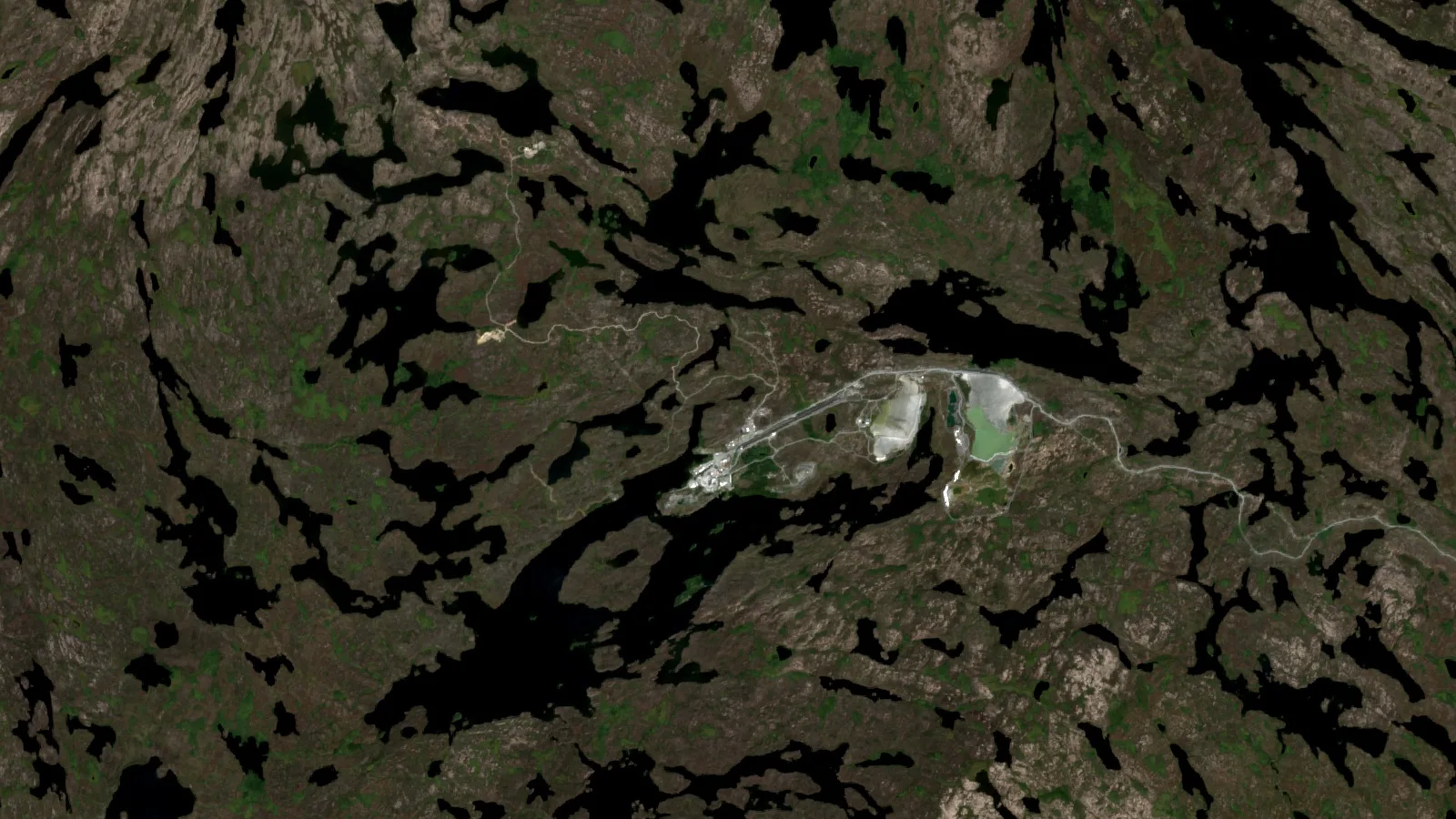
Picture a claim block north of La Ronge from orbit: forest, lakes, wetland, a few rock ridges, and the scars of recent fires. SSR Mining’s own reports of fires near Seabee in 2024 and 2025 show how active that last factor is. Gold deposits in Saskatchewan’s shield are hard-rock targets under that mixed cover, so a satellite screen here is a structural and terrain exercise first, and a mineral-mapping exercise only where rock shows.
Where satellite data earns its keep
- ✔ Shear zones and faults. Seabee’s ore sits in an en échelon network of shears. Lineaments, offset lakes and linear valleys can be traced from elevation models and imagery across a whole belt.
- ✔ Outcrop windows. Ridges, shorelines, road cuts and burned ground expose rock where multispectral and hyperspectral data can map alteration minerals such as sericite and carbonate.
- 📊 Glacial geology. Eskers, drumlins and ice-flow direction show where till came from, which tells you where to sample a dispersion train up-ice, as at EP.
- 📊 Access and footprint. Lakes for floatplanes, winter road routes, wetlands and fire scars all shape a program’s cost and its permit application.

▶ Short feature (3:11): satellite screening combined with soil geochemistry for copper and gold in British Columbia. · 3:11
Where it cannot help
- ⚠ Under till and forest. Optical sensors see the canopy or the surface of glacial deposits, not the bedrock that hosts gold deposits in Saskatchewan.
- ⚠ Winter. Snow and short days remove much of the year for optical work in the north.
- ⚠ Grade and depth. A surface map cannot tell you whether a shear carries 1 g/t or 10 g/t at 300 metres. Only drilling does.
Seabee’s 1990 feasibility study expected 379,241 ounces; by 2012 the mine was about to pass one million.
The useful job for satellite data is ranking: picking the parts of a 6,000-hectare claim that deserve till sampling and geophysics first, and the parcels that add little but still cost $15 per hectare a year. It does not replace the assessment files or a drill.
Public data on gold deposits in Saskatchewan
The Saskatchewan Geological Survey publishes the free data that should sit under any screen:
- 📊 Saskatchewan Mineral Deposit Index (SMDI): a searchable record of known showings, including the 500-plus gold occurrences.
- 📊 Saskatchewan Mineral Assessment Database (SMAD): non-confidential assessment files, where past drilling and sampling on your ground will appear.
- 📊 Mining and Petroleum GeoAtlas: maps of economic and general geology.
- ✔ MARS: the live disposition map, for open and held ground.
Contained ounces: turning grade and tonnes into gold
Most claims on gold deposits in Saskatchewan will never reach a resource estimate, but buyers still talk in tonnes and grams per tonne. The conversion is simple: tonnes times grade in g/t gives grams of gold, and dividing by 31.1035 gives troy ounces. The calculator below does that and adds a recovery rate and a gold price you set yourself. Its default grade of 5.0 g/t is the processed grade SSR Mining guides for Seabee in 2026; the default price is an example only.
Calculator
How much gold is in a given tonnage and grade?
Enter tonnes, grade, recovery and a gold price to see contained ounces and gross metal value.
- Contained gold: 500 kg
- Recovered gold: 16,075 troy oz
- Gross metal value (US$, before costs): $66,712,749
Assumptions: 1 troy ounce = 31.1035 g. Default grade is SSR Mining’s 2026 guided processed grade for Seabee (about 5.0 g/t). Default price is an example near the Kitco bid of US$4,156.50 per ounce on 15 October 2026; check today’s price. Because the gold price is entered in US dollars per ounce, the gross value is in US dollars (US$), not Canadian dollars (C$). Recovery is your own input, capped at 100%. Results are gross metal content and value only, with no costs, dilution, royalties or tax. Arithmetic only, not a resource.
At the defaults, 100,000 tonnes at 5.0 g/t holds 500 kilograms, or about 16,075 troy ounces. Priced at the Kitco bid of US$4,156.50 on 15 October 2026, rounded to US$4,150 in the calculator, that is roughly US$66.7 million of gross metal. Seabee’s mill, at about 1,200 tonnes a day, would get through that tonnage in under three months. Treat any figure like this as an exploration target until a qualified person has estimated a resource under NI 43-101.
Screening Saskatchewan ground with Farmonaut
We work at the ranking step. Our satellite-based mineral detection takes your claim outline as coordinates, KML or KMZ, plus the target mineral, and analyses multispectral or hyperspectral data for alteration halos, faults and fractures and deposit-associated patterns. The report shows high-potential zones with prospectivity heatmaps, estimated location and depth ranges, and georeferenced GIS files, delivered in 5 to 20 business days depending on size and mineral. The Premium+ report adds TargetMax drilling intelligence, with drilling-angle recommendations and interactive 3D subsurface models.
Across our work we have scanned more than 100,000 hectares for 20+ mineral types in 25+ countries, and satellite screening can cut early-exploration timelines from months to days and early-exploration cost by up to 80 to 85%. On gold deposits in Saskatchewan we say plainly where till, forest or snow limits the read and where geophysics or till sampling should take over. Our results are exploration targets that sit ahead of any resource estimate, not a resource, not NI 43-101 disclosure and not a guarantee of a find.
Draw your MARS claim at mining.farmonaut.com, Map Your Mining Site, or ask for a quote. The satellite-driven 3D mineral prospectivity mapping overview shows what a deliverable looks like. For licensing systems elsewhere, see the mining cadastre portal guide by country.
Frequently asked questions
Where are the gold deposits in Saskatchewan?
Mostly in the Precambrian shield across the northern third of the province, especially the La Ronge and Glennie domains of the Trans-Hudson orogen. The Flin Flon area produced by-product gold from copper-zinc ore, and the Beaverlodge domain near Lake Athabasca hosted the historical Box mine.
Is there a gold mine in Saskatchewan operating today?
Yes. SSR Mining’s Seabee operation, about 125 km north-east of La Ronge, produced 54,986 ounces in 2025 and guides 60,000 to 70,000 ounces for 2026. Ore currently comes from the Santoy underground mine.
Who owns the Seabee mine in Saskatchewan?
SSR Mining owns 100% of Seabee. It acquired the operation with Claude Resources on 31 May 2016 and expanded its exploration ground around Seabee by buying Taiga Gold in April 2022.
How much gold does Seabee have left?
At 31 December 2025, SSR Mining reported 505,000 ounces of Proven and Probable reserves at 4.63 g/t, plus, separately, 212,000 ounces Measured and Indicated and 203,000 ounces Inferred resources, exclusive of reserves. Do not add the categories together.
How do you stake a gold claim in Saskatchewan?
Register an account in MARS, select open parcels on the map (up to 6,000 hectares per claim) and pay $0.60 per hectare, with a $300 minimum. Ground staking with posts is no longer how new claims over gold deposits in Saskatchewan are made.
How much does it cost to keep a mining claim in Saskatchewan?
Nothing in the first year. From year two to year ten you must spend $15 per hectare a year (minimum $240 per claim), and $25 per hectare from year eleven. You can pay or deposit any shortfall within 90 days of the period’s end.
Is gold prospecting in Saskatchewan allowed without a claim?
Only recreational panning with a pan, on ground where no one else holds the mineral rights and with the surface owner’s permission. Sluices, dredges, screens and even hand shovels need a mineral claim.
Is there gold in the North Saskatchewan River?
Yes, but it is very fine. The provincial survey describes “flour-like” gold near Prince Albert, minor historical production, and a dredging attempt near Cutwell between 1905 and 1909 that met with little success.
Is there still gold in Saskatchewan to find?
The 2012 survey report calls the province under-explored, notes that new discoveries continue, and says most known deposits were drilled only to depths under 350 metres. Untested depth below known gold deposits in Saskatchewan is the obvious opportunity.
Do I need permits to drill a claim in Saskatchewan?
Yes. Surface disturbance work on Crown land needs Ministry of Environment permits, drilling normally needs a Temporary Water Rights Licence from the Water Security Agency, and the duty to consult First Nation and Métis communities may apply. Airborne surveys with no surface use need no permit.
Can satellites find gold deposits in Saskatchewan?
Not directly. They map faults and shear zones, outcrop alteration, glacial landforms and access, which helps rank ground before till sampling, geophysics and drilling. They cannot see through till or forest, or measure grade.
A note on provincial statistics: the federal 2024 production table puts Canada’s gold output at 185,555 kilograms but shows Saskatchewan’s gold as “x”, the Statistics Canada symbol for figures suppressed to meet the confidentiality requirements of the Statistics Act. With one producing gold mine, company filings are the practical source for output from gold deposits in Saskatchewan.
Farmonaut mineral detection
Map your mining site from space
Send your claim or licence boundary as KML, KMZ or a polygon. Farmonaut returns ranked satellite exploration targets for it, usually in 5 to 20 business days.

Keep reading
Sources
- Government of Saskatchewan, Mineral Administration Registry Saskatchewan (MARS) (2026): saskatchewan.ca
- Government of Saskatchewan, The Mineral Tenure Registry Regulations, consolidated to SR 62/2024 (2024): publications.saskatchewan.ca
- Saskatchewan Geological Survey, Report 262: Saskatchewan Gold (2012): publications.saskatchewan.ca
- SSR Mining, Seabee operation page, year-end 2025 reserves and resources (2026): ssrmining.com
- SSR Mining, Full-year 2025 results and 2026 guidance, SEC filing (2026): sec.gov
- SSR Mining, Fourth quarter and full-year 2024 results (2025): ssrmining.com
- SSR Mining, Second quarter 2026 results, SEC filing (2026): sec.gov
- Natural Resources Canada, Mineral production of Canada by province, Table G01 (2024): sead.nrcan-rncan.gc.ca
- Statistics Canada, Guide to symbols used in tables (2026): statcan.gc.ca
- Government of Saskatchewan, Mineral Exploration Guidelines for Saskatchewan (2016): publications.saskatchewan.ca
- Government of Saskatchewan, Recreational gold panning and placer mining (2026): saskatchewan.ca
- Government of Saskatchewan, Duty to consult First Nations and Métis communities (2026): saskatchewan.ca
- Government of Saskatchewan, In Saskatchewan we are all Treaty people (2024): saskatchewan.ca
- Government of Saskatchewan, Saskatchewan Geological Survey: GeoAtlas, SMDI and data (2026): saskatchewan.ca
- Government of Saskatchewan, Mineral tenure (2026): saskatchewan.ca
- Kitco, Live gold price chart, bid on 15 October 2026 (2026): kitco.com
Discussion
Questions, corrections or field experience? Share them below. First-time comments are reviewed before they appear, and your email is never published.
No comments yet. Be the first to add a question or your experience.

 SMA Investments Ltd
 NTS Group (Pty) Ltd
 Mine4Africa
 Lithspo Minerals Limited
 Tintina Mining Group
 Dalgety Minerals Pty Ltd
 Vortex Minerals Pty Ltd
 Faith At Work (Pty) Ltd
 Geotech Mining Solutions plc
 Vulcan International Limited
 Kidepo Associates
 GKY Mining
 Alkimy SARL
 Double A Trading
 GemSprout Metals Limited
 Qader Group
 Ileys General Trading
 SG Gold Mining LLC
 VRV Global Pte Ltd
 Omsri International FZE
 G.I.T.T.
 Jaunita Erss Ltd
 Almosi SARL
 SRK Consulting
 Berks Gold Limited
