

Gold exploration · British Columbia
Gold mining in BC: the mines that pour gold today, the claim rules behind new ground, and what satellites can map in mountain terrain
Key takeaways
- BC produced 19,794 kg of gold in 2024, about 10.7% of the Canadian total in the same table.
- Brucejack (Newmont) poured 231,000 oz in 2025 and is guided to 260,000 oz in 2026; Blackwater (Artemis Gold) has been in commercial production since 1 May 2025.
- New claims go through the Mineral Claims Consultation Framework, in effect since 25 March 2025.
- Holding cost is mostly work: C$5 per hectare a year at first, C$20 from the seventh year.
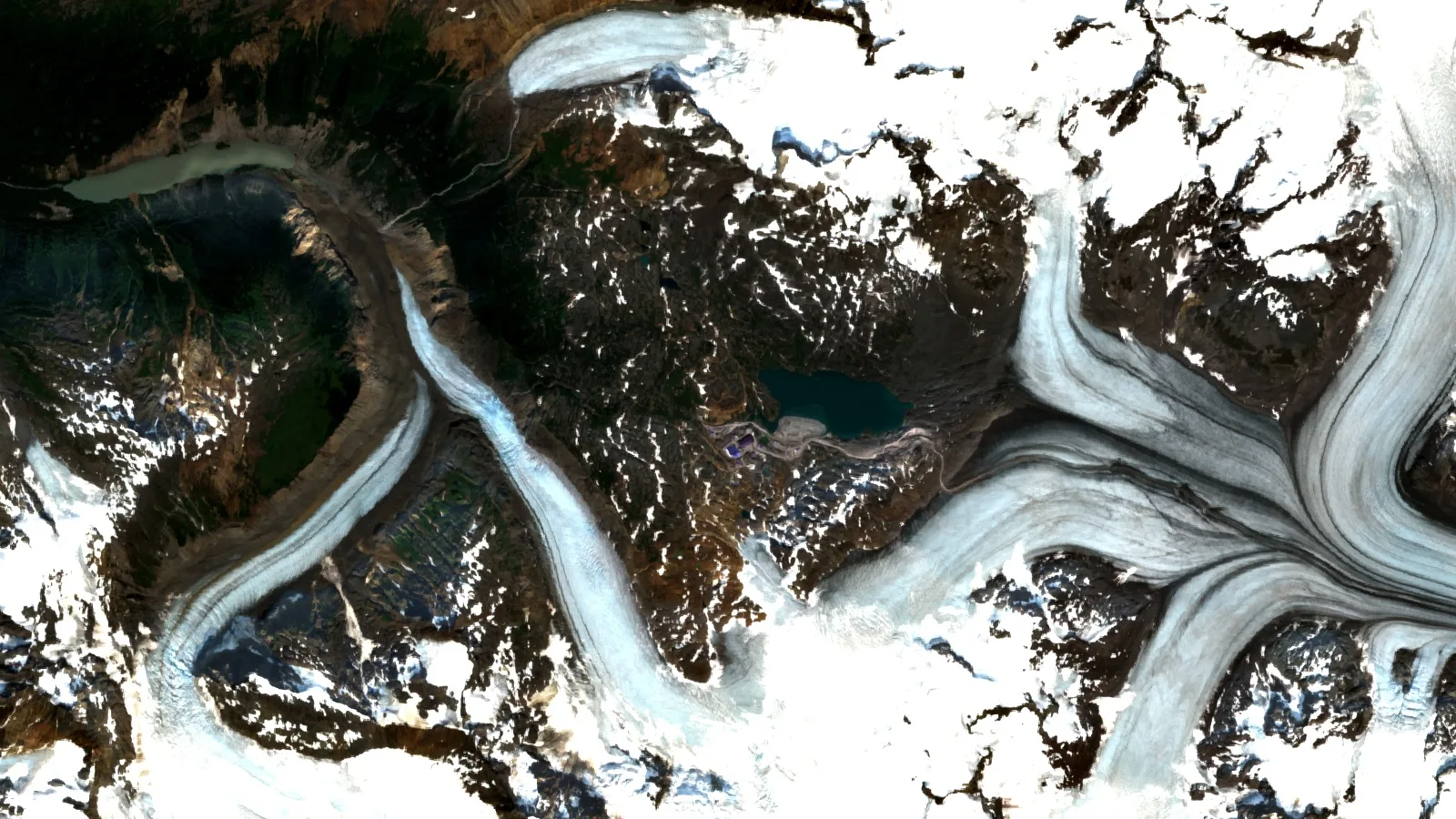
- Satellites screen exposed rock, structure and access. They do not see gold under forest, snow or till.
In this article
- Gold mining in BC today: output, value and where it comes from
- The Golden Triangle, British Columbia's main gold district
- Beyond the Golden Triangle: Cariboo, Kamloops and central BC
- How to stake a gold claim in BC: Mineral Titles Online, fees and work
- What satellites can and cannot see in BC gold country
- How Farmonaut screens BC gold ground from orbit
- BC gold mining companies, exploration spending and buying in
- Frequently asked questions about gold mining in BC
Gold mining in BC is led by Newmont’s Brucejack and Red Chris mines in the Golden Triangle, with Blackwater, New Afton and Mount Milligan producing further south, and new ground is acquired online through Mineral Titles Online at C$1.75 per hectare after a First Nations consultation step.
If you hold ground, fund a junior or advise one, gold mining in BC is a different business from gold in the rest of Canada. The rocks are younger and mountainous, a lot of the gold comes out of copper mines, and the claim registry changed in 2025 so that First Nations are consulted before a claim is registered. Our overview of gold exploration across Canada compares the provincial claim systems side by side; this page stays in British Columbia and goes mine by mine, fee by fee.
Brucejack alone poured 231,000 ounces of gold in 2025, more than Blackwater’s 192,808 in its first year.
Gold mining in BC today: output, value and where it comes from
How much gold does British Columbia produce? The 2024 mineral production table published by Natural Resources Canada, built from Statistics Canada data and dated February 2026, lists 19,794 kilograms of gold produced in British Columbia. Shipments were worth C$1.97 billion. Canada’s total in the same table is 185,555 kilograms, so BC supplied roughly one ounce in every nine or ten.
The same table explains why gold mining in BC looks the way it does. British Columbia produced 300,187 tonnes of copper in 2024, about 68% of the national 444,587 tonnes. Porphyry copper-gold deposits are big, low-grade bodies, and they deliver gold as a by-product alongside the copper. When you read a list of BC gold producers, many of them are copper mines with gold credits.
Only Ontario, Quebec and Nunavut published higher 2024 figures in that table. Over a decade, gold mining in BC, Canada, has trended up, but not in a straight line. Using the same NRCan series, from the 2015 table onward, output rose from 12.4 tonnes to a high of 22.4 tonnes in 2021, then eased as some mines moved through lower-grade phases.
Chart
British Columbia gold output, 2015 to 2024
Tonnes of gold produced per year (kilograms divided by 1,000)
The British Columbia Geological Survey puts those tonnes in a provincial context. Its Provincial Overview of Exploration and Mining for 2024 forecast the total value of BC mine production at $16.5 billion, with gold at 11.5% of that value, behind coal and copper. Nine metal mines operated during at least part of 2024. That small number is worth remembering: gold mining in BC rests on a handful of large operations, not hundreds of small ones.

▶ Video (3 min 11 s): how satellite and soil data are used to look for copper and gold in British Columbia. · 3:11
The Golden Triangle, British Columbia’s main gold district
Ask a BC geologist where gold mining in BC is concentrated and the first answer is the northwest. The BC Geological Survey’s circular on the Golden Triangle of northwestern British Columbia calls it the popular name for a loosely defined region that holds most of the major gold, silver and copper deposits in west-central Stikinia. Stikinia, or the Stikine terrane, is an old oceanic island arc that runs for about 1,000 km along the Canadian Cordillera. Most deposits in the Golden Triangle are tied to the Hazelton Group volcanic rocks and the intrusions that came with them.
Mining in the Golden Triangle of British Columbia is not new. The same circular counts more than 150 mines that have operated since prospectors arrived at the end of the nineteenth century, with past producers such as Granduc, Eskay Creek, Anyox, Kitsault, Premier, Dolly Varden and Snip. For gold mining in BC, the Golden Triangle is where history, modern production and most of the exploration money overlap.
More than 150 mines have operated in the Golden Triangle since the end of the nineteenth century.
Brucejack mine: the high-grade end of gold mining in BC
The Brucejack mine is one of the province’s largest gold producers. The BC Geological Survey describes it as an epithermal gold-silver deposit, the type that forms near surface from hot fluids and can carry very high grades in narrow zones. Its ownership has changed more than once: the survey’s 2023 circular lists Newcrest Mining as owner and cites earlier reserve statements from Pretium Resources. In a June 2026 news release, Newmont describes itself as the owner and operator of the Brucejack mine.
Newmont’s full-year 2025 results filing reports 231,000 ounces of gold from Brucejack in 2025, down from 258,000 in 2024, and guides to 260,000 ounces in 2026 on better stope availability and higher throughput. Searches for “Brucejack mine Newcrest” or “Pretium Brucejack” lead to the same underground mine; only the owner’s name has changed.
Red Chris, Galore Creek and the copper-gold giants
Red Chris, about 17 km east-southeast of the community of Iskut according to the survey’s 2024 overview, is an alkalic porphyry copper-gold mine. Newmont holds 70% and operates it, and Imperial Metals holds 30%. On 19 June 2026 the Province approved an amended Environmental Assessment Certificate and an amended Mines Act permit for a block cave, an underground method that lets the ore collapse into draw points under its own weight. Newmont says the change extends mine life into the mid-2040s, and a final investment decision was still to come at the time of the release. Newmont’s share of Red Chris gold in 2025 was 62,000 ounces.
Newmont also owns 50% of Galore Creek Mining Corporation, which holds the Galore Creek copper-gold deposit. It is not a producing mine. Deposits of that size explain why many golden triangle BC mining companies describe themselves as copper-gold explorers rather than gold explorers.
Chart
Gold poured at four BC mines in 2025
Thousand troy ounces (koz), calendar 2025, as reported by each operator
Eskay Creek: a past producer in construction
Eskay Creek produced gold and silver in the past and is being rebuilt. Skeena Gold & Silver, which owns 100% of the project, reported in a March 2026 project update that construction was 49% complete at 28 February 2026, with initial production targeted for the second quarter of 2027 and commercial production in the third quarter. Until then, it is a construction project and should be valued as one, however large it looms in gold mining in BC’s northwest.

▶ Video (10 min 34 s): how gold is mined and processed, from ore to doré, which helps when reading mill grades and recoveries. · 10:34
Beyond the Golden Triangle: Cariboo, Kamloops and central BC
The modern Golden Triangle is only half the story of gold mining in BC. British Columbia exists as a province partly because of gold. The Canadian Encyclopedia’s account of the Fraser River Gold Rush says around 30,000 gold seekers reached the river in 1858, and fears of American annexation led to the founding of British Columbia as a colony on 2 August 1858. The Cariboo Gold Rush followed between roughly 1861 and 1867, centred on Williams Creek, 125 km southeast of Prince George, where Barkerville grew up at the end of the 650 km Cariboo Road.
In the far northwest, gold found on Pine Creek near Atlin in 1898 diverted thousands of people bound for the Klondike, and placer mining has continued on Atlin Lake tributaries since. Placer gold, recovered from gravels rather than bedrock, still has its own claim type in BC, covered below.
Blackwater: the newest gold mine in BC
Blackwater, operated by Artemis Gold, sits in central British Columbia about 160 km southwest of Prince George. Artemis reports its first gold pour in January 2025 and commercial production from 1 May 2025, with 192,808 ounces produced in its first year. In the third quarter of 2026 the mill treated 1.48 million tonnes at 1.55 g/t gold with 90% recovery and produced 69,546 ounces. Grade is quoted in grams per tonne (g/t): 1.55 g/t means 1.55 grams of gold in each tonne of ore.
New Gold, Kamloops, BC: New Afton under new ownership
Many readers search for New Gold in Kamloops, BC, because the New Afton mine sits near the city. New Gold’s year-end 2025 report describes New Afton as located in south-central British Columbia near Kamloops and reports 2025 production of 62,945 ounces of gold from 4.4 million tonnes of ore grading 0.52 g/t gold and 0.57% copper. New Gold no longer owns it independently: Coeur Mining’s second-quarter 2026 results say its acquisition of New Gold closed in late March 2026, and Coeur now operates New Afton and is developing its C-Zone.
Mount Milligan and the Cariboo Gold Project
Centerra Gold’s Mount Milligan is an open-pit gold-copper mine in north-central BC. Centerra’s second-quarter 2026 report gives 38,175 ounces of gold from Mount Milligan in that quarter. In central BC, Osisko Gold Group announced a formal construction decision for the Cariboo Gold Project on 14 September 2026, with a first gold pour expected in the first quarter of 2029. The company lists agreements with the Lhtako Dené Nation and Williams Lake First Nation and continuing consultation with Xatśūll First Nation.
| Mine or project | Area | Owner (2026) | Status | Latest gold figure |
|---|---|---|---|---|
| Brucejack | Golden Triangle | Newmont | Operating, underground | 231,000 oz in 2025; 260,000 oz guided for 2026 |
| Red Chris | Golden Triangle, near Iskut | Newmont 70%, Imperial Metals 30% | Operating open pit; block cave permitted June 2026, investment decision pending | 62,000 oz in 2025 (Newmont’s 70%) |
| Eskay Creek | Golden Triangle | Skeena Gold & Silver | In construction, 49% complete (Feb 2026) | Initial production targeted Q2 2027 |
| Galore Creek | Golden Triangle | Galore Creek Mining Corp. (Newmont 50%) | Deposit, not producing | None published here |
| Blackwater | Central BC, SW of Prince George | Artemis Gold | Operating open pit since May 2025 | 192,808 oz in 2025; 69,546 oz in Q3 2026 |
| New Afton | Near Kamloops | Coeur Mining (acquired New Gold, March 2026) | Operating, underground gold-copper | 62,945 oz in 2025 |
| Mount Milligan | North-central BC | Centerra Gold | Operating open-pit gold-copper | 38,175 oz in Q2 2026 |
| Cariboo Gold | Central BC, Cariboo | Osisko Gold Group | Construction decision Sept 2026 | First pour expected Q1 2029 |
Owners and status confirmed from each company’s 2026 filings or releases linked above. Figures are reported production, not resources.
A practical way to sanity-check any gold mining in BC headline is to turn tonnes and grade into ounces yourself. The calculator below uses the standard conversion of 31.1035 grams per troy ounce and starts with Blackwater’s third-quarter 2026 mill figures.
Calculator
How much gold is in a given tonnage, and what is it worth?
Enter ore tonnes, grade, recovery and a gold price to see contained and recovered ounces.
- Recovered gold: 66,378 oz
- Gross value of recovered gold: 275.5 US$ million
Assumptions: contained ounces = tonnes x grade (g/t) / 31.1035. Defaults are Artemis Gold’s reported Q3 2026 Blackwater mill figures (1.48 Mt at 1.55 g/t, 90% recovery, Artemis Gold release, 13 October 2026); reported production differs because of stockpiles and timing. The gold price is in US dollars per ounce and the gross value is in US dollars (not Canadian dollars); the default is an example near Kitco’s US$4,151 bid on 15 October 2026, so check today’s price. Gross value only, before mining, processing, royalty and tax costs; not a resource, reserve or valuation. Not investment advice.
How to stake a gold claim in BC: Mineral Titles Online, fees and work
Gold mining in BC starts, legally, with a Free Miner Certificate. Under section 8 of the Mineral Tenure Act, a certificate must be issued to a person aged 18 or over who is ordinarily resident in Canada for at least 183 days a year or authorized to work in Canada, to a Canadian corporation, or to a partnership of qualifying partners. Schedule B of the Mineral Tenure Act Regulation sets the fee at C$25 for an individual, C$500 for a corporation, and nothing for an individual senior over 65.
Cell claims, placer claims and what registration costs
BC claims are cell claims, selected on the grid in Mineral Titles Online (MTO), the province’s registry of mineral, placer and coal rights. The regulation says each cell’s area is set by its location on the registry grid, so check the hectares MTO shows before you budget. The regulation sets registration at C$1.75 per hectare for a mineral cell claim, which covers hard-rock (lode) gold, and C$5.00 per hectare for a placer cell claim, which covers gold in gravels. A 500-hectare (1,236-acre) mineral claim therefore costs C$875 to register.
Since 25 March 2025 registration is no longer instant. The MTO home page records that changes were made to Mineral Titles Online that day to bring the Mineral Claims Consultation Framework (MCCF) into effect. The province’s Declaration Act action plan report explains why: in 2023 the BC Supreme Court ordered the ministry to consult on mineral claim registrations, and the MCCF is how it now consults First Nations before a claim is registered. Build that waiting time into any plan that depends on new ground.
More change is coming. The Mineral Tenure Act reform engagement site shows policy development from spring 2025 to summer 2026 and a target of fall 2026 to introduce legislation. Rules in this section reflect the Act as current to 6 October 2026; confirm with Mineral Titles before you rely on them.
Infographic
From open ground to a drill hole in British Columbia: six steps for a hard-rock (mineral) claim
- 1Check the groundUse the MTO map viewers for open cells, and MapPlace, MINFILE and ARIS for history.
- 2Free Miner CertificateC$25 for a person, C$500 for a company, C$0 for seniors over 65.
- 3Apply in MTOFile a cell claim application; First Nations are consulted under the MCCF first.
- 4Register and payC$1.75 per hectare for a mineral claim, C$5 for a placer claim.
- 5Keep it in good standingWork C$5 to C$20/ha a year, or double in cash; file assessment reports.
- 6Permit, then drillGet a Mines Act permit before mechanical disturbance or exploratory drilling.
Keeping a claim alive: work, cash and the ten-year credit cap
The real cost of holding a BC claim is the exploration and development work you must register each anniversary year. Section 8 of the regulation sets the minimum at C$5 per hectare in each of the first and second anniversary years, C$10 in the third and fourth, C$15 in the fifth and sixth, and C$20 per hectare in every year after that. A placer claim needs C$20 per hectare every year.
Instead of doing the work you can pay, but the payment is double the work value, so C$10 to C$40 per hectare for a mineral claim and C$40 for a placer claim. Cash can only be paid for the next anniversary year. Work, by contrast, can be applied to future anniversary years up to a maximum of ten. If neither is registered, section 35 of the Act says the claim forfeits to the government at the end of its expiry date. Apart from an extension when a holder dies, the section allows no grace period.
Chart
Work or cash: what a BC claim costs to keep each year
Canadian dollars per hectare per anniversary year
Because surplus work rolls forward, a single good field season can protect a claim for years. The second calculator shows how far a work budget goes on a claim of your size, and what the same years would cost in cash.
Calculator
How many years does your registered work keep a BC claim in good standing?
Enter your mineral claim area, the next anniversary year to cover and the work value (C$) you will register.
- First anniversary year that needs new work or cash: 9
- Work value left over (C$): $0
- Paying cash instead for the same years (C$): $100,000
- Work needed for the first year alone (C$): $2,500
- Registering a new claim of this size (C$): $875
- Claim area in acres: 1,236 acres
All amounts are Canadian dollars (C$). Work values per hectare from section 8 of the Mineral Tenure Act Regulation, B.C. Reg. 529/2004 (C$5 in years 1 and 2, C$10 in years 3 and 4, C$15 in years 5 and 6, C$20 after); payment in lieu at double the work value (section 10); credit capped at 10 future anniversary years; registration at C$1.75/ha (Schedule B). Mineral claims only. Registration fees for work and report costs not included. 1 ha = 2.471 acres. Example values only; confirm with Mineral Titles.
Permits for gold mining in BC come after the claim
A claim gives you the mineral right and, under section 14 of the Mineral Tenure Act, the right to use the surface for exploration. The same section says no mining activity may be done until the holder receives any permit required under section 10 of the Mines Act. That Act defines a “mine” to include any place where mechanical disturbance of the ground or excavation is made to explore, and lists exploratory drilling among mine activities. In practice, prospecting, mapping and hand sampling sit below the permit line; trenching with machines and drilling do not. The BC Geological Survey’s 2024 overview uses the same split, describing grassroots exploration as activity typically below Mines Act permit thresholds.
Section 19 adds a notice duty: before a mining activity starts, the person must serve notice on owners of the surface and on certain Crown land tenure holders, then wait the prescribed period. Section 21 bars locating a title or exploring in a park without cabinet authorization. Mineral rights, surface rights and permits are three separate things in BC, and a buyer should check all three. For an overview of other countries’ registries, see our mining cadastre portal guide by country.
Recreational panning is the one part of gold mining in BC with a short rule of its own. Section 9 of the Mineral Tenure Act lets a person who is not a free miner hand pan for recreation, but not on a valid mineral title without the recorded holder’s permission. Anything beyond a pan, or any attempt to keep a find, falls under the claim rules above.
What satellites can and cannot see in BC gold country
British Columbia’s gold terrain is close to the opposite of a desert. High ground in the Golden Triangle exposes bare rock above the treeline, while valleys are filled with forest, till and river gravel. That mix suits satellite screening for gold mining in BC better than the flat, glaciated Shield further east, but only if the analyst works with the seasons and the slopes rather than against them.
Where satellite data helps on BC ground
- ✔ Alteration on exposed ridges. Epithermal systems such as Brucejack and porphyries such as Red Chris come with clay, sericite and iron-oxide alteration. Where rock is bare, multispectral and shortwave-infrared bands can map those minerals across whole valleys.
- 📊 Structure. Faults, fracture sets and intrusive contacts show up in elevation models and radar even where trees hide the surface.
- ✔ Gossans and colour anomalies. Rusty, oxidised outcrops stand out in colour imagery once the snow has melted.
- Access and footprint. Roads, glaciers, lakes, cutblocks and fish-bearing streams can be mapped before a permit application is drafted.
Where it cannot
- ⚠ Snow and cloud. High ground is snow-covered for much of the year, which leaves a short summer window for useful optical images.
- ⚠ Forest and cover. Optical sensors read the canopy or the surface of till and gravel, not the bedrock beneath.
- Steep slopes. Shadows and illumination differences on steep faces distort spectral readings and must be corrected.
- Grade and depth. No surface image tells you how many grams per tonne a vein carries at depth.
Field spectroscopy is the ground-level version of the same idea. The survey’s 2024 overview notes a Stewart-area explorer running a TerraSpec shortwave-infrared (SWIR) program near the Texas Creek intrusive unit, which ties hand-sample spectra to alteration. Satellite screening narrows down where that kind of fieldwork goes first.

▶ Video (11 min 35 s): satellite gold exploration in Alaska, the terrain closest to northwest BC in snow, relief and short seasons. · 11:35
Public BC data to load before any field season
Public geoscience for gold mining in BC is unusually deep. The survey’s circular on its online databases describes MapPlace, which lets you query geology, MINFILE, assessment reports, geochemistry and mineral titles together. MINFILE documents about 16,200 metallic, industrial mineral and coal occurrences. The Assessment Report Indexing System (ARIS) holds more than 41,500 assessment reports submitted since 1947, which become public after a one-year confidentiality period. The geochemical dataset has about 5 million determinations from more than 86,000 samples.
Those reports are a gift to the next explorer. Because claim holders must file assessment reports to keep tenure, decades of soil grids, drill logs and geophysics on most BC gold ground are already public. Reading them before you stake is the cheapest step in gold mining in BC, and it stops you paying to repeat someone else’s 1980s soil survey.
How Farmonaut screens BC gold ground from orbit
We are a satellite data company, and our role in gold mining in BC sits at the screening step, before geophysics and drilling. Our satellite-based mineral detection takes your area of interest as coordinates, a KML or KMZ file or a polygon, plus the target mineral. We pick multispectral or hyperspectral data, analyse it for alteration halos, faults, fractures and deposit-associated patterns, and deliver in 5 to 20 business days depending on area and complexity.
The Premium report gives high-potential zones, prospectivity heatmaps, estimated location and depth ranges, indicative quantity and a geological interpretation, as a PDF plus georeferenced GIS files. Premium+ adds TargetMax™ drilling intelligence with drill-angle recommendations and interactive 3D subsurface models; the satellite-driven 3D mineral prospectivity mapping overview shows a typical deliverable. Across 100,000+ hectares, 20+ mineral types and 25+ countries, this approach has cut early exploration timelines from months to days and can lower early-exploration cost by up to 80 to 85%.
Be clear about what that output is. A Farmonaut target is an exploration target that sits ahead of any resource estimate. It is not an NI 43-101 resource, it does not replace a Qualified Person’s work, and it is not an environmental or social clearance. In snow-covered or forested BC ground we say where cover limits the result.

▶ Video (2 min 47 s): hyperspectral, LiDAR and induced-polarization methods on a British Columbia gold project. · 2:47
To start, draw your claim at mining.farmonaut.com (Map Your Mining Site), or get a quote for a specific block.
BC gold mining companies, exploration spending and buying in
Who are the BC gold mining companies worth knowing, and who carries gold mining in BC day to day? Among producers, the list above gives Newmont, Imperial Metals, Artemis Gold, Coeur Mining and Centerra Gold. Among builders, Skeena Gold & Silver at Eskay Creek and Osisko Gold Group in the Cariboo. Behind them sit dozens of juniors holding claims around the producing camps, and their fortunes follow the exploration budget.
The budget behind gold mining in BC has shrunk from its peak. The BC Geological Survey’s 2024 overview estimates total exploration spending at $552.1 million in 2024, down from $643.5 million in 2023 and from the record $740.4 million in 2022. Less money chasing the same ground means fewer drill holes per claim, which makes cheap desktop screening and old assessment reports more valuable, not less.
If you are looking at buying claims rather than shares, our British Columbia gold claims buyer guide covers the transfer checks. For context on the other provinces, see Canada’s gold deposits by province.

▶ Video (10 min 44 s): the global race for gold, and why producers and juniors keep returning to established districts like BC's. · 10:44
Frequently asked questions about gold mining in BC
Where is gold found in British Columbia?
Most gold mining in BC happens in the Golden Triangle in the northwest (Brucejack, Red Chris), central BC (Blackwater, Mount Milligan) and the Kamloops area (New Afton). Historic placer districts include the Fraser River, the Cariboo around Barkerville and Atlin.
How much gold does BC produce a year?
The NRCan table built on Statistics Canada data lists 19,794 kg (19.8 tonnes) for 2024, worth C$1.97 billion in shipments, about 10.7% of the Canadian total in that table.
Who owns the Brucejack mine?
Newmont owns and operates Brucejack. It produced 231,000 ounces in 2025 and Newmont guides to 260,000 ounces in 2026. Earlier owners include Newcrest Mining and, before that, Pretium Resources.
What is the Golden Triangle in British Columbia?
The BC Geological Survey calls it a loosely defined region in northwestern BC holding most of the major gold, silver and copper deposits of west-central Stikinia, most of them tied to Hazelton Group rocks.
Is New Gold’s Kamloops mine still operating?
Yes. New Afton, near Kamloops, is operating under Coeur Mining, which completed its acquisition of New Gold in late March 2026. It produced 62,945 ounces of gold in 2025.
How do you stake a gold claim in BC?
Get a Free Miner Certificate (C$25 for a person, C$500 for a company), select open cells in Mineral Titles Online and apply. Since 25 March 2025 the application goes through First Nations consultation before registration. Registration costs C$1.75 per hectare for a mineral claim.
How much does it cost to keep a BC mineral claim?
Work of C$5 per hectare a year in years 1 and 2, rising to C$20 from year 7, or a cash payment of double those amounts for the next year only. Unpaid claims forfeit at the end of the expiry date.
Do I need a permit to explore for gold in BC?
For mechanised work, yes, as everywhere in gold mining in BC. The Mineral Tenure Act says no mining activity may start until any Mines Act permit is issued, and the Mines Act counts mechanical disturbance and exploratory drilling as work at a mine.
Can I pan for gold in BC without a claim?
Section 9 of the Mineral Tenure Act lets anyone hand pan for recreation, but not on a valid mineral title without the holder’s permission. Never use mercury.
Is there still gold in BC to find?
Explorers think so: the province recorded $552.1 million of exploration spending in 2024, and Eskay Creek and the Cariboo Gold Project are being built. Old assessment reports in ARIS and MINFILE are the place to start.
Can satellites find gold in British Columbia?
Not directly. For gold mining in BC they map alteration minerals on exposed rock, faults and access, which ranks ground for sampling. Snow, forest and till limit what they see, and they cannot measure grade at depth.
Authored by: Farmonaut Research & Content Team · Reviewed by: Farmonaut Mining & Mineral Exploration Team · Updated October 2026
General information about gold mining in BC only, not legal or investment advice. Fees, work values and consultation rules change; confirm with the Mineral Titles Branch. Farmonaut targets are exploration targets ahead of any resource estimate and carry no NI 43-101 status.
Farmonaut mineral detection
Map your mining site from space
Send your claim or licence boundary as KML, KMZ or a polygon. Farmonaut returns ranked satellite exploration targets for it, usually in 5 to 20 business days.

Keep reading
Sources
- Natural Resources Canada, Mineral Production of Canada 2024, Table G01 (2026): sead.nrcan-rncan.gc.ca
- Natural Resources Canada, Mineral Production of Canada 2023, Table G01 (2025): sead.nrcan-rncan.gc.ca
- Natural Resources Canada, Mineral Production of Canada 2015, Table G01 (2017): sead.nrcan-rncan.gc.ca
- BC Geological Survey, Information Circular 2023-05, the Golden Triangle (2023): cmscontent.nrs.gov.bc.ca
- BC Geological Survey, Information Circular 2025-01, Provincial overview of exploration and mining (2025): cmscontent.nrs.gov.bc.ca
- BC Geological Survey, Information Circular 2026-03, MapPlace, MINFILE and ARIS (2026): cmscontent.nrs.gov.bc.ca
- BC Laws, Mineral Tenure Act, RSBC 1996 c. 292 (current to 2026): bclaws.gov.bc.ca
- BC Laws, Mineral Tenure Act Regulation, B.C. Reg. 529/2004 (current to 2026): bclaws.gov.bc.ca
- BC Laws, Mines Act, RSBC 1996 c. 293, section 10 (current to 2026): bclaws.gov.bc.ca
- Government of BC, Mineral Titles Online, MCCF notice (2025): mtonline.gov.bc.ca
- Government of BC, Mineral Tenure Act reform engagement (2025): engage.gov.bc.ca
- Government of BC, Declaration Act Action Plan, action 2.14 (2023): declaration.gov.bc.ca
- Newmont, Red Chris block cave project receives major regulatory approvals (2026): s24.q4cdn.com
- Newmont, fourth quarter and full-year 2025 results, Form 8-K (2026): sec.gov
- Artemis Gold, 2025 production results for Blackwater, news release (2026): artemisgoldinc.com
- Artemis Gold, Q3 2026 Blackwater operating results, news release (2026): artemisgoldinc.com
- New Gold, Q4 2025 management's discussion and analysis (2026): sec.gov
- Coeur Mining, second quarter 2026 earnings release (2026): sec.gov
- Skeena Resources, Eskay Creek project update, Exhibit 99.1 (2026): sec.gov
- Centerra Gold, Q2 2026 management's discussion and analysis (2026): s205.q4cdn.com
- Osisko Gold Group, Cariboo Gold Project construction decision, Exhibit 99.1 (2026): sec.gov
- The Canadian Encyclopedia, Cariboo Gold Rush: thecanadianencyclopedia.ca
- The Canadian Encyclopedia, Fraser River Gold Rush: thecanadianencyclopedia.ca
- The Canadian Encyclopedia, Atlin: thecanadianencyclopedia.ca
- Kitco, Gold price today in USD (15 October 2026): kitco.com
Discussion
Questions, corrections or field experience? Share them below. First-time comments are reviewed before they appear, and your email is never published.
No comments yet. Be the first to add a question or your experience.

 CIMISCO SARL
 Mining SARL
 SenGold Invest SAS
 Sania Corporation
 Sean Mining Limited
 NTS Group (Pty) Ltd
 Mine4Africa
 Lithspo Minerals Limited
 Tintina Mining Group
 Dalgety Minerals Pty Ltd
 Vortex Minerals Pty Ltd
 Faith At Work (Pty) Ltd
 Geotech Mining Solutions plc
 Vulcan International Limited
 Kidepo Associates
 GKY Mining
 Alkimy SARL
 Double A Trading
 GemSprout Metals Limited
 Qader Group
 Ileys General Trading
 SG Gold Mining LLC
 VRV Global Pte Ltd
 Omsri International FZE
