

Tungsten skarn · Deposit-model guide
Tungsten Skarn Deposits: Scheelite, Garnet, Examples
A tungsten skarn forms where an evolved granite meets limestone and leaves scheelite in garnet-pyroxene rock. The USGS median for 41 deposits is 6.03 Mt at 0.44% WO3; scheelite glows blue under shortwave UV.
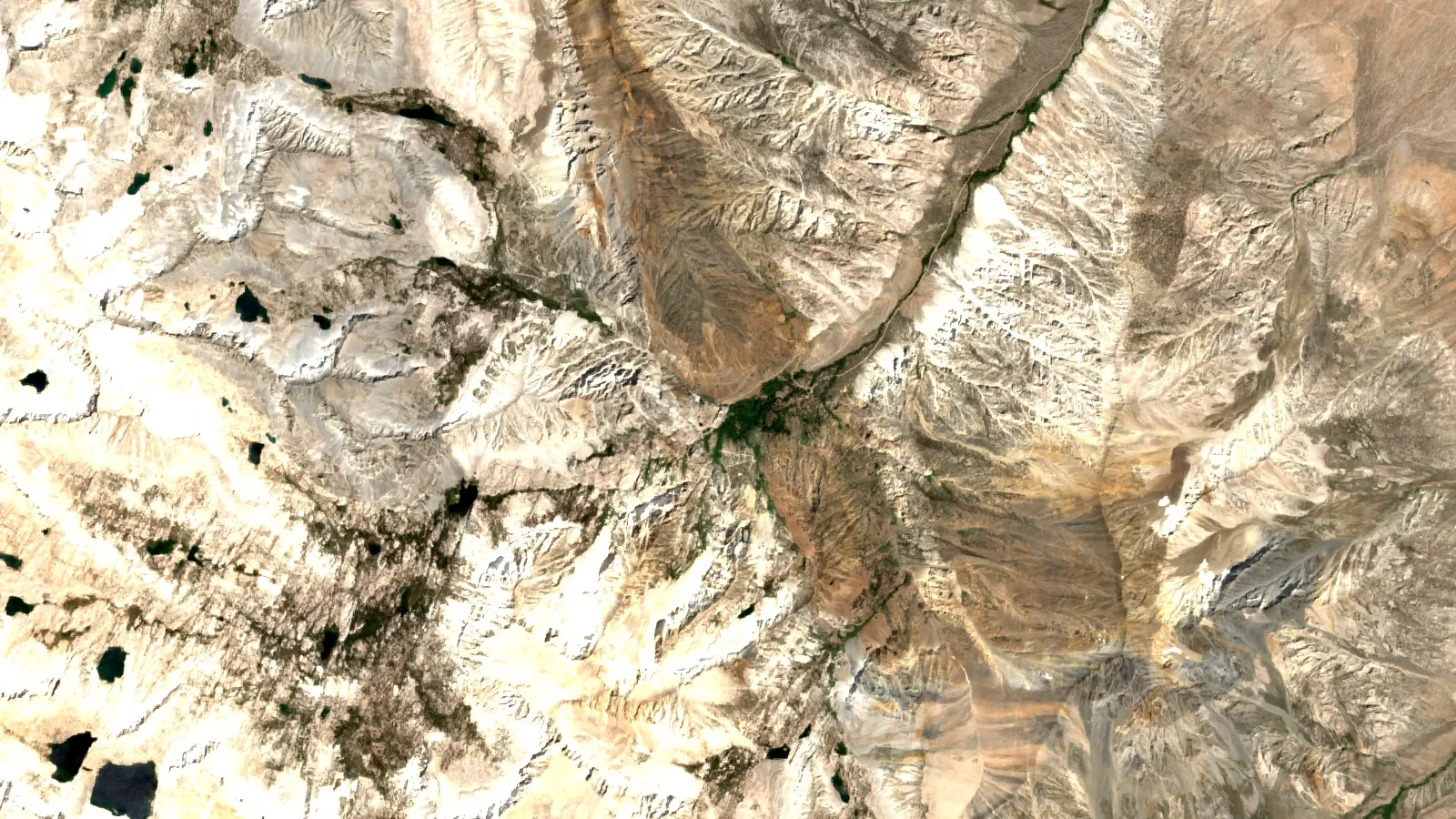
Key takeaways
- Skarn is the leading historical source of tungsten and holds the largest share of discovered tungsten resources (USGS SIR 2020-5085).
- The USGS 2020 model of 41 W skarns has a median of 6.03 Mt at 0.44% WO3; ore tonnage ranges from 0.4 to 76 Mt and grade from 0.14% to 1.20% WO3.
- Scheelite (CaWO4) fluoresces bright blue, bluish white or yellow under shortwave UV, so a UV lamp screens hand samples; assay confirms grade.
- Trace-element signature of W skarns: W, Mo, Zn, Cu, Sn, Bi, As, Fe and Mn; magnetics and induced polarisation outline sulphide-bearing ore (USGS OFR 95-831).
- Asian Metal listed European APT at US$2,335 per mtu on 19 November 2026, against a USGS concentrate average of US$252 per mtu in 2024.
In this article
- How tungsten skarn deposits form
- Skarn deposits: where tungsten fits among the skarn types
- Prograde and retrograde zones: garnet, pyroxene and where the scheelite sits
- Scheelite and wolframite: the two tungsten minerals
- Tungsten deposit types: skarn, vein, greisen and porphyry
- How big and how rich are tungsten skarns? Grade and tonnage
- Tungsten skarn examples with real figures
- How to find scheelite: the ultraviolet lamp test
- Exploration methods for tungsten skarns
- Tungsten price basis: APT, concentrate and the metric ton unit
- Estimate recovered WO3 and metric ton units
- China, Vietnam and the rest: where the tungsten comes from
- What to check before you buy, stake or fund a tungsten skarn prospect
- Frequently asked questions
A tungsten skarn is an ore body that forms where hot fluids from a granite push into limestone or other carbonate rock and turn the contact zone into a band of lime-rich silicate minerals (the “skarn”). The tungsten sits mostly in scheelite, a calcium tungstate (CaWO4). The U.S. Geological Survey (USGS) says tungsten skarns are the leading historical source of tungsten and hold the largest share of discovered tungsten resources among the deposit types that carry the metal (USGS Scientific Investigations Report 2020-5085). In geologists’ shorthand they are “W skarns”, because W is the chemical symbol for tungsten.
This guide is for explorers, licence holders, consultants and investors who need the deposit model in one place. It covers how a W skarn forms, what garnet and pyroxene tell you, how scheelite differs from wolframite, how big and how rich these deposits are, real examples with sourced figures, how to find scheelite (including the ultraviolet lamp test) and how the tungsten price is quoted. Two terms first. Grade is the share of tungsten trioxide (WO3) in the rock, in per cent. Tonnage is the amount of rock that carries that grade. “Mt” means million tonnes.
The deposit sizes and grades below are published third-party estimates, not Farmonaut results. Farmonaut satellite work produces exploration targets, not a JORC, NI 43-101 or SAMREC resource.
How tungsten skarn deposits form
Three ingredients are needed: a carbonate host, an evolved granite and a plumbing system that lets fluid move between them. The USGS describes the host as pure to impure limestone, dolostone, marble or calcareous mudstone, and the intrusion as a relatively evolved felsic rock such as tonalite, granodiorite, quartz monzonite or an I-type or S-type granite (USGS, 2020). Tungsten-bearing plutons tend to be more differentiated (further along the melt’s cooling path) and to carry a stronger signature of contamination by sedimentary rock than the plutons behind copper or zinc skarns.
The process runs in stages. First the heat of the intrusion bakes the carbonate into marble and hornfels (a hard, fine-grained baked rock). Then fluids leave the cooling granite, move into the marble and replace it, forming high-temperature minerals without water in their structure. Later, as the system cools, water-bearing minerals overprint the first set. Geologists call the early stage prograde and the later stage retrograde. The USGS notes that these stages can be preserved side by side, and that early minerals are cut and overprinted by later ones to varying degrees (USGS Open-File Report 95-831).
The result is an orebody that is usually stratiform, tabular or lens-shaped. It can run for hundreds of metres along the contact between rock types, with stockwork (a network of small veins) and local cross-cutting veins also common (USGS, 2020). Coarse, vuggy skarn with uneven grades tends to form from impure marble. Finer-grained, compact skarn with more even grades tends to form from pure marble (USGS OFR 95-831).
Skarn deposits: where tungsten fits among the skarn types
“Skarn” is the rock type, not the metal. The same contact process can make skarns rich in copper, iron, zinc, gold, tin or tungsten, depending on the granite and the host rock. The USGS groups tin and tungsten skarns together as one family of tin, tungsten and beryllium minerals found in skarns, veins, stockworks and greisens (altered granite rich in mica and quartz) at or near granite contacts (USGS OFR 95-831). Our overview of types of ore deposits shows where skarns sit next to porphyry, epithermal and sediment-hosted systems.
Tungsten skarns also differ from most copper skarns in one practical way: the main ore mineral is not a sulphide. The USGS notes that the principal ore minerals in tungsten and tin deposits are generally not sulphides, although sulphides can be present and tend to come with the late water-bearing minerals (USGS OFR 95-831).
Prograde and retrograde zones: garnet, pyroxene and where the scheelite sits
Reading the skarn minerals tells you which stage you are looking at. The table lists the main minerals the USGS reports for W skarns.
| Stage | Typical minerals | What it means for exploration |
|---|---|---|
| Prograde | Pyroxene (diopside-hedenbergite), garnet (grossular-andradite), idocrase, wollastonite | Marks the hot, early zone. Garnet-pyroxene skarn at a granite contact shows the system reached the carbonate. Scheelite can occur here but is often fine-grained and patchy. |
| Retrograde | Spessartine-rich garnet, biotite, amphibole, plagioclase, epidote, quartz, chlorite, plus sulphides (chalcopyrite, pyrite, pyrrhotite, sphalerite, bornite, arsenopyrite, bismuthinite), magnetite, fluorite, native bismuth | Hydrous overprint. Coarse, high-grade scheelite is often found here with sulphides. |
| Ore minerals | Scheelite, molybdenite, wolframite, cassiterite | Scheelite is the main tungsten mineral in skarns. Molybdenite and cassiterite can be by-products. |
Source for the table: USGS OFR 95-831. The same report explains that scheelite is first deposited near the marble front during early prograde metasomatism (the chemical replacement of rock by fluid), but it is generally remobilised and redeposited as coarse, high-grade masses with sulphides in zones of hydrous alteration. It also reports that early, anhydrous skarn generally contains fine-grained, high-molybdenum scheelite, while retrograde skarn contains medium to coarse, low-molybdenum scheelite. In tungsten-tin skarns, tungsten tends to concentrate close to the intrusion and tin farther out.
Garnet on its own is not ore. Most garnet-pyroxene skarn is barren or carries only traces of tungsten. The skarn is the host and the map; scheelite is the target. The wall rocks and the granite give extra clues. Wall-rock alteration commonly includes greisen, sericitic and silicic alteration, and the granite itself may be altered to mica, calcite and pyrite (USGS OFR 95-831).
Scheelite and wolframite: the two tungsten minerals
Scheelite (CaWO4) is the tungsten mineral of skarns. It has a Mohs hardness of 4.5 to 5 and a specific gravity of 5.9 to 6.1, meaning it is about six times as dense as water and sinks fast in a pan (Wikipedia, Scheelite). From its formula it holds about 80% WO3 by weight (our calculation from atomic masses). Wolframite, (Fe,Mn)WO4, is dark grey-black to brownish black with a specific gravity of 7 to 7.5 (Wikipedia, Wolframite). It is the typical mineral of quartz veins and greisens next to granite rather than of skarns, although both minerals can occur in some systems; the USGS lists wolframite among the ore minerals in W skarns.
The difference matters for the plant: the two minerals differ in density, chemistry and fluorescence, so metallurgical test work on the actual ore is the only reliable guide to recovery.
Tungsten deposit types: skarn, vein, greisen and porphyry
Tungsten occurs in several deposit types: skarn, vein, breccia, porphyry and disseminated or greisen types, among others (USGS, 2020). Skarn has been the leading historical source and holds the largest share of discovered resources.
| Deposit type | Host and setting | Main tungsten mineral | What to look for |
|---|---|---|---|
| Skarn | Carbonate rock at a granite contact | Scheelite | Garnet-pyroxene skarn, marble front, fluorescent scheelite, coarse sulphide-bearing retrograde zones |
| Quartz-wolframite vein | Veins in or above granite | Wolframite (some scheelite) | Vein swarms, greisen, tin and tungsten in stream sediment |
| Greisen and porphyry | Altered granite cupola; porphyry-style stockwork | Wolframite, scheelite, with molybdenum or tin | Mica-quartz alteration, molybdenum, tin, fluorine |
The table summarises the deposit types named in the USGS reports. The USGS also notes that hybrid deposits with skarn, vein and greisen parts exist. For example, it excluded Yaogangxian in Hunan, China from its skarn model because it holds a significant vein or greisen component as well as skarn (USGS, 2020). For a country-level look at one jurisdiction, see our guide to tungsten in Canada.
How big and how rich are tungsten skarns? Grade and tonnage
The USGS built a grade and tonnage model from 41 well-explored tungsten skarn deposits worldwide. The deposits in that data set range from 405,000 to 76,450,000 tonnes of ore at 0.14% to 1.20% WO3. The median deposit holds 6.03 Mt at 0.44% WO3. Nine in ten deposits hold at least 1.29 Mt, and one in ten holds 49.3 Mt or more. On grade, nine in ten are above 0.24% WO3, half are above 0.44% and one in ten is above 0.88% (USGS, 2020).
Chart
Tungsten skarn grades in two USGS models
Per cent WO3: the 10th, 50th and 90th percentile of deposits
The older model, from 1992, used 36 deposits and gave a median of 0.8 Mt at 0.64% WO3. The 2020 update raised the average tonnage sharply and lowered the average grade slightly. The USGS attributes this to the inclusion of large Chinese deposits, mineral inventories enlarged by exploration and changes in reporting standards such as JORC and NI 43-101. It also notes that higher prices mean lower cut-off grades, which brings in more tonnes at lower grade. The two models side by side are in the chart below.
Two lessons follow for anyone assessing a prospect. First, a W skarn is usually a mid-grade, medium-to-large deposit rather than a bonanza: at a median 0.44% WO3, one tonne of ore holds about 4.4 kg of tungsten trioxide. Second, the very rich deposits are small. In the USGS table the highest grades (1.0% to 1.2% WO3) belong to Cantung, Lened, Fox and Bailey, which hold 0.4 to 10.8 Mt, while the three largest by tonnage, Huangshaping, Sangdong and Xintianling (about 75 Mt each), grade 0.2% to 0.455%.
Tungsten skarn examples with real figures
The table gives figures from the USGS 2020 grade and tonnage data set (total endowment, meaning resources plus past production, reported at the lowest cut-off). Company and government resource statements follow below the table.
Chart
Size against grade for eight tungsten skarns
Total endowment (resources plus past production) in the USGS data set
| Deposit | Place | Ore (Mt) | Grade (% WO3) |
|---|---|---|---|
| Sangdong | Gangwon-do, South Korea | 76.4 | 0.455 |
| Mactung | Yukon / Northwest Territories, Canada | 44.9 | 0.851 |
| Cantung | Northwest Territories, Canada | 10.8 | 1.20 |
| Pine Creek | California, United States | 16.1 | 0.514 |
| Dolphin (King Island) | Tasmania, Australia | 19.0 | 0.75 |
| Watershed | Queensland, Australia | 49.3 | 0.14 |
| Los Santos | Castile and Leon, Spain | 7.2 | 0.298 |
| Bailey | Yukon, Canada | 0.405 | 1.00 |
Source for the table: USGS SIR 2020-5085, table 2. Those figures are historical totals and are not a current reserve for any company.
Cantung and Mactung, Canada
Cantung is a former tungsten skarn mine in the southwest corner of the Northwest Territories, about 720 km west of Yellowknife. It operated from 1962 to 1986 and changed hands several times. North American Tungsten Corporation bought it in 1997 and operated it from 2002 to 2003 and from 2005 to 2009, with a suspension in 2009 to 2010. Mining stopped when the company became insolvent in 2015. The company filed for creditor protection in June 2015, still owns the mine and holds its water licence, and the mine is in care and maintenance while the federal government plans closure and reclamation (Crown-Indigenous Relations and Northern Affairs Canada).
Mactung lies on the Yukon and Northwest Territories border. The Government of the Northwest Territories accepted an offer in June 2022 for Fireweed Zinc Ltd. to buy the property for C$15 million (GNWT news release). In June 2023 the owner, now Fireweed Metals (100% owner of the Macpass District that includes Mactung), reported a mineral resource of 41.5 Mt Indicated at 0.73% WO3 and 12.2 Mt Inferred at 0.59% WO3 (Kitco, 13 June 2023). The company calls it the world’s largest high-grade tungsten deposit, which is a company description rather than an independent ranking. Fireweed’s release of 15 September 2026 says the 2026 Mactung drilling programme is complete, at 2,099 m, and that the feasibility study is under way (Fireweed Metals release, 15 September 2026). The USGS flagged both Mactung and Cantung as examples of tungsten skarns that contain sulphide-rich zones with significant potential to generate acid (USGS OFR 95-831), a point any permit review will look at. Our sibling guide on Canadian tungsten projects goes deeper on these two.
Sangdong, South Korea
Sangdong is one of the largest tungsten skarns in the USGS data set at 76.4 Mt and 0.455% WO3. Almonty Industries reports that its Sangdong Phase I became commercially operational after it received mining facility inspection certificates for the processing and crushing facilities (announced 21 September 2026), and it announced an offtake agreement with Global Tungsten & Powders, a member of Austria’s Plansee Group, in July 2026 (Almonty project page). These are company statements. Output and recoveries are for the operator to report.
Pine Creek, California and the western United States
Pine Creek in California (16.1 Mt at 0.514% WO3) and Pilot Mountain in Nevada (12.6 Mt at 0.274%) are the best-known American examples in the USGS list. The U.S. did not mine tungsten commercially in 2025: USGS data show no U.S. mine production from 2021 to 2025 and net import reliance above 50% of apparent consumption (USGS Mineral Commodity Summaries 2026). The USGS notes that many small American tungsten skarns were worked under government subsidy during World War I, World War II and the Korean War, so old workings are common in the western states (USGS OFR 95-831).
King Island, Australia and other examples
The Dolphin mine on King Island, Tasmania, closed in 1992 on low prices and was restarted in 2023 by Group 6 Metals (formerly King Island Scheelite). Group 6 Metals Limited (ASX: G6M) operates it; its half-year report of 5 March 2026 reports record tungsten concentrate production of 43,468 mtu in the six months to 31 December 2025, with the company preparing a move from the pit to underground mining (ASX announcement, 5 March 2026). A Tasmanian Government release of 10 February 2025 said a debt-to-equity agreement means operations continue. The USGS table lists the Dolphin deposit at 19 Mt and 0.75% WO3. Spain’s Los Santos is on care and maintenance according to Almonty, with tailings retreatment as its current plan. Almonty also lists Portugal’s Panasqueira mine, which is not in the USGS skarn data set.
How to find scheelite: the ultraviolet lamp test
Scheelite glows. Under shortwave ultraviolet (UV) light it fluoresces bright blue, bluish white or yellow (Wikipedia, Scheelite), and that glow makes shortwave UV lamps a common tool for tungsten prospecting. Here is a working routine.
- Pick the right lamp. You need a shortwave lamp (around 254 nm), not a cheap longwave “black light”. Shortwave UV is hazardous to eyes and skin: use UV-blocking goggles and cover exposed skin.
- Work in the dark. UV fluorescence is easiest to see without daylight. Use a dark cover, a dark box over a sample or an after-dark traverse.
- Target the skarn. Walk the contact between granite and marble, check dumps and old workings, and scan fresh faces and loose blocks. Mark each glowing spot with GPS and photograph it.
- Confirm the colour. Scheelite with more molybdenum tends to fluoresce white to yellow, like powellite (a calcium molybdate), while molybdenum-poor scheelite is blue (Wikipedia, Scheelite). Since early prograde scheelite is typically high in molybdenum and retrograde scheelite low (USGS OFR 95-831), colour changes along a traverse can hint at which generation you are in. Treat that as a hint, not a rule.
- Check density and hardness. A sample that is much heavier than other rock of the same size and scratches easily with a knife points to scheelite. Other minerals, including powellite, also fluoresce, so assay the sample.
- Count grains, then assay. The glow shows presence, not grade. Estimating grade by eye from fluorescence is unreliable. Send channel or chip samples for WO3 assay.
The lamp is a screening tool for hand samples and outcrop. It will not see scheelite under cover, and it does not tell you how much tungsten the ground holds. Always get landowner permission and the right licence before sampling.
Exploration methods for tungsten skarns
A tungsten skarn programme usually moves from regional screening to the contact zone and then to drilling. The steps below follow the geophysical and geochemical guidance in the USGS deposit model, with practical notes.
- Find the right contact. Map carbonate rock next to evolved granite. Regional geological maps and geological survey databases give the first list of contacts. The USGS notes that tungsten skarns are associated with largely unfractured plutons (USGS OFR 95-831).
- Run stream-sediment and heavy-mineral surveys. Scheelite’s high density makes it easy to concentrate by panning. In a stream sample, scheelite grains point upstream to a skarn. Under UV light the pan concentrate shows grains at once.
- Soil and rock geochemistry. The USGS lists W, Mo, Zn, Cu, Sn, Bi, As, Fe and Mn as the trace-element signature of W skarns. Tungsten and molybdenum are the obvious ones to run first.
- Magnetics and induced polarisation. Magnetite, pyrrhotite and other sulphides are common, so magnetic and induced polarisation surveys can outline the surface projection of orebodies. Geophysics is also used to find the highly differentiated leucogranites that drive the system: they show a relatively weak magnetic response, low density and high radioelement content (USGS OFR 95-831). Gravity is less common because of its cost and non-specific response.
- Remote sensing. The USGS says remote sensing can identify carbonate terranes and iron enrichment in skarns where skarn is exposed, and in some cases map contacts between intrusions and sedimentary rock.
- Drill the contact. Because the ore is stratiform or lens-like, hole spacing and angle should cross the contact and the favourable beds.
Where satellite mapping helps
Satellites map surface and near-surface signatures; sampling and drilling confirm. For a W skarn, that means three jobs: outlining marble and carbonate belts next to granite, flagging garnet-pyroxene skarn and iron-oxide staining where rock is exposed, and ranking which part of a large licence is worth a ground visit. Our comparison of satellite, geochemical and geophysical methods shows how the three fit together, and radar imagery for cloudy ground covers the high-latitude and tropical belts where many tungsten skarns sit. A Farmonaut satellite mineral report can map alteration and surface signatures over a licence boundary as exploration targets (see satellite-based mineral detection).
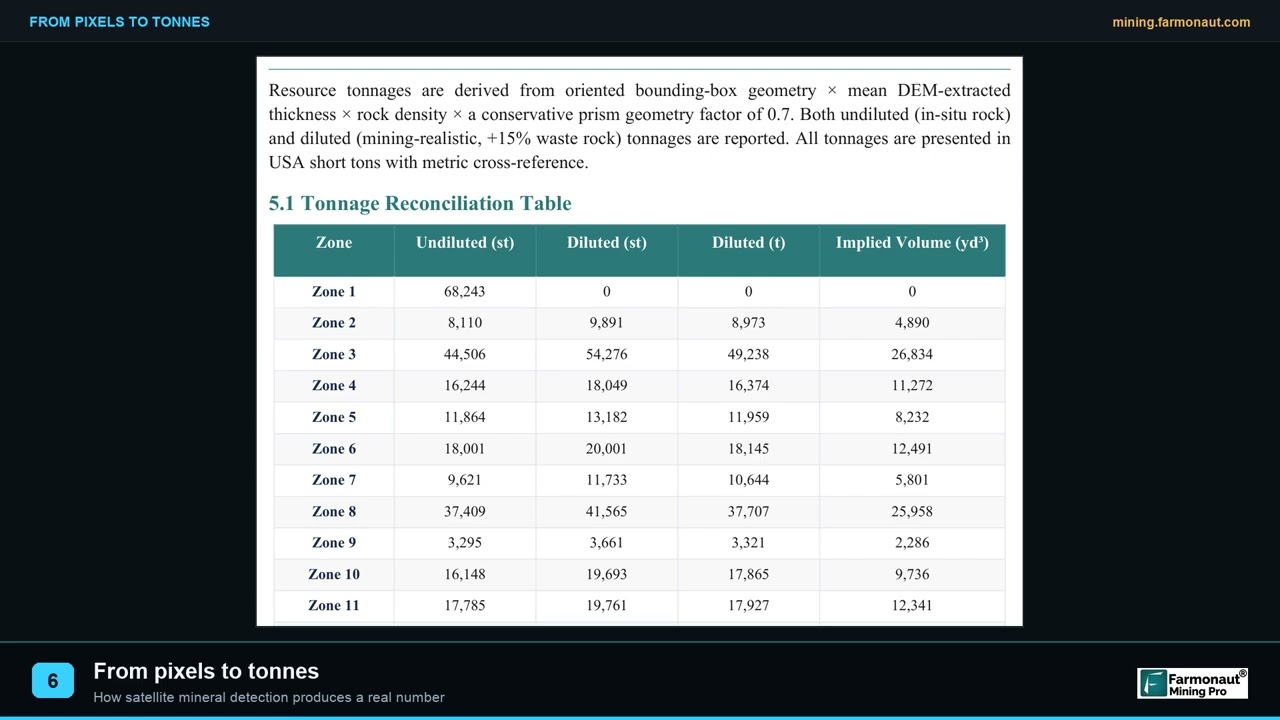
▶ How a satellite map becomes a tonnage and a grade, and which inputs are measured and which are assumed. · 2:54
Tungsten price basis: APT, concentrate and the metric ton unit
Tungsten is quoted in metric ton units (mtu). One mtu is 10 kg of WO3, which is one hundredth of a tonne (USGS, 2020). Two price series matter. Concentrate is what a scheelite mine sells. Ammonium paratungstate (APT) is the refined intermediate made from concentrate and is the market’s headline benchmark. USGS reports a concentrate average, in warehouse at Rotterdam, of US$225 per mtu of WO3 in 2021, US$275 in 2022, US$258 in 2023, US$252 in 2024 and an estimated US$380 in 2025 (USGS Mineral Commodity Summaries 2026).
Chart
Tungsten concentrate price
US$ per metric ton unit of WO3, average in warehouse at Rotterdam
APT has moved much higher since then. Fastmarkets assessed APT 88.5% WO3 cif Rotterdam and Baltimore at US$900 to 940 per mtu in January 2026 and US$1,650 to 1,900 in mid-February 2026, and tied the rise to Chinese export licensing, which began on 4 February 2025, plus stockpiling and low inventories (Fastmarkets, 18 March 2026). On 19 November 2026 Asian Metal, quoted in a SP Angel market note, listed European APT at Rotterdam at US$2,335 per mtu, down from US$2,405 the day before, and Chinese APT fob at US$1,845 (SP Angel, 19 November 2026). The gap between the two shows how far Chinese and non-Chinese markets have diverged.
Do not compare the USGS concentrate series with APT quotes directly. They are different products at different stages, and a concentrate payment is a percentage of the APT price. For a deposit, use a price deck you can defend, and update it before you quote economics. Not investment advice.
Estimate recovered WO3 and metric ton units
The calculator below turns a tonnage, grade and recovery into tonnes of WO3 and metric ton units, and gives a revenue figure at a price you type in. It is an exploration screening tool, not a valuation of any deposit.
Calculator
How much WO3 and how many mtu could this ore yield?
Enter your own tonnage, grade, recovery and price.
- Metric ton units (mtu): 352,000
- Contained tungsten metal: 2,791
- Gross value of recovered WO3 at your example price (US$, before payables and treatment charges): $176,000,000
Example values only, not a benchmark or a valuation: 0.44% WO3 is the USGS median grade for 41 tungsten skarns (SIR 2020-5085). One mtu is 10 kg of WO3, and W metal is 0.793 of WO3 by mass (USGS). Price is an example, use today’s price; money is in US$.
China, Vietnam and the rest: where the tungsten comes from
The USGS estimates 2024 world mine production at 82,000 tonnes of contained tungsten, with China at 67,000 tonnes, Vietnam 3,400, Bolivia 1,700, Russia 1,500 and Rwanda 1,300. Estimated 2025 output is 85,000 tonnes with China again at 67,000. China also holds the largest reserves, at 2.5 million tonnes of the more than 4.7 million world total; Australia is listed with 570,000 tonnes and Russia with 400,000 (USGS Mineral Commodity Summaries 2026). That concentration is why tungsten was designated a U.S. critical mineral in 2018 (supply concentration and import dependence), and the USGS prepared its 2020 skarn model to support assessments under Executive Order 13817. The largest end use is hard metal: an estimated 60% of U.S. tungsten consumption went into cemented carbide parts for cutting and wear-resistant applications (USGS, 2026). Our ranking of the highest-grade tungsten mines covers operating mines and output.
Chart
Tungsten mine production by country, 2024
Tonnes of contained tungsten; selected producers shown
What to check before you buy, stake or fund a tungsten skarn prospect
- Deposit type. Confirm it is a skarn, not a vein or greisen with a skarn rim. Recovery routes and grades differ.
- Grade and tonnage against the benchmark. Compare the claimed tonnage and WO3 grade with the USGS percentiles: a claimed 3% WO3 skarn is far above the 0.88% top-decile grade and needs very careful checking.
- Resource category. Inferred resources have a lower level of confidence and must not be converted to reserves (Fireweed’s own release says so for Mactung’s inferred estimate).
- Acid and fluorine. Sulphide-rich retrograde zones can generate acid, and some tungsten and tin skarns carry fluorine and beryllium (USGS OFR 95-831). Ask for static and kinetic test work.
- Metallurgy. Request flotation test work on the actual ore: fine scheelite and high-molybdenum scheelite behave differently.
- Licence and access. Many tungsten skarns sit in remote, cold or protected ground. Check the licence terms and permitting with the ministry before you apply.
- Market access. With Chinese and non-Chinese APT prices diverging, ask who the buyer is and under what offtake terms.
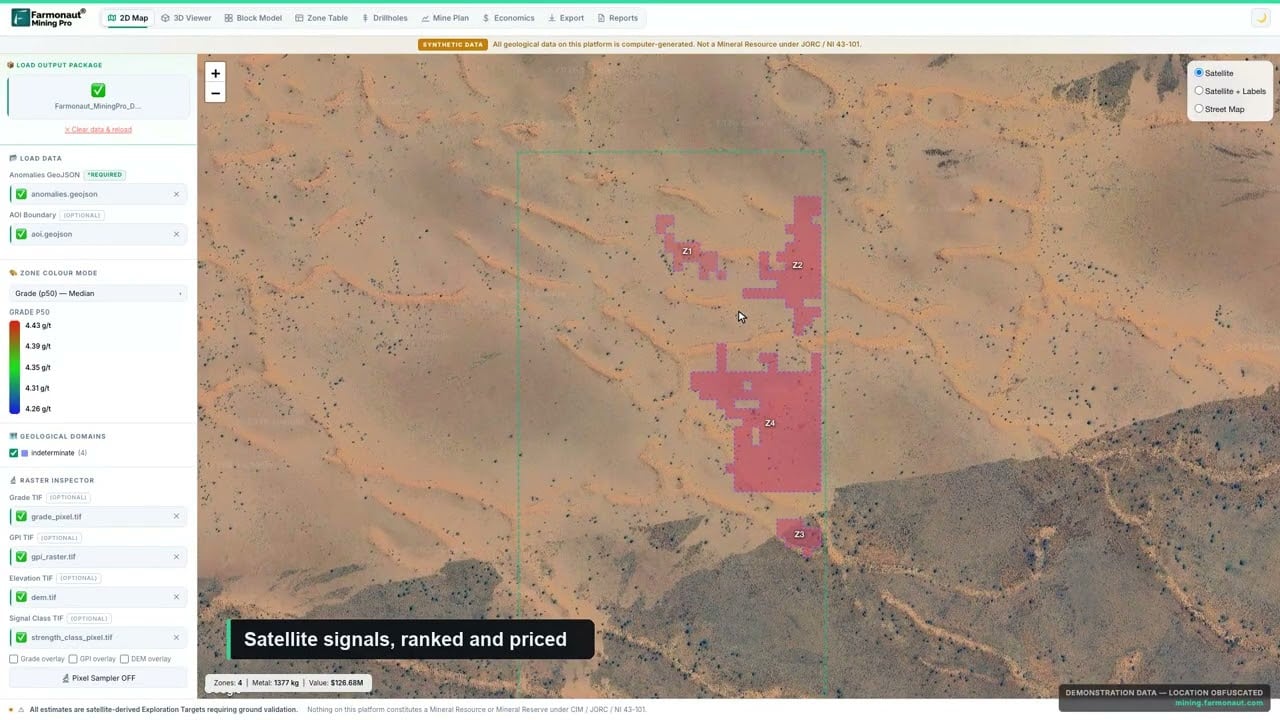
▶ A quick look at Farmonaut Mining Pro: from a licence boundary to a geological and economic picture (de-identified demo data). · 4:56
Frequently asked questions
What is a tungsten skarn?
A tungsten skarn is a deposit where fluids from an evolved granite replaced carbonate rock and left scheelite in a lime-silicate rock called skarn. It is the leading historical source of tungsten and holds the largest share of discovered tungsten resources (USGS, 2020).
What does W skarn mean?
W skarn is geologists’ shorthand for tungsten skarn, because W is the chemical symbol for tungsten. The USGS model for it is number 14a in the classic Cox and Singer series.
What is scheelite and what is it worth?
Scheelite is calcium tungstate, CaWO4, with about 80% WO3 by weight. Its value depends on the concentrate or APT price and the amount of WO3 recovered, which you can model in the calculator above.
How can you find scheelite?
Use a shortwave UV lamp at night or in a dark box, target granite-marble contacts and old workings, pan stream sediment (scheelite is dense) and check hardness and density. Then assay the sample, because fluorescence shows presence, not grade.
What colour is scheelite under a UV lamp?
Under shortwave UV, scheelite fluoresces bright blue, bluish white or yellow, depending partly on molybdenum content. Powellite also glows, so confirm by assay.
Does scheelite glow under a longwave black light?
Not reliably. Scheelite is a shortwave fluorescent, so use a shortwave lamp (around 254 nm) with eye protection; a longwave black light usually shows little or nothing.
What are the main tungsten deposit types?
Skarn, vein, greisen, porphyry and breccia types are the main ones, according to the USGS. Skarns are the largest source historically, and quartz-wolframite veins and greisens are the other major group (USGS, 2020).
What is the difference between scheelite and wolframite?
Scheelite is calcium tungstate, hardness 4.5 to 5, specific gravity near 6, and fluorescent. Wolframite is iron-manganese tungstate, darker and denser (7 to 7.5). Skarns carry scheelite; quartz veins carry wolframite.
How big is a typical tungsten skarn?
The median in the USGS 2020 model is 6.03 Mt at 0.44% WO3 from 41 deposits. Individual deposits range from 0.4 Mt to 76 Mt and from 0.14% to 1.2% WO3.
Which is the largest tungsten skarn?
In the USGS data set Huangshaping (China, 76.45 Mt at 0.2%) and Sangdong (South Korea, 76.4 Mt at 0.455%) have the largest ore tonnages. Mactung and Cantung are the best-known high-grade examples.
What is APT and how is it priced?
APT, ammonium paratungstate, is the refined intermediate. Fastmarkets assesses it as APT 88.5% WO3 cif Rotterdam and Baltimore, in US dollars per metric ton unit, and Asian Metal also lists Rotterdam and Chinese fob quotes. See the price section for dated figures.
Can satellites find tungsten skarns?
Satellites do not detect tungsten directly. They map carbonate belts, granite contacts, iron staining and skarn alteration where rock is exposed, which narrows the area to sample and drill.
This page is for information only. It is not investment advice and not legal advice. Deposit sizes and grades are published third-party estimates; Farmonaut satellite results are exploration targets, not a JORC, NI 43-101 or SAMREC resource. Confirm licence rules with the ministry. Get landowner permission before prospecting, wear UV eye protection with shortwave lamps, and never use mercury.
Farmonaut mining
Screen your ground for skarn contacts
Send a licence boundary and get a satellite mineral report that maps carbonate belts, alteration and surface signatures as exploration targets in 5 to 20 business days.

Mining Pro sample view, synthetic data
Sources
- USGS, Grade and Tonnage Model for Tungsten Skarn Deposits, 2020 Update (SIR 2020-5085): pubs.usgs.gov
- USGS, Preliminary Compilation of Descriptive Geoenvironmental Mineral Deposit Models (OFR 95-831): pubs.usgs.gov
- USGS, Mineral Commodity Summaries 2026: Tungsten: pubs.usgs.gov
- Crown-Indigenous Relations and Northern Affairs Canada, Cantung Mine Closure and Reclamation Project: rcaanc-cirnac.gc.ca
- Government of the Northwest Territories, GNWT agrees to sell Mactung property to Fireweed Zinc Ltd.: gov.nt.ca
- Kitco, Fireweed Metals announces tungsten resource (13 June 2023): kitco.com
- Fireweed Metals via Arctic Today, Mineral Resources for the Mactung Project: arctictoday.com
- Almonty Industries, Global Projects: almonty.com
- Fastmarkets, Tungsten 2026: Geopolitics sets global tone: fastmarkets.com
- SP Angel, Today’s Market View, 19 November 2026 (Asian Metal prices): share-talk.com
- Wikipedia, Scheelite: en.wikipedia.org
- Wikipedia, Wolframite: en.wikipedia.org
- Group 6 Metals, Half Year ended 31 December 2025 (ASX, 5 March 2026): announcements.asx.com.au
- Fireweed Metals, news release of 15 September 2026: placera.se
Discussion
Questions, corrections or field experience? Share them below. First-time comments are reviewed before they appear, and your email is never published.
No comments yet. Be the first to add a question or your experience.

 Enterprise Takreem
 Sean Mining Limited
 NTS Group (Pty) Ltd
 Mine4Africa
 Lithspo Minerals Limited
 Tintina Mining Group
 Dalgety Minerals Pty Ltd
 Faith At Work (Pty) Ltd
 Geotech Mining Solutions plc
 Vulcan International Limited
 Kidepo Associates
 GKY Mining
 Alkimy SARL
 Double A Trading
 GemSprout Metals Limited
 Qader Group
 Ileys General Trading
 SG Gold Mining LLC
 VRV Global Pte Ltd
 Omsri International FZE
 G.I.T.T.
 Jaunita Erss Ltd
 SRK Consulting
 Berks Gold Limited

 Client · Tanzania · Gold










