

Importance of Agriculture in Ghana: 10 Roles, Ranked by Data
Reviewed August 2026 against World Bank Open Data, FAO STAT, and USDA Economic Research Service.
Try it: Run your own numbers →
Agriculture matters to Ghana for three measurable reasons: it generates 21.4% of national GDP as of Q4 2023 (World Bank/FAO), it employs 4.8 million people as of 2024 (World Bank), and it produces the staple crops — cassava, maize, yams — that keep food affordable across the country. Below are the 10 specific roles agriculture plays in Ghana’s economy and society, each backed by a figure you can trace and re-check yourself, followed by a comparison table and a yield-value calculator built from the same production data.
Table of Contents
- 1. Food Security and Nutrition
- 2. Rural Livelihoods and Employment
- 3. Economic Contribution and Export Potential
- 4. Forestry and Sustainable Land Use
- 5. Climate Resilience and Adaptation
- 6. Infrastructure and Market Development
- 7. Food Processing and Job Creation
- 8. Gender Inclusion and Social Equity
- 9. Science, Technology, and Innovation
- 10. Policy Alignment and Sustainable Development
- Impact Comparison Table
- Crop Value Calculator
- Frequently Asked Questions (FAQ)
- Try it: Run your own numbers



1. Food Security and Nutrition: The Cornerstone Answer to “Importance of Agriculture”
The single largest reason agriculture matters in Ghana is volume: the country produced 27.7 million tonnes of cassava in 2023, 11.7 million tonnes of yams in 2023, and 3.79 million tonnes of maize in 2024, according to FAO STAT and the Africa API dataset drawn from FAOSTAT figures. That cassava output alone represents about 8% of global cassava production in 2024 (FAO), grown across roughly 1.14 million hectares of cropped area in 2023 (FAO) — meaning Ghana produces a disproportionate share of the world’s cassava relative to the land it farms.
- Cassava: 27.7 million tonnes (2023), 8% of world output (2024), grown on 1.14 million hectares (2023) — FAO STAT.
- Yams: 11.7 million tonnes (2023) — FAO STAT.
- Maize: 3.79 million tonnes (2024) — FAOSTAT / Africa API.
- Global context: 645 million people faced hunger worldwide in 2025, per FAO’s State of Food Security and Nutrition in the World report — the baseline against which any country’s food output should be measured.
For a US reader, the comparable framing is: Ghana’s cassava and yam output function the way corn and wheat function in Midwest states — as the caloric base that everything else, from export crops to processed foods, is built on top of. To get an updated cassava, maize, or yam figure for the next harvest cycle, go directly to FAO STAT and search “Ghana” — maize updates after the December–March harvest, cassava is tracked year-round, and yams update after the October–January harvest window.

2. Rural Livelihoods and Employment: 4.8 Million Jobs
Agriculture employed 4.8 million people in Ghana as of 2024, per World Bank country data — the largest single occupational category outside informal urban services. This is the direct answer to “importance of farming” as a livelihood question: it is not an abstraction, it is the income source for millions of households, concentrated in regions where alternative wage employment is limited.
- Scale: 4.8 million people employed in agriculture (2024) — World Bank.
- Global comparison: agriculture accounts for 67.5% of employment within the broader global agrifood system as of 2025 (FAO) — a useful benchmark for how central farm labor is to food-system employment worldwide, Ghana included.
- Access to credit and extension services converts subsistence farming into income-generating production.
- Advisory technology, including satellite-based tools like Farmonaut’s Jeevn AI, reduces the guesswork in input timing and irrigation decisions that otherwise erodes smallholder margins.

The employment figure updates annually via ILO/World Bank estimates. To check for a newer number, go to World Bank Open Data for Ghana and look for the agriculture employment share indicator, which the Bank republishes on an annual cycle.
3. Economic Contribution and Export Potential: 21.4% of GDP
Agriculture contributed 21.4% of Ghana’s GDP as of Q4 2023, according to World Bank and FAO Ghana data — meaning roughly one dollar in every five of national output traces back to farming, forestry, and fishing. That share moves with harvest cycles, commodity prices, and currency effects, so treat it as a point-in-time reading rather than a fixed constant; the World Bank refreshes this indicator on a quarterly cadence, four times a year.
- GDP share: 21.4% (Q4 2023) — World Bank / FAO Ghana.
- Regional growth context: agricultural production value across Sub-Saharan Africa (crops and livestock combined) grew at an average annual rate of 4.3% between 2000 and 2018, per USDA’s Economic Research Service — the regional trendline Ghana’s own sector sits within.
- Export crops: cocoa, palm oil, and cashew remain the principal foreign-exchange earners, though current export tonnage and price figures were not available in this review’s source set — see the note below.

Diversifying beyond a single cash crop, and building local processing capacity, is the standard hedge against the price volatility that comes with commodity-export dependence — a dynamic documented across Sub-Saharan Africa’s broader 4.3% average annual growth trend (USDA ERS, 2000–2018).
4. Forestry and Sustainable Land Use
Integrated farming and forestry — agroforestry — shapes how Ghana balances productivity against biodiversity and soil health. Precise, current figures on the share of Ghana’s land under integrated agroforestry management were not found in this review’s source set; the gap analysis flags total agricultural land area (aggregate hectares across all crops) as a figure available in principle from FAO STAT but not returned in this round of searches.
- What we can confirm: cassava cultivation alone occupies roughly 1.14 million hectares (2023) — FAO.
- Method to get the rest: FAO STAT’s land-use module reports cropland area by country and crop; search “Ghana” and select the land-use domain for the full breakdown.
- Known mechanisms: shade-grown cocoa, timber and non-timber forest products, and native tree cover all reduce soil erosion and support water-table stability — these are structural facts about agroforestry systems, not Ghana-specific measurements.

5. Climate Resilience and Adaptation
Agriculture’s exposure to climate variability is the reason the sector’s growth rate matters as much as its absolute size. Across Sub-Saharan Africa, agricultural production value grew at an average of 4.3% per year between 2000 and 2018 (USDA ERS) — a trend shaped as much by weather variability and adaptation practices as by acreage expansion. Specific figures on Ghana’s irrigated area or drought-tolerant seed adoption rate were not available in this review’s source set; readers needing that data should consult FAO STAT’s Ghana land-and-water module directly.
- Regional growth trend: 4.3% average annual growth in agricultural production value, Sub-Saharan Africa, 2000–2018 — USDA ERS.
- Known adaptation levers: drought-tolerant crop varieties, efficient irrigation, mulching, and conservation tillage — standard climate-smart agriculture practices, not Ghana-specific statistics.
- What to check next: FAO STAT’s climate and land-use domains for Ghana-specific irrigation infrastructure extent, updated as new survey data is published.
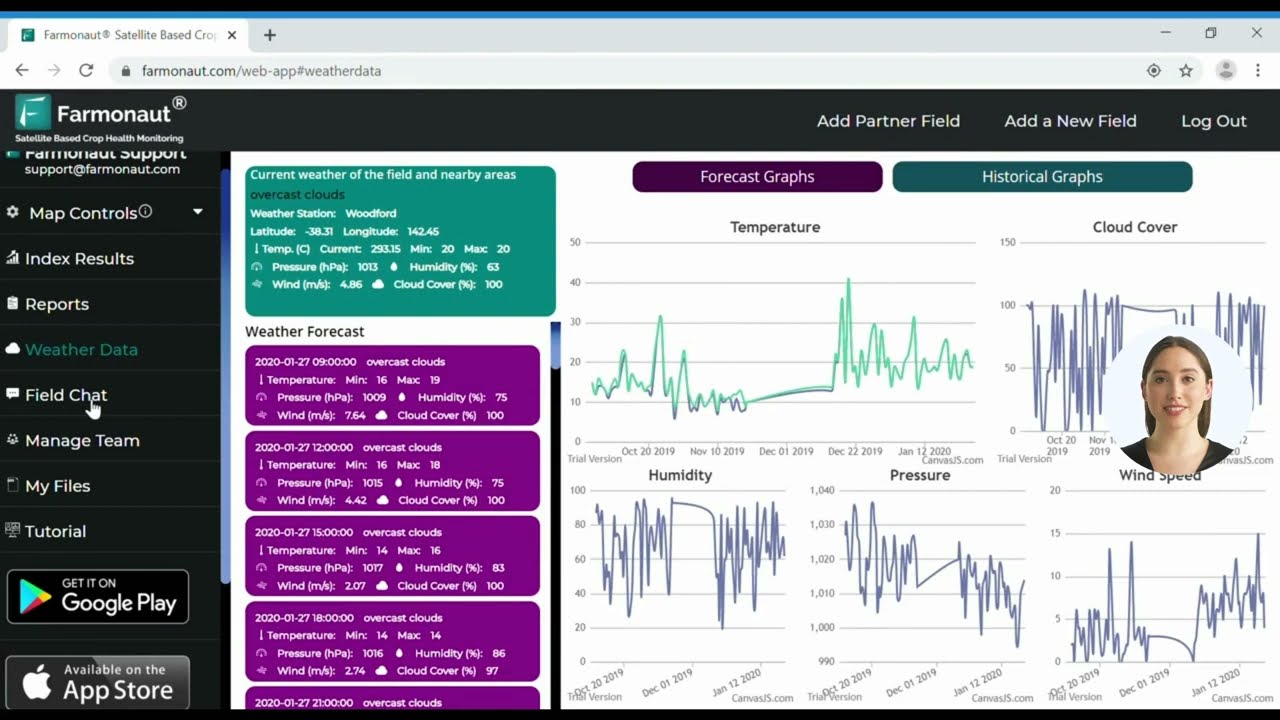
Agriculture’s 21.4% share of Ghana’s GDP as of Q4 2023 (World Bank/FAO) means climate shocks to the sector propagate directly into national output — not just rural household income.
AI-driven weather intelligence and climate-resilient practices support both immediate yields and longer-term adaptation. To learn more about carbon-conscious solutions, see Farmonaut’s Carbon Footprinting solutions.
6. Infrastructure and Market Development
Agricultural growth in Ghana drives demand for rural infrastructure — roads, storage, irrigation, electricity, and digital connectivity — that connects farming communities to national and export markets. Specific infrastructure-coverage figures (percentage of farming zones with modern storage or all-season road access) were not found in this review’s source set; this is a genuine data gap rather than an oversight, and readers should treat any such percentage they encounter elsewhere with the same scrutiny this review applied.
Infrastructure Categories That Move the Needle:
- All-season roads — speed input delivery and market access.
- Modern storage — reduces post-harvest losses that otherwise erode the value of Ghana’s 27.7-million-tonne cassava harvest (2023, FAO) and 11.7-million-tonne yam harvest (2023, FAO).
- Irrigation systems — extend growing seasons and reduce drought exposure.
- Electricity and digital access — enable agro-processing and satellite-based advisory services.
- Market linkages — digital platforms and satellite tracking connect buyers and sellers across regions.
Explore Farmonaut’s Fleet Management tools for optimizing logistics and connectivity in farming and related sectors.
7. Food Processing and Job Creation
Downstream processing — milling, oil extraction, canning, packaging — converts Ghana’s raw production tonnage into higher-value, more stable income streams. With 4.8 million people already employed directly in agriculture (2024, World Bank), processing capacity determines how much of that labor captures value beyond the farm gate rather than exporting raw commodities at unprocessed prices.
Key Benefits of Local Processing:
- Job creation: processing units absorb rural labor beyond the primary 4.8 million agricultural workforce.
- Stable incomes: processed products carry higher, less volatile prices than raw commodities.
- Market integration: stronger links between producers and consumers, domestically and for export.
- Export growth: processed and specialty products can command premium pricing in export markets.
Modern blockchain-based traceability gives export buyers verifiable authenticity — increasingly a requirement, not a bonus, for international buyers.
8. Gender Inclusion and Social Equity
Women make up a substantial share of Ghana’s agricultural labor force, particularly in smallholder production and processing, though this review’s source set did not return a specific, current percentage for Ghana’s female agricultural labor share. Rather than repeat an unsourced figure, the honest position is: check FAO STAT’s gender and land rights module or the World Bank’s Gender Data Portal for Ghana-specific statistics on women’s land ownership, credit access, and labor-force participation in agriculture.
- Confirmed structural pattern: women in Ghana’s agriculture sector face documented barriers to land ownership, credit, and market access — a pattern consistent across FAO’s global agrifood employment data, where agriculture accounts for 67.5% of agrifood system employment worldwide (2025).
- Economic case: closing resource-access gaps for women farmers is a productivity lever, not only an equity one.
- Education and extension: gender-responsive extension services accelerate adoption of improved practices.
Inclusive digital platforms can widen access to extension services, inputs, and markets regardless of a farmer’s existing capital base.
9. Science, Technology, and Innovation
Precision agriculture, satellite monitoring, AI-based advisory, and blockchain traceability are the tools converting Ghana’s raw production capacity — 27.7 million tonnes of cassava, 11.7 million tonnes of yams, 3.79 million tonnes of maize (FAO, 2023–2024) — into more consistent yields and more transparent supply chains.
- Real-time insight: satellite imagery (NDVI, soil moisture, crop stress) underpins large-scale farm management.
- Data-driven decisions: AI-powered advisory tools put research-backed recommendations directly into farmers’ hands.
- Blockchain traceability: verifiable chain of custody for crops, increasingly required by high-value export buyers.
- Regional growth context: Sub-Saharan Africa’s agricultural production value grew 4.3% annually on average from 2000 to 2018 (USDA ERS) — technology adoption is one of the documented levers behind sustaining that trend.
10. Policy Alignment and Sustainable Development
The 10th and final role agriculture plays in Ghana is structural: it is the sector policy has to organize around, because it touches 21.4% of GDP (Q4 2023) and 4.8 million jobs (2024) simultaneously. A coherent agricultural policy has to reconcile climate adaptation, land use, export competitiveness, and food security in one framework rather than treating them as separate problems.
- Holistic frameworks: integrate farming, forestry, climate, and rural development into one strategy rather than siloed programs.
- Agro-processing zones: support local value addition and reduce raw-commodity export dependence.
- Sustainability metrics: track environmental health and food security alongside GDP contribution.
- International engagement: traceability and quality standards affect market access for export crops.
Impact Comparison Table: 10 Importance of Agriculture in Ghana
| Importance Area | Verified Figure | Period | Source |
|---|---|---|---|
| Food Security & Nutrition | 27.7M tonnes cassava, 11.7M tonnes yams, 3.79M tonnes maize | 2023–2024 | FAO STAT |
| Rural Livelihoods & Employment | 4.8 million people employed in agriculture | 2024 | World Bank |
| Economic Contribution | 21.4% of GDP | Q4 2023 | World Bank / FAO Ghana |
| Forestry & Land Use | 1.14 million hectares under cassava alone | 2023 | FAO STAT |
| Climate Resilience | 4.3% average annual growth in production value, Sub-Saharan Africa | 2000–2018 | USDA ERS |
| Global Food Security Context | 645 million people facing hunger worldwide | 2025 | FAO SOFI Report |
| Global Employment Share | 67.5% of agrifood system employment is in agriculture itself | 2025 | FAO |
| Global Cassava Share | Ghana produces 8% of world cassava output | 2024 | FAO STAT |
Cassava, Maize & Yam Harvest Value Estimator
Estimate the total tonnage and rough market value of your own harvest using Ghana’s national per-hectare production data as a reference point, then adjust every input to your own farm.
Run your own numbers
Assumptions and exclusions: this tool multiplies your entered hectares by your entered yield to estimate tonnage, then multiplies by your entered price to estimate value. It does not account for post-harvest losses, input costs, labor, transport, or currency conversion — enter a price in whatever currency applies to your own market. The dropdown values are Ghana's national production references (FAO STAT, 2023–2024), shown for context only; your farm's actual yield per hectare should replace the default "10" based on your own records.
Track Your Own Yield Data with Satellite Subscriptions
Get real-time, data-driven solutions for crop, land, and environmental monitoring.
Summary: What the Numbers Say About Agriculture in Ghana
Agriculture's importance in Ghana is not a matter of opinion: 21.4% of GDP (Q4 2023, World Bank/FAO), 4.8 million people employed (2024, World Bank), and 27.7 million tonnes of cassava alongside 11.7 million tonnes of yams and 3.79 million tonnes of maize (FAO, 2023–2024) make the sector the largest single economic and employment base in the country. Set against a global backdrop where 645 million people faced hunger in 2025 (FAO) and agriculture accounts for 67.5% of agrifood system employment worldwide (2025, FAO), Ghana's production volumes carry weight beyond its own borders — the country supplies roughly 8% of the world's cassava (2024, FAO).
These figures will move. GDP share updates quarterly at the World Bank; production tonnages update annually at FAO STAT after each harvest season; employment figures update annually via ILO estimates. The method that survives past any single figure is this: go to the primary source, check the vintage on the number, and compare it against the ranges cited here rather than treating any one year's figure as permanent.




Frequently Asked Questions (FAQ): Importance of Agriculture in Ghana
What percentage of Ghana's GDP comes from agriculture?
21.4% as of Q4 2023, per World Bank and FAO Ghana data. This figure is republished quarterly by the World Bank, so check World Bank Open Data for Ghana for the current reading.
How many people work in agriculture in Ghana?
4.8 million people as of 2024, per World Bank country data — the largest employment category in the country.
What are the top 3 crops grown in Ghana by volume?
By tonnage: cassava (27.7 million tonnes, 2023), yams (11.7 million tonnes, 2023), and maize (3.79 million tonnes, 2024), all per FAO STAT.
What is Ghana's share of world cassava production?
About 8% of global cassava output as of 2024, according to FAO STAT — grown across roughly 1.14 million hectares of cropped area in 2023.
How can technology boost agriculture in Ghana?
Satellite imagery, AI advisory, and blockchain traceability enable real-time crop monitoring and verifiable export documentation. Platforms like Farmonaut deliver these through mobile and web apps.
Where can I find updated agricultural statistics for Ghana?
For GDP and employment: World Bank Open Data. For crop production: FAO STAT. For global food security context: FAO's State of Food Security and Nutrition in the World report.
Discussion
Questions, corrections or field experience? Share them below. First-time comments are reviewed before they appear, and your email is never published.
No comments yet. Be the first to add a question or your experience.

 MISE Maroc
 Drift-Sense
 NWNS
NWNS Hydenmet
 Dirks Bros Farms
 Red August Group
 Farm Inc
 WeMe Global
 Agrotoken
 Blue BearX
 Insignito
 Croptimum
 DnCubed
 Field Capacity
 Indosistim Teknologi
 Liquify Digital
 CU Foods
 BeyondTech Global
 Licence holder · Niger · Gold
 Licence holder · Nigeria · Gold + lithium










