

Early Agriculture in Egypt: Crops, Yields & Nile Irrigation
Reviewed August 2026 against World History Encyclopedia and Facts and Details archaeological summaries.
Try it: Run your own numbers →
Introduction: What Early Agriculture in Egypt Actually Looked Like
Early agriculture in Egypt began in the Predynastic Period, roughly 6000–3150 BCE, when farming communities took hold in the Nile Valley and the Faiyum Basin. Archaeological evidence for barley and wheat cultivation in Egypt dates back further still, to around 5000–6000 BCE, according to the World History Encyclopedia. This was not subsistence farming in the marginal sense — cereal harvests in Egypt returned roughly 11 times the seed sown, an efficiency ratio recorded in administrative records spanning the Predynastic through Dynastic periods, and one that outperformed most contemporary Mediterranean and Near Eastern farming systems.
This agriculture in Egypt was inseparable from the Nile’s flood cycle. Farmers did not fight the river; they built basins, canals, and embankments to direct it. The result was a food system stable enough to fund pyramid construction, pay laborers in grain, and price goods against a fixed grain standard — a pair of sandals cost roughly 1 deben, the same unit value as about 75 liters of wheat, during the New Kingdom (circa 1570–1069 BCE).
This article covers what people actually search for: the crops (emmer wheat, barley, flax), the irrigation methods that made cultivation possible beyond the riverbanks, and how ancient yields compare to what a modern USDA or FAO data table would show for the same crops today. Where a number isn’t published, we say so and point to where you can look it up yourself — because durability, not decoration, is the point of this piece.
Key Insight
The Nile’s flood wasn’t a hazard to manage around — it was the engine of the whole system. An 11:1 seed-to-harvest ratio, sustained across centuries without synthetic fertilizer, came directly from the silt that floodwater deposited every year.
Egypt’s Fertile Foundations: Geography, Silt, and the Nile
Egypt earned its reputation as the “Gift of the Nile” because its early agriculture depended almost entirely on one river’s behavior. The annual inundation deposited nutrient-rich silt onto floodplains, resetting soil fertility every season without the fallow years many other early farming regions required.
- ✔ Geographic Zones: The Nile Valley and Delta — Egypt’s core arable land — were bordered by desert on both sides, which concentrated population and farming activity along a narrow ribbon of river frontage.
- ✔ Rich Silt Deposits: Silt carried down from upstream highlands renewed soil nutrients each year, enabling repeated cultivation with minimal fallow.
- ✔ Faiyum Basin settlement: Alongside the Nile Valley proper, the Faiyum Basin was a second major zone of Predynastic farming activity, expanding the cultivable footprint beyond the main river channel.
- Try it: Run your own numbers
Archaeological dating places cereal cultivation in Egypt at 5000–6000 BCE, with agriculture fully established across the Nile Valley and Faiyum Basin by the Predynastic Period (6000–3150 BCE). That’s a multi-thousand-year head start relative to most Bronze Age farming systems documented elsewhere in the eastern Mediterranean.
Trivia Box
A pair of sandals and 75 liters of wheat cost the same in New Kingdom Egypt: 1 deben. Grain wasn’t just food — it was the currency backbone of the economy.
Advanced Irrigation & Water Management: Harnessing the Nile’s Rhythms
Irrigation is what separated early agriculture in Egypt from simple floodplain farming. By building basins, furrows, canals, and embankments, Egyptian farmers extended cultivation well past the natural reach of the flood and made harvests predictable rather than accidental.
- 📊 Maximize yield from nutrient-rich silt and extend arable land beyond the immediate riverbank
- ✔ Control the flow and distribution of floodwater, reducing both drought risk and erosion damage
- 📊 Enable more reliable annual cycles in regions with managed basin systems
Irrigation Systems and Practices
The earliest systems simply redirected seasonal floodwater into fields using basic earthworks. Over subsequent centuries — with hydraulic innovation advancing notably during the Middle Kingdom (2040–1782 BCE) — Egyptian engineers refined this into three core techniques:
- ✔ Basin irrigation — floodwater captured in low-lying fields divided by embankments, held and released on a schedule the farmer controlled rather than the river
- ✔ Canals to carry water across broader tracts of land that the flood alone wouldn’t reach
- ✔ Embankments to hold back uncontrolled flooding and manage precise watering windows
This network is what made the wider catalog of agricultural products in Egypt possible — without it, cultivation stays confined to a narrow flood-fed strip. The Middle Kingdom period specifically stands out in the archaeological record as when hydraulic engineering moved from ad hoc earthworks toward planned, maintained systems.
Pro Tip
Basin irrigation did double duty: it conserved water by controlling release timing, and it left fine silt behind as floodwater receded, enriching soil for the next planting and cutting the need for any added fertilizer.
Staple Crops and Grain Production: Wheat, Barley, and Flax
Grain sat at the center of ancient Egyptian life economically as much as nutritionally. Emmer wheat and barley were the two dominant crops, and — together with flax — they answer the “ancient egypt agriculture main crops wheat barley flax” query directly:
- ✔ Emmer wheat: The core ingredient in bread and cakes, used daily and in ritual offerings
- ✔ Barley: Used for porridge, bread, and — critically for the social economy — brewing beer
- ✔ Flax: Not a food crop, but grown at comparable scale for its fiber (see the Fibers section below)
These grains functioned as sustenance, traded goods, and tax payments simultaneously. Surplus grain fed the labor forces on large state construction projects and, at an 11:1 harvest-to-seed ratio, generated enough surplus to support non-farming specialists — craftsmen, scribes, priests — without importing food.
- ⚠ Risk or Limitation: The whole system hinged on flood height. Too little water meant drought and shortfall; too much meant destroyed embankments and eroded fields. Nilometers — stone gauges tracking flood height — existed precisely because the margin for error was that narrow.

📋 Ancient Egyptian Staple Crops: Core to Economy & Diet
- 🍞 Emmer Wheat – For flour, bread, cakes, and ceremonial food
- 🍺 Barley – For bread, porridges, and brewing beer
- 🥄 Lentils & Peas – High in protein, used in soups and stews
- 🥬 Onions, Garlic, Leeks – Provided vital nutrition and flavor
- 🍇 Figs, Dates, Pomegranates – For fresh eating, drying, and sweetening dishes
On the question of how these figures translate into modern per-acre or per-hectare tonnage: converting ancient liter-based grain measures into metric tons requires a grain density assumption, and sources cite a range of 0.512–0.705 kg per liter depending on the grain and how tightly it was packed. No single standard conversion is applied consistently across the archaeological literature, so treat any precise “tons per hectare” figure you see elsewhere for this period with caution unless it states which density it used. For a modern, directly comparable benchmark, USDA NASS QuickStats (quickstats.nass.usda.gov) publishes current U.S. wheat and barley yield per acre, updated after each harvest — that’s the figure to pull if you want a live comparison rather than an ancient one.
Diversification: Legumes, Vegetables, and Fruits in Ancient Egypt
Egyptian farmers didn’t rely on grain alone. Egypt’s crops extended well beyond wheat and barley into a diversified basket that stabilized the food supply against any single crop’s failure:
- ✔ Legumes: Lentils and peas enriched both diets and soil, fixing nitrogen and improving fertility for the staple grains grown in rotation with them.
- ✔ Vegetables: Onions, leeks, garlic, lettuce, cucumbers, and radishes added nutrition, variety, and seasoning to the everyday diet.
- ✔ Fruits: Figs and dates were the dominant fruit crops; grapes, pomegranates, and sycamore figs added sweetness and preservable food stocks.
The seasonal rhythm of the Nile created a diversified harvest calendar. Without refrigeration, produce was sun-dried or otherwise preserved to carry households through the months between harvests. On volumes: cereal grain yields are the only crop category with quantified figures in the archaeological and historical record; onion, lettuce, garlic, grape, and fig production volumes are not broken out in the sources available for this article. If you need a modern equivalent, FAO’s Food Balance Sheets (fao.org/faostat) publish current Egyptian production volumes by crop, updated annually.
- ✔ Key benefit: Diversified cropping increased resilience — a bad grain year didn’t necessarily mean a bad year for legumes, vegetables, or orchard fruit.

Investor Note
The specialization and expansion of crop diversity in ancient Egypt offer a modern parallel: diversified agricultural output has always been what buffers a farming region against a single bad season, a principle unchanged whether the record-keeping is a Ramesside papyrus or a USDA crop progress report.
Fibers and High-Value Crops: Flax & Papyrus
Egypt’s crop specialization extended past food entirely. Two non-food crops carried outsized economic weight:
- Flax: Fiber from flax plants was spun into linen, the primary textile for clothing, burial shrouds, and export trade. Linen quality signaled social status, and finished cloth moved both domestically and as a trade good to neighboring regions.
- Papyrus: Reeds harvested along the Nile’s marshy edges supplied material for paper, writing surfaces, basketry, and rope — tying agricultural output directly into state administration and record-keeping.
- ✔ Linen textiles and papyrus scrolls were central to Egypt’s craft and administrative economy, reinforcing production networks well beyond the farm gate.

🧵 Fiber Crops & Economic Value: Ancient Egypt at a Glance
- 🧺 Flax: Main source of linen, high trade and social value
- 📜 Papyrus: Essential for writing, administration, and record-keeping
- 🥥 Dates: Staple fruit, dried for storage, key for sweet treats and trade
- 🍇 Figs & Pomegranates: Used fresh or dried, important for nutrition and rituals
- 🧑🎨 Crafts from byproducts: Basketry, rope, mats, and more — linking farm output with artisanal industries
Livestock and Farm Economy: Animals on Ancient Egyptian Farms
Crop cultivation was only half of the farm economy. Livestock reinforced early agriculture in Egypt at every stage of the production cycle:
- ✔ Cattle: Provided plowing traction, transported goods, and supplied meat, milk, and hides
- ✔ Sheep & Goats: Supplemented diets with cheese, milk, and meat, and supplied wool and skins for textile and craft production
- ✔ Donkeys: Handled transport and field labor, extending farm operations beyond the immediate village
Animal husbandry fed into soil fertility through manure, supplied labor for fieldwork, and acted as an economic buffer during lean harvest years. Cattle, geese, and goats also appear repeatedly in temple offerings and tomb iconography, underscoring how tightly livestock was woven into both the economic and religious life of farming communities.
Common Mistake
It’s easy to underrate livestock’s role in soil maintenance and labor — without draft animals and manure, field preparation, planting, and harvest would have been far less productive, and in many years far less possible, across the Nile Valley.

Trade, Craft Specialization, and Economic Networks
Egypt’s agricultural surplus underwrote a substantial internal and international trade network. Surplus grain, linen textiles, dried fruit, and papyrus scrolls were exchanged for metals, timber, and luxury goods the Nile Valley didn’t produce locally.
- ✔ Storage & Preservation: Granaries and silos built from brick, stone, and pottery held harvests securely across the months between growing seasons, stabilizing both food supply and market prices.
- ✔ Craft Specialization: Rural craftspeople converted farm byproducts into baskets, pottery, rope, mats, and tools — pulling non-farming households into the broader agricultural production network.
- ✔ Administrative Management: Centralized administration tracked landholdings and taxation and redistributed surplus, tying agricultural output directly to state governance. The grain-to-currency link was concrete enough that goods were still priced in deben-equivalent wheat volumes during the New Kingdom.
Aligning production with seasonal cycles and religious observance reinforced Egypt’s social and economic organization around a shared agricultural calendar — a structure durable enough to persist across multiple political dynasties.

Sustainable Practices & Environmental Stewardship
Soil and water stewardship were central to how long early agriculture in Egypt actually lasted — this wasn’t a system that burned through fertility and moved on:
- ✔ Soil conservation: Basin irrigation minimized runoff and retained silt, cutting the need for any added fertilizer
- ✔ Rotation and legumes: Rotating in lentils and peas improved soil nitrogen and productivity, preventing the exhaustion that continuous cereal cropping would otherwise cause
- ✔ Water use efficiency: Canal and basin systems reduced waste and protected against both flooding and drought in the same design
This is the durable spine of the story: an 11:1 seed-to-harvest ratio sustained for millennia without synthetic inputs is not an accident of soil chemistry alone — it required active water management, planned crop rotation, and administrative coordination across an entire river valley. That combination, more than any single crop or flood year, is why the system persisted from roughly 5000 BCE through the end of the Dynastic period.

Tool: Estimate an Ancient Egyptian Field’s Grain Output
Use the 11:1 harvest-to-seed ratio recorded for ancient Egyptian cereals to see how much wheat or barley a given seed quantity would have returned, and what that implies in modern kilograms using the historical density range for grain.
Run your own numbers
Assumptions: uses the 11:1 harvest-to-seed ratio recorded in administrative records from Predynastic through Dynastic Egypt (World History Encyclopedia). Grain density range (0.512–0.705 kg/liter) reflects cited archaeological sources and is not standardized across them, so results are an estimate range, not a precise conversion. Excludes crop type differences, flood-year variability, and land area — this is a seed-to-harvest ratio tool only, not a per-hectare yield calculator.
Modern Insights: How Farmonaut Empowers Sustainable Agriculture
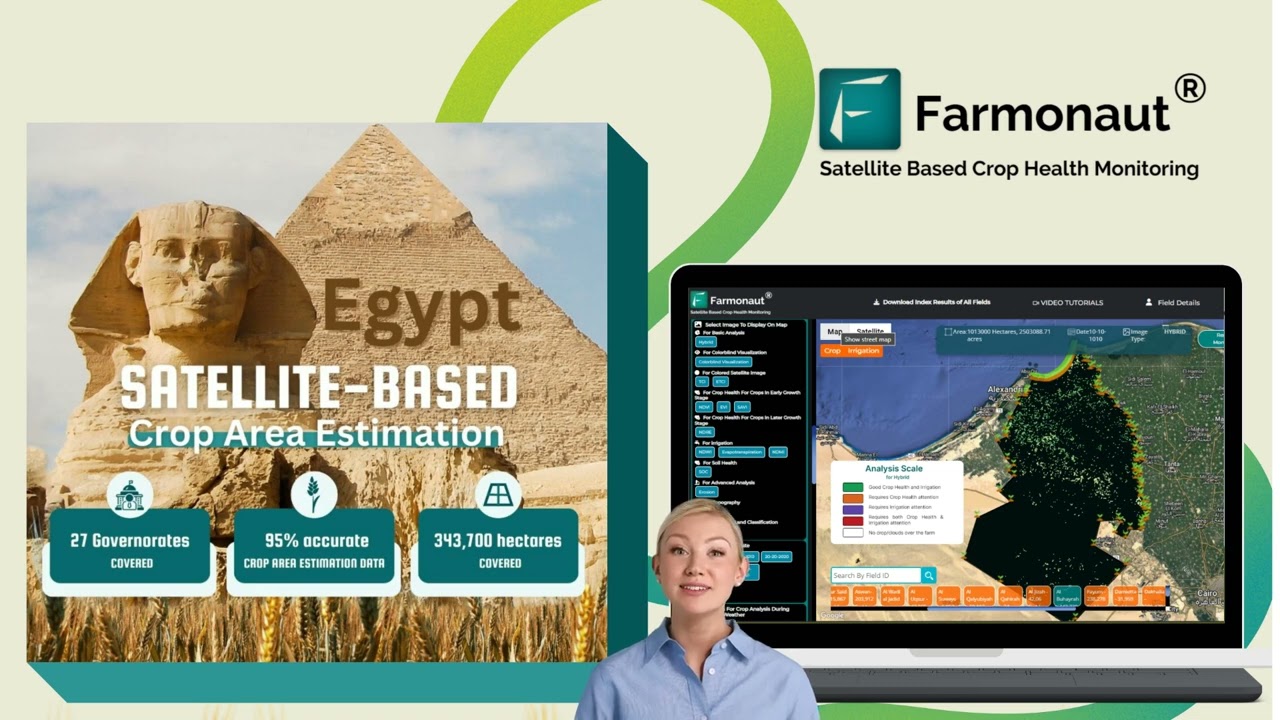
As a satellite technology company focused on turning field data into actionable decisions, we at Farmonaut see a direct line from ancient Egyptian water management to what precision agriculture does today. Our platform combines satellite-based monitoring, AI-driven advisory, and blockchain traceability to give today’s farmers the same kind of resource visibility that Nile basin engineers built by hand.
- ✔ Real-Time Farm Monitoring: NDVI and satellite imaging let farmers track crop health, water stress, and field variability without walking every acre. Our large-scale farm management solution supports both smallholders and commercial operations working from the same data.
- ✔ AI and Predictive Analytics: Our Jeevn AI Advisory System uses remote-sensing data for dynamic farm advice, weather outlooks, and tailored recommendations by field.
- ✔ Environmental Impact Tracking: We help operations measure and reduce carbon and water footprints. Learn more about Farmonaut’s carbon footprinting tools.
- ✔ Traceability: Blockchain-based tracking gives end-to-end product traceability, supporting consumer transparency. More on traceability.
- ✔ Financial Solutions: Satellite-based crop loan and insurance verification supports farmers’ access to finance while reducing fraud risk.
Our aim is to make satellite-driven, sustainable agriculture accessible everywhere — a mission that draws directly on what civilizations like ancient Egypt proved: disciplined resource management is what turns a river’s unpredictability into a durable food system.




Access satellite-powered insights for every farm, field, and project. API integration is available for developers and agribusiness: Farmonaut API (API Docs)
Comparative Table: Ancient Egyptian Crop Yields, Irrigation, and Sustainability
Figures below are ranges drawn from archaeological and historical sources rather than modern statistical surveys; treat them as an evidence-based sketch, not census-grade data. For a current, methodical comparison, cross-reference against FAO Food Balance Sheets or USDA NASS QuickStats for the same crop categories.
| Crop/Product | Primary Irrigation Method | Seasonality | Sustainability / Environmental Role |
|---|---|---|---|
| Emmer Wheat | Basin irrigation; annual flood management | Winter/Spring | Fertility renewed by silt each flood cycle |
| Barley | Basin, canal systems | Winter/Spring | Stabilized food supply; brewing gave it added trade value |
| Flax (Linen) | Furrow and canal | Spring/Early Summer | Low input crop; fiber byproduct fed craft economy |
| Date Palm | Grove canal and basin | Late Summer/Autumn | Perennial crop; erosion control and shade |
| Papyrus | Floodplain wetland irrigation | June–September peak | Sustained wetlands; renewable, no replanting needed |
Per-hectare tonnage figures for these crops are not applied consistently across sources — the underlying liter-to-kilogram grain density conversion ranges from 0.512 to 0.705 kg/liter depending on the source and grain type, and no single standard is used across the literature. Rather than presenting a false-precision number, use the calculator above with your own assumed density to generate an estimate, or consult FAO’s historical agricultural datasets for methodology notes.
✔ Five Key Takeaways on Ancient Egyptian Agriculture
- ✔ Irrigation technology turned the Nile’s flood cycle into a predictable, manageable food production system, with hydraulic engineering advancing markedly during the Middle Kingdom (2040–1782 BCE).
- ✔ Emmer wheat and barley returned roughly 11 seeds harvested for every 1 sown, an efficiency that funded state construction projects and non-farming specialists.
- ✔ Diversified farming — legumes, vegetables, and fruit — buffered communities against grain-year shortfalls.
- ✔ Flax and papyrus turned farm output directly into trade goods and administrative infrastructure, linking agriculture to state formation.
- ✔ Grain functioned as currency: 75 liters of wheat carried the same value as a pair of sandals (1 deben) in the New Kingdom, circa 1570–1069 BCE.
FAQs: Early Agriculture in Egypt
What were the most important agricultural products in Egypt?
The most important agricultural products in Egypt were emmer wheat, barley, flax (for linen), papyrus, dates, figs, and various legumes and vegetables. Grain — wheat and barley specifically — carried the most economic weight, functioning as food, trade good, and de facto currency: 75 liters of wheat equaled the value of a pair of sandals (1 deben) during the New Kingdom.
What is early agriculture, and when did it start in Egypt?
Early agriculture refers to the shift from foraging to deliberate crop cultivation and animal domestication. In Egypt, archaeological evidence places cereal (barley and wheat) cultivation at roughly 5000–6000 BCE, with farming fully established across the Nile Valley and Faiyum Basin by the Predynastic Period, 6000–3150 BCE — per the World History Encyclopedia.
How did irrigation support agriculture in ancient Egypt?
Irrigation used basins, canals, and embankments to manage the Nile’s annual flood, distribute water to fields beyond the immediate riverbank, and retain fertile silt. Hydraulic innovation advanced significantly during the Middle Kingdom (2040–1782 BCE), and the resulting basin systems maximized yield while minimizing the need for added fertilizer.
What were Egypt’s crops used for beyond food?
Flax was spun into linen for clothing, burial shrouds, and export trade. Papyrus reeds supplied paper, writing material, basketry, and rope, linking agricultural output directly to state administration and record-keeping — a use case with no direct food-crop equivalent.
How productive was ancient Egyptian farming compared to other early systems?
Cereal crops in ancient Egypt returned roughly 11 times the seed sown, according to administrative records spanning the Predynastic through Dynastic periods. That figure describes a seed-to-harvest ratio, not a per-hectare tonnage — converting it to modern tons per hectare requires a grain density assumption (sources cite 0.512–0.705 kg per liter), which is not standardized across the literature. Use the calculator above to model your own estimate, or check USDA NASS QuickStats for current, directly comparable wheat and barley yield-per-acre figures.
What role did livestock play in the agricultural system?
Livestock provided labor for plowing, transportation of goods, manure for fertilizer, and dietary diversity through meat, milk, and cheese. Cattle, sheep, goats, and donkeys were integral to field management and complemented the crop production cycle at every stage.
How do modern monitoring technologies like Farmonaut contribute to agricultural sustainability?
Farmonaut’s technologies enable real-time farm monitoring, environmental impact tracking, and supply chain traceability — giving land managers today the kind of granular resource visibility that Nile basin farmers built through basin irrigation, silt management, and centralized administration over thousands of years.








Conclusion: Lessons from Egypt’s Agricultural Pillar
Early agriculture in Egypt worked because it paired a genuinely rare natural asset — an annual, silt-bearing flood — with engineered discipline: basin irrigation, canal networks, crop rotation with legumes, and centralized grain administration. The result was an 11:1 harvest-to-seed ratio sustained across millennia, a diversified crop basket from grains to legumes to fiber crops, and an economy stable enough to price goods directly in wheat.
None of that required guessing. It required measurement — Nilometers tracking flood height, administrators tracking harvests and taxation, granaries tracking stored surplus against future need. That’s the throughline to what satellite agriculture does today: replace guesswork with field-level measurement. At Farmonaut, we build tools that give modern farmers the same kind of resource visibility the Nile Valley’s administrators had, just faster and at scale. Ancient Egypt’s lesson wasn’t luck — it was management, and that principle doesn’t expire.
Discussion
Questions, corrections or field experience? Share them below. First-time comments are reviewed before they appear, and your email is never published.
No comments yet. Be the first to add a question or your experience.

 Contec Global
 ASQI
ASQI Teledarbas
 Wild Oak Farm
 SFX
SFX BACF Africa
 Doodlakine
 Exurbia Geospatial
 FieldZero
 Indico Company
 Kubota
 FFBS
FFBS Jontra
 Tucor
Tucor
 Licence holder · Niger · Gold










