

Ancient agriculture · Tools and techniques
Ancient Egyptian Farming: Tools and Techniques by Season
Ancient Egyptian farmers worked with the Nile flood and a few hand tools: hoe, ox-drawn plough, flint sickle, threshing animals and winnowing scoops. Cereals were grown from at least 4,500 BCE (UCLA Encyclopedia of Egyptology, 2026).
Key takeaways
- Cereals were grown in Egypt from at least 4,500 BCE; the earliest Fayum grain dates to about 5,000 BCE, give or take 500 years (UCLA Encyclopedia of Egyptology, 2026).
- The field year ran: flood (July to September), basins drain (October to November), hoe or plough and sow, then harvest about six months later, between February and May.
- Core tools: wooden hoe, ox-drawn plough by the Old Kingdom, flint-toothed sickle (metal by the New Kingdom), animals for treading seed and threshing, scoops and sieves for winnowing.
- The shaduf appears in Egyptian art only from the 18th Dynasty, and only in gardens. FAO gives 2 to 4 cubic metres of water per hour as the typical range for this kind of lift (FAO, 1986).
- Arable land was 3.2% of Egypt’s land area in 2023, against a world average of 10.7% (World Bank).
In this article
- Ancient Egyptian farming tools at a glance
- How the Nile flood set the farming year
- Ancient Egyptian farming tools and techniques, step by step
- Water techniques: basins, pots and the shaduf
- Garden and orchard techniques
- What changed from the Old Kingdom to the New Kingdom
- How the natural environment shaped Egyptian farming
- What ancient Egyptians farmed
- Weeds, pests and losses
- Did ancient Egyptians use crop rotation and fertilizer?
- From the Nile flood to modern Egyptian farming
- How we checked the facts
- FAQ
Ancient Egyptian farming ran on the Nile’s yearly flood and a small kit of hand tools: a wooden hoe, an ox-drawn plough, a flint-toothed sickle, animals for treading seed and threshing, wooden scoops for winnowing, and granaries run by scribes. Egyptians grew cereals from at least 4,500 BCE, according to the UCLA Encyclopedia of Egyptology (2026). This guide walks through each tool in the order a farmer used it, season by season, with charts of the dated evidence and a calculator that shows how long a shaduf would take to water a plot of your size.
We use peer-reviewed Egyptology, a Purdue University history of Egyptian horticulture, FAO figures for traditional water lifts and World Bank data on modern Egypt. Where scholars disagree, or where the evidence is thin, we say so.
Ancient Egyptian farming tools at a glance
The table lists the main tools and what each one did. The sections below explain when and how each was used.
| Tool | Job on the farm | Made of | What the evidence shows |
|---|---|---|---|
| Hoe | Loosen wet silt, break clods, weed | Wooden blade hafted to a wooden handle | Early form was a forked branch; a hafted blade came later |
| Plough | Open the soil before or after sowing | Wood; metal shares added later | Drawn by a pair of oxen by the Old Kingdom |
| Mallet | Break large clods | Not stated in sources (shown in scenes) | Shown in tomb scenes of land clearing |
| Sickle | Cut cereal stalks | Flint teeth in a wooden or bone haft | Metal sickles common in the New Kingdom |
| Animals | Tread seed in, thresh grain | Sheep, goats, pigs, oxen | Sheep treading seed at Saqqara (c. 2400 BCE); oxen threshing in the tomb of Menna, Thebes (c. 1420 BCE) |
| Scoops and sieves | Winnow and clean grain | Wooden scoops; sieve material not stated | Sieving shown in Old Kingdom processing scenes |
| Yoke and pots | Carry water to garden beds | Wood, pottery | Shown in tombs from the Old Kingdom onward |
| Shaduf | Lift water to gardens | Wooden pole, bucket, clay counterweight | Earliest images from the 18th Dynasty |
Sources for the table: Jules Janick’s Ancient Egyptian Agriculture and the Origins of Horticulture (Purdue University, 2002) and Claire Malleson’s Cereals entry in the UCLA Encyclopedia of Egyptology (2026).
How the Nile flood set the farming year
Every task on an Egyptian farm followed the river. In the ancient pattern, the Nile began to rise in July and peaked in August. By September the flood was over, and between October and November the water drained out of the field basins. It left a layer of wet, nutrient-rich silt behind. The flood reached southern Egypt first, so farmers in the south started work a few weeks before farmers in the north.
The civil calendar named its three seasons after this cycle. It had 12 months of 30 days, grouped into three seasons of four months, plus five extra days at the end of the year, according to a 2009 study of the Egyptian civil calendar. The seasons were Akhet (inundation), Peret and Shemu. Because the calendar had no leap years, its dates slowly drifted against the real seasons, so the month called “inundation” did not always match the flood.
Akhet: the flood months
While the fields lay under water, there was little work to do on them. The civil year began with the feast of Wepet Renpet on the first day of the first month of Akhet. Because the calendar drifted, that day matched the real flood only in some centuries.
Peret: ploughing and sowing
As the basins drained, farmers broke the wet ground with hoes and ploughs and scattered seed by hand. Sheep or goats were sometimes driven over the field to press the seed into the mud.
Shemu: harvest
The grain needed little care while it grew. Harvest came about six months after sowing, between February and May, with sickles, threshing animals and winnowing scoops.
The height of the flood changed from year to year, and the harvest changed with it. Egyptians measured the river with nilometers, often stone wells linked to the river and marked with a scale. An archaeologist quoted by National Geographic (2016) says the readings were used to set taxes in pharaonic times, because a high reading pointed to a good harvest. The practice lasted for centuries: the nilometer on Rawda Island in Cairo, built in 716 CE and rebuilt in 861, was used to measure the flood and assess crop taxes, according to MIT course notes on the architecture of Cairo.
Ancient Egyptian farming tools and techniques, step by step
Tomb paintings, models and surviving tools let us follow one grain field through the year. The steps below go in that order. Malleson’s Cereals entry notes that the basic steps stayed the same from the Old Kingdom to the New Kingdom: land preparation, sowing, harvesting, threshing, winnowing and storage.
Infographic
One grain field through the year in 6 steps
- 1FloodThe Nile rises from July and peaks in August.
- 2DrainBasins drain in October and November, leaving wet silt.
- 3PrepareHoes, mallets and ox ploughs break the ground.
- 4SowSeed is broadcast and trodden in by animals.
- 5HarvestFlint or metal sickles cut the grain, February to May.
- 6ProcessOxen thresh, scoops winnow, scribes record the store.
Step 1. Break the ground with the hoe
The hoe was so basic that one ancient name for Egypt, Ta-meri, is translated by Janick as the beloved land cultivated by the hoe. He describes its development from a forked branch to a wooden blade bound to a handle. Workers used it to loosen silt after the flood, break up clods and clear weeds. Tomb scenes also show men breaking clods with mallets when new land was cleared. The hoe needed no animal.
Step 2. Plough with oxen
The plough began as a hoe that was dragged through the ground, perhaps first by a man pulling a rope. By the Old Kingdom it was pulled by a pair of oxen. Later, metal shares were added. In the New Kingdom the handles were braced with ladder-like crosspieces, and the shaft was tied to a yoke over the oxen’s horns, as Janick’s survey of tomb art shows. For comparison with another early farming tradition, see these farming tools of ancient China.
Step 3. Sow by hand and let animals tread the seed
Sowers scattered, or broadcast, seed by hand. Often the sower walked in front of the plough, so the oxen trod the seed in. Fine seed such as flax was shaken into the furrows. When seed was sown straight onto the mud after the flood, sheep, goats or pigs were driven over it. A tomb scene at Saqqara from about 2400 BCE shows a sower luring sheep forward with a handful of grain.
Step 4. Leave the crop to grow
On the floodplain, a cereal field needed little work between sowing and harvest. Malleson’s 2026 review says the land was left with little or no intervention for about six months. The silt held enough moisture for a winter crop of wheat, barley or flax.
Step 5. Harvest with the sickle
Early sickles had flint teeth set in a wooden or bone haft. Later sickles were curved with a short hand grip, and metal sickles were common in the New Kingdom. Some New Kingdom scenes show workers cutting the stalks just below the ears and dropping them into a net. Other scenes show grain tied into sheaves and loaded onto donkeys, or later carried in net baskets.
Step 6. Thresh with animals
Oxen were driven over the harvested grain so their hooves broke the ears and freed the grain. The tomb of Menna at Thebes, from about 1420 BCE, shows oxen threshing.
Step 7. Winnow and sieve
Workers tossed the threshed grain into the air with wooden scoops so the wind blew the chaff away. Then they sieved it, sometimes many times. Emmer and hulled barley needed several stages of processing before the grain was clean. The leftover straw and chaff were not waste. They were used as fuel, animal feed and temper for mudbrick and pottery.
Step 8. Measure and store the grain
Scribes measured and recorded the grain before it went into storage. Early farmers kept grain in buried baskets or jars. Later, storage became a state task, with shared silos and granaries. Tomb scenes from Beni Hasan and Thebes show workers carrying grain into silos while scribes register the amount.
Water techniques: basins, pots and the shaduf
Most grain was watered by the flood itself, held in basins. Earthen banks ran along the river, and cross banks divided the floodplain into enclosed basins. Janick gives basin sizes of 400 to 16,000 hectares and a flood depth of 0.3 to 1.8 metres, with the water held for a month or more before the surplus drained away. No more watering was then needed for a winter grain crop.
How much of this was planned from the top is debated. Older accounts describe large state canal systems. The Cereals entry in the UCLA Encyclopedia of Egyptology takes a narrower view: it finds no formal canal-based irrigation for farming before the Ptolemaic period, when large works were built in the Fayum. Before that, farmers managed the basins at a small, local scale.
Gardens were different. Vegetables, vines and fruit trees grew near the river and canals and needed water in the dry season. From the Old Kingdom onward, tomb scenes show gardeners carrying two pots on a shoulder yoke and tipping them into small beds of lettuce. Later the shaduf took over part of this work.
How the shaduf works
A shaduf is a long pole balanced on a post. A bucket hangs from one end and a large lump of clay weighs down the other. The worker pulls the bucket down into the water, and the counterweight helps lift it. Its earliest Egyptian images date to the 18th Dynasty at Thebes and Amarna. They show it watering gardens and vegetable plots, never grain fields, which hints that it arrived with other new technology, such as horses and chariots, during the Second Intermediate Period.
The shaduf stayed in use in Egypt until recent times. FAO’s review of water lifting devices (FAO, 1986) gives the counterpoise lift, or shadoof, a typical lift of 1 to 3 metres and a flow of 2 to 4 cubic metres per hour. That is small next to animal-driven wheels. It suits a garden, not a large wheat field.
FAO also lists how much power a person can keep up. For a 35-year-old, its table gives about 135 watts for one hour but about 75 watts over three hours, which is why long sessions at a water lift are slow.
Chart
How much water traditional lifts move per hour
Typical flow range in cubic metres per hour, selected traditional devices (FAO review)
Try the numbers for a plot of your own size below.
Calculator
How long would a shaduf take to water your plot?
Enter your plot size, the depth of water you want to apply and a flow rate.
- Water to lift: 25.0 m³
- Same volume in litres: 25,000 L
- Working days at your hours per day: 1.4 days
Example values only, not a benchmark or forecast. FAO (1986, Table 8) lists 2 to 4 cubic metres per hour for a counterpoise lift (shaduf) at a 1 to 3 metre lift; set your own flow if you know it. The only fixed constants are unit conversions (1 mm of water on 1 square metre = 1 litre; 1,000 litres = 1 cubic metre).
Garden and orchard techniques
Orchards and gardens took more skill than grain fields. They sat near the river and canals, needed water through the dry season, and grew crops that were worth the extra labour. Janick’s survey of tomb art and surviving plant remains describes several techniques.
Ripening sycamore figs by wounding
The sycamore fig reached Egypt more than 3,000 years BCE, but the wasp that pollinates it did not. Without it, the fruit dropped early or filled with insects. Egyptian growers learned to scrape or gash the young fruit. The wound makes the fig grow fast and ripen in three to four days, before pests can spoil it. Janick notes that the response is now known to be driven by ethylene. Metal scrapers and gashed fruit have survived, and a relief at Thebes shows the method.
Grapes on arbors and trellises
Tomb paintings show grapes grown on trellises and round arbors. Workers trod the grapes in vats while holding ropes hung from a frame, then squeezed the pulp in a cloth bag twisted between poles. Grapes were also dried as raisins.
Pots, ponds and palm basins
Fruit trees and ornamental gardens were often watered from ponds. A tomb scene from Thebes of about 1500 BCE shows a shaduf watering a palm orchard, with the water led into a mud basin at the foot of each palm. Small shrubs were also grown in large clay pots, an early form of container growing.
What changed from the Old Kingdom to the New Kingdom
Egyptian farming was not static. The core steps stayed the same, but tools and crops changed between the Old and New Kingdoms. The table sums up the changes described by Janick and Malleson.
| Area | Old Kingdom | New Kingdom |
|---|---|---|
| Plough | Wooden plough pulled by two oxen | Handles braced with crosspieces, shaft tied to a yoke on the horns; metal shares added over time |
| Sickle | Flint teeth in a wooden or bone haft | Metal sickles common |
| Garden water | Pots carried on a shoulder yoke | Pots plus the shaduf, first shown in the 18th Dynasty |
| Fruit | Dates, doum palm, sycamore fig, fig, grape | Pomegranate and carob (from the Middle Kingdom), olive and apple added |
| Grain | Emmer and barley | Emmer and barley (durum wheat came later, in the Ptolemaic period) |
How the natural environment shaped Egyptian farming
Egypt is almost rainless, so its farming depended on the river. The Greek historian Herodotus called Egypt the gift of the Nile, a phrase Janick quotes. Three features of the environment shaped every technique above.
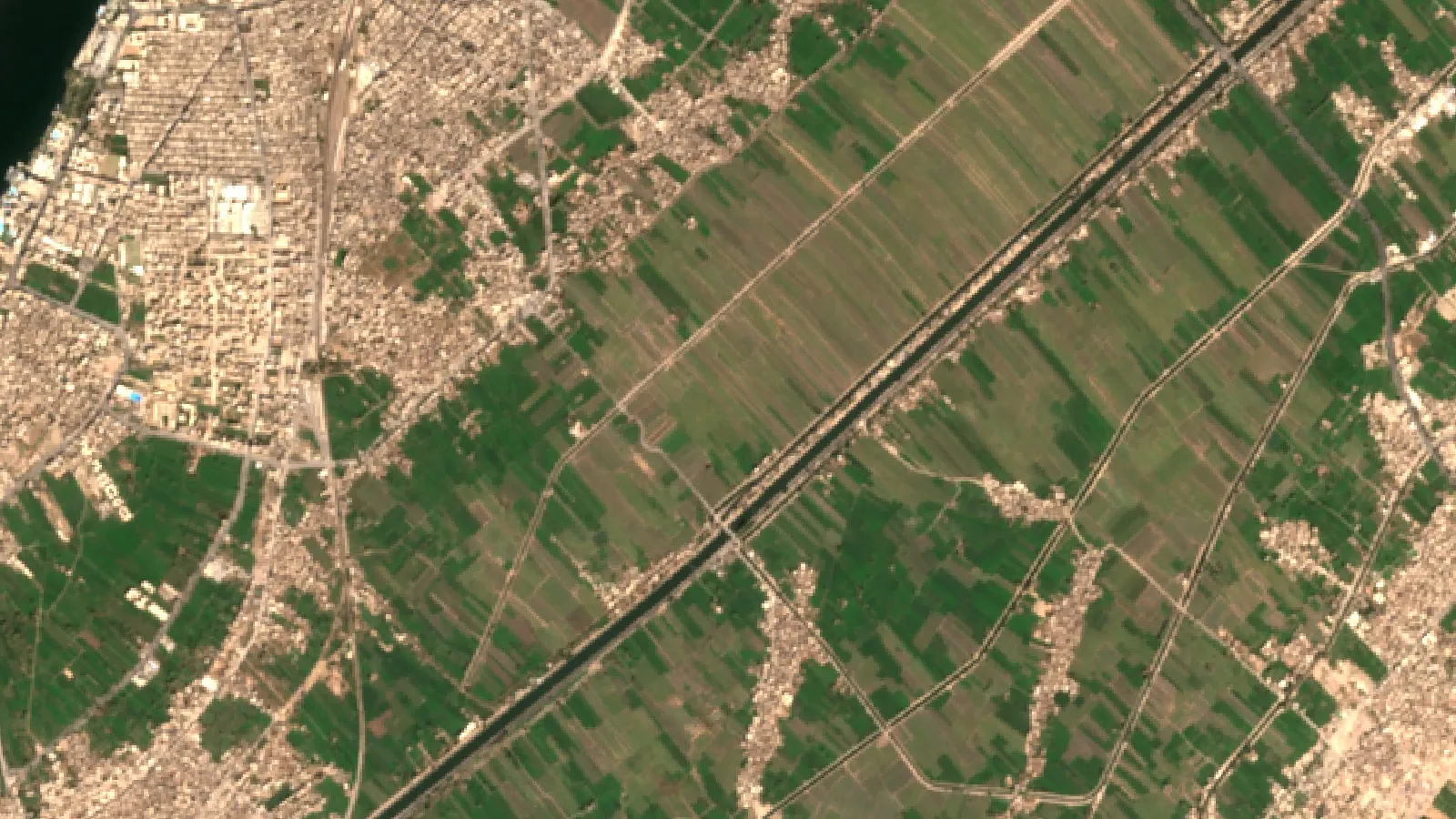
- A narrow green strip. Seen from space, the Nile valley is a thin band of dark green farmland between pale desert plateaus. NASA’s Earth Observatory notes that this watered strip is home to most of Egypt’s people.
- Silt that renewed the soil. The flood carried silt from the south. Pre-dam measurements show the soils were rich in nitrogen, phosphorus, potassium, calcium and other nutrients, Malleson notes. Janick notes that the silt made extra fertilizer unnecessary for the winter grain crop.
- A regular but variable flood. The flood came every year at about the same time, which made planning possible. Its height changed from year to year, and nilometer readings were used to set taxes.
The desert still limits Egyptian farming today. In 2023, arable land made up 3.2% of Egypt’s land area, against a world average of 10.7%, according to World Bank data.
Chart
Arable land as a share of total land area
Percent of land area, 2023, selected countries and world average

▶ How soil and water together decide what a farm can grow, and how satellites now track both · 9:40
What ancient Egyptians farmed
Emmer wheat and barley were the staple grains, used for bread and beer. Just five sites give good early evidence of domestic cereals in Egypt: the north shore of the Fayum, Merimde Beni Salama, el-Omari, Kharga Oasis and Sais. Radiocarbon dating places the earliest Fayum samples at about 5,000 BCE, give or take 500 years. Einkorn and club wheat turned up only as weeds in these early crops. Durum wheat came in the Ptolemaic period.
Chart
Earliest dated domestic cereals at five Egyptian sites
Oldest dates for emmer and barley finds, years BCE (ranges mix dating error and date spans; Sais by typology)
Other crops in Janick’s list include lentils, chickpeas, faba beans and cowpeas; onions, garlic, radishes, lettuce and melons; dates, doum palms and sycamore figs from before the first dynasties; grapes and figs by the Old Kingdom; and flax for linen and oil. Pomegranates and carob appear by the Middle Kingdom, olives and apples by the New Kingdom, and peaches and pears in the Greco-Roman period. For a fuller guide to the crops themselves, see what crops ancient Egyptians grew.
Weeds, pests and losses
Egyptian farmers had no herbicides. Before herbicides, farmers everywhere relied on hand weeding, careful sowing and removing weed seeds from seed grain, Malleson notes. Tomb scenes usually show weed-free fields, but plant remains from settlements show that real fields held many weeds. Malleson suggests weeds may not have hurt yields as much as we might expect, as long as the flood was not a disaster.
Pests were a real threat. Ancient texts quoted by Janick list worms, rats, grasshoppers, birds and even hippopotamuses as raiders of the fields. One tomb scene shows a boy chasing birds from a pomegranate tree with a sling. Janick also notes that the state protected many insect-eating birds.
Did ancient Egyptians use crop rotation and fertilizer?
The evidence for formal crop rotation is thin. Egyptians grew pulses such as lentils and beans as well as cereals, but in the sources we checked we found no clear proof that fields were rotated on a fixed plan. On the floodplain, the yearly silt did most of the work of renewing the soil, so extra fertilizer was not needed for the winter grain crop. Mixed sowing of two crops, known elsewhere as a maslin, has not yet been studied in ancient Egypt, Malleson notes.
Some ideas often credited to ancient Egypt need care. The plough and the hoe were in use by the Old Kingdom. The 365-day civil calendar kept the flood-based season names, but its dates drifted against the real flood. Large canal systems that freed farms from the flood came later. Perennial, year-round irrigation across Egypt only began in the 1800s under Mohammad Ali, mainly to grow cotton, according to Malleson’s review.
From the Nile flood to modern Egyptian farming
The old flood cycle is gone. Perennial irrigation from the 1800s ended the old flood-only farming cycle, and the Aswan High Dam, built in the 1960s, ended the yearly flood. Malleson writes that this has caused lasting damage to Egypt’s soils: the water table is rising and getting saltier because no flood washes the salts out, and farmers now depend on chemical fertilizers.
Yields are much higher than in the past, but they rest on a fully irrigated system. World Bank data put Egypt’s cereal yield at 7.4 tonnes per hectare in 2023, against a world average of 4.2. The World Bank also reports that 100% of Egypt’s agricultural land was irrigated in 2023, according to its irrigated land series.
Ancient farmers read the river to plan their year. Modern farmers can read their fields from space. The Farmonaut Satellite + AI Farm Monitoring System uses satellite images to map crop health and show where a field is changing, which can help a farmer decide where to look first. Farmonaut also offers product traceability, carbon footprinting, crop loan and insurance checks, fleet management and an admin app for agribusinesses with field teams. Developers can use the Farmonaut API and the API developer docs, and growers can open the app on web or mobile.
Chart
Cereal yield in Egypt and the world
Tonnes per hectare, selected years 1961 to 2023

▶ Farmonaut case study: measuring Egypt’s wheat area from satellite images · 1:24
How we checked the facts
We checked each claim against the sources named in the text and listed at the end of the page. Dates for tools and crops come from Janick (Purdue University, 2002) and Malleson (UCLA Encyclopedia of Egyptology, 2026). Where they differ, as on flood timing and on canals, we follow the more recent peer-reviewed entry and say so. Shaduf output and human power figures come from FAO’s 1986 review of water lifting devices, which gives typical ranges for devices in modern use, not ancient measurements. Modern figures for Egypt come from the World Bank and are dated.
FAQ
What tools did ancient Egyptians use for farming?
The main tools were the wooden hoe, the ox-drawn plough, mallets for breaking clods, flint-toothed sickles (later metal), wooden winnowing scoops, sieves, and storage jars and granaries. Gardens also used shoulder yokes with pots and, from the 18th Dynasty, the shaduf.
What techniques did ancient Egyptians use to farm?
They used basin irrigation to hold the flood on the fields, sowed into the wet silt as the water drained, used animals to tread in seed and thresh grain, and winnowed with scoops. Gardens near the river were watered by hand or by shaduf in the dry season.
How did the Nile affect ancient Egyptian farming?
The Nile flood watered the fields and left fresh silt each year. It gave the calendar its season names and set the work season, and its height changed the size of the harvest from year to year.
When did the Egyptians start using the shaduf?
The earliest Egyptian images of the shaduf date to the 18th Dynasty, in tombs at Thebes and Amarna. It was used for gardens and vegetable plots, not for grain fields.
Did ancient Egyptians build canals for farming?
Older accounts describe large canal networks. A 2026 review in the UCLA Encyclopedia of Egyptology finds no formal canal-based irrigation for farming before the Ptolemaic period. Before then, farmers managed flood basins at a local scale.
What crops did ancient Egyptians grow most?
Emmer wheat and barley were the staple grains, used for bread and beer. Lentils, beans, onions, garlic, lettuce, dates, figs, grapes and flax were also common.
Farmonaut crop monitoring
See your own fields from space
Draw your field once and Farmonaut maps crop health from satellite images on web, Android or iOS.




Keep reading
Sources
- Malleson, C., Cereals, UCLA Encyclopedia of Egyptology (Version 1, February 2026, DOI 10.5070/G9.3915): escholarship.org
- Janick, J., Ancient Egyptian Agriculture and the Origins of Horticulture, Acta Horticulturae 582, Purdue University (2002): hort.purdue.edu
- FAO, Water Lifting Devices (Irrigation and Drainage Paper 43), Table 8 Review of pumps and water lifts (1986): fao.org
- FAO, Water Lifting Devices (Irrigation and Drainage Paper 43), section 4.2 and Table 11 Power capability of human beings (1986): fao.org
- Belmonte, J. A., The Egyptian Civil Calendar: a Masterpiece to Organize the Cosmos, ASP Conference Series 409 (2009): aspbooks.org
- National Geographic, Ancient Nilometer discovered in Egypt (May 2016): nationalgeographic.com
- MIT course 4.615, The Architecture of Cairo: Nilometer, Rawda Island (course slide notes, undated): web.mit.edu
- NASA Earth Observatory, The Great Bend of the Nile, Day and Night (2003, updated 2025): science.nasa.gov
- World Bank, Arable land (% of land area), FAO data (accessed October 2026): data.worldbank.org
- World Bank, Cereal yield (kg per hectare), FAO data (accessed October 2026): data.worldbank.org
- World Bank, Agricultural irrigated land (% of total agricultural land) (accessed October 2026): data.worldbank.org
Discussion
Questions, corrections or field experience? Share them below. First-time comments are reviewed before they appear, and your email is never published.
No comments yet. Be the first to add a question or your experience.

 Dextrago
 Kubota
 FFBS
 Jontra
 Kalustyan
 Tucor
 Geno
 Hayleys Agriculture
 Linx Agritech
 Adinet
 Save Your Soils
 Grandstream Algérie
 XOS Realty
 Geospatial Lab Africa

 Licence holder · Niger · Gold










