

Almond Water Usage: Gallons Per Pound and in California
Reviewed August 2026 against USDA’s National Agricultural Statistics Service, the Almond Board of California, and the Congressional Research Service’s California water-use analysis.
Try it: Run your own numbers →
How Much Water Do Almonds Use? The Direct Answer
Growing a single almond takes 1 gallon of water, per the Almond Board of California’s water-use tracking. Scaled to a pound of kernels using the USDA’s 2025 statewide yield of 2,010 lbs per acre and the 3.0–4.0 acre-feet of irrigation water California orchards apply per acre each year, that is 486 to 648 gallons per pound. California’s 1,389,000 bearing acres of almonds (USDA NASS, May 2025) draw an estimated 4.7 to 5.5 million acre-feet of water a year, per the California Water Impact Network — enough that the crop shows up in nearly every debate about the state’s water budget.
The rest of this article breaks that number down: per almond, per pound, per acre, per state, and against the other crops competing for the same water. Every figure below carries its source and date, plus where to check for a more current number.
Almond Water Usage Per Pound and Per Almond
Two numbers answer most of what people search for here. Per almond: 1 gallon of water, per the Almond Board of California’s water-use tracking. Per pound of kernels: using the USDA’s 2025 statewide yield of 2,010 lbs per acre and California orchards’ 3.0–4.0 acre-foot-per-acre applied-water range, that works out to 486–648 gallons per pound, with 567 gallons per pound at the 3.5-acre-foot statewide average.
A separate line of research puts the same question differently. Fulton et al. (2018), published in Ecological Indicators, recalculated California’s almond water footprint using California-specific climate-station and yield data rather than global averages, and found the blue-water (irrigation) component at 1.7 gallons per almond — higher than earlier global-scale estimates on the blue-water share specifically, even as the study’s total footprint came out smaller overall. The same study found the footprint swung by up to 22% year to year across 2004–2015, and by as much as two-fold across different growing districts within the Central Valley in a single year — a reminder that any single “gallons per almond” figure is a statewide average, not a fixed physical constant.
Water use also is not evenly split across an almond’s life cycle. Trees planted from bare-root stock need irrigation for three to four years before their first commercial crop, so orchard establishment consumes water years before it produces a single pound of almonds — a detail worth remembering when comparing an orchard’s water use to an annual crop that plants and harvests in the same season.
Almond Water Usage in California: Acreage and Volume Over Time
Almond water usage in California has grown mostly because almond acreage has grown, not because the crop has become thirstier per acre. Congressional Research Service data show California almond acreage nearly doubling from 594,000 acres in 2004 to 940,000 acres in 2013. USDA NASS’s May 2025 California Almond Forecast put bearing acreage at 1,389,000 acres — up another 10,000 acres from 2024 — with a statewide yield of 2,010 lbs per acre (up 30 lbs from 2024’s 1,980 lbs) producing a forecast 2025 crop of 2.8 billion lbs, 3% above 2024’s 2.73 billion lbs. Separately, the California Water Impact Network’s September 2024 analysis, using Land IQ satellite mapping and California Department of Food and Agriculture records, put total statewide plantings (bearing plus young, non-bearing trees) at 1,563,000 acres.
That trajectory is the main driver behind almonds’ rising profile in California water debates: even as per-acre efficiency has improved, three decades of steady acreage growth have made almonds one of the largest single claims on the state’s irrigated agricultural water, covered in more detail in the water-budget section below.
California is not the only major agricultural exporter making large, headline-scale bets on irrigation infrastructure — for context on how another region is investing in water systems at scale, see this look at Peru’s irrigation expansion:

Almond Water Usage vs Other California Crops
Almonds are not the thirstiest crop in California on a per-acre basis — they sit in the upper-middle of the field. The most detailed public comparison comes from the Congressional Research Service report cited above, compiling 2013 California Department of Water Resources land- and water-use data: alfalfa and other irrigated hay top the list at 5.0-plus acre-feet applied per acre per year, followed by rice at 4.6, irrigated pasture at 4.1, tree nuts (almonds, pistachios and walnuts combined) at 3.5, field corn at 2.8, and most vegetables under 2.0.
| Crop | Applied water (acre-feet/acre/year) | Approx. gallons/acre/year |
|---|---|---|
| Alfalfa & irrigated hay | 5.0+ | 1,629,000+ |
| Rice | 4.6 | 1,498,900 |
| Irrigated pasture | 4.1 | 1,336,000 |
| Tree nuts (almonds, pistachios, walnuts) | 3.5 | 1,140,500 |
| Field corn | 2.8 | 912,400 |
| Vegetables | under 2.0 | under 651,700 |
Note: the CRS figures cover the tree-nut category as a whole (almonds, pistachios and walnuts together), not almonds in isolation; the almond-specific 3.0–4.0 acre-foot range used elsewhere in this article comes from more recent, almond-only tracking by the California Water Impact Network. Both point to the same conclusion: almonds sit close to the tree-nut average and well below alfalfa and rice on a per-acre basis, but because almond acreage has grown faster than almost any other California crop since 2004, the category’s total water draw has grown even where its per-acre efficiency has improved.
Where Almond Irrigation Fits in California’s Water Budget
California’s Department of Water Resources estimates that an average year irrigates 9.6 million acres statewide with 34 million acre-feet of water — 40% of the state’s total water use and 80% of the water California manages for human use, as distinct from instream environmental flows. Set against that, almonds’ 4.7–5.5 million acre-feet a year is 14% to 16% of all irrigated agricultural water in the state.
That share is also why almonds are politically visible in water-allocation fights in a way that, say, lettuce is not: at 1,389,000 bearing acres, almonds are grown on more land than almost any other California crop besides alfalfa, and unlike an annual row crop, an almond orchard cannot be fallowed for a dry year without losing the trees — a grower who skips irrigation to save water in a drought is not deferring a harvest, but killing an asset that took three to four years to become productive in the first place.
Almond Tree Water Consumption: Why the Number Is So High
Almond trees are deep-rooted, deciduous, and in active growth for most of California’s dry-summer season — leaf-out in February, harvest from August through October — during which little of that growth is fed by rainfall. Water managers estimate a tree’s water need with the reference-evapotranspiration (ETo) method: a crop coefficient (Kc) specific to almonds and their growth stage is multiplied by ETo, a figure derived from local temperature, humidity, wind and solar radiation at a weather station. California’s CIMIS network of agricultural weather stations publishes ETo for growers statewide, and University of California Cooperative Extension publishes the almond-specific Kc curve by growth stage, so an orchard’s actual water consumption changes weekly with the weather, not just with acreage — the 3.0–4.0 acre-feet-per-acre figure cited above is a season total, not a fixed daily draw.
Three variables explain most of the orchard-to-orchard spread: canopy size (a mature, densely planted orchard transpires more per acre than a young one), rootstock and soil type (sandy soils need more frequent, smaller irrigation sets than clay), and district-level heat — orchards in the hotter southern San Joaquin Valley run toward the 4-acre-foot end of the range, while coastal-influenced districts sit closer to 3.


Because ETo-based scheduling is a calculation rather than a guess, it is also the fastest lever available to an individual grower: matching irrigation sets to a current ETo/Kc calculation instead of a fixed weekly schedule is the single change most likely to move an orchard’s own gallons-per-pound number, whatever the statewide average happens to be in a given year.
Irrigation Efficiency: What’s Actually Changing
The water-per-almond number has been falling for three decades, not rising. The Almond Board of California reports that growers cut water use per almond by 33% between the 1990s and the 2010s, mainly by replacing flood and furrow irrigation with drip and micro-sprinkler systems. As of November 2023, over 80% of California almond acreage irrigates with microirrigation rather than flood methods, per the same tracking. The industry set a further target of a 20% reduction in water use per pound by 2025; as of 2022, growers had reached about three-quarters of that goal.
Two less-obvious efficiency levers: almond hulls, a byproduct of processing the kernel, are fed to dairy cattle in place of alfalfa hay — a substitution the Almond Board estimates saves 440 billion gallons of water a year, comparable to the annual water use of 4 million U.S. households. Separately, 930,000 acres of California almond orchards sit on soil suited to deliberate groundwater recharge, where growers flood orchard floors with surplus winter runoff to refill aquifers between irrigation seasons.


Data-driven irrigation scheduling is the newer lever. Real-time soil-moisture and canopy-stress data — the kind pulled from Farmonaut’s carbon footprinting and satellite monitoring tools — lets growers match water delivery to what the trees measurably need that week rather than a fixed calendar schedule. Financing matters too: crop loan and insurance products underwritten against satellite-verified orchard conditions give growers room to invest in drip retrofits without betting the whole season on a single water year. On the supply side, fleet management software cuts the diesel and time cost of running irrigation-equipment routes across multi-block operations, and product traceability tools let processors document water-efficient growing practices for buyers who ask for it.
Calculator: Estimate Your Orchard’s Water Use Per Pound
Enter your own acreage, applied irrigation water and expected yield to see your orchard’s total water use and gallons per pound, using the same math behind the statewide 486–648 gallons-per-pound range above.
Run your own numbers
Assumptions: uses a fixed conversion of 325,851 gallons per acre-foot and treats applied irrigation water as the orchard’s full water use; it excludes rainfall contribution, off-field distribution losses, and hull/shell byproduct water credits. Defaults reflect the statewide 2025 USDA yield and the 3.5-acre-foot mid-range applied-water figure cited above — replace them with your own numbers.
Almond Cultivation and Production in India: How It Compares
India’s almond farming is small and regionally specific. USDA’s Foreign Agricultural Service puts India’s marketing-year 2024/2025 domestic almond production, on a shelled-kernel basis, at 4,150 metric tons — “marginally lower” than the year before, per its Tree Nuts Annual GAIN report — a rounding error next to California’s 2.8-billion-pound 2025 crop. Cultivation is concentrated in the cooler valleys of Jammu & Kashmir and Himachal Pradesh, where altitude and winter chill hours make almond trees viable at all; USDA FAS reporting notes the sector has not scaled meaningfully beyond those regions.
India’s almond market runs on imports, not domestic cultivation: the same USDA FAS reporting forecasts India’s MY2024/2025 almond imports at 190,000 metric tons — nearly 46 times the country’s own harvest — with California supplying 86% of that volume (about 163,400 metric tons), after India lifted a retaliatory tariff on U.S.-origin almonds. In practical terms, the water-usage numbers this article covers above are also the water story behind most almonds eaten in India. For a deeper look at India’s almond-growing regions, varieties and production trends, see our companion piece, Almonds Grown in India: 7 Powerful Trends Shaping 2026.
Monitoring Orchard Water Stress with Satellite Data
Satellite remote sensing gives growers and water managers a way to check how much water an orchard actually needs in a given week, without walking every block. NDVI (vegetation vigor) and NDWI (canopy water content) indices, computed from multispectral satellite passes, flag water-stressed zones inside an orchard days before visible wilting — early enough to correct an irrigation-set malfunction or a clogged drip line before it costs yield.
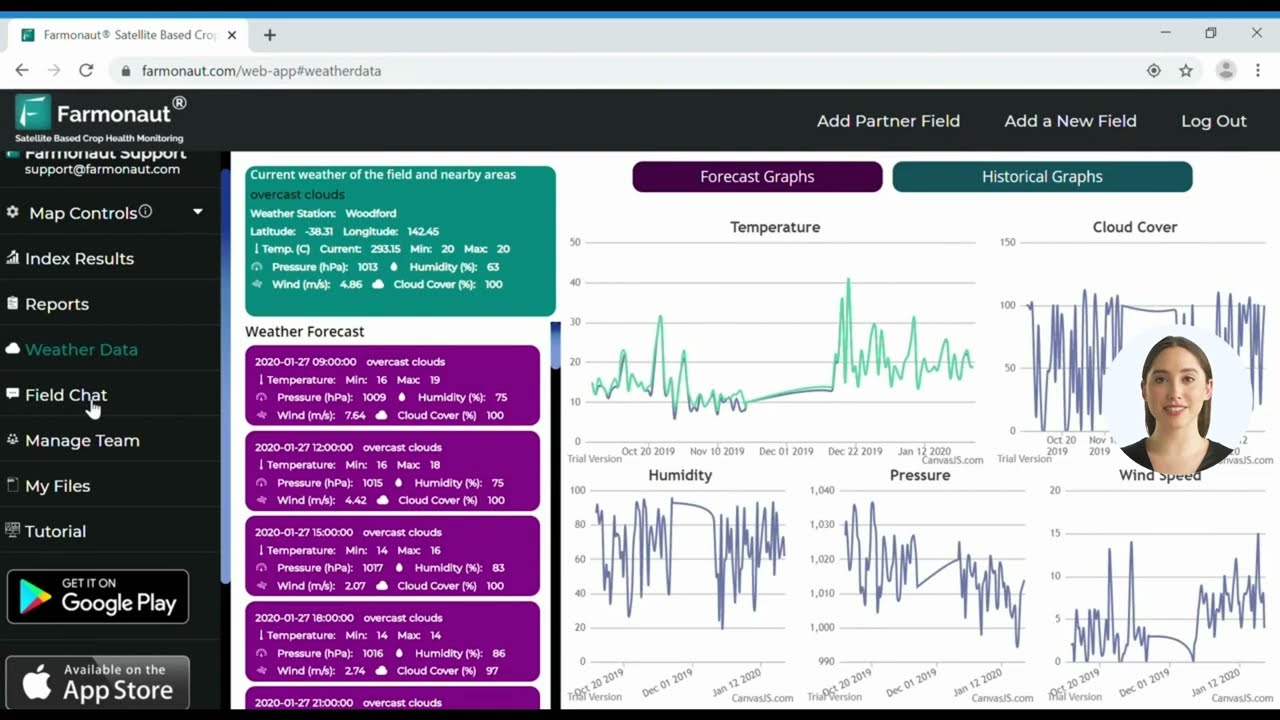
Farmonaut’s large-scale farm management platform applies this at the operation level, letting almond growers and their agronomists monitor soil moisture, canopy health and irrigation demand across every block from one dashboard. For teams building their own water-scheduling tools, the Farmonaut API and its developer documentation expose the same NDVI, NDWI and weather layers programmatically, so an irrigation-scheduling app or a water district’s monitoring system can pull orchard-level water-stress data without operating its own satellite pipeline.


Farmonaut Apps and Tools
We at Farmonaut build satellite monitoring tools for orchard operations of any size, from a single almond block to a multi-district operation tracking water stress across thousands of acres.



Download the mobile app, use the web platform, or integrate the Farmonaut API directly into an existing irrigation-scheduling system — the same NDVI, NDWI and soil-moisture layers referenced above are accessible either way.
FAQs: Almond Water Usage
1. How much water does it take to grow one almond?
1 gallon, per the Almond Board of California’s water-use tracking. Because that figure is a statewide average built on three decades of efficiency gains, an individual orchard’s number moves with its irrigation method, soil and climate district — the 486–648 gallons-per-pound range in this article captures most of that spread.
2. How much water do almonds use per pound in California?
486 to 648 gallons per pound of kernels, using the USDA’s 2025 statewide yield (2,010 lbs/acre) and the 3.0–4.0 acre-foot-per-acre range California orchards apply, with 567 gallons per pound at the 3.5-acre-foot average. Use the calculator above with your own acreage, water and yield numbers for an orchard-specific figure.
3. How does almond water usage compare to other crops?
On a per-acre basis, almonds (tracked with pistachios and walnuts as “tree nuts” in California DWR data) apply 3.5 acre-feet per acre per year — less than alfalfa (5.0-plus), rice (4.6) and irrigated pasture (4.1), and more than field corn (2.8) or most vegetables (under 2.0). See the comparison table above for the full breakdown.
4. How much water do almonds use across California overall?
California’s 1,389,000 bearing acres of almonds (USDA NASS, May 2025) draw an estimated 4.7 to 5.5 million acre-feet of water a year, per the California Water Impact Network’s September 2024 analysis — 14% to 16% of all irrigated agricultural water in the state, out of the 34 million acre-feet the California Department of Water Resources reports for statewide irrigated agriculture in an average year.
5. Is almond farming water-intensive compared to other tree nuts?
Among California’s major tree crops it is mid-range: pistachios and walnuts share the same “tree nuts” water-use category, reported at 3.5 acre-feet per acre in Congressional Research Service data, so almonds are not an outlier within that group. What sets almonds apart is scale — at 1,389,000 bearing acres, California grows far more almond acreage than pistachio or walnut acreage, which is why the almond total dominates tree-nut water-use headlines even though the per-acre number is shared.
6. Where can I get more current almond water-use and production numbers?
USDA NASS publishes California’s almond acreage and yield forecast every May, with a more precise Objective Measurement Report every July — search “California Almond Forecast” on nass.usda.gov for the current release. The Almond Board of California updates its water-use-efficiency tracking on its water-wise page, and the California Department of Water Resources periodically republishes statewide irrigated-acreage and water-use estimates through its Land & Water Use program. For India-specific production and import figures, USDA’s Foreign Agricultural Service publishes an annual Tree Nuts Annual GAIN report for New Delhi.
Bottom Line
Almonds use more water per acre than corn or most vegetables, less than alfalfa or rice, and about the same as their fellow tree nuts, pistachios and walnuts. The number people actually search for — 486 to 648 gallons per pound, or 567 gallons per pound at California’s statewide average water application — is a real, sourced range built from USDA yield data and California applied-water figures, not an unattributed “4,000 liters per kilogram” claim with no method behind it. Whatever orchard or state is being evaluated, the acre-feet-applied-per-acre-per-year figure is the number to ask for; everything else here is arithmetic built on top of it.
Discussion
Questions, corrections or field experience? Share them below. First-time comments are reviewed before they appear, and your email is never published.
No comments yet. Be the first to add a question or your experience.

 LACOS Geoinformation
 Pulsar Supernova
 Magrifly
 LatConnect 60
 Disease Free Life
 WebsEdge
 Blickwinkel
 Agricultural Credit Policy Council
 MCSOD
MCSOD Marei Nursery
 eKGIS
eKGIS Mostas Tech
 Andex
Andex FCF India
 Unifrutti Gulf
 Deluxe Conseil
 WICO
WICO
 Licence holder · Niger · Gold
 Licence holder · Nigeria · Gold + lithium










