

Pomegranate Yield: 7 Top Tips for Maharashtra 2025
“Maharashtra farmers can boost pomegranate yield by up to 30% using precise NDVI data for crop management.”
Introduction: Maharashtra’s Pomegranate Revolution
Maharashtra stands at the heart of India’s pomegranate cultivation, accounting for a major share of production and export. In 2025, maximizing pomegranate yield is more important than ever. Facing fluctuating weather, evolving pests, and resource constraints, farmers need precise, actionable insights for every stage of the crop. This comprehensive guide delivers the seven top tips for boosting yield using advanced soil, irrigation, nutrient, NDVI, and organic practices — all grounded in the latest research, guidelines, and real agronomic data from Maharashtra’s leading regions.
Why Focus on Pomegranate Yield in 2025?
As Maharashtra’s farmers move towards data-driven agriculture, the year 2025 presents both challenges and opportunities:
- Years of research from ICAR-National Research Centre on Pomegranate (Solapur) and the Maharashtra State Department of Agriculture have led to refined guidelines for every phenological stage (from planting to harvest).
- Precision tools like NDVI (Normalized Difference Vegetation Index) and satellite monitoring have become accessible for monitoring fruit crop health and optimizing resource application.
- Adoption of drip irrigation methods reduces water use by up to 20% while maintaining high yields — critical for the state’s semi-arid regions.
- Specialized fertilizer blends and organic amendments are being recommended based on actual local soil test data (N, P, K, S, Zn in ppm/kg per acre).
- Farmers in Solapur, Indapur, Daund, Rahta, Parner, and beyond are already reaping the rewards from these improved management practices.
By mastering these seven yield-focused tips, pomegranate growers in Maharashtra will be equipped to increase both quantity and quality — ensuring profitability in the years ahead.



Farmonaut’s satellite-powered technology is designed to help you monitor NDVI, track crop health, and optimize input application in real time, bringing precision to every farmer’s field.
Pomegranate Crop Management Guide Table – Top 7 Tips
| Tip Number | Agronomic Practice (Focus Keyword) |
Recommended Actions | Estimated Impact on Yield (%) | Notes/Best Timing |
|---|---|---|---|---|
| 1 | Soil Health & Preparation Soil, SOC, pH, Salinity |
– Test SOC, adjust pH to 6.5–7.0 – Apply compost/farmyard manure to reach SOC 0.8–1.5% – Address salinity with good drainage/drip flushing |
+10-12% | Before planting Post-harvest for rejuvenation |
| 2 | Smart Irrigation Scheduling Drip irrigation, NDWI |
– Install/maintain drip system – Schedule 4–6 mm/d, adjust by NDVI/NDWI – Increase frequency at flowering/fruit set |
+7-10% | Critical during flowering/fruit set Monitor September–November |
| 3 | Nutrient Management N, P, K, S, Zn |
– Use soil test reports (N, P, K, S, Zn in ppm/kg/acre) – Apply Urea, DAP, MOP, Sulphur, Zinc Sulphate as per calculated gaps – Balance with organic sources when SOC is low |
+8-11% | Split dose; main applications pre-flowering and fruit set |
| 4 | NDVI / Satellite Data Application NDVI, canopy, stage |
– Monitor NDVI for stress/pest risk – Use threshold NDVI 0.65–0.80 at fruit stage – Combine with NDWI for moisture decisions |
+5-7% | Continuous; pay attention during vegetative and fruit stages |
| 5 | Weed, Pest & Disease Management Weed, pest, blight |
– Scout for Nutgrass, Parthenium (weed) – Address butterfly/borer, blight (chemical/organic as per advisory) – Identify via NDVI declines, inspect frequently |
+6-9% | Weekly monitoring, especially September–November |
| 6 | Optimal Bahar & Harvest Timing Mrig, Ambe, stage |
– Align bahar cycle with local rainfall/temperature – Harvest at peak NDVI; avoid late harvest to reduce rot/losses |
+4-6% | Mrig: Sept–Nov Ambe: Mar–May |
| 7 | Organic & Sustainable Approaches Organic manure, compost |
– Apply compost, neem cake, green manure regularly – Rotate with legumes or cover crops – Reduce chemical load incrementally for resilience |
+3-5% | Ongoing, especially prior to planting and after harvest |
“Optimal irrigation scheduling reduces water usage by 20% while maintaining high pomegranate yields in Maharashtra fields.”
Tip 1: Soil Preparation and Health (SOC, pH, Salinity)
Healthy soil is the cornerstone for maximizing pomegranate yield in Maharashtra. Scientific research from the centre in Solapur and state department guidelines recommend a targeted approach to soil management:
- SOC (Soil Organic Carbon): Target optimum range at 0.8–1.5% (current regional values are critically low, e.g., 0.11–0.17% SOC are common in Pomegranate fields; annual reports 2022–2023).
- pH: Adjust to a neutral 6.5–7.0 via lime (if acidic) or gypsum (if alkaline or saline conditions).
- Salinity: Drip irrigation helps prevent salt build-up, but flush with sufficient water during post-harvest or when EC becomes high.
- Farmyard Manure: Annual application (10–20 tons/acre) is recommended for improving organic content.
- Soil Testing: Test for N, P, K, S, Zn using ppm and convert to kg/acre (N: 18–27 kg/acre at fruiting optimal; Zn: 0.9–1.8 kg/acre).
Regular testing, balanced composition, and organic amendment lay the foundation for every subsequent crop stage, safeguarding against nutrient gaps and stress.

Bonus Resource: Explore Farmonaut’s Carbon Footprinting tools for tracking soil carbon, improving health, and ensuring compliance with sustainability standards in Maharashtra pomegranate orchards.
Tip 2: Smart Irrigation Scheduling & Drip Systems
Water management is pivotal, especially in regions like Solapur, Indapur, and Rahta where semi-arid conditions dominate. Research (ICAR, Maharashtra State Department of Agriculture, 2022–2023) confirms that drip irrigation delivers superior efficiency for pomegranate cultivation:
- Drip method: Delivers water directly to the root zone, minimizing evaporation (recommended “method” across all major regional advisories).
- Recommended frequency: 4 mm per day in post-harvest; 4–6 mm during critical stages (fruit development/harvest). Typically, irrigate every two days in the main fruiting & ripening window.
- NDWI (Normalized Difference Water Index): Monitor for real-time crop moisture — declining NDWI indicates potential stress and need to adjust frequency.
- Critical periods: Flowering, fruit set, and September–November (Mrig Bahar); avoid overwatering at dormancy stages.

Optimize irrigation logistics and water use with Farmonaut’s fleet management solutions for large-scale farms across Maharashtra.
Tip 3: Tailored Nutrient Management — N, P, K, S, Zn
Balanced nutrient content keeps pomegranate trees productive and resilient:
- Soil Test-Based Application: Use latest local (district-level) data to identify and address gaps in N, P, K, S, Zn. For example, Nashik region’s actual values in 2025 show N and K are often below optimum at fruiting.
- Recommended fertilizers:
- N: Urea for quick release; Farmyard Manure/Compost for slow, sustained N supply
- P: DAP, Single Super Phosphate (chemical); Bone Meal, Rock Phosphate (organic)
- K: Muriate of Potash, Sulphate of Potash (chemical); Wood Ash, Compost (organic)
- S: Elemental Sulfur, Gypsum
- Zn: Zinc Sulphate/Chelates (chemical); Zincated Compost (organic)
- Split applications: Ensure split dose at post-pruning, pre-flowering, and fruit development for optimal uptake.
- Keep watch on “criticality”: “Low” and “moderate” nutrient levels require action; “high”/“within range” can be held.
- Convert all ppm values to kg/acre using the conversion factor (kg/acre = ppm × 0.91) for precise application rate calculation.
- Balance chemical and organic fertilizers to avoid rapid pH swings and salinity build-up.

Find more on nutrient management’s effect on NDVI-based health with Farmonaut’s large-scale farm management portal: Centralized Dashboard for Farm Managers.
Example (Fruit Development Stage, Maharashtra): If soil test (September 2025, Parner) shows
N: 19 kg/acre (low); K: 136 kg/acre (low); P: 19 kg/acre (low); Zn: 1.0 kg/acre (at lower range),
Then recommended applications will be (per acre):
Urea (N): 8–12 kg, SSP (P): 23–56 kg, MOP (K): 39–76 kg, Zinc Sulphate: 1–3 kg — plus 200–900 kg compost or manure for slow release.
Tip 4: Harnessing NDVI and Satellite Data for Precision Management
Advanced tools like NDVI (Normalized Difference Vegetation Index) revolutionize crop management by quantifying plant health, stress, and canopy development. Current guidelines (2023–2025) strongly endorse NDVI tracking for pomegranates in all major regions of Maharashtra:
- Healthy NDVI range:
- Vegetative/Fruiting: 0.65–0.80 (green, dense canopy; maximum yield potential)
- Fruit Ripening/Harvest: 0.47–0.66 (NDVI naturally declines with senescence — but a sudden drop outside this range signals stress or pest trouble)
- Post-Harvest/Dormancy: 0.3–0.45 (expected decline; monitor for early “red flag” of possible persistent pest/disease)
- Combine NDVI with NDWI: Use NDWI for fine-tuning irrigation during critical stages. Example: dropping NDVI plus NDWI below 0.4 = possible water deficit.
- Farmonaut App: Real-time NDVI/NDWI mapping helps farmers and managers in Maharashtra instantly spot decline or stress across large orchards.
- Weekly monitoring schedule: Scan NDVI in synchrony with key phenological periods (e.g., vegetative flush, fruit-set, late fruit development for both Mrig Bahar and Ambe Bahar cycles).
Access NDVI analytics through our Farmonaut API or directly integrate with farm management systems using detailed API Developer Docs.
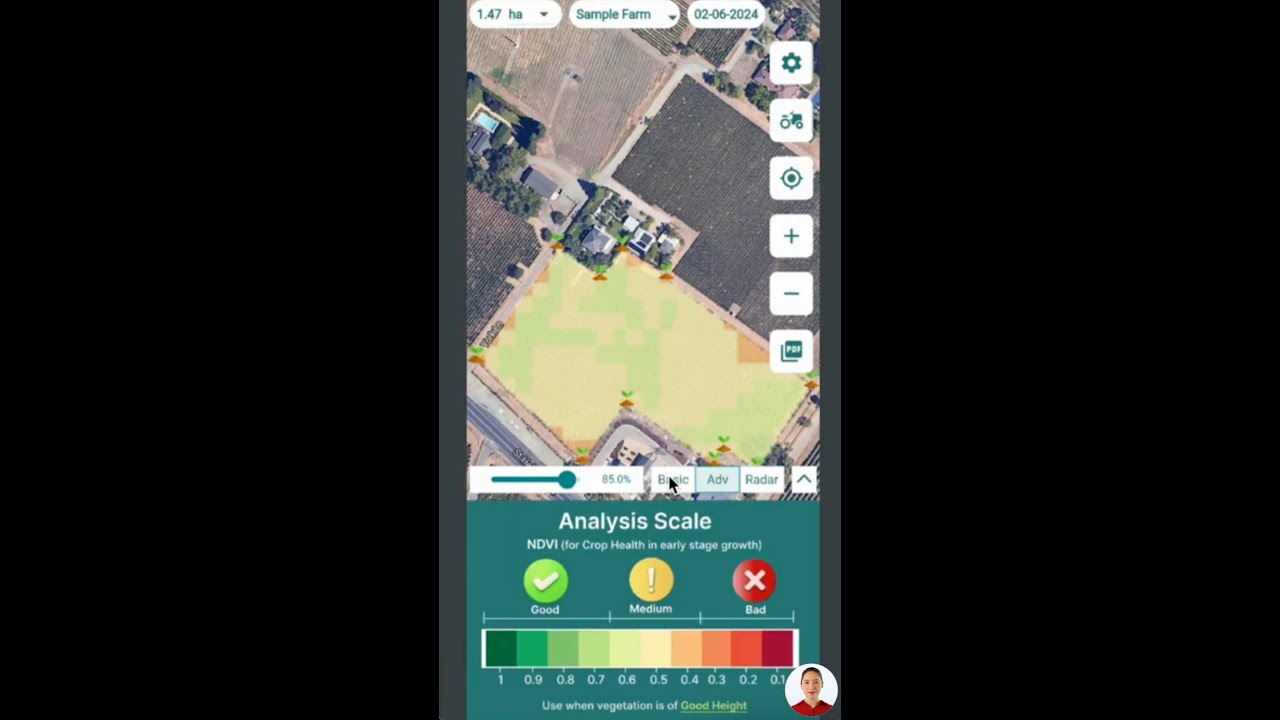
NDVI and NDWI help to ensure every fertilizer application, irrigation, and advisory is precisely timed and tailored to actual crop and soil conditions.
Tip 5: Integrated Weed, Pest & Disease Control (Preventing Losses in 2025)
Weed, pest, and disease pressure is increasingly the “hidden yield gap” across pomegranate fields in Maharashtra’s Indapur, Solapur, Parner, Daund, Rahta, and adjacent regions. Key advisory points:
- Weeds:
- Cyperus rotundus (Nutgrass), Parthenium hysterophorus (Congress grass), Amaranthus — dominate after monsoon (September–November).
- Manual weeding or targeted glyphosate spot applications (pre-harvest or post-monsoon recommended).
- Mulching with compost or organic residue also suppresses weed growth and adds organic carbon.
- Pests:
- Pomegranate Butterfly (Deudorix isocrates) (high risk at fruiting), fruit borers, aphids, mealybugs — detected by sudden NDVI drop or canopy thinning.
- Solutions include: chlorantraniliprole/spinosad sprays (chemical), neem oil/pheromone traps (organic, recommended wherever possible).
- Diseases:
- Bacterial blight (Xanthomonas axonopodis pv. punicae) — documented as a top regional concern; other threats include fruit rot (Alternaria), wilt (Fusarium), anthracnose.
- Spray streptocycline/copper fungicide (chemical/organic as per risk and regional advisory).
- Scouting: Weekly scouting is essential — NDVI/satellite plus physical inspection delivers most reliable “early warning.”
- Adjust by stage: Fruit development and pre-harvest are most vulnerable periods (September–November; March–May for Ambe Bahar).

For control of major pests (like butterfly and mealybugs), consult the Farmonaut app for timely, stage-wise recommendations – minimizing chemical use while maximizing crop protection.
Tip 6: Bahar Management — Mastering Mrig and Ambe Bahar Cycles
Pomegranate phenology in Maharashtra runs on the unique “bahar system”, with two primary flowering/fruiting cycles:
- Mrig Bahar (monsoon flush): flowering June–July, harvest September–November.
- Ambe Bahar (spring flush): flowering February–March, harvest September–November/next cycle.
Aligning fertilizer/irrigation actions and disease intervention with the local bahar is foundational:
- Tailor nutrient applications based on the phenological stage: vegetative growth, flowering, fruit-set, fruit development, and harvest.
- Use NDVI trends to pinpoint the actual stage (for example, NDVI 0.67–0.80 at fruiting suggests a “ready” crop for harvest).
- Time post-harvest interventions (mulching, organic matter addition, pruning) to the rest period after bahar cycles.

Tip 7: Organic and Sustainable Crop Management in Maharashtra
Sustainability boosts long-term yield potential and market value. Organic and integrated approaches are gaining traction:
- Farmyard Manure & Compost: Use 3–5 tons/acre annually to elevate SOC and buffer nutrient delivery. Composting on-farm residues is both eco-friendly and cost-saving.
- Cover Cropping: Plant legumes/green manure during dormancy to fix N and suppress weeds.
- Neem Cake & Wood Ash: These organic sources not only provide K and micronutrients but also help thwart soil-borne pest buildup.
- Reduce chemical input load: Gradually reduce chemical fertilizer and pesticide dependency by pairing with organic alternatives whenever possible.

We at Farmonaut are committed to supporting regenerative, traceable farming practices, ensuring your produce meets the highest standards for domestic and export markets.
For advisory and documentation: Use Farmonaut’s Crop Loan & Insurance Verification solution powered by satellite-based monitoring.
Enabling Precision: How Farmonaut Empowers Pomegranate Farmers in Maharashtra
Farmonaut delivers satellite-generated NDVI, NDWI, moisture & stress analytics — right to your phone! Whether managing a single acre or hundreds, our platform enables:
- Real-time monitoring of plant vigor and canopy cover across all growth stages; immediate alerts for stress, pest, or disease issues.
- AI-based advisories customized by crop region (Indapur, Parner, Daund, Solapur, etc.), soil composition, and actual field health.
- Blockchain-powered traceability — certify your produce as safe and sustainable for premium market.
- Connect via Android, iOS, Web Browser — with fleet management, loan/insurance documentation, and environmental impact dashboards.

Try Farmonaut’s Large-Scale Farm Management Tools—Simplify NDVI crop monitoring, organize field teams, deploy tailored fertilizer schedules, and generate instant reports for stakeholders.
FAQs: Pomegranate Yield in Maharashtra (2025 Edition)
Q1: What are the typical (and best) yield ranges for pomegranate in Maharashtra in 2025?
A: Based on data from ICAR and the Maharashtra State Department of Agriculture (2022–2023), the average yield for well-managed orchards in Maharashtra is 4000–6000 kg/acre (10–15 t/ha). With precise nutrient management, NDVI monitoring, and optimal irrigation, yields can exceed 8000 kg/acre (20 t/ha) in select fields (“highest recorded yield” per Solapur research centre).
Q2: Which soil and nutrient values should I monitor most closely?
A: Key soil test indicators: SOC (target 0.8–1.5%), pH (optimum 6.5–7.0), salinity (avoid > moderate EC), N (18–27 kg/acre at fruiting), P (18–36 kg/acre), K (137–228 kg/acre), S (9–18 kg/acre), Zn (0.9–1.8 kg/acre).
Q3: What is the ideal NDVI range at fruiting and harvest?
A: Healthy NDVI values at peak fruit development and just before harvest are 0.65–0.80. A prolonged or rapid drop (to <0.55) signals stress, pest/disease infestation, or impending senescence.
Q4: Which fertilizers are best for organic pomegranate crop management?
A: Farmyard manure, compost, neem cake, bone meal, rock phosphate, wood ash, zincated compost are all recommended. These improve not only N, P, K, S, and Zn content, but also bolster soil health, SOC, and disease resistance.
Q5: How can I balance water savings and yield under drip irrigation?
A: Adjust irrigation using both NDVI/NDWI trends and phenological stage. During peak fruit set, monitor NDVI weekly and maintain recommended soil moisture. Reducing excess water post-harvest helps control salinity and saves resources while maintaining yield.
Q6: Can Farmonaut help with obtaining crop loan or insurance for my pomegranate orchard?
A: Yes! While we don’t directly provide financial services, Farmonaut offers satellite-based verification and monitoring that simplifies bank and insurance documentation for agricultural fields in Maharashtra.
Conclusion: Achieve High-Yield Pomegranate Harvests
Pomegranate growers in Maharashtra face both vast opportunity and evolving challenges as we approach 2025 and beyond. The keys to exceptional yield – healthy soil, smart irrigation, balanced nutrient application, real-time NDVI insights, and an integrated approach to weed, pest, and disease management – all come together as a result of collaboration between scientific research, on-farm wisdom, and the latest satellite technologies.
By implementing these 7 top tips — and leveraging smart tools like Farmonaut’s app and web solutions — farmers can consistently achieve 4000–6000 kg/acre (and unlock potential for even more) in both Mrig and Ambe Bahar cycles. The era of precision, profitability, and sustainability in Maharashtra’s pomegranate belt has arrived.
Ready to take your fields to the next level? Download the Farmonaut App now to start making data-driven decisions — Get it on Google Play or Available on App Store.

 Delicio
 Payagri
 WB Dev
 Sama Premium
 Prochecker
 Tres Valles
 LACOS Geoinformation
 Pulsar Supernova
 Magrifly
 LatConnect 60
 WebsEdge
 Blickwinkel
 Agricultural Credit Policy Council
 MCSOD
MCSOD Marei Nursery
 eKGIS
eKGIS Mostas Tech
 Andex
Andex FCF India
 Unifrutti Gulf
 Deluxe Conseil
