

Reviewed August 2026 against IMARC Group, USDA Economic Research Service, and MarketsandMarkets data.
Try it: Run your own numbers →
Who Is the Target Audience for Agriculture AI?
The target audience for agriculture AI splits into five groups that buy for different reasons: large-scale row-crop operators chasing labor and input savings, small and mid-size farms weighing a real cost barrier, agribusinesses and cooperatives building traceability into supply contracts, extension agents and policymakers scaling advisory reach, and agri-tech investors screening a market that is still growing double digits a year. None of these groups buys the same tool for the same reason, and a vendor or reader who treats “farmers” as one audience will misjudge both the sales pitch and the ROI case.
The clearest evidence of that split comes from farm size data rather than marketing language. In the United States, the USDA Economic Research Service found that 70% of large-scale crop farms had adopted GPS guidance/autosteering by 2023, versus 52% of midsize crop farms — an 18-point gap driven almost entirely by capital availability and acreage over which to amortize the equipment (USDA ERS, chart 110550). Yield monitors and soil mapping show the same pattern: 68% adoption on large-scale farms per the same ERS dataset. Globally, IMARC Group and Mordor Intelligence estimate AI-powered precision agriculture adoption at roughly 60% on large farms versus 20–25% on small and medium farms as of 2025 (IMARC Group, AI in Agriculture Market). That 35-to-40-point gap is the single most important number in this article: it tells you the target audience is not “farmers” in general, it is large operators first, with small and mid-size operations adopting only where the entry cost drops or the tool is bundled into something they already pay for.
Key Insight
The Buyer Map: Farm Size, Region, Role
Before picking any of the seven solutions below, map the reader against three axes: how big is the operation, what region are they farming in, and what role do they hold (operator, agronomist, extension officer, investor). A large US grain operation and a Saudi date-palm cooperative are both “target audience for agriculture,” but they enter at different price points and different starting technologies.
| Buyer Segment | Primary Driver | Entry Technology | Adoption Evidence |
|---|---|---|---|
| Large-scale row-crop operator (US) | Labor cost, input savings at scale | GPS autosteering, yield monitors | 68–70% adoption, USDA ERS 2023 |
| Midsize crop farm (US) | Margin protection, catching up to peers | Soil moisture sensing, variable-rate irrigation | 52% adoption, USDA ERS 2023 |
| Small/part-time farm | Cost barrier dominates; needs bundled or subsidized tools | Mobile advisory apps, satellite imagery (no hardware) | 20–25% global adoption, IMARC/Mordor 2025 |
| Arid-region operator (Saudi Arabia, Gulf) | Water scarcity, saline soils | Precision irrigation, greenhouse climate control | Market at 35% precision-ag share, IMARC 2025 |
| Agribusiness / cooperative | Traceability, export compliance | Blockchain traceability, carbon documentation | Buyer-driven, not yet separately quantified |
| Extension agent / policymaker | Reach more farmers per staff-hour | AI advisory dashboards, chatbots | Emerging; no national adoption rate published |
That table is the spine of this article: it does not expire when a market-size number updates, because farm size and region will keep sorting buyers the same way regardless of which year’s figures you plug in. Where a cell says “not yet separately quantified,” that is deliberate — no market report in this article’s research base breaks out cooperative or extension adoption specifically, and inventing a percentage there would fail the standard this piece is held to.
1. Precision Irrigation: Who Buys It and Why
Precision irrigation is the highest-readiness solution for arid-region buyers and the clearest ROI story for any operator paying for water or electricity to pump it. The buyer is anyone farming under water restriction, on a metered allocation, or on saline groundwater — which is why Gulf states and the western US are both natural early markets, even though they arrived there by different regulatory routes. The technology stack:
- ✔ IoT sensors and soil moisture probes—provide granular, field-specific data to AI models, reflecting real-time soil conditions.
- 📊 Integration with local weather stations and remote sensing data—for adaptive irrigation schedules based on evapotranspiration and weather forecasts.
- ⚠ Reduction in water and energy consumption—AI-driven variable-rate irrigation systems can cut irrigation requirements by roughly 20–40% in documented pilot deployments without sacrificing crop yields; ask any vendor for the trial report behind that figure before buying at scale.
- ✔ Prevention of nutrient leaching—precise irrigation ensures nutrients remain available to crops, minimizing run-off and environmental impact.
- ✔ Resilience against extreme weather—AI-driven irrigation reduces the risk of crop stress and dehydration during prolonged droughts or heatwaves.
- Try it: Run your own numbers

Pro Tip

For buyers who want to test this before committing to hardware, Farmonaut provides satellite-based soil moisture mapping and remote irrigation assessment — a way to validate the water-savings case on your own fields before installing probes. Explore the satellite-powered agriculture platform to see site-specific data first.
2. AI-Driven Crop Phenotyping for Stress Tolerance
This solution’s buyer is different from the irrigation buyer: it’s plant breeders, seed companies, and research-linked farms working on climate-resilient cultivars, not day-to-day field operators. AI-driven phenotyping platforms rapidly assess genetic diversity and select for:
- ✔ Heat tolerance—improving survival and yield in high-temperature growing seasons.
- ⚠ Drought tolerance—enabling crops to perform with limited water availability.
- ✔ Salinity resistance—selecting varieties adapted to saline soils and irrigation sources, a priority in Gulf-region agriculture and in parts of the western US with saline groundwater.
- 🌱 Yield stability—working with local germplasm and international wheat, barley, and date-palm improvement programs.
- 📊 Shorter breeding cycles—automated image and data analysis speeds up trait selection versus manual field scoring.
Common Mistake
3. AI in Greenhouse Optimization & Controlled Environments
The buyer here is the capital-efficient horticulture operator — commercial greenhouse growers of vegetables, herbs, and ornamentals, plus increasingly smallholders moving into higher-value protected agriculture. AI-powered climate control inside greenhouses is redefining controlled-environment agriculture through:
- ✔ Automated shading, ventilation, and fertigation—AI learns from environmental data (temperature, CO2, humidity) to optimize energy usage and stabilize yields.
- 📊 CO2 enrichment strategies—AI balances energy consumption against photosynthetic optimization for higher, more predictable yields.
- ⚠ Active climate-stress mitigation—predictive algorithms anticipate heat waves and stress periods, automatically adjusting ventilators and irrigation cycles.
- ✔ Lower operational costs—AI targets only the input needed, when needed, benefiting both large commercial operations and smallholders moving up-market.

This is where the target audience for agriculture broadens toward capital-efficient yield optimization: farmers moving their crop portfolio toward higher-value horticultural production regardless of outside weather volatility. Farmonaut’s technologies assist greenhouse operators with real-time monitoring and environmental impact assessment. Interested in carbon footprint tracking for a greenhouse operation? See how to track and reduce greenhouse emissions here.
4. Integrated Pest & Disease Management with AI
The buyer for AI-driven IPM spans both large operators protecting thousands of acres and smallholders who cannot afford to lose a single season’s crop. AI is changing integrated pest management through:
- ✔ Computer vision and machine learning—detecting early outbreaks of pests, foliar disease, and environmental stress using high-resolution drone and satellite imagery.
- 📊 Predictive modeling from weather, phenological stage, and trap data—enabling precision timing of interventions and reduced chemical inputs.
- 🌱 Slower resistance development—strategic rotation and targeted application reduce the risk of resistance building in pest populations.
- ⚠ Resource optimization for both large operators and smallholders—automated scouting and analytic reports produce smarter, site-specific recommendations.
Key Insight
5. Soil Health & Nutrient Management, Including Microbials
Nutrient-management buyers range from large operators optimizing fertilizer spend across thousands of acres to specialty growers adopting biological inputs as a category. This is also where a distinct and fast-growing sub-market belongs: agricultural microbials — bacteria and other biologicals used as biofertilizers, biopesticides, and soil amendments. IMARC Group sizes the global agricultural microbials market at $11.6 billion in 2025, projected to reach $26.8 billion by 2034, a 9.40% CAGR for 2026–2034 (IMARC Group, Agricultural Microbial Market). In the United States specifically, MarketsandMarkets sizes the market at $2,676.2 million in 2025, rising to a projected $5,423.5 million by 2030 at a 15.2% CAGR — nearly double the global growth rate, reflecting faster US uptake of biological inputs as a fertilizer-cost hedge and a regenerative-agriculture selling point (MarketsandMarkets, US Agricultural Microbial Market).
Beyond microbials, AI-powered nutrient management tools serve:
- ✔ AI-assisted soil profiling—mapping field variability in pH, salinity, and organic matter using affordable sensors and remote data.
- 📊 Dynamic fertilizer recipes—nutrient budgeting platforms that react to plant needs in real time, tailored to sub-field zones.
- ⚠ Lower nitrogen losses—precision recommendations cut excess application, protecting groundwater and reducing greenhouse gas emissions.
- ✔ Climate resilience—AI insights support sustainable intensification for both rain-fed and irrigated farms.

Investor Note
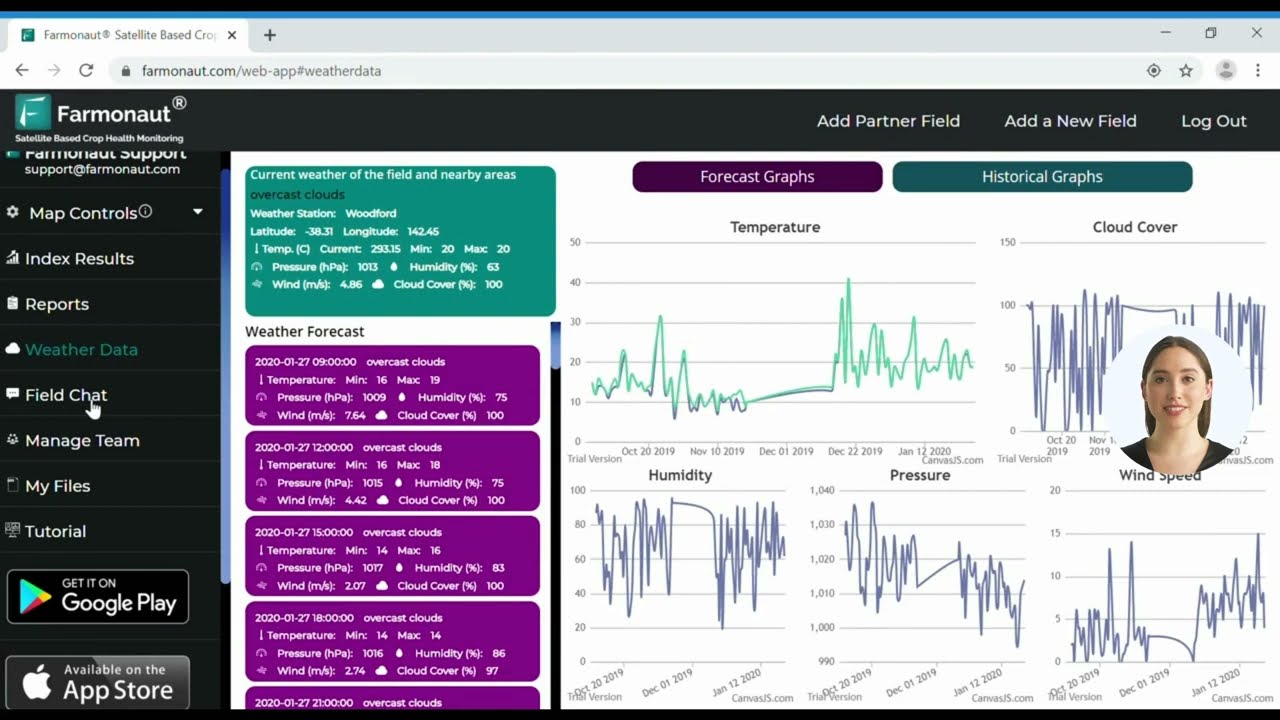
For buyers digitizing soil health management more broadly, Farmonaut’s satellite solutions deliver real-time crop vigor and soil condition data — supporting sustainable growth, optimized fertilizer use, and compliance documentation for environmental policy.
6. Market Intelligence, Extension & Farmer Empowerment
This solution’s target audience is explicitly the reach-constrained buyer: extension agents serving more farmers than they can visit in person, smallholders who need advisory in their own language, and buyers/lenders who need a verifiable record rather than a farmer’s word. Innovations reshaping this segment include:
- ✔ AI chatbots and digital advisory apps—real-time, multilingual advice on planting windows, input use, and weather-risk mitigation, vital for smallholders without an agronomist on call.
- 📊 Crop forecast dashboards—AI-driven analysis of market trends and demand-supply dynamics, strengthening farm-level planting and selling decisions.
- ⚠ AI-powered extension programs—extension officers use data-driven insights to serve more farmers per staff-hour than manual visits allow.
- ✔ Blockchain-based traceability platforms—let growers and buyers verify crop origin and quality, building trust in export-facing supply chains.
Need full traceability from field to shelf? Discover Farmonaut’s traceability tools here. - ✔ Crop loan and insurance verification tools—enable lenders to underwrite farm credit and insurance more efficiently, reducing fraud and improving access to capital.
Check our crop loan and insurance verification product.

Pro Tip
7. Workforce & Capability Building
The final buyer group is institutional: agricultural colleges, extension services, and cooperative boards responsible for making every other solution on this list usable. Without a digitally skilled workforce, AI-enabled agriculture stalls regardless of how good the underlying model is. Priorities include:
- ✔ Data literacy—training in how to collect, interpret, and act on sensing and analytics outputs.
- 👨💻 Sensor and device maintenance—hands-on skills to choose, calibrate, and troubleshoot IoT and farm sensors for persistent data accuracy.
- 📊 AI model interpretation—building decision confidence with machine-generated recommendations for irrigation, pest, and nutrient systems.
- 🧑🌾 Risk management training—building resilient farming mindsets and robust agronomic decision frameworks.
- ✔ Policymaker and extension-staff upskilling—aligning government support and farmer-facing programs to maximize technology adoption.
- Engage with agricultural colleges for curriculum updates on AI and digital agronomy.
- Leverage extension networks to introduce hands-on learning modules.
- Run workshops on sensor use, mobile apps, and satellite interpretation.
- Recruit local technology champions at farm and cooperative level.
- Measure and refine learning outcomes against real-world adoption metrics.
For enterprise-scale large-scale farm management with modular, digitally enabled workforce tools, explore the Farmonaut Agro Admin App, built for end-to-end farm data, fleet, and resource management.
Key Insight
Comparison Table: 7 AI Solutions by Buyer Fit
| AI Solution | Primary Buyer | Key Application | Adoption Readiness | Example Use Case |
|---|---|---|---|---|
| AI-Based Precision Irrigation | Arid-region operators, water-metered farms | Water stewardship, yield optimization | High — 70% GPS/autosteering on large US farms (USDA ERS, 2023) | Variable-rate irrigation for wheat, barley, dates, row crops |
| AI Crop Phenotyping | Breeders, seed companies, research-linked farms | Variety selection, trait screening | Medium | Identifying drought- and salinity-tolerant wheat varieties |
| Greenhouse Optimization AI | Commercial horticulture growers | Energy, CO2 control, crop growth | Medium-High | Climate-adaptive greenhouses for tomatoes, herbs |
| AI IPM & Disease Detection | Large operators and smallholders alike | Pest/disease management | High | Drone-based early pest warning |
| Soil Health, Nutrient & Microbial AI | Fertilizer-cost-sensitive operators, biologicals adopters | Fertilizer optimization, biological inputs | Medium; US microbials growing 15.2% CAGR (MarketsandMarkets, 2025) | Satellite-guided soil nutrition mapping, biofertilizer trials |
| AI Market Intelligence & Extension | Extension agents, smallholders, lenders | Forecasts, advisory, digital extension | High | App-based planting and market-pricing advice |
| Workforce Capability AI Tools | Colleges, extension services, cooperatives | Training, data literacy, support | Emerging | Digitized extension, hands-on IoT training |
Investor Note
Irrigation Savings Calculator
Enter your own field size, water cost, and pumping details below to estimate what the 20–40% precision-irrigation water reduction cited above could be worth on your operation.
Run your own numbers
Assumptions: uses only the inputs you provide plus the 20–40% AI-driven variable-rate irrigation reduction range cited from vendor pilot deployments in this article. Excludes equipment, sensor, and installation costs, and does not account for yield impact, crop type, or regional water rights. Use it to size the water-cost opportunity, not as a full ROI or payback-period estimate.
Saudi Arabia Precision Agriculture Market: The Numbers
Saudi Arabia is one region where this buyer map plays out at national scale, and it is measured directly. IMARC Group sizes the Saudi Arabia precision agriculture market at $91.5 million in 2025, projecting growth to $201.2 million by 2034 — a 9.15% CAGR for 2026–2034 (IMARC Group, Saudi Arabia Precision Agriculture Market). Within that market, precision agriculture technology holds an estimated 35% share in 2025 per the same report — meaning the rest of the market is split across adjacent categories such as controlled-environment systems and advisory services that the report tracks separately.
That $91.5 million-to-$201.2 million trajectory is smaller in absolute terms than the US or global markets, which is exactly why buyer targeting matters more here, not less: a national market this size cannot support broad-based subsidy programs the way larger economies can, so early adoption concentrates on large operators and government-backed demonstration projects tied to Vision 2030 water-security goals. For readers who need a figure this brief cannot supply — country-specific farmer adoption percentages, per-hectare implementation costs, or quantified water savings under Saudi climate conditions — those numbers are not published in any market report available for this rewrite. The right method is to check the Saudi Ministry of Agriculture's quarterly reports and Vision 2030 technology infrastructure announcements, which are published on a recurring schedule and will carry farm-level detail that global market-sizing reports do not.
For broader context on how Saudi Arabia's farming sector is applying these technologies on the ground, see this related coverage of 7 innovations transforming farming in Saudi Arabia.
Where This Fits Against Cleantech and Adjacent Markets
Readers researching cleantech marketing audience segmentation sometimes land here looking for how agri-AI fits inside the broader clean-technology buyer landscape. The honest answer is scale: Acumen Research and Consulting sizes the global cleantech market at $914.18 billion in 2024, projected to reach $2,685.72 billion by 2034 (Acumen Research and Consulting, Clean Technology Market). Precision agriculture — Saudi Arabia's $91.5 million market included — is a narrow, agriculture-specific slice of that far larger cleantech category, and the buyer segmentation for the two overlaps only where water efficiency, energy use, and emissions reporting intersect with farm operations. A cleantech-specific audience-segmentation strategy is a different exercise from the farm-size-and-region map this article builds; treat this as a pointer, not a substitute.
Challenges and Key Considerations
- ⚠ Data access and interoperability—Many smallholders in remote or underserved regions lack devices or reliable network connectivity. Scalable solutions must offer affordable, offline-first sensors and localized-language interfaces to maximize reach.
- ⚠ Economic viability—AI and precision equipment reduce input costs over time, but the upfront investment in sensors, drones, and greenhouse automation remains a real barrier, especially below the large-farm threshold where USDA ERS shows adoption drops sharply. Leasing models and government-backed financing help close that gap.
- ⚠ Agronomic adaptation—Recommendations must align with local agronomy, soil types, and crop calendars. Ongoing farmer feedback loops help train and improve AI models over time.
- ⚠ Data privacy and trust—Farmers need confidence in how their data is used. Transparent data policies and clear benefit communication build the trust that drives wider participation.
- ⚠ Environmental compliance—Monitoring and reducing environmental impact is now expected by both domestic and export buyers; traceability and carbon-footprint documentation are increasingly a condition of market access, not a differentiator.
Quick Buyer-Fit Checklist
- Farm size: Large operation → start with irrigation or IPM (highest documented adoption). Small/midsize → start with mobile advisory or satellite imagery (lowest hardware cost).
- Water constraint: If water-metered or in an arid region, precision irrigation is the highest-ROI entry point.
- Export or contract buyer requirements: If traceability or carbon documentation is contractually required, start there regardless of farm size.
- Existing workforce skill: If no one on staff can interpret sensor data, budget for training before buying hardware — the tool underperforms without it.
- Capital access: Check for regional leasing, cost-share, or demonstration-farm programs before assuming a full upfront purchase is the only path in.
FAQ
1. Who is the actual target audience for agriculture AI solutions?
Five groups, each with a different buying trigger: large-scale operators (highest current adoption — 70% for GPS guidance per USDA ERS, 2023), midsize farms (52% adoption, same source), small/part-time farms (20–25% global adoption per IMARC/Mordor, 2025), agribusinesses and cooperatives needing traceability, and extension agents/policymakers scaling advisory reach. Each buys a different entry technology and expects a different ROI case.
2. How do AI-driven tools reduce irrigation and input costs?
AI models use real-time data from sensors, satellite imagery, and weather stations to build precise irrigation and input schedules, reducing water use by roughly 20–40% in documented pilot deployments and cutting fertilizer waste. Actual results depend on baseline irrigation practice, so request the underlying trial data from any vendor before sizing a business case.
3. Does this include biological inputs like agricultural microbials?
Yes — bacteria-based biofertilizers and biopesticides are a fast-growing adjacent category. IMARC Group sizes the global agricultural microbials market at $11.6 billion in 2025, rising to $26.8 billion by 2034 at a 9.40% CAGR; the US market alone is $2,676.2 million in 2025, projected to $5,423.5 million by 2030 at 15.2% CAGR per MarketsandMarkets.
4. How big is the Saudi Arabia precision agriculture market specifically?
$91.5 million in 2025, projected to reach $201.2 million by 2034 at a 9.15% CAGR (2026–2034), per IMARC Group. Precision agriculture technology holds an estimated 35% share of the broader Saudi agri-tech market as of 2025.
5. Can these platforms be used offline in areas with poor connectivity?
Many leading solutions are built offline-capable, supporting data logging and advisory features where network access is intermittent — a requirement for the smallholder segment of the target audience in remote regions worldwide.
6. What role does Farmonaut play?
Farmonaut provides satellite-based monitoring, AI-based advisory, and blockchain traceability for agriculture at every scale — helping farmers, businesses, and governments optimize productivity and transparency while reducing environmental impact. Cross-platform apps and APIs support broad accessibility across all the buyer segments mapped in this article.
Conclusion
The target audience for agriculture AI is not one persona — it is at least five, sorted first by farm size and capital access, then by region and regulatory context. The USDA's 18-point adoption gap between large and midsize US farms, IMARC's 35–40 point gap between large-farm and small-farm global adoption, and Saudi Arabia's still-small but steadily compounding $91.5 million market all point to the same conclusion: match the solution, the price point, and the messaging to where a buyer actually sits on that map, not to an assumed average farmer.
The durable takeaways:
- Farm size predicts adoption more reliably than crop or country — check USDA ERS's precision-agriculture chart series for the current large-vs-midsize-vs-small breakdown before planning any go-to-market segmentation.
- Water-constrained regions adopt irrigation AI first; capital-constrained operations adopt free or low-hardware tools (mobile advisory, satellite imagery) first.
- Biologicals and microbials are a genuinely separate, faster-growing buyer segment (15.2% US CAGR vs. 9.40% global) worth tracking on its own, not folding into "precision agriculture" broadly.
- National markets like Saudi Arabia's are worth watching at the source — the Ministry of Agriculture's quarterly reports and Vision 2030 announcements will always be fresher than any single market-research snapshot.
- Workforce capability is the limiting factor most buyer-fit checklists skip; a tool bought without training budget underperforms regardless of segment.
Ready to Explore Farmonaut's Platform?



The target audience for agriculture AI keeps expanding downward from large operators toward every farm size, region, and role mapped in this article — the data above is the evidence, and the buyer-fit checklist is how to act on it.

 Godrej Agrovet
 Hayleys Agriculture
 Linx Agritech
 Adinet
 Save Your Soils
 GalaxEye Space
 Grandstream Algérie
 XOS Realty
 Geospatial Lab Africa
 Agro La Gándara
 HIPSAC
 ZOL Zimbabwe
 Juligerm
 AdBio
AdBio MISE Maroc
 NWNS
NWNS Red August Group
 Farm Inc
 WeMe Global
 Agrotoken
 Blue BearX
 Insignito
 DnCubed
 Indosistim Teknologi
 Liquify Digital
 CU Foods
 BeyondTech Global
 Rouge VC
 AgroRisk
 Oath Inc
 Esri North East Africa
 MDCV UK
 Etech Consulting Madagascar
 Vestlandsforsking
 WB Dev
 Sama Premium
 Tres Valles
 Blickwinkel
 Agricultural Credit Policy Council
 eKGIS
eKGIS Mostas Tech
 Andex
Andex Deluxe Conseil
 WICO
WICO Chimera Innovation
 SkyHarvest
 Teledarbas
 Exurbia Geospatial
 FieldZero
