

AI in Farming Industry: 7 Ways Transforming Australia
Summary: The Rise of AI in Australia’s Farming Industry
In 2025 and beyond, AI in farming industry continues reshaping the agricultural industry in Australia through precision technology, advanced agriculture machinery industry innovations, and data-driven decision-making. This revolution brings enhanced productivity, sustainability, and future resilience for Australian farmers and the environment. No longer a futuristic concept, artificial intelligence is now an integral part of farming operations—from smart tractors and robotic harvesters to satellite-based crop health monitoring and predictive analytics platforms.
The fusion of AI, IoT technologies, and satellite-driven insights enables unprecedented precision, smarter resource use, improved soil and water management, and enhanced sustainability for a future-ready industry. In this blog, we’ll explore seven transformative ways AI is changing the face of Australian agriculture through agriculture machinery, smart software, and next-generation data approaches.
Featured Trivias
“AI-powered machinery boosts crop yield prediction accuracy by up to 30% for Australian farmers.”
“Over 60% of large Australian farms now integrate AI-driven solutions for precision agriculture and resource management.”
Introduction to AI in the Farming Industry
As we approach 2026 and beyond, Australia’s agricultural industry is at a unique crossroads. With vast and diverse zones, the country faces challenges like climate variability, soil degradation, water scarcity, and changing consumer demand. Yet, AI in the farming industry continues to offer promising solutions—from combating unpredictable weather patterns and improving crop yields to ensuring sustainability via environmental best practices.
The agriculture machinery industry in Australia is now defined by AI-driven automation, precision agronomy, satellite insights, and sustainable practices.

Let’s explore the seven key ways AI is transforming Australia’s farming industry, advancing agricultural machinery and reshaping the landscape with technology and innovation.
1. Precision Agriculture Machines: AI, Sensors & Vision
Precision agriculture is the cornerstone of modern farming in Australia. The rise of AI-powered machinery—from state-of-the-art tractors and combine harvesters to smart planting equipment—has revolutionized field operations. These advanced machines are:
- ✔ Equipped with high-resolution sensors, GPS, and computer vision to analyze soil and field conditions in real-time.
- ✔ Capable of measuring crop health, planting patterns, and adapting fertilizer application for maximum productivity.
- ✔ Delivering precision in irrigation scheduling, planting density, and resource allocation.
- ✔ Autonomous navigation across farmlands with minimal or no human supervision, making them increasingly common on large Australian properties.
Assuming that all AI farming equipment operates the same—in reality, field conditions, software features, and compatibility with existing machinery significantly impact results in the Australian agriculture machinery industry.
These modern machines aren’t just a shift—they represent a fundamental evolution, enabling farmers to minimize waste, reduce operational costs, and improve safety and efficiency.
Visual List: Top Precision Machinery Advancements
- 🛠️ Autonomous Tractors: Smart navigation, optimal soil tilling, low labor input
- 🌱 Variable Rate Planters: Data-driven seed placement, maximizing germination
- 🎯 Sensor-based Sprayers: Targeted pesticide use, reducing environmental impact
- 📷 Multi-spectral Cameras: Detailed crop mapping and plant diagnostics

Integrating AI-enabled machinery with real-time weather algorithms leads to smarter in-season decisions. Australian farmers can pre-empt droughts or floods by adjusting sowing windows and input use, optimizing both yield and sustainability.
2. AI-Powered Drones & Robotic Harvesters in Australia
The next frontier for Australian farming is taking flight—and rolling into orchards. AI in the farming industry now powers drones and robotic harvesters, with remarkable outcomes:
- 🚁 AI-powered drones can conduct detailed aerial surveys, monitor for pest infestations, and detect crop diseases early—boosting resilience to environmental threats.
- 🤖 Robotic harvesters are programmed to selectively pick fruits and vegetables with pinpoint accuracy, reducing waste and enhancing yield quality.
- 🦾 Autonomous systems are increasingly integral on Australian farms, alleviating labor shortages, especially in remote and rural communities long challenged by workforce gaps.

These smart machines are vital for Australian orchards, broadacre farms, and vineyards—offering precision crop monitoring, enhancing harvest scheduling, and reducing post-harvest losses.
Global demand for AI-powered agriculture machinery is projected to hit $13 billion by 2028. Australia’s early adoption makes it a compelling region for agri-tech investors looking beyond 2026.
Five Key Benefits of Drones and Robotic Harvesters
- ✔ Early warning of pests & diseases
- ✔ Lower labor costs by up to 40%
- ✔ Smarter picking, reducing bruising & crop loss
- ✔ High-frequency field data for AI platforms
- ✔ Enabling harvests in vast/remote zones

3. Predictive Analytics & Data Integration for Smart Decisions
A major leap for the agriculture machinery industry in Australia comes from harnessing massive amounts of data—not just from sensors, but also satellites, weather stations, and cloud-based databases. AI algorithms integrate this information to deliver:
- 📊 Predictive analytics forecasting crop yields, soil moisture, and weather extremes—helping farmers adjust strategies ahead of adverse events.
- 🔄 Data-driven fusion providing actionable insights tailored to regional and local conditions.
- 🧮 Better resource allocation by analyzing past outcomes, current threats (e.g., drought), and future scenarios.
In Australia’s diverse climate zones, where variability and extremes are increasingly common, such predictive capabilities support resilience and sustainability. It enables smarter planning, reduces risk, and helps align cropping cycles with changing environmental patterns.
Pro Tip: Many modern AI tools integrate remotely with satellite-based APIs so farmers or software developers can access real-time datasets directly into farm management apps.
- 📡 Developer Resource: Farmonaut Satellite Weather API Developer Docs
4. Smart Irrigation & Water Resource Optimization
Water scarcity has long been a defining challenge for the Australian agricultural industry. However, AI enables new levels of precision in irrigation and water management:
- 💧 AI-driven irrigation systems monitor field moisture, weather forecasts, and satellite imagery to optimize water application by crop and location.
- 💻 Machine learning models predict water needs, reducing over- or under-watering and improving yields.
- 🌍 Supports compliance with national and local water regulations and conservation targets.
In semi-arid and drought-prone Australian farming zones, AI-regulated irrigation systems can cut water use by up to 50% compared to traditional methods—while maintaining or improving yield.
This integration of real-time AI insights into smart irrigation schedules is fast becoming the gold standard.
Key Benefits: AI-Driven Irrigation
- ✔ Reduced water waste
- ✔ Optimized plant health under variable climate
- ✔ Automated compliance with environmental standards
- ✔ Lower labor & energy requirements
- ✔ Sustainable, scalable farming for the future



Must-Know
- ✔ AI in irrigation helps align Australia’s farming industry with evolving environmental regulations for smarter, sustainable water management.
5. Soil Health Monitoring & Fertilizer Optimization Using AI
Maintaining healthy soil is central to sustainable agriculture. Today’s AI in the farming industry offers advanced soil analysis and fertilizer application platforms that:
- 🛰️ Analyze satellite and field sensor data to pinpoint soil nutrient deficiencies, compaction, and degradation risks.
- 📊 Advise precise fertilizer rates, reducing environmental contamination and improving input efficiency.
- 🧬 Tailor crop nutrition to regional conditions for higher yields and lower costs.
Precision fertilizer application, fueled by AI insights, curbs over-fertilization and runoff, protecting Australia’s unique ecosystems.
Australian grain and cotton farms using AI-based soil monitoring have seen a reduction in fertilizer use by 15–25% on average while boosting total crop output.

6. Farmonaut: Satellite & AI Insights Transforming Agriculture
In the ever-evolving landscape of AI in Australia’s farming industry, Farmonaut is a leader in satellite-based agriculture solutions for all scales of operations. We believe in democratizing access to advanced satellite imagery, AI-driven insights, traceability, and fleet management—all delivered affordably through our web, Android, and iOS apps, as well as API platforms.
- 🌍 Satellite-Based Crop Monitoring: Using multispectral imagery and AI to provide insights into vegetation health (NDVI), soil condition, and resource use across Australian farms.
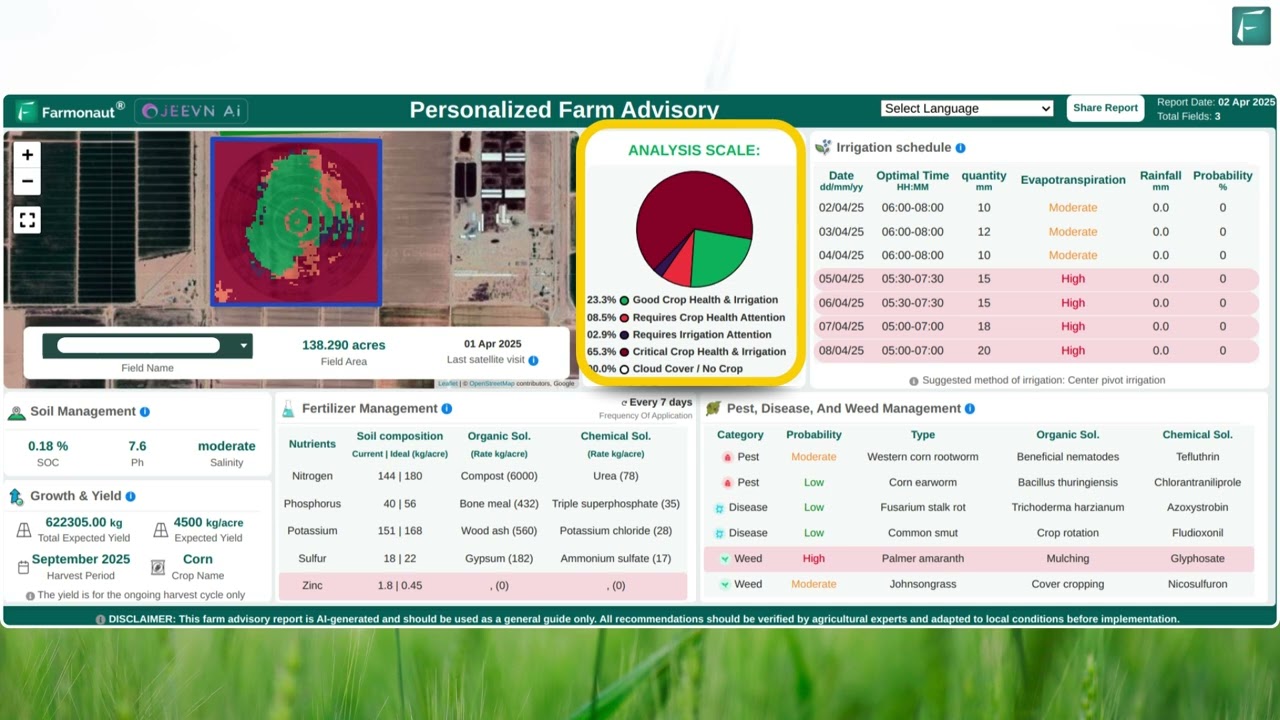
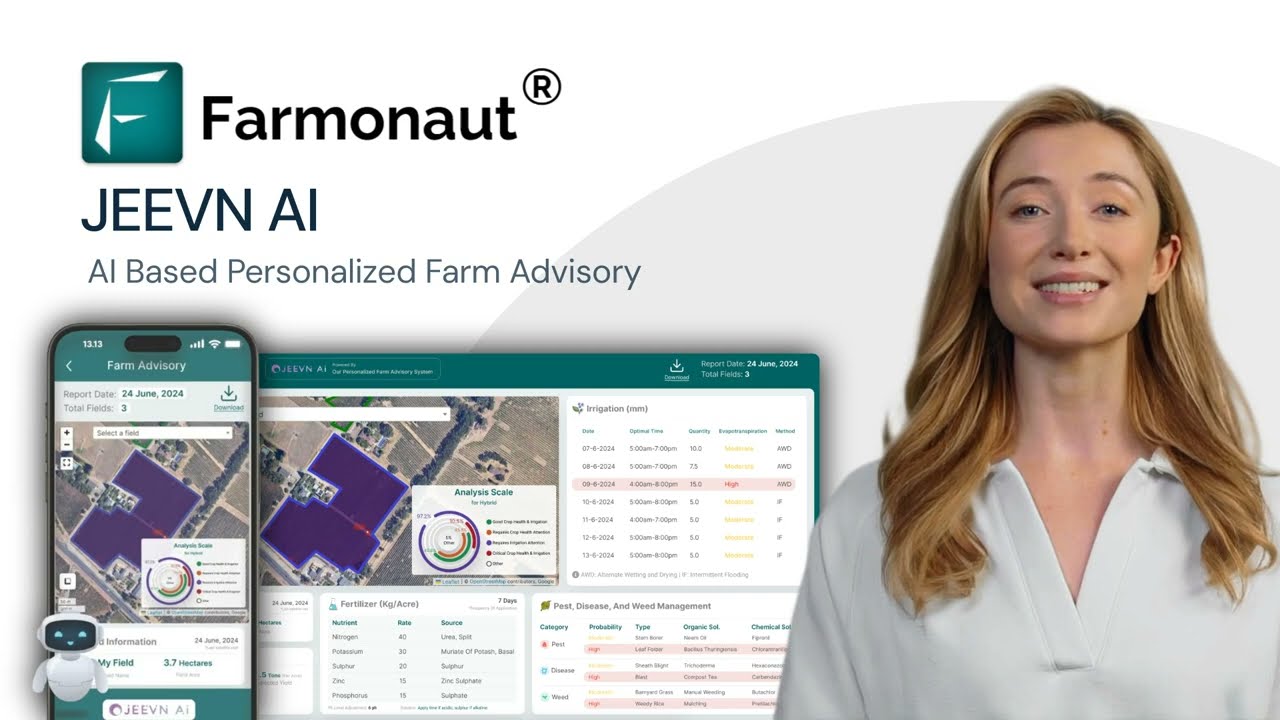
- 🧠 Jeevn AI Advisory System: Delivers real-time weather forecasts, customized crop management strategies, and operational efficiency recommendations for sustainable productivity.
- 🔗 Blockchain-Based Traceability: Traces the entire journey of a crop, enhancing food safety and ensuring transparent supply chains.
- 🚚 Fleet and Resource Management: Optimizes logistics and equipment deployment to reduce costs and improve operational oversight.
- 🌱 Environmental Impact Tracking: Real-time carbon footprint monitoring for regulatory compliance and eco-friendly certification.
Note: Our farm management solutions scale for individual Australian farmers, agribusinesses, government organizations, and financial services—for field-level decision-making and industry-wide optimization.
👉 Explore our farm management platform for actionable satellite-driven intelligence, tailored for the Australian agricultural landscape.
Integrate Farmonaut’s API (API link) with farm software, agri-robots, and precision equipment for seamless, real-time data access across devices and regions.

7. Sustainable Practices: AI for Carbon, Traceability & Beyond
Future-focused AI in the farming industry supports a holistic approach to sustainability. From carbon management to product traceability and regenerative practices:
- 🌱 AI-enhanced carbon footprinting allows farms to calculate and minimize greenhouse emissions. See: Farmonaut Carbon Footprinting Platform.
- 🔗 Supply chain traceability—with blockchain and AI—ensures every shipment is verified, reducing fraud and increasing transparency (Traceability Details).
- 🌾 Integration of AI with sustainability initiatives helps farmers implement rotational cropping, eco-friendly fertilizer use, and soil regeneration.
These AI tools help the Australian agricultural industry align with national and global targets for carbon neutrality and sustainable production by 2026 and beyond.
- ✔ Regenerative agriculture powered by AI is projected to be a key trend across Australia’s unique farming zones, addressing long-term soil health and biodiversity goals.
“AI-powered machinery boosts crop yield prediction accuracy by up to 30% for Australian farmers.”
“Over 60% of large Australian farms now integrate AI-driven solutions for precision agriculture and resource management.”
Visual List: AI for a Greener Future
- 🌏 Carbon tracking: Reduced farm emissions verified by data
- 🔄 Supply chain blockchain: Full product traceability
- 🌾 Soil thriving: AI-enabled soil restoration practices
- 💧 Water savings: Data-driven conservation strategies
- 🔐 Certifiable compliance: Meeting new sustainability standards
Comparison Table of AI Applications in Australian Agriculture
| AI Application | Estimated Adoption in Australia | Key Benefits | Impact on Sustainability | Notable Use Cases |
|---|---|---|---|---|
| Yield Prediction & Crop Sensing | 60%+ of large farms (2025) | Improved yield forecasts, proactive input allocation | Reduces overproduction & resource waste | Grain and cotton farms using satellite-AI |
| Autonomous Agricultural Machinery | Rapidly increasing, 45-55% large farms | Lower labor costs, improved safety, scalable operations | Direct fuel, time & emission savings | AI tractors, harvesters, planters |
| Disease & Pest Early Detection (Drones) | 35-50% in affected regions | Reduced loss, faster response, targeted treatment | Less pesticide use, better biodiversity | Aerial drone surveys in wheat & orchards |
| Fertilizer & Water Optimization | 30–40% | Input cost savings, yield quality gains | Minimizes runoff & water waste | AI irrigation & fertilization on horticulture |
| Blockchain Traceability | 15–20% and growing | Transparency, fraud prevention, market access | Traceable eco-labels, responsible sourcing | Export crops, premium produce supply chains |
| Environmental Footprint Management | 10–20% | Regulatory adherence, market differentiation | Enables low-carbon certification | Carbon tools for grains, livestock, irrigated crops |
| Fleet & Resource Management via Satellite | 25–35%, especially large enterprises | Operational efficiency, asset accountability | Smoother, less resource-intensive logistics | Farmonaut Fleet Management on large-scale farms |
Challenges, Opportunities, and the Road Ahead
While AI in farming industry adoption is surging, several challenges still limit universal access and efficiency, especially for remote Australian communities:
- ⚠ High initial costs for AI-enabled machinery—prohibitive for some smallholders
- ⚠ Need for digital literacy—many farmers need training on data/AI platforms
- ⚠ Reliable rural internet connectivity—still an issue in several remote zones
- ⚠ Integration with legacy systems—older equipment may require upgrades
Underestimating ongoing support needs (updates, troubleshooting, cyber-security) for AI, IoT, and satellite data platforms in a dynamic climate like Australia’s.
Opportunities and the Future
- 🔥 5G, IoT & real-time satellite integration promise smarter, more connected farms by 2026 and beyond
- 🙌 Affordable subscription-based platforms (like ours at Farmonaut) lower technology entry barriers for all farm scales
- 📱 API-first approaches enable farm software providers and OEMs to embed AI insights seamlessly
- 🥇 Eco-certification and traceability will become valuable assets for market access
For Australian agriculture, AI will underpin not only field operations but entire business models in agri-finance (crop loan and insurance insights), logistics, and global trade certifications.
Australian AI farming startups and IoT-enabled machinery suppliers are attracting global funding for their focus on environmental sustainability, export traceability, and climate resilience. Long-term growth is strongly aligned with evolving regulatory frameworks by 2026.
FAQ: AI in Farming Industry
What is the main benefit of AI in the Australian farming industry?
AI enables precise, data-driven decisions in planting, harvesting, irrigation, and resource allocation, which boosts yields, cuts costs, and supports sustainable practices even under climate variability.
How does AI-powered machinery reduce environmental impact?
By using smart sensors and analytics, AI machinery applies water, fertilizer, and pesticides only where needed, minimizing runoff and promoting soil and ecosystem health.
Is smart farming affordable for small to medium Australian farmers?
Subscription access to satellite-based analytics and modular AI tools (like Farmonaut) significantly lower entry costs for smaller operations compared to traditional hardware-heavy setups.
Do I need special technical skills to use AI agri-platforms?
Most modern AI farming platforms are user-friendly and come with training resources, but a basic willingness to learn new systems is always valuable.
How will AI in the agriculture machinery industry evolve by 2026?
Expect tighter integration of autonomous machinery, real-time IoT sensors, satellite intelligence, and instant environmental reporting—enabling next-level traceability, compliance, and productivity.
Farmonaut’s weather and satellite data API provides real-time field insights for custom farm apps, web dashboards, and large agri-ecosystems. Get started with our API for next-gen smart farming.
Utilize Farmonaut’s large scale farm management solution for end-to-end satellite intelligence—manage fields, monitor crop health, receive soil/water alerts, and improve precision, all within your dashboard or mobile device.
Conclusion
AI in the farming industry is revolutionizing not only the agriculture machinery industry of Australia but the entire operational mindset of smart farming for 2026 and beyond. Through integrated AI platforms, autonomous machines, drones, predictive analytics, and sustainable resource management, Australian farmers and agribusinesses are better equipped than ever to face climate variability, scarcity, and global competitiveness.
As data and digital literacy levels grow, barriers will continue to fall. With access to affordable, scalable, and mobile-ready solutions—such as those delivered by Farmonaut, powered by cutting-edge satellite intelligence and AI—Australia stands at the forefront of technological transformation in global agriculture.
- ✔ Smarter machines are reducing costs and risk
- ✔ AI-driven insights are optimizing yield and quality
- ✔ Sustainable practices are easier to measure and achieve
- ✔ Australian agriculture is positioned for future growth
- ✔ Farmonaut provides accessible, data-driven solutions for individual farmers, businesses, and governments across the industry
For developers and agri-enterprises, experiment with our Farmonaut API and see how satellite and AI can transform your agri-business—from smart machinery scheduling to full supply chain carbon tracking.
The same satellite and AI-driven platforms that empower Australian agriculture (such as Farmonaut) are unlocking new value in mining, land reclamation, and infrastructure management—expanding the potential for multi-sector innovation.

 Sampurn AgriConnect
 FCF India
 Unifrutti Gulf
 Deluxe Conseil
 TVS Electronics
 BW Pipelines
 WICO
WICO Gen Chayat
 Chimera Innovation
 SkyHarvest
 Polaris Digitech
 Teledarbas
 Wild Oak Farm
 SFX
SFX Doodlakine
