

Agri Food Marketing: Agri Marketing Magazine Trends 2026
Summary: The Future of Agri-Food Marketing in 2025–2026
Agri food marketing is advancing at a phenomenal pace, shaped by technological integration, data-driven innovation, and evolving consumer attitudes around sustainability. By 2025 and beyond, the agricultural products marketing realm will be characterized by AI-powered tools, efficient digital platforms, sustainable branding, and a profound emphasis on transparency and traceability. Marketers, farmers, and brands must rely on innovative channels and strategies to reach a global, eco-conscious consumer base. This blog explores 2026’s key trends, challenges, and opportunities, revealing how agri marketing magazine insights and real-world technology — including sector leaders like Farmonaut — are shaping the industry’s future today and tomorrow.
Trivial Insights: Fast Facts

Agri Food Marketing Landscape in 2026: Evolving Far Beyond Traditional Methods
The landscape of agri food marketing has never been more dynamic. With the relentless advance of technology and digital innovation, traditional methods — such as localized marketplaces and seasonal fairs — are rapidly being replaced or supplemented by sophisticated digital channels, data analytics, and a relentless drive toward sustainability. This ongoing transformation is propelled by:
- Shifting consumer preferences for transparency and sustainability
- Emergence of AI-driven marketing tools and marketing analytics
- Stringent global policies and competitive market pressures
- The integration of blockchain traceability and real-time data for food supply chains
As marketers, producers, and farmers navigate this complex ecosystem, the need to stay informed and agile has never been more critical.
Technological Integration: The Heart of Agri Food Marketing 2025–2026
One of the most significant developments in agricultural products marketing is the integration of advanced digital technologies. Today’s producers and marketers are increasingly relying on online marketplaces, social media, dedicated apps, and e-commerce portals to showcase everything from fresh produce to value-added, processed goods. This adoption of digital solutions is not just a trend; it represents a fundamental change in how agricultural value is created, delivered, and captured.
- Unlike conventional methods (physical stores, local markets), digital platforms enable farmers and agribusinesses to connect with a broader, global audience at unprecedented efficiency.
- Mobile apps and responsive web portals make it possible for even small-scale farmers to list, market, and sell products directly to consumers or retailers, maximizing value capture.
- Advanced customer management and analytics allow marketers to optimize product positioning, pricing strategies, and promotional campaigns.
The adoption of AI — from real-time crop and supply monitoring to precision recommendations for marketing and logistics — enables today’s agricultural enterprises to move far beyond traditional channels and set new standards for connectivity and profitability.
AI & Data Analytics: Unlocking Precision in Agri Food Marketing
The increasing importance of data analytics in agricultural products marketing cannot be overstated. Artificial Intelligence (AI) and machine learning facilitate a granular understanding of consumer behavior, market trends, and emerging preferences. Predictive analytics allows for more accurate demand forecasting, pricing optimization, and real-time decision-making. This level of precision marketing was nearly unthinkable a decade ago.
- Predictive analytics enables marketers to anticipate changes in demand, guiding both crop planning and go-to-market strategies and minimizing resource wastage.
- AI-powered tools personalize outreach by analyzing customer engagement and response to previous campaigns.
-



Explore real-time, actionable insights for agri-marketing via Farmonaut’s apps and web platform — empowering farmers and businesses with satellite-powered visibility, AI analysis, and data-backed advisory.
In short, AI has made possible a level of responsiveness and market agility that defines 2025–2026’s global agri food marketing ecosystem.

Digital Platforms, Marketplaces, Apps, and Social Media: The New Marketing Channels
Today’s digital landscape presents a hybrid ecosystem for agri-food marketing. The rise of online marketplaces, omnichannel apps, and highly strategic use of social media allow agricultural marketers to connect with consumers across geographies and cultures while ensuring a seamless, end-to-end buying experience.
- Direct-to-Consumer (D2C) Models—Cut out intermediaries by selling straight to buyers, leveraging e-commerce and branded experiences for greater market access and profit margins.
- Social Commerce—Harness viral, visual storytelling on platforms such as Instagram and Facebook to engage, educate, and convert consumers across demographics.
- Mobile-first Strategies—Design apps and web portals from the ground up to suit the digital behaviors of farmers, buyers, and marketers on mobile devices globally.
- Platform Integration—API integrations (like Farmonaut APIs and developer tools) enable streamlined access to satellite insights, resource management, and traceability for B2B and enterprise agri brands.
As the market shifts toward frictionless, AI-driven digital channels, access to reliable data and transparency becomes the minimum expectation in agricultural products marketing.
Shifting Consumer Preferences: Opportunities and Challenges for Marketers
In 2026, consumers are informed, connected, and increasingly vocal about the origin, ethics, and environmental impact of the food they consume. Agri-food marketers must adapt to a new era defined by:
- Sustainability as a purchasing driver—Modern buyers want proof of sustainable farming, water and resource conservation, and ethical labor. Farmonaut’s carbon footprinting solution enables farmers and agri-brands to track, manage, and communicate environmental accountability—building customer trust and competitive edge.
- Transparency & Certification—Certification labels such as organic, carbon-neutral, and fair trade serve as important marketing tools to foster loyalty. Farmonaut’s blockchain-based traceability empowers brands to offer tamper-proof supply chain transparency.
- Personalization & Experience-driven Engagement—Personalized recommendations, augmented reality farm tours, and rich stories about the farmer’s journey deeply engage audiences and boost brand value.
This reality presents opportunities for those who skillfully address concerns around food safety, authenticity, and responsible practices.
Trivial Insights (Midway):

Sustainability: The Critical Pillar of Agri Food Marketing
“Sustainability” is not simply a buzzword — it is now a marketing imperative. Global consumers place heavy emphasis on the environmental, social, and economic impacts of food production. Agri-food marketers can no longer afford to treat sustainability as an afterthought. Instead, it must be built into the core narrative and backed up by measurable practices and certifications.
- Farmonaut’s Environmental Impact Tools — We deliver real-time, satellite-powered carbon footprinting and resource monitoring, supporting sustainable practices across crops and livestock. These tools simplify compliance and make it feasible for farmers and businesses of all sizes to showcase their ecological responsibility to consumers and regulators alike.
- Community and Narrative-building — Marketing is increasingly about storytelling that puts farmers, regions, and sustainable trade models at the center. Transparent, honest communication with the end consumer forms the bedrock of trust and brand exclusivity.
- Eco-friendly Packaging, Local Sourcing & Regeneration Practices — These attributes resonate powerfully with the 2026 buyer, helping to differentiate brands in a crowded, global market.

The Role of Agri Marketing Magazine & Digital Information Platforms
Agri marketing magazine and advanced information platforms maintain a pivotal role in today’s evolving agri food marketing sector. These resources enable everyone—from farmers and agribusiness professionals to digital marketers—to remain updated with:
- Current market trends, opportunities, and challenges
- Regulatory policy changes impacting agricultural trade
- Latest technological advancements and how to deploy them for better market access and growth
- Case studies of successful strategies (excluding any direct partnerships or anecdotes pertaining to Farmonaut)
- Guidance around digital branding, sustainability certifications, and supply chain optimization
Agri marketing magazines act as trusted voices, often functioning as hubs for networking, collaboration, and best-practice sharing in the rapidly shifting agricultural sector.
Future Trends: Technology & Innovation in Agri Food Marketing 2025–2026
Looking ahead, the future of agri food marketing will be shaped by several transformative trends — all of which point to an ecosystem radically more transparent, data-powered, and consumer-responsive:
- Blockchain-powered Traceability: After cryptocurrencies, blockchain is becoming essential for authenticity in supply chain transparency — verifying product origin, reducing fraud, and building buyer trust. (Learn how Farmonaut’s blockchain solution delivers traceability)
- Precision Ag Input Marketing: By leveraging AI and remote sensing data, marketers deliver exact recommendations for inputs (like seeds, fertilizers, pesticides)—minimizing waste and maximizing yields.
- Direct-to-Consumer (D2C) and Farm-to-Table Models: Disintermediate long supply chains, offer premium, differentiated, and transparent food offerings to global consumers.
- Virtual and Augmented Reality Experiences: Enable virtual farm tours, immersive education, and interactive product discovery for higher consumer engagement.
- AI-powered Personalized Nutrition: Use data analytics to tailor food products and marketing campaigns based on individual health data and preferences.
- Smart Contracts & Automated Insurance: With tools like Farmonaut’s satellite-verified crop insurance, automation reduces disputes and speeds up access to finance.
- Environmental Impact Disclosure: Market leaders will increasingly disclose resource consumption, carbon footprints, and regenerative farming adoption.
- Collaborative and Cooperative Marketing Models: Strengthen bargaining power and risk mitigation for smallholder farmers through digital collectives and online coops.
This next wave of innovations ensures agri food marketing not only adapts to consumer expectations but leads transformation toward sustainable growth.
Agri Food Marketing Trends Comparison Table 2025–2026
Below is a trends comparison table highlighting emerging agri food marketing strategies, estimated adoption rates, key technologies, and their forecasted impact on sustainability for 2025–2026.
| Trend Name | Description | Estimated Market Adoption Rate (2025, %) | Key Technologies Involved | Impact on Sustainability (Score/10) |
|---|---|---|---|---|
| AI-driven Supply Chains | Real-time optimization of production, inventory, and distribution using predictive AI insights | 65% | AI, Data Analytics, IoT, Satellite Monitoring | 9 |
| Digital Marketplace Expansion | Migration from local/physical stores to multi-channel, global online sales | 72% | E-commerce SaaS, Mobile Apps, APIs | 7 |
| Blockchain Traceability | Tamper-proof end-to-end transparency of product origin and handling | 40% | Blockchain, Smart Contracts, Digital IDs | 8 |
| Sustainable Packaging Solutions | Adoption of compostable, recyclable, lower-impact materials for shipping & retail | 54% | Material Science, Eco-Labels | 7 |
| Personalized Nutrition Campaigns | Harnessing consumer health data for tailored food marketing and product dev | 46% | AI, Genomics, Data Analytics | 6 |
| Virtual/Augmented Reality Product Journeys | Immersive virtual farm tours and product experiences via VR/AR | 22% | VR/AR, Mobile Apps, Storytelling Platforms | 7 |
| Carbon Footprint Tracking & Emission Labeling | Products labeled with verified environmental impact and carbon data | 37% | Satellite Monitoring, Blockchain, IoT | 9 |
| Regenerative Agriculture Marketing | Promotion of products from farms adopting regeneration (soil health, biodiversity, carbon sequestration) | 18% | Remote Sensing, AI, Sustainability Certifications | 10 |
How Farmonaut’s Technologies Empower the Agri Sector
At Farmonaut, we are dedicated to making satellite-driven, AI-powered solutions affordable and accessible for farmers, agribusinesses, government policy-makers, and financial institutions globally. Here’s how our advanced tools and platforms are accelerating progress in agri food marketing, sustainability, and data-driven growth:
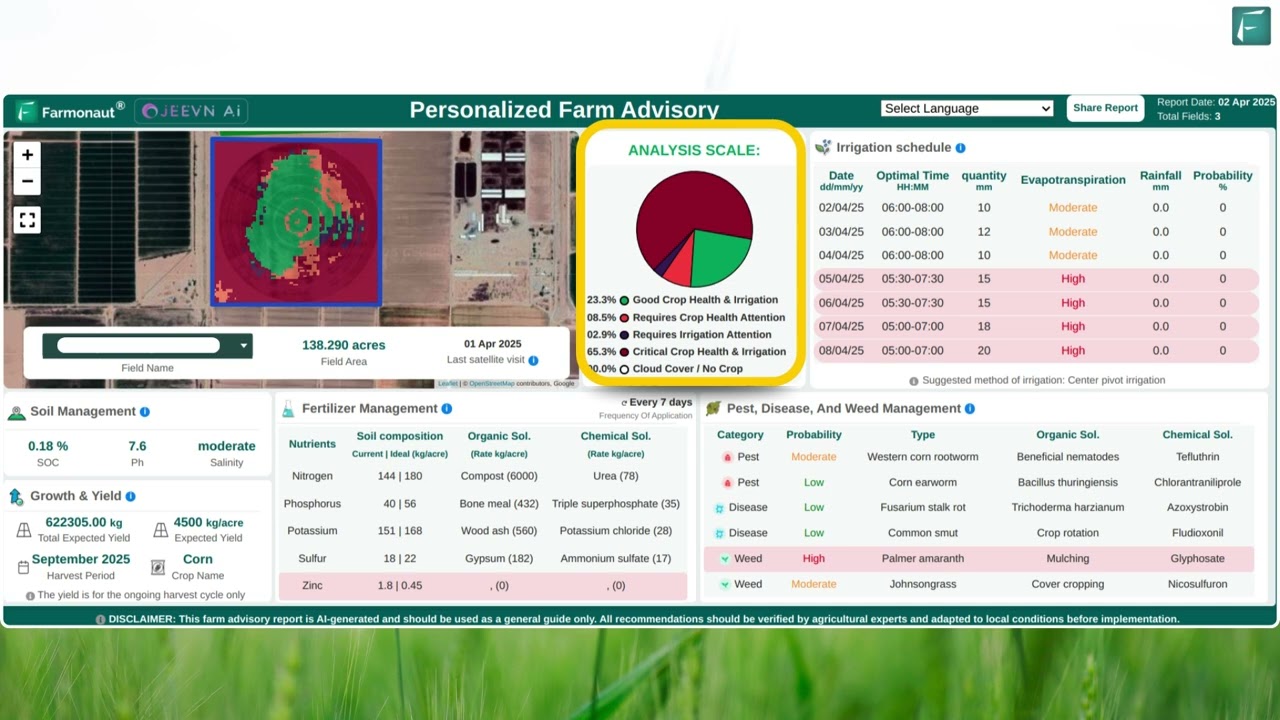
- Satellite-Based Monitoring: Real-time insights into crop health, soil moisture, and environmental conditions using NDVI and multispectral imaging.
- Jeevn AI Advisory System: Real-time, hyperlocal weather, crop, and resource guidance for smarter, more precise farming and marketing strategies.
-
Blockchain Traceability: End-to-end tracking for agri products, ensuring supply chain authenticity and transparency.
Learn more: Farmonaut Traceability Product Page -
Resource & Fleet Management: Manage vehicles, equipment, and operational logistics at scale.
Discover benefits: Farmonaut Fleet Management Solution -
Environmental Impact Tracking: Monitor and communicate carbon footprints, supporting compliance and market differentiation.
Explore carbon solutions: Carbon Footprinting for Agriculture & Mining -
Satellite-driven Verification for Financing: Enable banks and insurance to automate loan approvals and risk assessment.
See product page: Farmonaut Crop Loan & Insurance - Scalable Digital Access: From small farmers with limited resources to large government programs, our modular platform and subscription model offer flexibility and cost efficiency.
-
API Access for Developers: Integrate our satellite imagery, analytics, and real-time monitoring into your own agri products.
See developer resources: Farmonaut API & Developer Docs
Our platform is available on web and mobile, supporting users worldwide.
Driving Digital Access, Inclusivity, and Infrastructure in Agri Food Marketing
Ensuring equal access and inclusivity is one of the most critical challenges in the modernization of agri food marketing. Smallholder farmers, especially in emerging regions, may face hurdles in adopting the latest digital infrastructure and AI-driven platforms. Here’s how the sector is evolving:
- Mobile-First Approach: Lowering barriers for technology adoption by prioritizing mobile apps, SMS-based tools, and simple user interfaces.
- Farmer Training and Extension Services: Digital learning modules and advisory platforms allow farmers to upgrade skills and access critical market information remotely.
Explore: Farmonaut’s digital advisory and training tools - Rural Infrastructure Investment: Governments and NGOs are incentivized to expand internet, electricity, and device access.
- Digital Cooperatives: Farmer groups and collectives use digital tools to synergize bulk sales, negotiate better pricing, and access markets formerly out of reach.
The success of next-generation agricultural products marketing will depend on leveling the playing field for all producers, regardless of scale or geography.
Conclusion: Navigating the Road Ahead in Agri Food Marketing
By 2026, agri food marketing represents a seamless blend of the traditional and the technological, balancing local identity and global trends, and driven by the dual imperatives of profitability and sustainability. Brands and marketers that invest in digital integration, transparency, consumer engagement, and verifiable eco-practices will not simply survive but thrive.
- Layering digital intelligence over every phase of the agricultural products marketing chain is now essential—not optional.
- Agility in adopting new tools, channels, and models will separate front-runners from laggards.
- Staying informed via authoritative resources—like agri marketing magazines, information platforms, and trusted technology providers—is vital for continuous growth.
Farmonaut is committed to enabling this transition with affordable, scalable, and transparent digital solutions for today’s and tomorrow’s agri food ecosystem.
FAQ: Agri Food Marketing & Digital Trends 2026
-
What is agri food marketing, and how is it evolving for 2025–2026?
Agri food marketing involves strategies for promoting and selling agricultural products. By 2026, it will be deeply integrated with AI-powered analytics, digital platforms for broader reach, and strong sustainability narratives to meet changing consumer (consumer preferences, transparency, traceability) and regulatory expectations.
-
How does AI change agricultural products marketing?
Artificial Intelligence (AI) enables precise market segmentation, demand forecasting, campaign personalization, supply chain optimization, and real-time adaptation by leveraging continuous streams of data.
-
Why is blockchain traceability important in agri food marketing?
Blockchain ensures tamper-proof records of a product’s journey from farm to table. This fosters transparency, protects brand authenticity, and appeals to environmentally and ethically conscious consumers.
-
What are the biggest challenges for farmers in digital marketing?
The largest hurdles are digital infrastructure gaps, access to training and devices, understanding of digital marketing channels, and managing price volatility. Mobile-first solutions and digital literacy programs help address these barriers.
-
What is Farmonaut’s role in this landscape?
Farmonaut provides satellite-driven, AI-enabled tools for resource monitoring, blockchain-based traceability, environmental impact assessment, and advisory systems—empowering farmers, businesses, and governments with actionable insights and improved market access.
-
Which digital platforms are most critical for agricultural products marketing?
E-commerce portals, social media, mobile apps, and integrated AI/analytics platforms are essential for reaching a global audience, optimizing pricing strategies, and engaging consumers with compelling, transparent storytelling.
-
How can smallholder farmers benefit from digital trends?
With the right tools—affordable apps, SMS advisory, shared platforms, and access to AI-driven data—smallholder farmers can reach new markets, improve resource management, gain better bargaining power, and secure financial and insurance services.
Explore more about digital, sustainable, and transparent agri food marketing for 2026 and beyond with Farmonaut’s latest insights and technologies.
Empower your operation with the future of agricultural innovation!
Discussion
Questions, corrections or field experience? Share them below. First-time comments are reviewed before they appear, and your email is never published.
No comments yet. Be the first to add a question or your experience.

 Sama Premium
 Mahaswami
 Prochecker
 Tres Valles
 LACOS Geoinformation
 Pulsar Supernova
 Magrifly
 LatConnect 60
 WebsEdge
 Blickwinkel
 Agricultural Credit Policy Council
 MCSOD
MCSOD Marei Nursery
 eKGIS
eKGIS Mostas Tech
 Andex
Andex FCF India
 Unifrutti Gulf
 Deluxe Conseil
 Licence holder · Niger · Gold
 Licence holder · Nigeria · Gold + lithium










