

Reviewed September 2026 against USDA Farm Service Agency lending rate notices, AgDirect published rate tables, and University of Illinois farmdoc daily machinery cost analysis.
Try it: Run your own numbers →
An agricultural equipment credit line is a revolving facility that lets a farm operation draw funds as needed, up to a set limit, rather than receiving one lump sum. As of September 2026, commercial equipment lenders like AgDirect price these facilities from 6.50% for loans of $250,000 or more up to 7.95% for loans between $5,000 and $24,999, while USDA Farm Service Agency direct loans run separately at 5.125% for Operating Loans (January 2025 rate) and 5.500% for Ownership Loans (February 2025 rate). This guide compares the two paths, walks through five concrete benefits, and gives you a way to time your draws and repayments against your own planting and harvest cash flow.

Understanding Agricultural Equipment Credit Lines
An agricultural equipment credit line — also called an agricultural line of credit or simply agricultural equipment credit — is extended by commercial lenders, equipment manufacturers’ captive finance arms, and government-backed programs to support farm operations. Unlike a term loan, which disburses a fixed amount upfront on a fixed schedule, a credit line lets the borrower draw funds as needed up to a pre-approved limit, repay, and draw again.
Key Characteristics
- Revolving structure: Draw, repay, and re-borrow within the approved limit without reapplying each time.
- Seasonal alignment: Draws can be timed to input purchases and planting, with repayment concentrated after harvest revenue arrives.
- Tiered pricing: Rates typically scale with loan size — AgDirect’s September 2026 published table runs from 7.95% on the smallest tier ($5,000–$24,999) down to 6.50% on loans of $250,000 or more.
- Down payment range: AgDirect equipment financing requires 0–30% down as of September 2026, depending on equipment age, borrower history, and loan-to-value.
- Broad equipment scope: Tractors, combines, planters, irrigation systems, sprayers, and precision-ag hardware all qualify under most programs.
Rate & Term Comparison: FSA vs. Commercial Equipment Financing
The two most-cited financing paths for US farm equipment purchases are USDA Farm Service Agency (FSA) direct loans and commercial equipment financing such as AgDirect. They serve different purposes: FSA loans are federally administered, income- and eligibility-gated, and carry longer terms; commercial equipment credit lines are faster to access, tier-priced by loan size, and built around revolving draws rather than one disbursement.
| Financing Type | Rate (as published) | Typical Term | Down Payment | Source & Date |
|---|---|---|---|---|
| USDA FSA Farm Operating Loan | 5.125% | Up to 7 years | Set by eligibility review | USDA FSA, January 2025 |
| USDA FSA Farm Ownership Loan | 5.500% | Up to 40 years | Set by eligibility review | USDA FSA, February 2025 |
| AgDirect equipment financing, $250,000+ | 6.50% starting rate | Varies by equipment/collateral | 0–30% | AgDirect, September 2026 |
| AgDirect equipment financing, $5,000–$24,999 | 7.95% | Varies by equipment/collateral | 0–30% | AgDirect, September 2026 |
Read the source directly rather than relying on a cached number: USDA publishes updated FSA rates on the first of most months at USDA Farm Service Agency’s lending rate announcements, and full program terms — including the 7-year Operating Loan and 40-year Ownership Loan repayment windows — are documented at FSA’s guaranteed farm loans page. AgDirect updates its tiered commercial rates quarterly at AgDirect’s rate table; because rates there change seasonally, note your date of access when you compare quotes.
Why Machinery Costs Are Driving Demand for Credit Lines
Equipment credit demand tracks equipment cost inflation directly. University of Illinois farmdoc daily reports that machinery costs on US grain farms reached $171 per acre in 2024, and that the price of a 200-horsepower tractor rose 287% between 1990 and 2024. More immediately, machinery costs on grain farms climbed 25% between 2021 and 2024 alone — a three-year jump that outpaces most operating budgets’ capacity to absorb from cash flow.
- Capital scale: A $171-per-acre machinery cost on a 1,000-acre operation is $171,000 a year in equipment-related expense alone — well above what most operating budgets can fund without financing.
- Cash flow timing: Equipment purchases cluster before planting; revenue arrives after harvest. A revolving line lets a farm draw for the input purchase and repay on the operation’s own calendar instead of the lender’s.
- Repair vs. replace pressure: As covered under maintenance below, rising repair costs push some operators toward financing newer equipment instead of continuing to repair aging machines.
Full methodology and the underlying USDA price-index basis for these figures are in farmdoc daily’s October 2025 machinery cost analysis.

1. Enhanced Farm Productivity Through Modern Equipment
Access to current-generation equipment — GPS-guided tractors, precision seed drills, variable-rate applicators — improves both field efficiency and yield outcomes. An equipment credit line makes that access possible for operations that would otherwise have to defer a purchase for several seasons while cash reserves rebuild. Given that a 200-horsepower tractor now costs 287% more than it did in 1990 (farmdoc daily, 2024 basis), financing is often the only realistic path to a timely upgrade rather than a multi-year deferral.
- Precision fieldwork reduces input waste and improves per-acre output consistency
- Timely planting and harvest equipment reduces losses tied to weather-window misses
- Financing spreads the $171-per-acre machinery cost burden across the equipment’s productive life instead of concentrating it in one cash-strapped season

2. Financing Flexibility Tailored to Planting and Harvest Cycles
Unlike a term loan with a fixed monthly schedule regardless of season, an agricultural equipment credit line lets a borrower draw for an input or repair when the need arises and repay when harvest revenue lands. This is the direct answer to how timing of draws and repayments should align with planting and harvest cycles: draw during the pre-planting and in-season windows when equipment and input costs hit, and concentrate repayment in the post-harvest window when grain or livestock revenue is realized.
- Draw for spring equipment purchases or repairs ahead of planting
- Make interest-only or minimum payments through the growing season
- Repay principal from post-harvest revenue, then re-borrow the following cycle
FSA Operating Loans are built around a similar logic at the federal level — repayment terms run up to 7 years, structured so annual payments can track expected income rather than a flat amortization schedule (USDA FSA, 2025). Commercial revolving lines replicate that same cash-flow logic but with faster access and no federal eligibility review.
Need to track equipment usage and location once it’s financed? See how Farmonaut Fleet Management uses satellite monitoring to track utilization and reduce operating costs on financed machinery.
Building financial technology that needs live field data? The Farmonaut API and its developer documentation support integration with satellite and weather data for lenders and fintech platforms.

3. Enabling Technological Adoption and Innovation
Precision-ag hardware — GPS auto-steer, sensor-based irrigation controllers, drone sprayers — carries the same cost inflation pressure documented above, and credit lines are frequently the mechanism that gets this equipment onto mid-size operations rather than only the largest farms.
- GPS-guided tractors, automated planters, and sensor-based irrigation reduce input usage and improve field precision
- Drone-based scouting and spraying equipment becomes accessible when spread across a revolving line rather than a single upfront payment
- Product traceability tools integrate with newly financed equipment to document production practices for both buyers and lenders
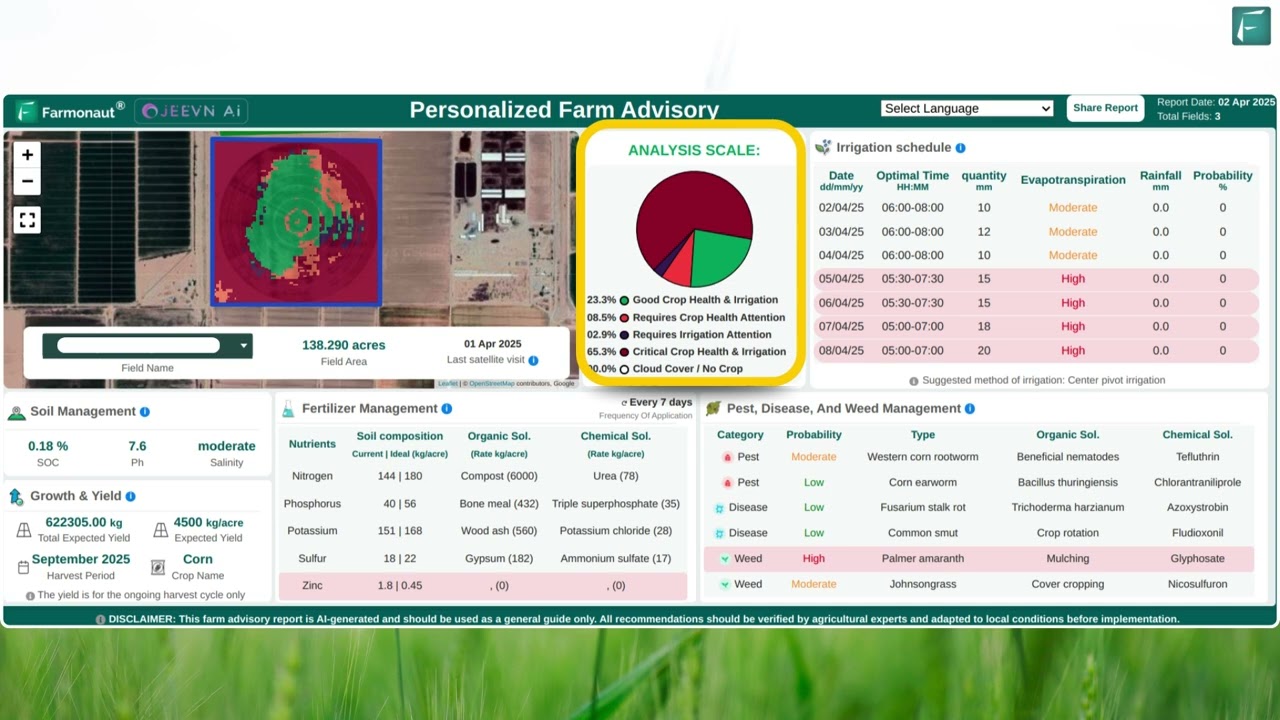
Some lenders offer preferential terms tied to lower-emission or resource-efficient equipment purchases; where that applies, tools like carbon footprinting can help document the practice change a lender or buyer is asking to see.
4. Maintenance Cost Control and Resource Management
This is where financing intersects directly with repair economics. Bureau of Labor Statistics data, reported via Investigate Midwest, shows agricultural machinery repair costs rose 41% between 2020 and 2024. Separately, the Public Interest Research Group found that farms lose an average of $3,348 per year to equipment downtime and repair-related restrictions, while preventive maintenance programs can cut those costs by 12–18% compared with a purely reactive repair approach.
This is the direct case for regular maintenance on financed equipment: a $3,348 average annual downtime cost, combined with a 41% rise in repair pricing since 2020, means deferred maintenance on a newly financed machine erodes the value of the financing decision itself. A credit line can also fund the maintenance and repair side directly — a lower-cost draw against the same facility rather than a separate loan — which keeps the 12–18% preventive-maintenance savings achievable instead of deferring repairs until a breakdown forces an expensive emergency draw.
- Use minor draws against the line for scheduled maintenance rather than letting service intervals slip
- Track machine hours and service intervals digitally so draws are timed to manufacturer schedules, not breakdowns
- Budget for the 41% repair cost increase since 2020 when comparing “repair the old unit” against “finance a replacement”



Planning maintenance and resource use across multiple fields or a fleet of financed machines? The Farmonaut Agro Admin App supports multi-field monitoring and resource planning for larger operations managing equipment acquired via credit lines.
5. Mitigating Financial and Climatic Uncertainties
A credit line’s revolving structure means funds are available for an urgent repair or replacement without a fresh loan application after a breakdown, drought, or flood damages equipment or delays field operations.
- Quick access to funds for backup machinery or emergency irrigation repairs
- Draws can cover a repair even mid-season, when a term loan’s underwriting timeline would cost a planting or harvest window
- Limits can sometimes be temporarily raised for a documented emergency need, subject to lender approval

This matters most for small and mid-size operations with limited collateral, where an idle combine during harvest or a failed irrigation pump during a dry spell translates directly into lost revenue. Satellite-based asset verification can also support faster underwriting in these situations — see Farmonaut’s Crop Loan and Insurance solutions for how field and crop status data can back a financing or insurance claim.
Draw Timing Calculator: Match Repayments to Your Cycle
Use the calculator below to see how a draw against an equipment credit line compares in interest cost at the AgDirect commercial tiers versus the FSA rates cited above, based on how many months you carry the balance before your harvest-season repayment.
Run your own numbers
Assumptions: simple interest on the financed balance only, no compounding, no fees or origination charges included. This estimates interest cost for a single draw-to-repayment cycle; it does not model a multi-draw revolving balance across a full season or amortizing term-loan payments. Confirm actual pricing and fee structure with your lender before relying on this for a financing decision.
A Note on Florida and Regional Equipment Financing
Equipment financing terms are not published on a state-by-state basis by USDA or by commercial lenders like AgDirect — both price nationally by loan size tier rather than by region, so a Florida operation sees the same 6.50%–7.95% AgDirect tiers and the same 5.125%/5.500% FSA rates as an operation in Iowa or Kansas. Regional or state-specific rate differences, where they exist, come from local Farm Credit System associations and community ag lenders, which set their own pricing by charter territory rather than through a centralized published table. If you need financing terms specific to a Florida operation, the most direct path is a rate quote from your regional Farm Credit association or a direct comparison against the national AgDirect and FSA figures above.
Challenges and Considerations
Equipment credit lines are not without friction points:
- Rate tiering by loan size: Smaller draws carry higher rates — AgDirect's 7.95% tier applies to loans as small as $5,000, nearly 1.5 percentage points above the $250,000+ tier's 6.50% starting rate (AgDirect, September 2026). Sizing your request matters.
- Down payment variability: AgDirect's 0–30% down payment range means the actual cash required upfront depends heavily on equipment age and borrower history — get the specific figure in writing before committing.
- Collateral requirements: Most equipment credit lines are secured by the equipment itself or other farm assets; a thin asset base can constrain the limit a lender offers.
- FSA eligibility review: Federal Operating and Ownership Loans carry lower headline rates (5.125%/5.500%) but require an eligibility and income review that commercial equipment financing does not.
- Administrative upkeep: A revolving line still requires monitoring — tracking the outstanding balance against the limit and matching draws to a repayment plan you can actually meet from harvest revenue.
How Farmonaut Supports Equipment Verification and Fleet Management
As a satellite technology company, Farmonaut supports farmers, agribusinesses, and financial institutions with tools that complement equipment financing decisions:
- Satellite-based crop monitoring: Multispectral imagery tracks vegetation health and soil moisture, helping operators judge whether financed irrigation or spraying equipment is delivering the expected return.
- AI-powered advisory: JEEVN AI provides field-level insights and weather forecasts that support decisions about when to draw on a credit line for a repair or upgrade.
- Fleet and resource management: Track location and utilization of equipment acquired through financing — useful both for the operator and for a lender verifying asset use.
- Traceability and carbon footprint tracking: Support documentation for sustainability-linked financing terms where a lender offers preferential pricing tied to lower-emission or resource-efficient equipment.
These tools are available via web, Android, and iOS, as well as via API for institutions building their own verification workflows.
Frequently Asked Questions
-
What is the current interest rate on agricultural equipment credit lines?
Commercial equipment financing rates vary by loan size. As of September 2026, AgDirect's published table starts at 6.50% for loans of $250,000 or more and runs up to 7.95% for loans between $5,000 and $24,999. USDA FSA direct loans, which follow separate federal eligibility criteria, were priced at 5.125% for Farm Operating Loans (January 2025) and 5.500% for Farm Ownership Loans (February 2025). Both sets of rates update on a regular schedule — check AgDirect's rate page and USDA FSA's lending rate announcements for the current figures before applying.
-
How is an agricultural equipment credit line different from a term loan?
A term loan disburses a fixed lump sum on a fixed repayment schedule. A credit line is revolving: draw what you need, repay, and draw again within your approved limit, without reapplying for each transaction.
-
How should I time draws and repayments around planting and harvest?
Draw for equipment purchases, inputs, or repairs ahead of or during the planting season, when cash outlay is highest and revenue hasn't arrived. Concentrate repayment in the post-harvest window once crop or livestock revenue is realized. FSA Operating Loans structure their up-to-7-year terms around a similar seasonal repayment logic (USDA FSA, 2025); a revolving commercial line lets you replicate that same timing with more flexibility on the draw side.
-
What down payment should I expect on agricultural equipment financing?
AgDirect's published range as of September 2026 is 0–30%, depending on equipment age, condition, and the borrower's credit and payment history. Get the specific percentage in writing for your situation before committing to a purchase.
-
Does regular maintenance actually reduce equipment costs, and by how much?
Yes, and the figures are specific: farms lose an average of $3,348 per year to equipment downtime and repair-related restrictions (Public Interest Research Group, 2023), while a preventive maintenance approach can cut costs 12–18% compared with reactive repair. Given that agricultural machinery repair costs rose 41% between 2020 and 2024 (BLS, via Investigate Midwest), staying ahead of scheduled maintenance protects the return on financed equipment more than it did five years ago.
-
Is there equipment financing specific to Florida or other individual states?
Neither USDA FSA nor major commercial lenders like AgDirect publish state-specific equipment financing rates — pricing is set nationally by loan size tier. State or regional variation typically comes through local Farm Credit System associations, which price by charter territory; contact your regional association directly for Florida-specific terms.
-
What can I purchase with an agricultural equipment credit line?
Tractors, combines, planters, irrigation systems, sprayers, and precision-ag hardware such as GPS guidance and sensor systems typically all qualify under both FSA and commercial equipment financing programs.
-
Can I manage financed equipment digitally once I've acquired it?
Yes. Fleet and resource management platforms, including Farmonaut's, track location, utilization, and maintenance scheduling for machinery acquired through financing — useful for both the operator and any lender monitoring the financed asset.

Conclusion
Agricultural equipment credit lines exist to solve a specific, quantifiable problem: machinery costs that rose 25% on US grain farms between 2021 and 2024 alone, against operating budgets that can't absorb a $171-per-acre cost jump in a single season. The choice between a revolving commercial line — priced 6.50% to 7.95% depending on size at AgDirect as of September 2026 — and a federal FSA Operating or Ownership Loan at 5.125% or 5.500% comes down to speed of access versus eligibility review and term length.
The durable method here doesn't expire when these specific rates change: check the loan-size tier your draw falls into, compare that tier's rate against the current FSA rate for your loan type, size the down payment against the 0–30% range, and time your draw-to-repayment window to your actual harvest revenue date rather than a lender's default schedule. Revisit the source pages linked throughout — FSA's monthly rate notices and AgDirect's quarterly table — each time you're sizing a new draw, since both change on a predictable schedule but not a fixed number.
Farmonaut supports this decision-making with tools that complement credit-driven equipment investments: carbon footprinting, product traceability, and fleet management for tracking and verifying equipment once it's financed.
Ready to monitor your fields and manage financed equipment with satellite-driven data? Try the Farmonaut app:
Agricultural Equipment Credit Lines: Rates, Terms, and a Method You Can Reuse Every Season.

 Godrej Agrovet
 Hayleys Agriculture
 Linx Agritech
 Adinet
 Save Your Soils
 GalaxEye Space
 Grandstream Algérie
 XOS Realty
 Geospatial Lab Africa
 Agro La Gándara
 HIPSAC
 ZOL Zimbabwe
 Juligerm
 AdBio
AdBio MISE Maroc
 NWNS
NWNS Red August Group
 Farm Inc
 WeMe Global
 Agrotoken
 Blue BearX
 Insignito
 DnCubed
 Indosistim Teknologi
 Liquify Digital
 CU Foods
 BeyondTech Global
 Rouge VC
 AgroRisk
 Oath Inc
 Esri North East Africa
 MDCV UK
 Etech Consulting Madagascar
 Vestlandsforsking
 WB Dev
 Sama Premium
 Tres Valles
 Blickwinkel
 Agricultural Credit Policy Council
 eKGIS
eKGIS Mostas Tech
 Andex
Andex Deluxe Conseil
 WICO
WICO Chimera Innovation
 SkyHarvest
 Teledarbas
 Exurbia Geospatial
 FieldZero
