

Agricultural Extension Services: 5 Examples & Initiatives (2025 & Beyond)
Meta Description: Agricultural extension services initiatives empower farmers in 2025 with sustainable practices, digital tools, and climate-resilient techniques. Explore five powerful agricultural extension services examples transforming global agriculture.
“Over 70% of farmers in 2025 accessed digital agricultural extension services for climate-resilient practices.”
Table of Contents
- Agricultural Extension Services in 2025: Empowering Farmers for Sustainable Growth
- The Role of Agricultural Extension Services
- Current Trends: Modern Agricultural Extension Service Initiatives (2025)
- Agricultural Extension Services Examples: 5 Initiatives
- Comparison Table of Agricultural Extension Service Initiatives (2025)
- Farmonaut & The Digital Revolution in Agriculture
- Challenges Facing Agricultural Extension Services
- The Future of Agricultural Extension Services: 2026 & Beyond
- FAQ: Agricultural Extension Services Initiatives
- Conclusion
Agricultural Extension Services in 2025: Empowering Farmers for Sustainable Growth
As we transition into 2026 and look back at the progress of the agriculture sector in 2025, it’s evident that agricultural extension services initiatives have evolved from their traditional role into modern, tech-enabled models. These initiatives have become the cornerstone for bridging the knowledge gap between research institutions and farming communities, equipping farmers with the latest sustainable practices, digital tools, and climate-resilient agriculture solutions.
Agricultural extension services today encompass a range of programs aimed at educating and empowering farmers, facilitating access to quality inputs, markets, and supporting livelihoods through technology and participatory approaches. In this blog, we explore the core role of modern extension, key agricultural extension services examples, emerging trends for 2026, and specific innovation drivers like Farmonaut’s digital solutions.



The Role of Agricultural Extension Services: Bridging Gaps & Empowering Communities
At its core, agricultural extension involves the transfer of knowledge, skills, and technologies from research institutions and government bodies to farmers and other rural stakeholders. The gap between innovation and adoption is often significant. Here, extension workers act as vital intermediaries, interpreting complex scientific findings and tailoring them as context-specific advice for local communities and field conditions.
- Disseminating new techniques: Extension makes modern cultivation techniques, improved crop varieties, and sustainable pest & disease management available to farmers.
- Enhancing resource conservation: Extension services train communities on water-conservation methods, soil health improvement, and resource management for resilient farming systems.
- Actor in rural development: By facilitating access to markets, credit, and quality inputs, extension empowers farmers to enhance productivity and household livelihoods.
- Responding to evolving challenges: The focus in 2025 and beyond is on climate change adaptation, digital transformation, and inclusive development in the agriculture sector.

Current Trends: Modern Agricultural Extension Service Initiatives (2025)
Contemporary agricultural extension services initiatives are driven by the urgent need for sustainability, digital innovation, and climate resilience. The integration of technology and inclusive policy reforms is rapidly changing how extension is designed and delivered.
Key Innovations Shaping Extension (2025 & 2026):
- Digital tools and platforms: The proliferation of smartphones, mobile apps, and improved network connectivity has enabled widespread access to personalized advisory services, real-time weather forecasts, and market information in even the most remote rural areas.
- Participatory approaches: Farmer Field Schools (FFS) and peer-to-peer groups emphasize collaborative, hands-on learning and encourage farmers to engage in integrated management and experimentation in their fields.
- Climate-smart extension: Extension services now prioritize climate change adaptation by introducing drought-tolerant crops, agroforestry systems, water harvesting, and conservation agriculture methods.
- Targeted inclusivity: Special attention is given to women and youth, recognizing their potential to drive the sector. Women-centric and youth-focused extension programs are removing systemic barriers and fostering rural entrepreneurship.
- Integration of advanced data: The adoption of AI-based advisory systems, remote sensing, and big data analytics is increasing the precision and relevance of extension recommendations.

Agricultural Extension Services Examples: 5 Impactful Initiatives in 2025
Let’s examine five transformative agricultural extension services initiatives from diverse regions. These examples illustrate the breadth of modern extension in empowering farmers with sustainable practices, digital access, and resilience-building tools for the changing climates of 2026 and beyond.
1. India’s e-Choupal: Digital Platform for Rural Empowerment
e-Choupal is a pioneering digital platform deployed across rural India that empowers farmers with real-time market prices, weather forecasts, crop management advice, and direct links to buyers—reducing dependency on intermediaries. By integrating mobile access and local language content, e-Choupal ensures that both smallholder and commercial farmers can make data-driven decisions. The facilitation of traceability and digital procurement further supports food system transparency and efficiency.
- Key focus: Sustainable market access, information dissemination, and resource management.
- Main activities: Digital kiosks, mobile alerts, crop advisory, weather updates.
- Target: Over 4 million farmers by end of 2025.
Explore blockchain-powered traceability systems to enhance supply chain transparency and food safety on your farm.

2. Kenya’s M-Farm: Mobile-Based Advisory for Smallholders
In Kenya, M-Farm provides smallholders with a mobile application delivering timely SMS alerts, interactive voice response (IVR) information, and peer-to-peer sharing on best practices, market prices, and crop management. Farmers can instantly check the best prices and connect with buyers directly from their fields, ensuring better income and reducing dependency on physical markets or middlemen.
- Key focus: Digital tools for market information, tailored pest and disease advice, and collaborative buying/selling.
- Main activities: App-based trading, mobile advisory, farmer forums.
- Impact: Impacted 1.2 million farmers as of 2025.
Understand how carbon footprinting tools support climate-smart agriculture by integrating satellite monitoring and resource management.

3. Nigeria’s N-Power Agro Extension Initiative: Climate Resilience Training
Nigeria’s N-Power Agro Extension Initiative, backed by both government and NGOs, focuses on empowering young people and women with training in climate-resilient agriculture. This program actively disseminates cutting-edge technologies and supports sustainable development in rural regions by providing training on climate-smart crop varieties, water harvesting, and integrated pest management.
- Key focus: Enhancing youth and women participation, climate adaption, and food system resilience.
- Main activities: Field demonstrations, mobile advisory, agri-entrepreneurship support.
- Impact: Over 2 million beneficiaries by 2025 across West Africa.
Unlock access to crop loan and insurance verification for digital extension in agricultural financial services.

4. Vietnam’s Digital Farmer Field Schools (FFS): Participatory Learning at Scale
Vietnam’s Digital Farmer Field Schools (FFS) model brings together intensive, hands-on training in integrated pest management, soil health, and water conservation with mobile-based learning modules. Incorporating digital tracking of field experiments and peer-to-peer knowledge exchange, this initiative is engaging thousands of rice and coffee growers in building more resilient, sustainable cropping systems.
- Key focus: Participatory education, technology adoption in integrated systems, water and pest management.
- Main activities: Interactive FFS groups, digital diagnostic tools, mobile learning.
- Impact: Improved practices among 750,000+ farmers, 18% reduction in pesticide use in target regions (by 2025).
Explore large scale farm management digital tools for efficient monitoring, planning, and advisory in field operations.
5. Brazil’s Agroclimatic Advisory System: AI-Driven Sustainable Decision Support
Brazil’s rapidly expanding Agroclimatic Advisory System leverages AI, remote sensing, and climate-data analytics to offer region-specific weather forecasts, pest alerts, and sustainable cropping advice. Delivered through smartphone apps and IVR, the system supports precision agriculture and resource optimization, reducing water use and input waste across large-scale and smallholder operations.
- Key focus: Sustainable production, AI-guided decision making, water and energy conservation.
- Main activities: AI-based advisories, remote environmental monitoring, risk management guidance.
- Impact: Over 1.8 million users; Up to 22% estimated reduction in water use on participant farms by end-2025.
Find out how satellite-based fleet management optimizes agricultural logistics, further contributing to sustainable sector growth.

“Five major global initiatives in 2025 focus on empowering farmers with sustainable farming techniques and resource management.”
Comparison Table of Agricultural Extension Service Initiatives (2025)
| Initiative Name | Country/Region | Focus Area | Main Activities | Estimated Number of Farmers Reached (2025) | Estimated Environmental Impact | Notable Outcomes |
|---|---|---|---|---|---|---|
| e-Choupal | India | Digital Tools, Market Access | Digital kiosks, weather & market info, traceability. | 4 million+ | 15% supply chain emissions reduction (est.) | Increased incomes & transparency in trade |
| M-Farm | Kenya | Mobile Advisory, Market Info | Mobile apps/SMS, pricing, buyer connections | 1.2 million | 8% reduction in food waste (est.) | Direct market linkages, reduced inefficiencies |
| N-Power Agro Extension Initiative | Nigeria/West Africa | Climate Resilience, Youth/Women Empowerment | Climate training, digital advisory, FFS, entrepreneurship | 2 million | 12% water conservation (est.) | New jobs, improved adaptive capacity |
| Digital Farmer Field Schools (FFS) | Vietnam | Participatory Learning, Integrated Management | FFS groups, digital tools, peer-to-peer learning | 750,000 | 18% pesticide reduction (est.) | Higher yields, safer practices, empowered communities |
| Agroclimatic Advisory System | Brazil | AI, Climate, Resource Optimization | AI-based advisory, big data analytics, water risk management | 1.8 million | Up to 22% water use reduction | Precision farming at scale, climate adaptation |

Farmonaut & The Digital Revolution in Agricultural Extension Services Initiatives
The transformation of agricultural extension services is impossible without embracing next-generation technology platforms. As a leading satellite technology provider, we at Farmonaut play an important role in supporting digital extension by enabling real-time crop monitoring, AI-powered advisory systems, blockchain-based traceability, and resource management for farmers, businesses, and governments around the globe.
- Satellite-based monitoring: Our platform delivers NDVI (vegetation health), soil conditions, and field analytics across any scale—helping farmers and extension services to tailor advice and act on time.
-
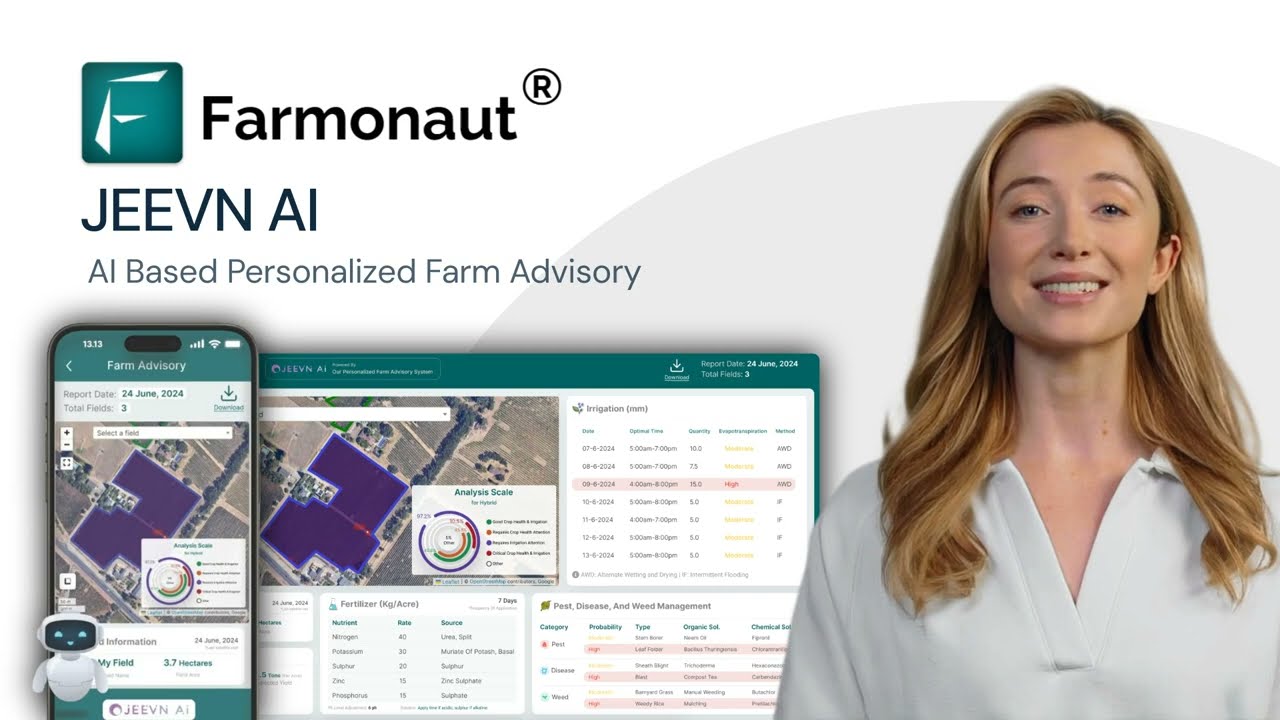
AI-based advisory: With tools like Jeevn AI, we deliver actionable insights for weather risk, precise input application, and climate adaptation directly to rural areas via our Android, iOS, and web apps.
Try Jeevn AI-powered farm advisory on your field today. - Blockchain traceability: We support supply chain management, ensuring food safety and transparency for farmers connected to modern extension systems (learn more about blockchain traceability).
- Environmental impact monitoring: Our platform enables easy carbon footprint tracking for agriculture, allowing digital extension programs to promote responsible, sustainable practices in resource management (see API use case).
- Fleet and resource optimization: With fleet management tools, we contribute to reduced emissions, efficient transport, and lower operational costs for growers and extension efforts.
Our solutions are designed to be cost-effective and scalable, making high-impact, digital extension accessible to even the most remote rural communities. For those who wish to integrate satellite advisory into existing agricultural extension services examples, our API and developer documentation are available for seamless third-party development.
Key Challenges in Agricultural Extension Services Initiatives (2025–2026)
Despite impressive advances, several challenges persist for agricultural extension service scalability, impact, and sustainability:
- Underfunding and human resource gaps: Many national extension services struggle with inadequate staffing and resources, limiting their capacity to reach remote areas.
- Last-mile delivery challenges: Bridging the gap between research and farmers in isolated or marginalized communities remains difficult despite increased network connectivity.
- One-way communication: Legacy systems often prioritize top-down information dissemination over demand-driven, two-way knowledge exchange.
- Gender and youth inclusion: Cultural and practical barriers continue to limit access to training, markets, and technology for women and rural youth.
- Climate emergencies: Increasingly erratic weather, pest outbreaks, and natural disasters place more pressure on agricultural extension services initiatives to deliver up-to-date adaptive solutions.
- Integration of advanced technologies: Digital transformation is uneven due to cost, infrastructure, digital literacy, and language constraints.
Innovative approaches such as ongoing professional development for extension workers, multi-stakeholder partnerships, and two-way community feedback are helping to address these obstacles. Integrating environmental impact tools and big data platforms—like those from Farmonaut—is also empowering rapid scalability and context-specific recommendations.
The Future of Agricultural Extension Services: From 2026 Onwards
Looking to 2026 and beyond, agricultural extension service models are expected to become more integrated, digitally driven, and inclusive:
- Hyper-personalized, data-driven advice: AI-based platforms, IoT sensors, and satellite monitoring (like those provided by Farmonaut) will further tailor recommendations to the field, crop, and community levels.
- Real-time climate risk management: Digital alerts and predictive analytics will identify threats early, enabling farmers to act quickly to protect their livelihoods.
- Community-driven approaches: Farmers will be increasingly empowered as co-designers and evaluators of extension content, ensuring local adaptation and greater trust.
- Environmental accountability: Carbon footprint tracking, resource-use optimization, and blockchain-enabled traceability will become fundamental for market access and sustainability standards.
- Universal access via mobile and web: Language localization, app-based services, and affordable technology (see Farmonaut apps for all devices) will continue to break down barriers.
- Extension as a driver of rural transformation: With renewed investment and innovation, extension will be central to realizing the goals of food security, climate adaptation, and rural prosperity.
The integration of API-based, modular digital advisory services into national and private agricultural extension systems will further accelerate this transformation.
FAQ: Agricultural Extension Services Initiatives
1. What are agricultural extension services initiatives?
Agricultural extension services initiatives are structured outreach programs that connect farmers and rural stakeholders to the latest research, technologies, skills, and market information. They aim to facilitate knowledge transfer, technology adoption, and community empowerment for sustainable agricultural growth.
2. Why are digital tools important in agricultural extension services examples?
Digital tools—such as mobile apps, IVR systems, and AI-driven advisory—enable real-time access to climate, pest, and market information, especially for farmers in remote areas. They increase inclusion, reduce costs, and tailor recommendations, making extension more responsive and scalable.
3. How do extension services support climate-resilient agriculture in 2025?
Extension services support farmers in adopting climate-resilient practices by delivering training in drought-tolerant crops, water conservation, agroforestry, and integrated pest management. They also provide risk alerts and adaptation advice through digital platforms and participatory learning groups.
4. What is the role of Farmonaut in agricultural extension service transformation?
We at Farmonaut empower digital extension by providing real-time satellite crop monitoring, AI-based advisory, blockchain traceability, and environmental impact tools that extension networks, farmers, and governments can access across devices and via APIs.
5. Are women and youth included in extension initiatives?
Yes, modern agricultural extension services initiatives design targeted programs for women and youth, ensuring they access resources, training, credit, and leadership development, thus promoting inclusive and equitable rural growth.
6. How can I access Farmonaut’s digital extension solutions?
Choose your preferred platform:
Farmonaut Web App,
Android App,
iOS App, or directly integrate our
API into your advisory systems.
Conclusion: Sustainable Agricultural Growth through Extension (2025–2026)
In the evolving landscape of global agriculture, agricultural extension services initiatives are more crucial than ever for empowering farmers, supporting sustainable practices, and fostering resilient food systems. With technology, inclusivity, digital platforms, and climate-smart approaches at their core, modern extension services continue to bridge gaps between research, policy, and rural communities.
As we at Farmonaut demonstrate, the power of satellite and AI-driven insights lies in making knowledge accessible, actionable, and impactful—helping the sector adapt to changing environments and achieve long-term growth.
- Extension is no longer static: It is dynamic, adaptive, and essential for meeting the food security and climate challenges of the years ahead.
- Digital transformation is key: Enabling all farmers, regardless of scale or geography, to be part of the next wave of agricultural sustainability.
- Partnerships and continuous innovation will keep extension relevant, effective, and scalable towards 2030 and beyond.
Explore Farmonaut’s digital extension solutions and developer tools to join the journey for sustainable agricultural growth today!

 Rashail Infotech
 Unifrutti Gulf
 Deluxe Conseil
 TVS Electronics
 BW Pipelines
 WICO
WICO Gen Chayat
 Chimera Innovation
 SkyHarvest
 Polaris Digitech
 Teledarbas
 Wild Oak Farm
 SFX
SFX Doodlakine
 Exurbia Geospatial
