

Agriculture Project Proposal for Funding: 10 Steps 2026
“Only 1 in 5 agriculture project proposals secure funding due to incomplete project design and unclear sustainability plans.”
Introduction: The Competitive Landscape of Agriculture Project Proposals
In 2026, the quest for funding for agriculture projects is a high-stakes, competitive endeavor. As global food demands and climate resilience dominate international agendas, a compelling agriculture project proposal for funding must blend innovation, practicality, and a results-driven framework that addresses rural development goals, environmental management, and farm profitability. Whether you’re a farmer’s cooperative, agribusiness, NGO, or government unit, understanding best practices in proposal writing is the critical first step to accessing resources and unlocking opportunities for sustainable agriculture.
Key requirements—from clear objectives, baseline data, robust management, and sustainability plans—now shape which projects secure investment. This comprehensive guide will equip you with actionable steps to craft a winning project proposal for agriculture that meets 2025–2026 expectations, ensures compliance with regional agricultural priorities, and delivers measurable social and environmental impact. Along the way, we’ll integrate digital innovations, highlight Farmonaut’s satellite-backed solutions, and provide expert tips to maximize proposal success.
“Proposals with detailed management strategies are 60% more likely to receive funding from agricultural grant agencies.”
1. Executive Summary: Your Project Proposal at a Glance
The executive summary is your project’s elevator pitch—short yet compelling, ensuring funders immediately grasp the core value proposition and the suitability of your agriculture project proposal for funding. This section should:
- Clearly define the project objective: Are you aiming to increase yields, reduce input costs, improve sustainability, or create value-added products?
- State location: Identify the region, country, or community where the initiative is grounded.
- Indicate scale: Provide acreage/hectares, production capacity, or number of intended beneficiaries.
- Highlight social & environmental outcomes: Quantify anticipated improvements—such as yield increases, income jumps, reduced chemical use, or job creation.
- Summarize your “ask”: Specify the total budget, funding requested (grant or loan), and projected return on investment—either financial, social, or environmental.
A strong executive summary instantly aligns your project proposal for agriculture with funders’ key goals—demonstrating that you’ve done your homework and ensuring your proposal is noticed first.
2. Problem Statement and Rationale
Here, establish the compelling need your agriculture project proposal for funding addresses by describing the current farming constraints in your local context. Tie your problem statement to national agricultural priorities and demonstrate, with hard data and qualitative insights, why intervention is crucial now.
Subsections to include:
- Describe problems: Are you facing low productivity, post-harvest losses, limited irrigation, pest pressures, or market access issues?
- Link to broader priorities: How does this align with regional or national interests: food security, rural job creation, youth engagement, or climate resilience?
- Provide evidence: Back your argument with baseline indicators—such as recent crop yields, production costs, or income levels. Use testimonials or local data where applicable (e.g., “Only 60% of irrigation needs are currently met.”)
A clear, data-driven problem statement lays the foundation for a practical, results-oriented intervention that will appeal to grant reviewers and funding agencies alike.
3. Project Design and Activities: From Seeds to Sustainability
In this pivotal section, lay out the technical approach of your project—detailing innovative solutions and best practices tailored to local conditions. The following elements must be addressed:
- Technical approach: Will you deploy improved seed varieties, precision irrigation systems, soil health management, integrated pest management, or value chain development?
- Phases & Timeline: Clearly define readiness, implementation, and post-implementation sustainability, attaching a realistic timeline (typically 24–36 months) with explicit milestones.
- Innovation & resilience: Factor in climate risk mitigation (e.g., drought-tolerant crops, disaster planning, crop diversification) and technologies that improve resource-use efficiency and sustainability.
A well-structured project design demonstrates technical feasibility, sets expectations, and builds confidence that your agriculture proposal will deliver the promised outcomes.

4. Market Access and Value Addition: Unlocking Profitability
To secure funding for agriculture projects, you must show that your project is market-responsive and designed for long-term farm profitability. This section focuses on:
- Market analysis: Who are your target buyers? What are the current demand trends, pricing, and competitors?
- Value chain interventions: Detail strategies for post-harvest handling, processing, improved storage, certifications (like organic or GAP), and establishing local or export market linkages.
- Revenue models: Will you use direct sales, contract farming, farmers’ cooperatives, or export networks? How will farmers or stakeholders capture additional value?
By addressing these questions, your project proposal for agriculture aligns resources and activities along the chain—for sustainable returns and scalable community impact.

5. Social and Environmental Benefits
Modern funders demand more than productivity—they want evidence that your initiative delivers social inclusion and fosters environmental sustainability. Key sections include:
- Social benefits: Document job creation, gender inclusion, youth participation, and plans for capacity building in your agriculture project proposal for funding.
- Environmental safeguards: Outline practices for soil health restoration, water management, reduced chemical/fertilizer use, biodiversity conservation, and compliance with environmental laws.
- Monitoring & indicators: Propose relevant key performance indicators such as yield per hectare, income uplift, water-use efficiency, and greenhouse gas accounted for (e.g., carbon footprint).
Highlight your commitment to a holistic development approach that recognizes the interconnectedness of people, profits, and the planet.

6. Technical Feasibility and Risk Management
Technical feasibility and proactive risk management are critical to convince funders your agriculture proposal is viable. This section must:
- Assess site/soil suitability: Analyze local soil and water resources, state any baseline limitations, and demonstrate appropriate adaptation measures.
- Identify technical partners: Extension services, research institutions, equipment/input suppliers should be included to support project success.
- Address risks: Present a risk matrix—the most likely threats (weather, market volatility, supply disruptions) and concrete mitigation strategies (insurance, diversified markets, adoption of climate-resilient varieties).
Pro Tip: Use digital large-scale farm management platforms for real-time monitoring and early warning systems to further strengthen your project’s resilience and attract investor confidence.
7. Project Management and Governance
Solid project management is essential for funding for agriculture projects. This section defines how activities will be overseen, managed, and reported. Include:
- Roles and responsibilities: Diagram a clear structure with implementation team, project steering committee, and inclusion of farmer representatives.
- Implementation plan and procurement strategy: Detail procurement processes, ensure compliance with local procurement laws, and describe how resources will flow efficiently to on-ground teams.
- Capacity building: Offer modules and training for farmers on optimal input use, record-keeping, financial literacy, and core sustainability practices.
A sound governance framework ensures transparency, boosts credibility with funders, and increases the likelihood of smooth project delivery.

8. Financial Plan: Making Every Rupee Count
Your financial plan is the backbone of a viable proposal. Provide clarity, accountability, and economic rationale for every resource requested:
- Detailed budget: Break down capital expenditures, operating costs, recurring vs. one-time expenses, and depreciation estimates.
- Funding sources: Specify sources besides the requested grant or loan (in-kind contributions, co-financing, blended finance models) to show the project’s leverage potential.
- Financial projections: Share cash flow forecasts, breakeven points, sensitivity analysis for risk, and if relevant, repayment terms.
- Economic viability: Illustrate expected productivity increases, input cost reductions, increased income, and anticipated returns.
By providing detailed, transparent numbers, you assure funders theirs will be a well-stewarded investment.



9. Monitoring, Evaluation, and Sustainability
Well-defined monitoring and evaluation (M&E) plans prove to funders you can measure success, learn, and adapt. This section should:
- Set baseline & endline indicators: Track yields, water use efficiency, carbon footprint, farmer income, or other relevant metrics aligned with project objectives.
- Describe data collection: Outline who will collect and analyze monitoring data, how often, and methods for periodic reporting.
- Plan independent verification: Consider third-party assessment at project close to validate results and extract lessons learned.
- Include exit strategy: Explain how project benefits will continue post-funding (e.g., handover to local cooperatives, maintenance plans, established supply chains).
Effective M&E is not just about reporting to funders—it’s about continuous improvement and maximizing impact for rural farming communities.
10. Compliance and Context for 2025 and Beyond
To succeed, your project proposal for agriculture needs to research and align with contemporary compliance standards, digital innovation, and local realities.
- Match national policies: Reference current agricultural, nutrition, and climate policies in your country or region to demonstrate strategic alignment with government and donor goals.
- Include digital tools: Wherever possible, leverage affordable digital technologies—such as satellite-based monitoring, blockchain traceability, and mobile advisory platforms—to simplify project management, data collection, and farmer advisory.
- Make accessible: Ensure all submission documents are user-friendly, translated where needed, and scalable for smallholder farming systems.
Step-by-Step Proposal Component Table
| Step Number | Proposal Component | Description | Importance Score (1-5) | Sample Content/Tip |
|---|---|---|---|---|
| 1 | Executive Summary | Concise overview covering objectives, scale, beneficiaries, funding ask, and impact | 5 | Summarize key metrics in a 1-page format; use striking outcome statements. |
| 2 | Problem Statement & Rationale | Clearly define the pressing challenge and its broader ramifications | 4 | Use local statistics and testimonials for credibility. |
| 3 | Project Design & Activities | Technical strategy, phases, timelines, and innovative methods | 5 | Divide activities by phase: preparation, implementation, post-project. |
| 4 | Market Access & Value Addition | Market analysis, value chain interventions, and projected revenue channels | 4 | Include buyer personas & potential sales channels. |
| 5 | Social & Environmental Benefits | Jobs, inclusion, capacity building, & sustainability safeguards | 4 | Quantify expected social and ecological gains. |
| 6 | Technical Feasibility & Risk Management | Site analysis, partnerships, risk matrix, and mitigation | 5 | Prepare a table of risks and countermeasures. |
| 7 | Project Management & Governance | Management structure, decision lines, training plans | 4 | Define a simple organogram and outline training topics. |
| 8 | Financial Plan | Budget breakdown, funding sources, projections, ROI | 5 | Attach a budget table and brief finance narrative. |
| 9 | M&E & Sustainability | KPIs, learning, reporting, and exit strategies | 4 | Line up indicators with baseline and target figures. |
| 10 | Compliance & 2025 Context | Policies, tech, inclusion, and digital enablement | 3 | Show alignment to policy and tech advances. |
Farmonaut: Driving Data-Driven Agriculture Projects
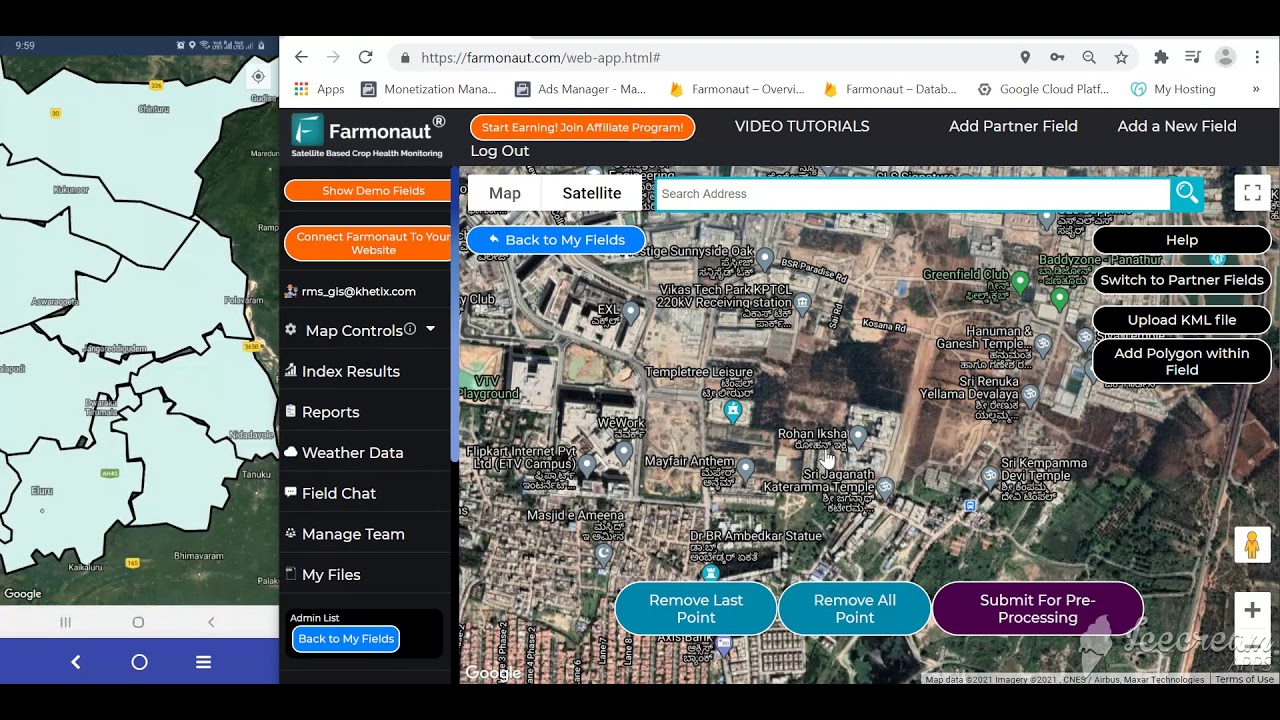
In crafting a project proposal for agriculture that meets 2026 requirements for market access, resource management, and climate resilience, digital platforms play a transformative role. Farmonaut, a leader in satellite-based agricultural monitoring, is at the forefront of these innovations, helping stakeholders maximize efficiency and sustainability.
- Real-time monitoring: Utilizing multispectral satellite imagery to track crop health, irrigation needs, soil conditions, and vegetation trends.
- AI advisory: Integrate AI-driven recommendations for irrigation, pest management, seasonal planning, and disaster mitigation with Farmonaut’s Jeevn AI system.
- Blockchain traceability: Secure product quality and market trust by integrating product traceability solutions in your value chain activities.
- Environmental impact tracking: Monitor sustainability metrics, including carbon footprint tracking, water stewardship, and compliance with environmental safeguards.
- Financing verification: Simplify loan/insurance access for farmers with satellite-based verification—see crop loan & insurance verification for more details.
- Fleet management: Optimize logistics with resource tracking and vehicle monitoring to reduce operational costs.
Farmonaut offers tools via web, Android/iOS app and API (API access, Developer Docs) for farmers, businesses, and government agencies managing large-scale or community-wide agriculture projects.

Key Insights & Pro Tips
✔ Key Benefits of Modern Agriculture Proposal Design
- 🌱 Improved yields and cost savings via tailored input management
- 📊 Data-backed risk reduction and early warning systems
- ⚡ Faster approvals from transparent, digital compliance methods
- 🤝 Inclusive capacity building for youth, women, and rural communities
- 🌍 Demonstrated environmental impact—from water savings to lower carbon footprints
🌟 Essential Features Funders Expect in 2026
- ✅ Clear objectives mapped to measurable outcomes
- ✅ Digital monitoring tools for real-time M&E
- ✅ Climate-smart strategies and mitigation planning
- ✅ Comprehensive financials with sensitivity analysis
- ✅ Local governance frameworks for lasting impact
- 📈 Strong data analysis with up-to-date baseline indicators enhances funding prospects.
- 🔎 Transparent procurement and logical implementation plans reduce delays and align with local laws.
- 🌐 Multi-channel market linkages (supermarkets, online, export) drive project sustainability.
- 💡 Inclusive capacity building programs help retain talent, especially among the youth.
- 🚀 Systematic use of blockchain or traceability debunks fraud and builds consumer confidence.
Frequently Asked Questions (FAQ)
-
Q: What is the most important part of an agriculture project proposal for funding?
The Executive Summary and Problem Statement are vital for initial screening, but success hinges on a balance between strong technical design, robust financial planning, and detailed monitoring and evaluation mechanisms—demonstrating both practical viability and measurable outcomes.
-
Q: What digital tools should I integrate for the 2026 funding context?
Use satellite-based monitoring for real-time crop status, blockchain-based traceability for secure value chains, and digital apps for monitoring, advisory, and reporting. Solutions like Farmonaut offer all these features in one platform.
-
Q: How do I ensure compliance and policy alignment?
Review and cite current national agricultural policies, climate commitments, and donor guidelines. Incorporate digital compliance tools and present them in your submission structure to ensure quick evaluation.
-
Q: Is it necessary to include environmental and social indicators?
Absolutely. Funders are increasingly focused on sustainability, gender/youth inclusion, waste reduction, and environmental monitoring; proposals without these components tend to score lower.
-
Q: Where can I get more resources for building project proposals?
Utilize digital agricultural monitoring and advisory apps (see Farmonaut’s mobile/web platform), access open datasets, and refer to guidelines published by leading donor agencies or governmental portals.
Conclusion: Building Proposals for a Profitable, Sustainable Farming Future
In summary, crafting a high-impact agriculture project proposal for funding in 2026 requires a systematic approach rooted in data analysis, digital innovation, and sustainability. With global shifts toward climate resilience, value addition, and inclusive rural development, projects must demonstrate both immediate returns and long-term impact.
Proposals should reflect a practical framework aligned with funder priorities, national/regional agricultural strategies, and community-driven goals. Integrating real-time satellite monitoring, blockchain traceability, and digital M&E strengthens compliance and transparency, key for successful funding outcomes. For farmers, agribusinesses, NGOs, and government agencies, this ten-step guide is designed to help maximize the viability, profitability, and durability of funding for farming projects in an increasingly competitive landscape.
Farmonaut stands as a neutral, educational provider of satellite-based agricultural intelligence, supporting the digital transformation that 2026’s funders demand. Whether optimizing crop health, tracking environmental indicators, or verifying resources for financing, these tools empower stakeholders to build smarter, more resilient farming systems for the decade ahead.
Start building your agriculture project proposal for funding today, and position your initiative at the forefront of sustainable, profitable, and impactful rural development.
Discussion
Questions, corrections or field experience? Share them below. First-time comments are reviewed before they appear, and your email is never published.
No comments yet. Be the first to add a question or your experience.

 Click2Cloud
 TVS Electronics
 BW Pipelines
 WICO
WICO Gen Chayat
 Chimera Innovation
 SkyHarvest
 Polaris Digitech
 Teledarbas
 Wild Oak Farm
 SFX
SFX BACF Africa
 Doodlakine
 Exurbia Geospatial
 FieldZero
 Indico Company
 Licence holder · Niger · Gold










