

Farm Record Keeping Software: Top Apps Compared
Reviewed August 2026 against USDA NASS (Census of Agriculture, Sheep and Goat Inventory) and USDA AMS pesticide recordkeeping guidance.
Try it: Estimated annual cost of manual record keeping →
Farming software for record keeping is a digital system that replaces paper logs and spreadsheets with a single record of field activity, livestock events, input use, and compliance documents. The best agriculture record keeping software lets you log an activity once — in a barn, a truck cab, or offline in a field with no signal — and have it sync into reports you can hand to a lender, an auditor, or an organic certifier. Below is a feature-by-feature comparison of seven farm record keeping apps, what USDA actually requires you to keep and for how long, and a calculator that estimates the hours a mid-size operation loses to manual bookkeeping.
What Counts as Agriculture Record Keeping Software
Agriculture record keeping software centralizes the records a farm is either required or expected to keep: crop inputs (seed, fertilizer, pesticide applications with dates and rates), field-level activity logs, livestock inventory and health events, labor and equipment hours, harvest and sales records, and any documentation tied to certification or insurance. Instead of a notebook in the truck and a separate spreadsheet at the kitchen table, one system holds the whole season and the whole herd.
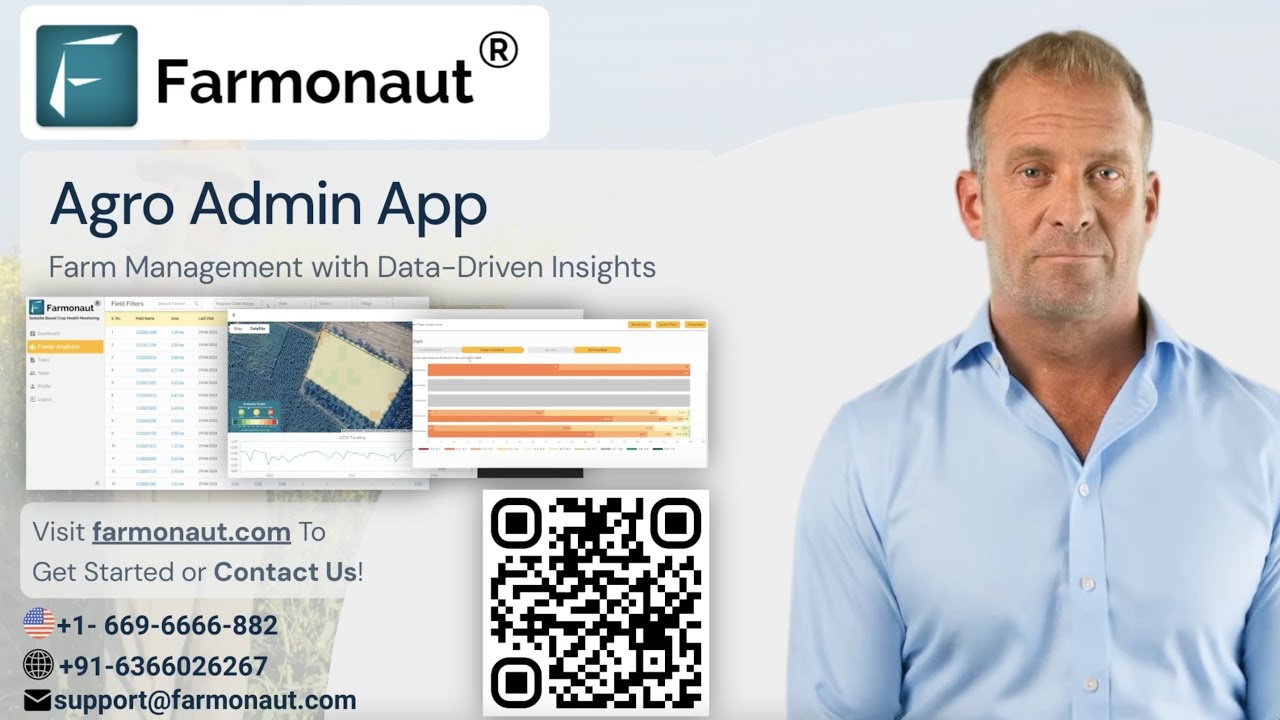
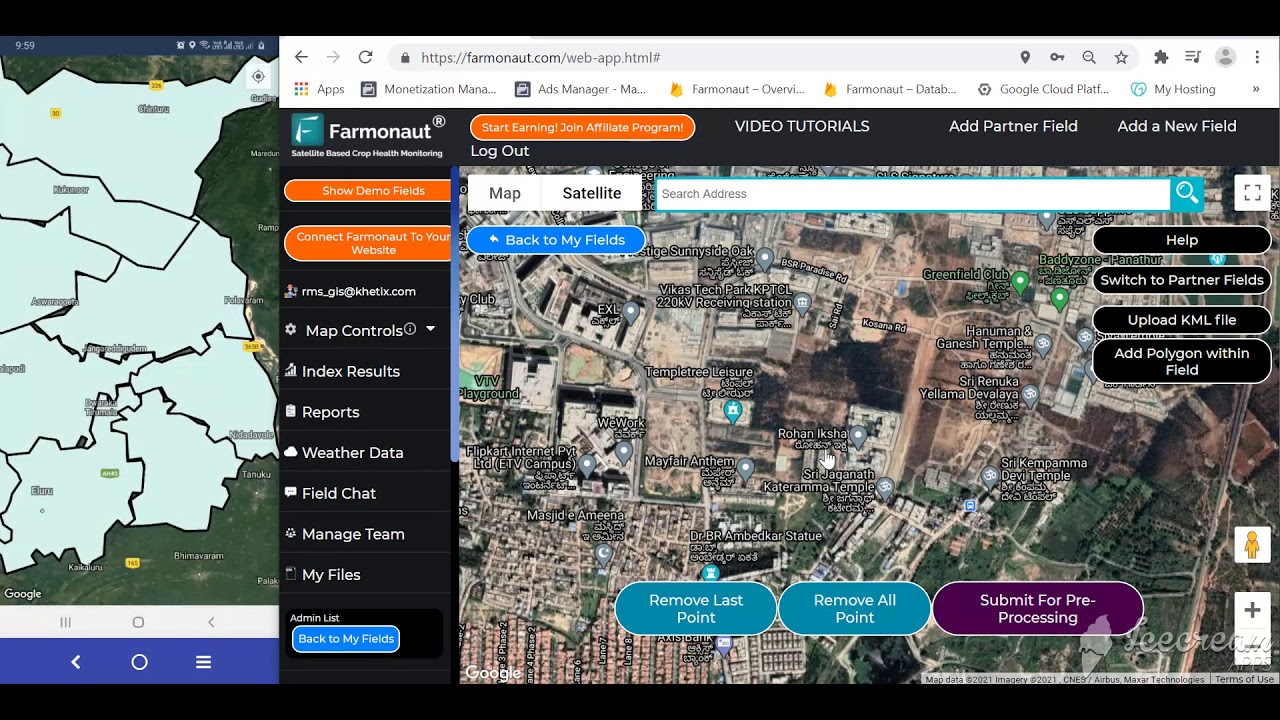
A related but distinct category is mapping software in agriculture, which layers satellite imagery, GIS, and sensor data onto field boundaries. Record keeping software tells you what happened and when; mapping software tells you where and shows you the field from above. The strongest farm management platforms — including several compared below — do both, so a spray record and the field it was applied to live in the same system.




Farms building their own workflow tools on top of satellite and weather data can pull it directly through Farmonaut’s API, with implementation details in the API developer documentation.
The Scale of US Farming: Why Records Matter
The 2022 Census of Agriculture, published by USDA’s National Agricultural Statistics Service (NASS), counted 1,900,487 farms operating across 880 million acres of farmland in the United States, for an average farm size of 463 acres. That census is conducted every five years, with the next full count due in 2027 — check USDA NASS’s Census of Agriculture directly for the current release. Every one of those operations, regardless of size, faces the same underlying problem: activity that happens across hundreds of acres or multiple pastures has to be captured accurately enough to survive an audit, an insurance claim, or a lender’s review.
A 2024 survey of agricultural software adoption found that 63% of farms were already using some form of farm management software, with cloud-based solutions holding a 65% share of that market. The same survey reported farms expect a minimum 3:1 return on investment before adopting new software — meaning a tool has to demonstrably save more in time, compliance risk, or input waste than it costs. That’s a useful bar to hold any app in the comparison table below against.
What Is Bookkeeping in Agriculture?
Bookkeeping in agriculture is the ongoing recording of a farm’s financial and operational transactions — input purchases, labor and equipment costs, sales, and the field or livestock activity tied to each one — kept in enough detail to reconcile with tax filings, loan applications, and any regulatory record a farm is required to produce. It differs from general small-business bookkeeping in one important way: agricultural records have to connect a transaction to a physical location and date (which field, which pasture, which animal group) because that link is what certifiers, auditors, and USDA program administrators actually check.
The clearest example of a hard legal requirement is pesticide application recordkeeping. Under the Federal Pesticide Recordkeeping Program, private applicators of federal restricted-use pesticides must retain application records — product, EPA registration number, application date, location, and rate — for a minimum of 2 years. That retention window is a floor, not a suggestion; several states layer additional requirements on top of it. Details are maintained by USDA AMS’s pesticide recordkeeping program, and it’s worth checking that page directly since state-level additions change independently of the federal floor.
Bookkeeping, in short, is the discipline; record keeping software is the tool that makes the discipline sustainable at farm scale instead of dependent on one person’s memory.
Feature Comparison: 7 Farm Record Keeping Apps
The table below compares seven agriculture record keeping apps on the criteria that actually differ between them: whether they handle livestock as well as crops, whether they work offline, what platforms they run on, and rough entry-level pricing. Pricing for third-party tools changes; treat these as starting-tier estimates to confirm on each vendor’s own site before buying.
| App Name | Key Features | Livestock Records | Offline Capture | Platform Availability | Est. Starting Price |
|---|---|---|---|---|---|
| Farmonaut | Satellite & AI crop monitoring, geospatial mapping, blockchain traceability, fleet and resource management | Basic (crop-focused) | Limited | Android, iOS, Web, API | From $19/mo |
| Trimble Ag Software | Field mapping, input tracking, crop planning, weather integration | No | Yes | Web, iOS, Android | From $25/mo |
| AgriWebb | Livestock and crop records, offline data capture, task scheduling | Yes — built for livestock | Yes | Web, iOS, Android | From $20/mo |
| Agworld | Farm planning, crop notes, agronomist collaboration, GIS mapping | No | Partial | Android, iOS, Web | From $16/mo |
| Cropio | Remote sensing, satellite image analysis, weather, yield forecast | No | No | Web | Custom quote |
| Granular | Comprehensive record keeping, financial analysis, operational reporting | No | Partial | Web, iOS | From $35/mo |
| Fieldmargin | Simple mapping, field notes, task management, GPS tracking | Basic | Yes | Android, iOS, Web | Free + $10/mo premium |
If your operation runs livestock, especially sheep, AgriWebb is the only tool in this table purpose-built for herd and flock records alongside crop data. If you’re managing large acreage with satellite-based field monitoring as the primary need, Farmonaut and Cropio lean that direction. Trimble, Agworld, and Granular are strongest for row-crop operations with heavier agronomic planning needs. Fieldmargin is the simplest entry point for a small or transitioning operation testing whether digital record keeping is worth the switch at all.

Sheep and Livestock Record-Keeping Requirements
Livestock record-keeping software needs to handle a different rhythm than crop software: births, deaths, breeding events, weight gains, and movements happen continuously rather than on a planting-to-harvest calendar. USDA NASS’s annual Sheep and Goat Inventory survey shows the scale involved: as of January 1, 2024, the United States held 5.03 million head of sheep and lambs, including 2.87 million breeding ewes. The 2023 lambing rate came in at 103 lambs per 100 ewes, and recorded sheep death loss for calendar year 2023 was 200,000 head nationally.
Every one of those figures — inventory, lambing rate, death loss — is exactly the kind of data point a sheep record-keeping system should be tracking at the flock level, not just the national level. A flock-level record that tracks lambing rate against the 103-per-100 national benchmark, or death loss against the national rate, turns a compliance chore into a management signal: a flock lambing well below 103 per 100 ewes, or losing sheep at a rate well above the national figure, is telling you something worth investigating. NASS republishes this survey every January; check USDA NASS’s Sheep and Goat Inventory survey directly for the current year’s figures.
For cattle, poultry, and goat operations, NASS publishes equivalent annual inventory surveys under the same Guide to NASS Surveys program — the same recordkeeping logic (track individual or group-level events, compare against the published national benchmark) applies regardless of species, even though this article’s cited figures are specific to sheep.
- Individual or group ID, breed, and acquisition date
- Breeding dates, lambing/calving/kidding outcomes, and weaning weights
- Health treatments, vaccinations, and any withdrawal periods before sale or slaughter
- Mortality date and cause, where known
- Movement between pastures or off-farm sales, with destination

Agriculture Traceability Software and Compliance
Traceability software extends record keeping one step further: it doesn’t just log what happened on your farm, it preserves a chain of custody as a product moves off-farm — batch or lot numbers, harvest or slaughter dates, and downstream buyers — so that a food safety recall or a certification audit can trace a specific unit back to its origin. Farmonaut’s approach uses blockchain-based logging so that record entries can’t be altered after the fact; details are at Farmonaut’s traceability solutions page.
The compliance case for traceability and record keeping software overlaps directly with the pesticide recordkeeping requirement discussed above: a 2-year minimum retention on federal restricted-use pesticide records, batch-linked to the field and crop it was applied to, is exactly the kind of record an inspector or certifier will ask to see on short notice. A digital system with search and date filters produces that record in minutes; a filing cabinet does not.
Farms also increasingly need to document environmental outcomes alongside compliance records — carbon sequestration estimates, input reduction, and water use — for supply-chain sustainability reporting. Farmonaut’s carbon footprinting tool and fleet management module extend the same record-keeping backbone to those use cases, so equipment hours and environmental metrics sit in the same system as pesticide and harvest logs rather than a separate spreadsheet.

Calculator: Hours Lost to Manual Record Keeping
USDA does not publish a national figure for hours spent per month on farm record keeping, so instead of guessing at one, this calculator lets you enter your own operation’s numbers — field count, herd/flock size, and your estimated minutes per manual entry — to see roughly how many hours a season of paper or spreadsheet record keeping costs you, and what a 3:1 return threshold (the minimum ROI farms expect from software, per the 2024 adoption survey) would mean in practical terms.
Estimated annual cost of manual record keeping:
Assumptions: this estimates only the time cost of manual re-entry and filing, not compliance risk, missed deadlines, or data-entry errors. It excludes software subscription cost itself — compare the estimated cost above against the starting prices in the feature table to judge payback. Field and herd counts are not used in the arithmetic; they’re there to help you judge whether your entry-count estimate is realistic for your operation’s size.
Adopting a Farm Record Keeping App: A Checklist
The specific hours farms spend on manual bookkeeping, and the exact split between digital and paper record systems nationally, are not currently published in USDA data — if you need that figure for your own operation, the most direct method is to time a representative week of your own record keeping (entries logged, minutes per entry) and run it through the calculator above, or ask your extension office whether a regional survey has covered it. What is well established is the sequence that makes adoption stick:
- Start with the modules you’re legally required to keep. Pesticide application records (2-year federal minimum) and any livestock movement or health records tied to certification come first — get those into the system before anything discretionary.
- Standardize field and lot codes before entering historical data. A record keeping app is only as useful as its ability to compare this season to last; inconsistent naming breaks that immediately.
- Choose offline-capable software if any part of your operation has weak signal. AgriWebb, Fieldmargin, and Trimble Ag Software all support offline capture per the comparison table above; confirm current offline behavior on the vendor’s own site before relying on it in the field.
- Set calendar-based retention rules that match your compliance floor. Two years is the federal minimum for restricted-use pesticide records; check whether your state adds to that before setting your own retention period shorter than what’s legally required.
- Test the ROI math yourself. The 2024 adoption survey’s 3:1 minimum expected return is a floor farms report expecting, not a guarantee — run your own numbers (see calculator above) against actual subscription pricing before committing to an annual plan.
Farmonaut’s crop plantation and forest advisory suite extends the same record-keeping approach to forestry and land management, for operations that combine cropland with timber or reclamation acreage.

Frequently Asked Questions
Q1: What is the best farming software for record keeping?
There isn’t a single best app for every operation — the right choice depends on whether livestock is involved. AgriWebb is the strongest option for combined livestock-and-crop record keeping among the seven compared above. Farmonaut and Cropio lead on satellite-based field monitoring. See the full comparison table for platform, offline support, and starting price.
Q2: What is bookkeeping in agriculture, specifically?
It’s the ongoing recording of financial transactions and the physical farm activity behind them — input purchases, labor, equipment costs, and sales — tied to a specific field, pasture, or livestock group and date, so the record can reconcile with tax filings and satisfy any regulatory or certification review.
Q3: How long do I need to keep pesticide application records?
Federal restricted-use pesticide application records must be retained for a minimum of 2 years under the USDA Federal Pesticide Recordkeeping Program. Some states require longer retention or additional detail — confirm current federal guidance at USDA AMS’s pesticide recordkeeping program.
Q4: What should a sheep or livestock record-keeping app track?
At minimum: individual or group ID, breeding and birth events, health treatments and withdrawal periods, mortality, and movement records. Comparing your flock’s lambing rate and death loss against USDA NASS’s published national figures (103 lambs per 100 ewes and 200,000 head death loss for 2023) is a useful sanity check on your own records.
Q5: How many farms in the US actually use record-keeping software?
A 2024 agricultural software adoption survey found 63% of farms were using some form of farm management software, with cloud-based tools holding 65% of that market. Full methodology is at the agricultural software adoption survey.
Q6: Can Farmonaut integrate with other farm management or ERP tools?
Yes, via Farmonaut’s API, documented in the developer docs, allowing satellite, weather, and geospatial data to flow into existing crop, livestock, or ERP systems.
Conclusion: Choosing Agriculture Record Keeping Software
The starting point isn’t the flashiest AI feature — it’s matching the app to what you’re actually required to track. If pesticide records are your main compliance exposure, any of the seven tools above with input tracking will clear the 2-year federal minimum with room to spare. If livestock is central to your operation, AgriWebb’s offline, herd-specific design is built for that in a way general crop-planning tools aren’t. And if satellite-based field monitoring across large acreage — relevant to roughly 463 acres on the average US farm per the 2022 Census — is the priority, Farmonaut and Cropio are the two in this comparison built around that.
Whichever tool you choose, the durable test doesn’t change year to year: can it produce, in minutes, the specific record an inspector, lender, or certifier asks for — with the date, location, and rate attached? An agriculture record system that passes that test on day one will still be passing it next season, regardless of which app wins the next feature race.
Discussion
Questions, corrections or field experience? Share them below. First-time comments are reviewed before they appear, and your email is never published.
No comments yet. Be the first to add a question or your experience.

 Insignito
 Croptimum
 Dalmia Bharat Sugar
 DnCubed
 Pistachio ST
 Field Capacity
 Indosistim Teknologi
 Liquify Digital
 CU Foods
 BeyondTech Global
 Rouge VC
 AgroGreen Dynamics
 AgroRisk
 Oath Inc
 Reddane Farming
 Esri North East Africa
 Cresol
 MDCV UK
 Etech Consulting Madagascar
 Licence holder · Niger · Gold










