

Starter tools · Buyer guide
Best Farming Tools for Beginners: 10 Picks With Prices
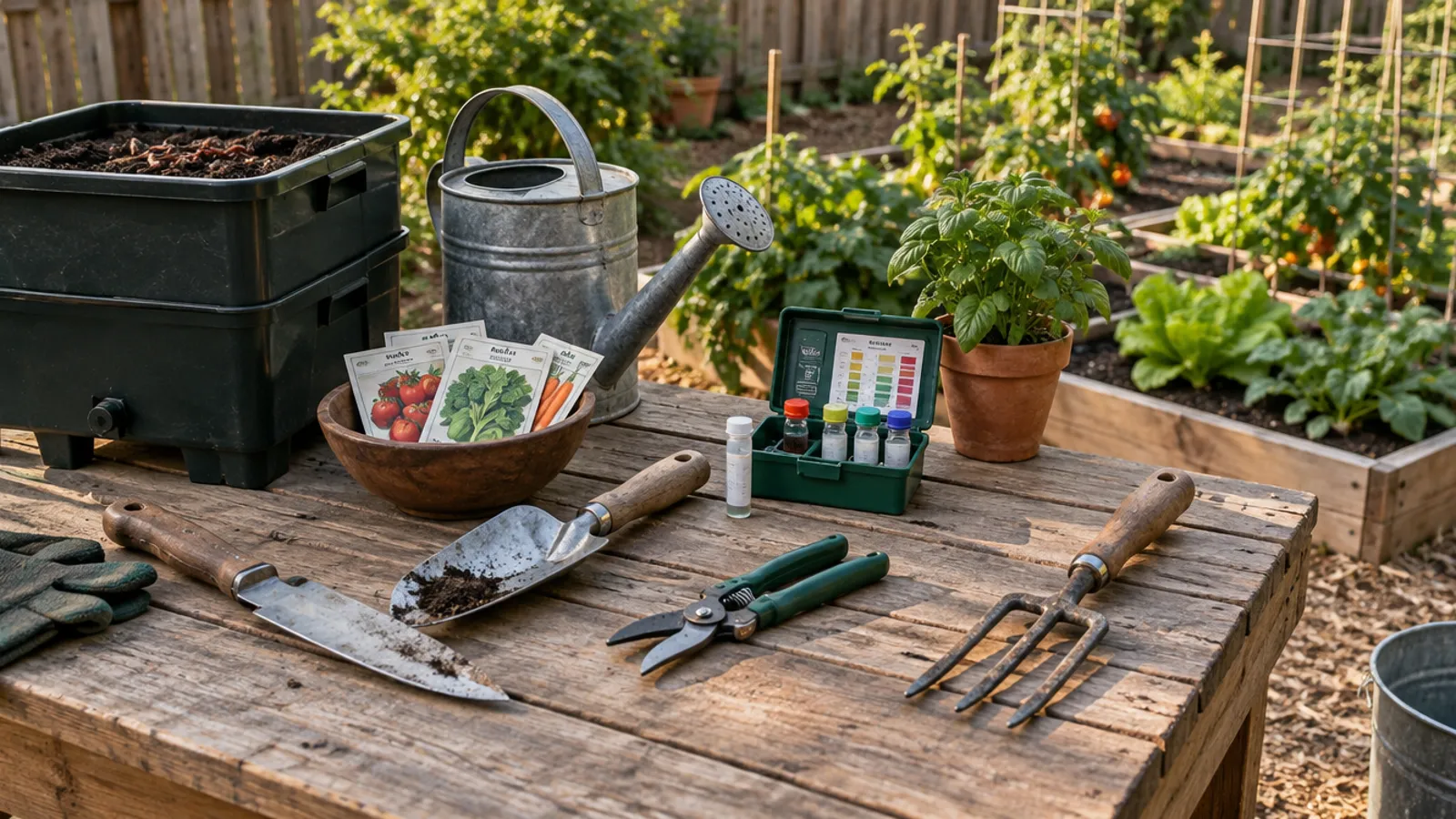
Start with a lab soil test, a trowel and hand fork, a hori-hori, a bypass pruner, root-zone watering, the right containers, a worm bin, a compost bin and row cover. University soil tests cost $10 to $30 at the US labs we checked, and raised-bed drip kits were listed at $44.49 to $129.95 in October 2026.
Key takeaways
- Buy a lab soil test first: $10 at Penn State, $25 at Utah State and $30 for lawn and garden at UW-Madison (fees checked October 2026).
- Illinois Extension advises buying the best hand tools you can afford; a Felco 2 pruner was listed at $78.04 and a stainless hori-hori at $38.50 (October 2026).
- Size containers by crop: Illinois Extension gives more than 20 in for tomatoes, 16 in for peppers and 10 in for greens and herbs.
- Oregon State Extension sizes worm bins at 1 cu ft and 1 lb of food waste a week per lb of worms; a 2 cu ft bin suits a household of two or three.
- Skip smart sensors, electric composters and tunnels in year one; row cover was $23.99 for 83 in x 50 ft, while UF/IFAS priced high tunnels at $6.72 per sq ft (2017 invoice).
In this article
- Best farming tools for beginners at a glance
- How we chose and checked this list
- Ranked: the best farming tools for beginners
- Urban farming supplies: what to buy for a balcony or small yard
- Worm bin size: tools and rules for worm farming beginners
- Season extension tools: from row cover to tunnels
- What to skip in your first season
- Starter-kit budget calculator
- How to set up and care for your beginner tools
- Safety basics for hand tools
- When to add satellite crop monitoring
- FAQ
The best farming tools for beginners are a short, cheap list: a hand trowel and fork, a hori-hori knife, a bypass pruner, a way to water at the roots, a lab soil test, containers or a raised bed, a worm bin, a compost bin and a length of row cover. A university soil test costs $10 to $30 at the US labs we checked, and a drip kit for two or three raised beds was listed at $44.49 to $129.95 in October 2026.
This guide ranks ten starter items for small urban and backyard plots. Each one has a “Best for” line, an example price with its date and seller, and the extension advice behind it. You also get a list of urban farming supplies you can skip at first, three charts and a starter-kit budget calculator that shows how many seasons your harvest needs to pay the kit back.
Best farming tools for beginners at a glance
The table sums up the ten picks. Prices are examples from named retailers and university labs, checked on 16 October 2026. They are list prices or dealer asks, not averages, and they will change. Where we could not confirm a price on a page we opened, the cell says so.
| Rank and tool | Best for | Example price (Oct 2026) | Where the price comes from |
|---|---|---|---|
| 1. Lab soil test | Knowing what your soil needs | $10 to $30 per sample | Penn State, Utah State and UW-Madison labs |
| 2. Trowel and hand fork | Containers and small beds | Not confirmed | Buy the best you can afford (Illinois Extension) |
| 3. Hori-hori knife | Weeding, planting, dividing | $38.50 | Charley’s Greenhouse list price |
| 4. Bypass pruner | Herbs, harvest, light pruning | $78.04 (Felco 2) | Kilian Hardware list price |
| 5. Drip kit or soaker line | Raised beds and rows | $44.49 to $129.95 | Greenhouse Megastore and Renee’s Garden list prices |
| 6. Containers or a raised bed | Balconies, patios, poor soil | Not confirmed | Sizes from Illinois Extension |
| 7. Worm bin and worms | Kitchen scraps in small homes | $64.99 to $110.94 per lb of worms | Meme’s Worms and Hydrobuilder sale prices |
| 8. Compost bin | Yard waste and bulk scraps | Not confirmed | Build or buy locally |
| 9. Row cover | Frost and insect protection | $23.99 for 83 in x 50 ft | Grow Organic list price |
| 10. Spade or digging fork | In-ground plots | Not confirmed | Sharpen before first use (K-State) |
How we chose and checked this list
We ranked tools by how early a beginner needs them and how much harm skipping them does. A soil test comes first because it decides what you buy next. Hand tools come next because you use them every week. Gadgets that need an app or a power socket come last, or in the skip list.
For advice we used university extension publications from Illinois, Kansas State, Oregon State, Kentucky, Clemson and Florida, plus OSHA guidance on hand-tool safety. For prices we opened each retailer or lab page on 16 October 2026 and copied the price shown. A sale price is marked as a sale. We did not test the products, and no seller paid to be listed. Treat every price as an example, compare a few sellers, and add shipping and tax.
Ranked: the best farming tools for beginners
1. A lab soil test
Best for: every new plot, before you buy fertilizer, lime or compost by the bag.
Chart
Routine home soil test fee at three US university labs
US$ per sample, standard or lawn-and-garden test, selected labs
A soil test tells you the pH and the nutrient levels, and the report says how much lime or fertilizer to add. Clemson Extension explains that its report gives a lime amount per 1,000 square feet and fertilizer advice for the plants you list, and its soil testing factsheet asks for only a nominal fee for a standard test.
Fees at the labs we checked were low. The Penn State Agricultural Analytical Services Lab lists a standard soil test kit at $10. The Utah State routine home soil test costs $25. The UW-Madison lab brochure (August 2025) lists a lawn and garden routine analysis at $30. In the UK, the RHS soil analysis service charged £43 per sample for non-members (£36 for members) when we checked.
Use your own state or provincial lab when you can, because its advice fits local soils. Home colour-change kits are cheaper per use, but they do not come with a lab’s fertilizer advice.
2. Hand trowel and hand fork
Best for: planting seedlings, mixing compost into pots and loosening soil in small beds.
These are the two tools you will touch most. Illinois Extension calls tools one of the biggest expenses for home gardeners. It says higher-quality shovels, rakes, pruners and trowels cost more but last longer, so buy the best you can afford and keep them clean and dry. A one-piece or firmly fixed head matters more than the handle colour. Stainless steel resists rust. A comfortable grip helps if you have weak hands.
3. Hori-hori knife
Best for: weeding, cutting through roots, dividing plants and checking planting depth.
A hori-hori is a narrow, dished blade with one sharp edge and one serrated edge. Many have depth marks on the blade. It does part of the job of a trowel, a weeder and a knife, which is why it suits a beginner with a small tool budget. Charley’s Greenhouse listed a Terrebonne stainless hori-hori with a 7¼-inch blade at $38.50 (list price, 16 October 2026). Store it in its sheath; it is a knife.
4. Bypass hand pruner
Best for: harvesting herbs and peppers, trimming tomatoes and cutting back soft stems.
Bypass pruners cut like scissors and leave a clean cut on live stems. Kilian Hardware listed the Felco 2, the original Felco design, with replacement blades sold separately, at $78.04 (list price, 16 October 2026). Cheaper pruners exist. If you buy one, check that the blades can be sharpened. Kansas State Research and Extension says hand pruners in good condition can be sharpened in about 10 minutes, and that well-kept tools cut cleaner, rust less and last longer.
5. Drip kit, soaker line or a good watering can
Best for: raised beds and rows that dry out fast; a can is enough for a few pots.
Drip lines and soaker hoses put water at the roots and keep leaves dry. Raised beds dry out faster than ground beds, so Kentucky Extension advises placing them near a good water source. Greenhouse Megastore listed the DIG raised bed drip kit at $44.49. Renee’s Garden listed a drip kit for two or three 4 x 8 ft beds at $129.95 (both list prices, 16 October 2026). A timer can be added later. For a balcony with five pots, a watering can and a saucer under each pot will do.
6. Containers, grow bags or a raised bed
Best for: balconies, patios, rented yards, poor soil and gardeners who cannot bend far.
Container size is the most common beginner mistake. Illinois Extension gives minimum pot sizes: more than 20 inches for tomatoes, 16 inches for peppers, 12 inches for carrots and 10 inches for leafy greens and herbs. A 10-inch pot holds about 3 gallons of mix and a 16-inch pot about 10 gallons. Soft-sided grow bags work where you have no ground to dig.
Kentucky Extension notes that raised beds and containers suit urban gardeners, small spaces and people with limited mobility. Every container needs drainage holes. Avoid very small or dark pots in full sun, because the roots can overheat. Crops such as lettuce, spinach, radish, chard and peas can crop with four to six hours of sun a day.
7. Worm bin and red wigglers
Best for: apartment and small-home kitchen scraps, and a steady supply of worm castings for pots.
A worm bin turns fruit and vegetable scraps into vermicompost. You can buy a stacking bin or drill air holes in a plastic tote. Sizing matters more than the brand; see the worm section below. The worms are the main running cost. Meme’s Worms listed 1 lb of red wigglers (about 800 to 1,200 worms) at a sale price of $64.99 (regular $79.99), and Hydrobuilder listed 1 lb at a sale price of $110.94 (16 October 2026). Shipping live worms is seasonal, so check the seller’s live-arrival terms.
8. Compost bin or tumbler
Best for: leaves, spent plants and larger volumes of scraps in a yard.
A worm bin handles kitchen scraps, but not a pile of autumn leaves. A simple bin made of pallets or wire mesh, or a closed tumbler, takes yard waste. Hot composting can finish in about six to eight weeks in good conditions and kills weed seeds, while worm composting is slower and does not, according to Oregon State University Extension. Many cities sell subsidised bins; check yours before you buy one online.
9. Row cover
Best for: early spring and autumn frost, and keeping flying insects off young brassicas.
Lightweight fabric row cover is the cheapest season-extension tool. Laid over hoops or straight on the crop, it traps some heat and blocks many insects. Grow Organic listed Agribon AG-19 row cover, 83 inches by 50 feet, at $23.99 (list price, 16 October 2026). Hold the edges down with pins, sandbags or soil so wind cannot lift it. Lift it when insect-pollinated crops such as squash start to flower.
10. Spade or digging fork
Best for: in-ground plots, new beds and turning compost.
Container growers can skip this one. If you dig in the ground, buy a spade or fork with a solid step and a handle that fits your height. Kansas State Extension points out that shovels and other digging tools have no sharp edge when you buy them, so the buyer needs to file one on. A file costs far less than a second spade.
Urban farming supplies: what to buy for a balcony or small yard
Urban farming supplies differ from rural tools mainly in size and in what you can do with waste. On a balcony, the weight of wet soil and the path water takes when it drains matter. In a yard, you have more room for a compost bin and a raised bed.
- Balcony or patio: five to ten containers or grow bags sized for the crop, a bagged potting mix, a watering can, a trowel, a hori-hori and a small worm bin.
- Small backyard: one or two raised beds, a soil test for the native soil, a drip kit, a pruner, a compost bin and a roll of row cover.
- Community garden plot: a soil test (ask whether the garden has one on file), a spade or fork, a hand fork and a row cover. Check the garden’s rules on hoses and bins.
The USDA urban grower resource hub lists help for city growers, including the Office of Urban Agriculture and Innovative Production and Natural Resources Conservation Service support for high tunnels, composting facilities and irrigation. That help is mainly for people growing food as a business, not a single balcony, but it is worth reading if you plan to sell.
If you outgrow these basics, our guide to farm tools and their uses with pictures covers larger field tools.
Worm bin size: tools and rules for worm farming beginners
The worm bin is the item most beginners size wrong. Oregon State University Extension (EM 9034, reviewed 2024) gives a simple rule: about 1 cubic foot of bin space and 1 pound of food waste per week for each pound of worms. A pound holds about 1,000 worms.
Chart
Worm bin sizing by household size
Oregon State University example bins
In OSU’s example, a 14-gallon bin 1 ft deep, 1 ft wide and 2 ft long gives 2 cubic feet, enough for 2 to 2½ lb of worms. That handles about 2 lb of kitchen waste a week, roughly what a household of two or three produces. A household of four to six needs about 6 cubic feet and up to 6 lb of worms for about 6 lb of waste a week. The bin should stay about 1 foot deep, because red wigglers live near the surface.
What else you need:
- Bedding: shredded newspaper or cardboard. OSU says worms need 75% to 85% moisture in their bedding, about as damp as a wrung-out sponge. Keep a 2-inch layer of fresh bedding over the food.
- The right worm: red wigglers (Eisenia fetida), not garden earthworms. OSU warns that a pound you order may hold fewer than 1,000 worms because some bedding is mixed in.
- A place to keep it: worms do best between about 55°F and 77°F, so protect an outdoor bin from heat, frost, rain and animals.
- A tarp or sheet for harvest: OSU’s light method piles the compost in cones; the worms move down away from the light and you brush off the compost from the top.
Worm compost is slow. OSU says finished vermicompost can take up to six months, and it can hold up to 4% more nitrogen than conventional hot compost.
▶ Ten small farm businesses you can start without owning a farm, including worm composting. · 6:03
Season extension tools: from row cover to tunnels
Once your first season works, the next tool is usually something that adds weeks to it. Start with row cover. Move up only if you plan to grow more food than you can eat or sell.
The step up costs a lot more. A University of Florida IFAS study (FE1135) priced a 30 x 84 ft high tunnel at $16,929, or $6.72 per square foot with all parts, based on a 2017 invoice. Florida growers it surveyed in 2021 reported $5.20 per square foot on average. Caterpillar tunnels of 1,600 square feet, priced from a supplier in 2021, cost $2,234 to $5,656, or $1.39 to $3.53 per square foot. These are Florida examples from 2017 and 2021, so prices today will be different.
Chart
Cost per square foot of tunnel options in Florida
US$ per sq ft of covered area; research invoice (2017), grower survey and supplier prices (2021)
What to skip in your first season
Many starter lists push gadgets before basics. These items can wait until you know your plot.
- Smart soil sensors before a lab test. A moisture probe can help with watering, but it does not replace a soil test’s pH and nutrient advice. Buy the $10 to $30 lab test first.
- Electric kitchen composters. They dry and grind food waste in a machine. That is not the same as compost made by worms or microbes, and they need power. A worm bin or outdoor bin is cheaper to run.
- Hydroponic and LED grow-light kits, unless you have no sun at all. Lettuce, spinach, chard and parsley can grow with as little as four to six hours of sun (Kentucky Extension).
- Cheap boxed tool sets. Illinois Extension’s advice is to buy fewer, better tools. Two good hand tools beat ten that bend.
- Power tillers for a few beds. A spade, a fork and compost on top do the job at this scale.
- Heavy-duty tunnels in year one. Learn with row cover first.
Starter-kit budget calculator
Enter what you expect to pay for each item and the value of the food you think you will grow in a season. The calculator adds up the kit and shows how many seasons of harvest it takes to cover the cost. The defaults are round examples, not benchmarks. Use the prices from your own shops.
Try the numbers for your own farm below.
Calculator
What will your starter kit cost, and when does it pay back?
Enter your own prices and the value of the food you expect to grow.
- Containers or beds subtotal: $80
- Cost per container or bed, all-in: $98
- Seasons of harvest to cover the kit: 1.3 seasons
Example values only, not a benchmark or a forecast; every number is your input. Defaults are round examples near the prices we saw in October 2026 (soil test fees from Penn State, Utah State and UW-Madison; drip kits $44.49 to $129.95; worms $64.99 to $110.94 per lb). Harvest value is your own estimate of what the food would cost to buy. Shipping and tax are not included.
How to set up and care for your beginner tools
- Test before you buy inputs. Send a soil sample from each area you will plant, and follow the lab’s lime and fertilizer advice.
- Set up water first. Put beds and containers where a hose or tap can reach. Lay drip lines before you plant.
- Start small. Grow a few crops you eat often, in the right size of pot, before you add more beds.
- Clean tools after use. Illinois Extension advises removing soil with a brush or hose, wiping pruner blades, and oiling metal parts lightly to stop rust. Rub linseed oil into wooden handles.
- Sharpen at the bevel angle. Use a whetstone or file and keep the original bevel. Illinois Extension warns against power grinders, because the heat can make the metal brittle.
- Store tools dry and off the ground. A pegboard keeps hand tools in view, and long handles go on a rack.
- Keep a simple log. Note planting dates, watering and harvests. It shows which tools earn their place.
▶ Seven simple ways to protect soil and water, from compost to cover crops. · 4:34
Safety basics for hand tools
OSHA’s hand and power tools guide is written for workplaces, but two points fit a home plot. Wear suitable protective gear such as gloves and safety goggles for jobs that can throw debris or cut skin. Keep blades sharp, because OSHA notes that dull tools can be more dangerous than sharp ones. Also wear gloves when you handle soil, compost and worm bedding, and store knives and pruners closed. If you use any fertilizer or pest product, follow the product label and local rules.
When to add satellite crop monitoring
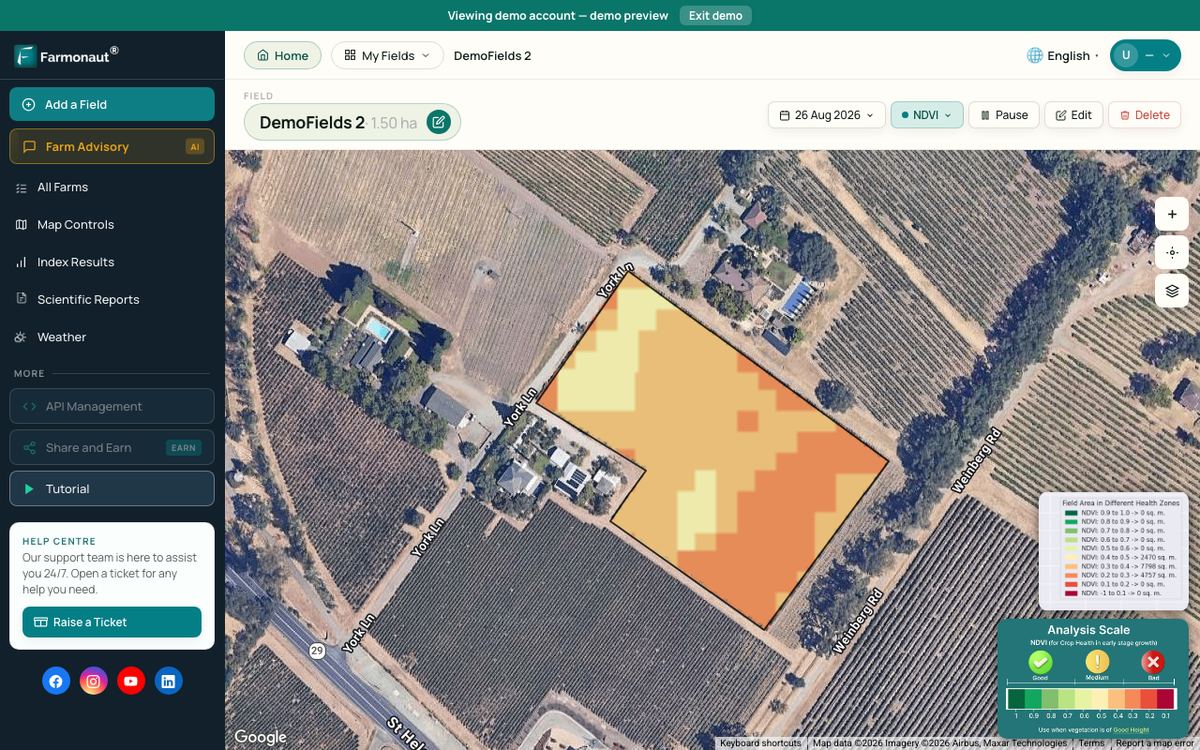
A beginner with pots does not need satellite data. It starts to help when you farm a plot large enough that you cannot walk every row each week. The Farmonaut Satellite + AI Farm Monitoring System shows vegetation maps for fields you draw, which can point you to the part of a field to check first. You still need to look at the plants to find the cause. You can try it through the Farmonaut web and mobile apps.
Related pages on our site: farm management for large holdings, satellite and weather API developer docs, fleet management, carbon footprint tracking, product traceability and crop loan and insurance verification.

▶ Six plain steps to start precision farming without buying a robot. · 4:18
We cover a connected topic in Tomato Farming Tips for Beginners: 7 Ways to Succeed.
FAQ
What are the first tools a beginner farmer should buy?
Start with a lab soil test, a hand trowel and fork, a hori-hori or weeder, a bypass pruner and a way to water at the roots. Add containers or a raised bed, a worm bin or compost bin, and row cover as your plot grows.
How much does a beginner tool kit cost?
It depends on how many containers or beds you build. Single items we checked in October 2026 ranged from a $10 university soil test to a $78.04 pruner and a $129.95 drip kit. Use the calculator above with your own prices.
Is worm farming suitable for an apartment?
Yes, if the bin is sized right and kept between about 55°F and 77°F. Oregon State Extension says a 2-cubic-foot bin with 2 to 2½ lb of worms handles about 2 lb of kitchen waste a week, enough for a household of two or three.
What moisture do worms need in a worm bin?
Oregon State Extension says bedding should hold 75% to 85% moisture, about as damp as a wrung-out sponge. Add dry shredded paper if it gets too wet.
Do I need a soil test for containers?
Usually not if you use fresh bagged potting mix, which is made for containers. Test the soil in raised beds filled with garden soil and in any in-ground plot.
Which urban farming supplies can wait?
Smart sensors, electric composters, hydroponic kits, grow lights and tunnels can wait until you have grown one season with the basics and know what your plot lacks.
Farmonaut crop monitoring
See your own fields from space
When your plot grows into a field, draw it once and Farmonaut shows satellite vegetation maps for it through the season, on web, Android or iOS.



Keep reading


Sources
- Clemson Cooperative Extension HGIC, Soil Testing factsheet: hgic.clemson.edu
- Penn State Agricultural Analytical Services Lab, Soil fertility testing fees (checked Oct 2026): agsci.psu.edu
- Utah State University Analytical Laboratories, Home soil testing (checked Oct 2026): usu.edu
- UW-Madison Soil and Forage Analysis Lab, Services and fees brochure (August 2025): uwlab.soils.wisc.edu
- RHS, Soil analysis service (fees checked Oct 2026): rhs.org.uk
- University of Illinois Extension, Garden Tool Maintenance (2021): extension.illinois.edu
- Kansas State Research and Extension, MF3288 How to Clean and Sharpen Garden Tools: bookstore.ksre.ksu.edu
- University of Illinois Extension, Small-space containers big with new gardeners (April 2021): extension.illinois.edu
- University of Kentucky Carter County Extension, Gardening in Small Spaces (May 2024): carter.ca.uky.edu
- Oregon State University Extension, Composting with Worms EM 9034 (2011, reviewed 2024): extension.oregonstate.edu
- University of Florida IFAS, FE1135 The Cost of High Tunnel and Caterpillar Tunnel Establishment: ask.ifas.ufl.edu
- USDA Farmers.gov, Urban grower resources: farmers.gov
- OSHA 3080, Hand and Power Tools: osha.gov
- Charley’s Greenhouse and Garden, Terrebonne stainless hori-hori knife (list price, 16 Oct 2026): shop.charleysgreenhouses.com
- Kilian Hardware, Felco 2 pruner (list price, 16 Oct 2026): kilianhardware.com
- Greenhouse Megastore, DIG raised bed drip kit (list price, 16 Oct 2026): greenhousemegastore.com
- Renee’s Garden, drip irrigation kit for garden beds (list price, 16 Oct 2026): reneesgarden.com
- Meme’s Worms, red wiggler worms 1 lb (sale price, 16 Oct 2026): memesworms.com
- Hydrobuilder, Tip Top Bio-Control red worms 1 lb (sale price, 16 Oct 2026): hydrobuilder.com
- Grow Organic, Agribon AG-19 row covers (list prices, 16 Oct 2026): groworganic.com
Discussion
Questions, corrections or field experience? Share them below. First-time comments are reviewed before they appear, and your email is never published.
No comments yet. Be the first to add a question or your experience.

 Messina Beej
 Dirks Bros Farms
 Red August Group
 Farm Inc
 WeMe Global
 Agrotoken
 Blue BearX
 Insignito
 Croptimum
 DnCubed
 Field Capacity
 Indosistim Teknologi
 Liquify Digital
 CU Foods
 BeyondTech Global
 Rouge VC
 AgroGreen Dynamics
 AgroRisk
 Licence holder · Niger · Gold










