

Forestry · Machine buyer guide
Forestry Machines Compared: Types, Uses and Cost per Ton
Forestry machines work in systems. In a University of Montana contractor survey, stump-to-truck cost in 2019 was $29.12 per green ton for ground-based whole-tree logging, $36.86 for cut-to-length and $44.50 for cable logging.
Key takeaways
- Pick the logging system first: ground-based whole-tree, cut-to-length or cable. Slope, soil, products and distance decide it.
- Montana contractors reported 2019 stump-to-truck costs of $29.12 (ground-based), $36.86 (cut-to-length) and $44.50 (cable) per green ton (University of Montana BBER, 2020).
- Distance matters: skidding 600 feet cost $6.74 per green ton and 1,800 feet cost $11.15 in the same 2019 survey.
- Daily skidder costs rose 64% and feller-buncher costs 23% from 1993 to 2013 in constant 2013 dollars (Montana Logging Machine Rates, 2015, via BBER).
- In the US, OSHA’s logging standard (29 CFR 1910.266) requires seat belts for operators of machines with rollover or falling-object protection.
In this article
- Forestry machines at a glance
- How we chose and checked the numbers
- The three logging systems that decide which forestry machines you need
- Cost of forestry machines by logging system
- How logging costs changed over a decade
- Forestry machines compared one by one
- How to choose the best forestry machines for your job
- What it costs to run a forestry machine
- Forestry machine technology to look for
- Safety rules for forestry machines
- Planning harvests around the machines
- FAQ
Forestry machines are the harvesters, feller-bunchers, skidders, forwarders, processors, loaders and mulchers that cut trees and move wood from the stump to a truck. Which one is best depends on the logging system. In a University of Montana survey of logging contractors, a ground-based whole-tree crew cost $29.12 per green ton from stump to loaded truck in 2019, a cut-to-length crew $36.86 and a cable crew $44.50.
This guide compares the main types of forestry machines, what each one does, what it costs to run, and how to choose. It includes charts built from university and USDA Forest Service studies, and a calculator that turns a machine’s daily cost into a cost per ton for your own job.
Forestry machines at a glance
Most mechanized logging in North America uses one of three systems. Each system is a set of machines that work as a team. The machines in one system must be balanced, because the slowest machine sets the pace for the whole crew.
| Machine | Main job | Used in | Best for |
|---|---|---|---|
| Feller-buncher | Cuts trees and lays them in bunches | Whole-tree, ground-based | Plantations and gentle slopes |
| Harvester | Fells, delimbs and cuts logs to length at the stump | Cut-to-length | Thinning and selective cuts |
| Grapple skidder | Drags bunches of whole trees to the landing | Whole-tree, ground-based | Short to medium distances |
| Forwarder | Carries cut logs off the ground to the roadside | Cut-to-length | Soft soils and long hauls |
| Processor or delimber | Removes limbs and cuts stems at the landing | Whole-tree | High-volume landings |
| Log loader | Sorts logs and loads trucks | All systems | Every landing |
| Cable yarder | Pulls logs uphill on steel cable | Cable | Steep slopes |
| Mulcher or masticator | Chops slash and small trees | Site preparation, fuel work | Fire-risk and replanting sites |
How we chose and checked the numbers
We did not rank brands. Prices and models change fast, and no public data set compares them fairly. Instead we compared machine types using published cost studies. The main source is the University of Montana Bureau of Business and Economic Research logging cost presentation from February 2020. It reports survey costs from Montana contractors for 2009 to 2019, and machine rates from a 2015 study.
We added time-and-cost studies by USDA Forest Service researchers in the US South and East. These studies measured real machines on real jobs. Each study covers one site and one set of trees, so its numbers show what is possible, not an average. All dollar figures are in the dollars of the year each study reports. They are cost estimates, not dealer list prices or auction results.
The three logging systems that decide which forestry machines you need
Before you pick a machine, pick the system. The system depends on slope, soil, tree size, the products you sell and the distance to the road.
Ground-based whole-tree system
A feller-buncher cuts the trees. A grapple skidder drags the bunches to a landing. A delimber or processor removes limbs and cuts logs, and a loader puts them on trucks. In the Montana survey this was the lowest-cost of the three systems; its costs assumed slopes under 35%. It suits plantations and flat to rolling ground.
Cut-to-length system
A harvester fells each tree, strips the limbs and cuts the stem into logs at the stump. A forwarder then carries the logs to the road. The limbs stay in the stand and form a mat that the machines drive on. This system costs more per ton in the Montana data, but it carries logs instead of dragging them. It is common in thinning work.
Cable system
On steep ground, crews often fell by hand with chainsaws. A cable yarder then pulls logs uphill to a landing. In the Montana survey, yarding alone cost $21.79 to $29.17 per green ton in 2019, depending on distance. That makes cable logging the most costly of the three systems shown.

▶ How radar satellites see through clouds, useful for planning in wet, cloudy regions. · 2:37
Cost of forestry machines by logging system
The chart below shows the full stump-to-truck cost of each system in the 2019 Montana survey. The ground-based figure assumes average sale units on slopes under 35%. The survey asked contractors for their own cost estimates, so the numbers reflect what loggers reported, not audited accounts.
Chart
Stump-to-truck cost by logging system
$ per green ton, Montana contractor survey, 2019
The cost of a system is the sum of its machines. In the 2019 ground-based figures, felling was $7.90 per green ton, skidding 1,200 feet was $8.74, processing was $8.14, loading was $3.89 and administration was $2.45. In the cut-to-length system, the harvester alone was $16.56 per green ton, and forwarding 2,000 feet added $14.50.
Distance matters a lot. Skidding 600 feet cost $6.74 per green ton in 2019, while skidding 1,800 feet cost $11.15. Forwarding 3,000 feet cost $17.00. Good road and landing layout can cut costs as much as a new machine can.
How logging costs changed over a decade
The Montana survey repeated the same questions every two years. Ground-based and cable costs stayed fairly flat from 2009 to 2019, while cut-to-length costs rose from $32.58 to $36.86 per green ton. All three dipped in 2011. One contractor wrote that low bid rates were not sustainable. Another survey comment is useful for budgets: a 10% change in fuel price changes logging costs by about 2.5%.
Chart
Total logging cost by system, 2009 to 2019
$ per green ton, stump to loaded truck, Montana contractor survey
The same presentation compared daily machine costs from 1993 with 2013, adjusted to 2013 dollars. Skidder costs rose 64% and feller-buncher costs rose 23%. The authors linked the rise to higher purchase prices, emission rules, new technology, safety features, steel prices and off-road diesel, which went from $1.33 to $3.50 a gallon in 2013 dollars.
Chart
Daily machine cost, 1993 vs 2013
$ per day in 2013 dollars, Montana machine rates
Forestry machines compared one by one
1. Feller-buncher
Best for: clearcuts and plantation thinning on gentle ground.
A feller-buncher grips a tree, cuts it with a saw or shear, and holds several stems before laying them in a bunch for the skidder. Tracked models handle rough ground. Rubber-tired models move faster between trees. In a USDA Forest Service study in a hardwood stand on the George Washington and Jefferson National Forests (2018), a drive-to-tree feller-buncher averaged 52.8 green tons per productive machine hour. Its machine rate was $150.44 per productive hour, and its unit cost was $2.50 to $3.44 per green ton.
Pros: high output, operator stays in a protected cab. Cons: needs a skidder and a processor to finish the job; less suited to steep slopes.
2. Harvester
Best for: selective cuts, thinning and sites where soil must be protected.
A harvester does four jobs at once: it fells, delimbs, measures and cuts the stem to length. Modern heads record each log’s length and diameter, which helps the crew cut to the mill’s order. In the Montana survey, the harvester was the costliest single step in the cut-to-length system, at $16.56 per green ton in 2019. The upside is that the wood leaves the stand as finished logs.
Pros: one machine replaces several steps; slash stays on site. Cons: higher cost per ton in the Montana survey.
3. Grapple skidder
Best for: moving whole trees short to medium distances.
A skidder drags bunches of trees to the landing with a hydraulic grapple. Grapple size matters. In a USDA Forest Service study of four harvesting systems in a loblolly pine plantation, cost from woods to landing ranged from $1.92 to $3.16 per ton. The two systems with a large-capacity skidder cost less per ton than the two with a conventional skidder.
In a study of high-tonnage harvesting in pine energy plantations (2016), a skidder with an oversized grapple averaged 112 green tonnes per productive hour. Its cost was $1.95 per green tonne over a 10-year life. The feller-buncher in the same study cost $3.85 per green tonne, for about $5.80 in total.
Pros: fast, simple, fairly low cost. Cons: dragging can disturb soil; cost rises steeply with distance.
4. Forwarder
Best for: long extraction distances, soft or wet soils, and cut-to-length logs.
A forwarder has a crane and a load bunk. It lifts logs and carries them clear of the ground. In a side-by-side thinning study in southern Alabama (1996), a harvester and forwarder system cost $0.14 less per cord than a skidder system when it produced cut-to-length wood. It cost $3.77 more per cord when it produced 7.5-foot wood. Product length changed which system won.
Pros: low soil disturbance; logs arrive clean. Cons: slower per trip than a skidder on short hauls.
5. Processor or delimber
Best for: busy landings in whole-tree systems.
A processor sits at the landing. It strips limbs and cuts stems into logs. A slide-boom delimber does a similar job. In the Montana presentation, a slide-boom delimber cost $1,533 a day in 2013, the highest daily rate of the machines listed. Processing in the 2019 survey cost $8.14 per green ton in ground-based work.
Pros: keeps the landing moving; sorts products. Cons: limbs pile up at the landing and need handling.
6. Log loader
Best for: every operation.
A loader sorts logs and fills trucks. It is often the cheapest step. In the 2019 Montana survey, loading cost $3.89 per green ton in ground-based work and $4.61 in cut-to-length work. A loader that waits for trucks still costs money, so trucking and loading should be planned together.
7. Cable yarder
Best for: slopes too steep for ground machines.
A yarder uses a tower and steel lines to pull logs uphill. It protects steep soils but costs more. In the 2019 survey, yarding 800 feet cost $21.79 per green ton and yarding 2,000 feet cost $29.17. Hand-felling for the same system added $5.59.
8. Mulcher or masticator
Best for: site preparation, fuel reduction and firebreaks.
A masticator chops slash and small trees into chips that stay on the ground. In a USDA Forest Service study of mastication in northern Idaho, a rotary-head masticator treated 0.57 acres an hour on average. Costs averaged $530 per acre, with a range of $335 to $1,395. Slope, tree density and the size of the area changed the time needed.
Other machines worth knowing
Chippers turn tops and small trees into fuel chips. A Forest Service case study of a chipper-forwarder in Georgia estimated $15 to $25 per dry tonne to chip and forward biomass 153 meters. That study dates from 1986, so use it only as a rough guide. Stump grinders, mulchers and bulldozers also prepare land for planting.
How to choose the best forestry machines for your job
Use these steps before you buy, lease or hire a contractor.
- Check the slope and soil. Ground machines suit gentle slopes. In the Montana survey, the ground-based figures assumed slopes under 35%. Steeper ground often needs cable systems.
- Match the products. Mills that buy cut-to-length logs favour harvesters and forwarders. Whole-tree chips and pulpwood favour feller-bunchers and skidders.
- Measure the distance. Extraction distance can change skidding cost by more than half, as the 600-foot and 1,800-foot figures show.
- Balance the crew. In the Alabama thinning study, output was limited by the single skidder or forwarder. Add capacity where the bottleneck is.
- Plan for real use. Machines do not work every scheduled hour. The Montana presentation used 65% utilization for feller-bunchers, grapple skidders and forwarders, 60% for cable skidders and 90% for gate delimbers.
- Count the full cost. A machine rate includes purchase price, interest, insurance, taxes, fuel, oil, repairs and the operator’s wage. Benefits are often about 50% of the wage rate, according to the same presentation.
- Check safety rules. See the safety section below and local rules before work starts.
Chart
Assumed machine utilization
% of scheduled hours spent working productively
What it costs to run a forestry machine
Cost per ton is the daily cost divided by the tons a machine produces in a day. The tons depend on hours scheduled, the share of hours the machine really works, and output per working hour. Use the calculator below with your own numbers. A contractor can compare the result with the rate paid per ton to see the margin.
The Montana presentation gives a simple method: find the cost per hour or day, find the production rate, then divide to get cost per unit of output. The example values in the calculator are round numbers chosen to sit near break-even. They are not benchmarks.
Try the numbers for your own farm below.
Calculator
What does your machine cost per ton?
Enter your own machine cost, hours and output.
- Tons per day: 130.0 tons
- Margin per ton: -$0
- Margin per day: -$30
Example values only, chosen near break-even; not benchmarks or forecasts. The 65% default utilization is the assumption the University of Montana BBER (2020) used for feller-bunchers, grapple skidders and forwarders. Daily cost should include ownership, fuel, repairs and operator wages.
Forestry machine technology to look for
New machines bring better cabs, cleaner engines and more data. Some trends help the buyer directly.
- On-board computers on harvester heads record log sizes and help cut to the mill’s order.
- Telematics report hours, fuel use and faults, which help track the true utilization of each machine. Our page on satellite-based fleet management tools covers tracking machines across sites.
- Cleaner engines meet tighter emission rules, but the Montana presentation lists emission standards as one reason new machine prices rose.
- Better cabs and guards protect operators from falling objects and rollovers.
- Satellite and drone maps help plan harvest blocks, roads and landings before machines arrive.
Satellite images can also show where canopy has changed after a harvest and how regrowth is going. Tools such as the Farmonaut Satellite + AI Farm Monitoring System track vegetation change over time; they show where a change happened, not its cause, so a forester should check the ground.
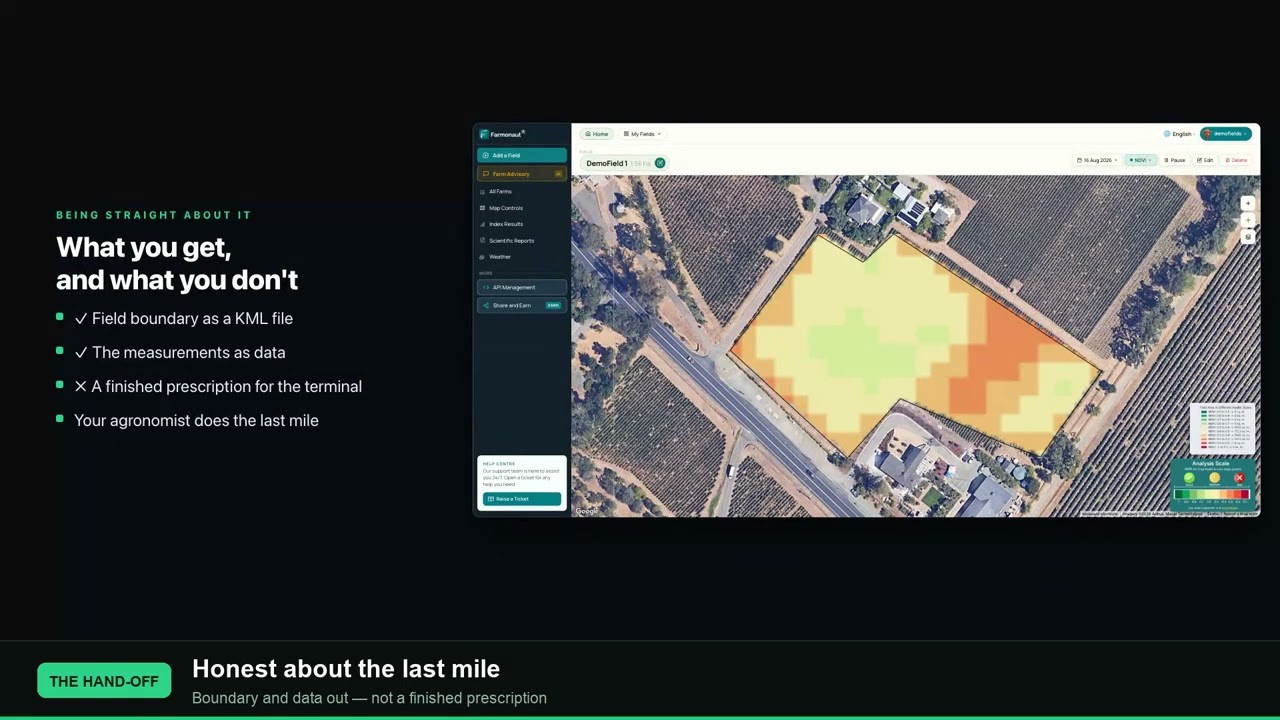
▶ How satellite maps and precision equipment work together. · 2:12
Safety rules for forestry machines
Logging is dangerous. OSHA’s logging overview says that by many measures it is the most dangerous occupation in the United States. Hazards include falling and rolling trees, rough terrain, bad weather and remote sites far from medical care.
In the US, the OSHA logging standard, 29 CFR 1910.266, covers machines such as skidders, loaders and feller-bunchers. It requires a seat belt for each operator of a machine with rollover or falling-object protection, and it says seat belts must not be removed. No one but the operator may ride on a mobile machine unless they have equal protection. Rules differ in Canada, the UK, Europe and Australia, so check local rules and get professional safety advice for your site.
Planning harvests around the machines
Good planning lowers machine cost. The FAO forestry paper on planning forest roads and harvesting systems (1977) treats roads, landings and harvesting machines as one plan rather than separate choices. That idea still holds: short, well-placed skid trails and landings cut both cost and soil damage.
Before a harvest, map the stand, mark streams and steep areas, and set landings where trucks can reach them. After the harvest, check soil disturbance and replant where needed. Owners who report on emissions can use a carbon footprinting analysis to count fuel use from machines and trucks.
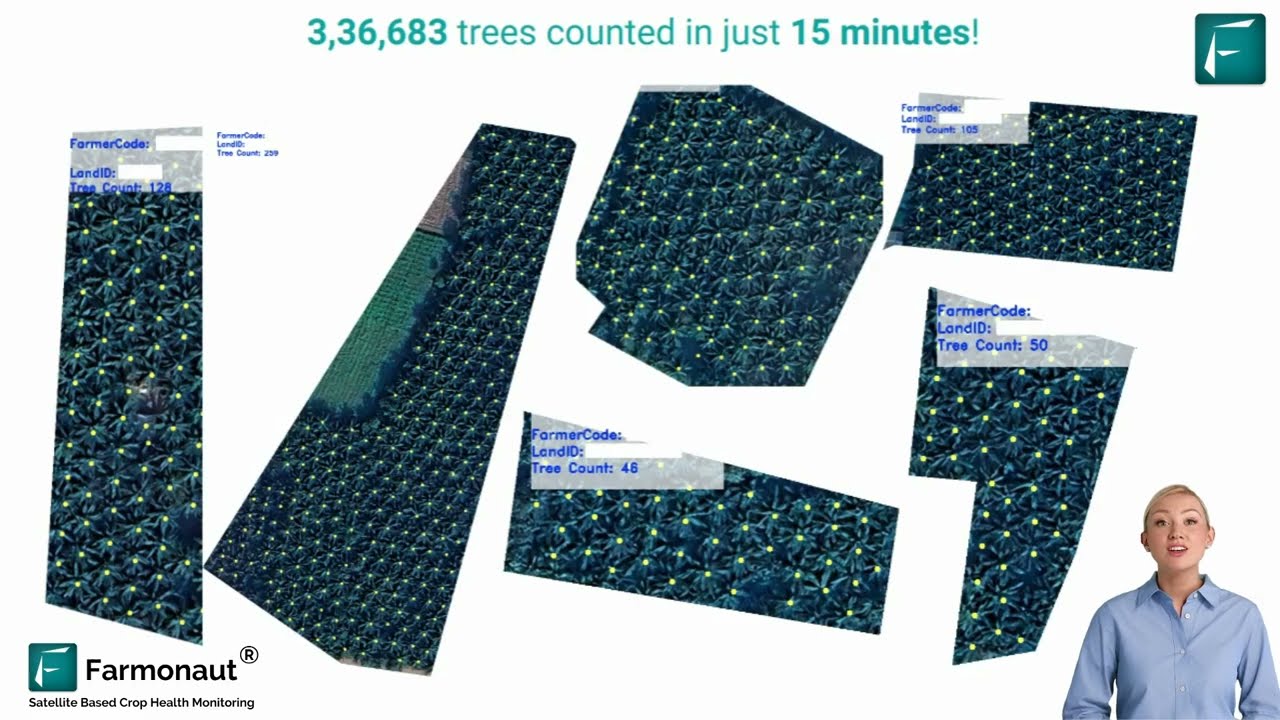
▶ Satellite and AI tree detection for counting and mapping trees. · 4:05
FAQ
What are the main types of forestry machines?
The main types are feller-bunchers, harvesters, skidders, forwarders, processors or delimbers, log loaders, cable yarders, and mulchers or masticators. Chippers and stump grinders are also common.
Which forestry machine system costs the least?
In the University of Montana 2019 contractor survey, the ground-based whole-tree system cost $29.12 per green ton from stump to truck, compared with $36.86 for cut-to-length and $44.50 for cable. Costs on your site will differ with slope, distance and tree size.
What is the difference between a skidder and a forwarder?
A skidder drags whole trees or bunches along the ground. A forwarder lifts cut logs into a bunk and carries them, which usually causes less soil disturbance.
How many hours does a forestry machine really work?
The Montana presentation used utilization of 60% to 65% of scheduled hours for most felling and extraction machines and 90% for a gate delimber. Weather, moves and repairs take up the rest.
Do forestry machine operators need seat belts?
In the US, OSHA’s logging standard requires seat belts for operators of machines fitted with rollover or falling-object protection. Check the rules in your own country or state.
Related pages on our site: plantation and forest advisory, product traceability and API developer docs.
Farmonaut forest monitoring
Watch your stands from space
See vegetation change across your forest blocks before and after harvest.



Keep reading
Sources
- University of Montana BBER, Logging cost presentation, Foresters Forum (2020): bber.umt.edu
- USDA Forest Service, Klepac and Mitchell, conventional harvesting system on George Washington and Jefferson NF (2018): research.fs.usda.gov
- USDA Forest Service, Comparison of four harvesting systems in a loblolly pine plantation: research.fs.usda.gov
- USDA Forest Service, Jernigan et al., High tonnage harvesting and skidding for loblolly pine energy plantations (2016): research.fs.usda.gov
- USDA Forest Service, Lanford and Stokes, Comparison of two thinning systems, Part 2 (1996): research.fs.usda.gov
- USDA Forest Service, Mastication: a fuel reduction and site preparation alternative: research.fs.usda.gov
- USDA Forest Service, Evaluation of chipper-forwarder biomass harvesting concept: research.fs.usda.gov
- OSHA, Logging overview: osha.gov
- OSHA, Logging operations standard 29 CFR 1910.266: osha.gov
- FAO, Planning forest roads and harvesting systems, Forestry Paper 2 (1977): fao.org
Discussion
Questions, corrections or field experience? Share them below. First-time comments are reviewed before they appear, and your email is never published.
No comments yet. Be the first to add a question or your experience.

 MapMyCrop
 Cresol
 Atur Kuliner
 MDCV UK
 Zerella Group
 Etech Consulting Madagascar
 Vestlandsforsking
 Agritein
 Delicio
 WB Dev
 Sama Premium
 Prochecker
 Tres Valles
 LACOS Geoinformation
 Magrifly
 LatConnect 60
 Blickwinkel
 Agricultural Credit Policy Council
 Marei Nursery
 eKGIS
eKGIS Mostas Tech
 Exploration consultancy · South Africa · Gold
 Licence holder · Niger · Gold
 Licence holder · Nigeria · Gold + lithium










