

Cotton · Disease guide
Bollrot in Cotton: Causes, Symptoms and 7 Controls
Boll rot is decay of cotton bolls by a mix of fungi and bacteria, favoured by wet weather, dense canopies and insect wounds. US losses swung from 271,001 bales in 2022 to 19,903 in 2024 (Crop Protection Network). Here is how to spot it and seven ways to keep it down.
Key takeaways
- Boll rot is a group of fungal and bacterial rots, including Diplodia, Fusarium, Alternaria, anthracnose and bacterial blight (CRDC Cotton Pest Management Guide 2025-26).
- US boll rot losses were estimated at 271,001 bales in 2022, 71,623 in 2023 and 19,903 in 2024 (Crop Protection Network, 480 lb bales).
- Wet, humid weather, a thick canopy, rain splash and stink bug wounds raise risk; open bolls left in wet weather rot and tight-lock.
- NC State Extension sets a 10% internally damaged boll threshold for stink bugs in bloom weeks 3 to 5.
- The CRDC tactics are field practices: open canopy, drainage, residue incorporation, farm hygiene and boll counts on ten plants at ten sites.
In this article
- What is bollrot in cotton?
- Symptoms of boll rot and how to diagnose it
- What causes boll rot and when is risk highest?
- How much yield does boll rot cost?
- Boll rot against other boll and leaf diseases
- 7 strategies to manage boll rot of cotton
- Is chemical control of boll rot an option?
- Does an extra control step pay on your farm?
- Technology for boll rot risk: what helps and what does not
- A season plan for boll rot
- Common mistakes
- Key points
- How we checked the numbers
- FAQ
Bollrot, or boll rot of cotton, is decay of the cotton boll caused by a mix of fungi and bacteria. It turns bolls brown or black, stains the lint and can stop locks from fluffing out. Wet, humid weather, a dense canopy and insect wounds in the boll wall favour it. In the United States, boll rots cost an estimated 271,001 bales in 2022, 71,623 bales in 2023 and 19,903 bales in 2024, according to Crop Protection Network loss surveys. Control rests on field practice: an open canopy, good drainage, fewer insect wounds, sound varieties, residue control, timely harvest and regular scouting.
This guide explains how to tell boll rot apart from other boll damage, which organisms cause it and when risk is highest. It then sets out seven strategies, each tied to a published extension guide, plus a calculator to test whether an extra control step pays on your farm. For wider cotton practice, see our guide to sustainable cotton practices for higher yields.
What is bollrot in cotton?
Boll rot is not one disease. It is a group of rots that attack bolls from the time they set until harvest. Australia’s Cotton Pest Management Guide 2025-26, published by the Cotton Research and Development Corporation (CRDC), says boll rots “are caused by a number of fungal and bacterial pathogens”. The same guide names two related forms. Tight lock is a boll rot where the lock stays hard and does not fluff out. Seed rot is a boll rot that starts inside the seed.
Many of these organisms are secondary invaders. They live on crop debris, dead flowers and soil, and they enter the boll through a wound or through the sutures as the boll opens. That is why insect damage, rain splash and long wet spells matter so much. A healthy boll wall is a good barrier; a punctured one is not.
In the United States the loss surveys group these rots together under “boll rots (Fusarium and others)”. In the South Carolina figures, the boll rot value also includes hardlock on bottom bolls from several causes, a note in the 2022 survey. Growers in the Southeast often use “hardlock” for bolls that open but whose locks stay stuck together, so the two terms overlap in the field.
Common causal organisms
The CRDC guide and US extension sources describe these main groups. Several can be found on the same boll.
| Organism | Type | What you see | Notes |
|---|---|---|---|
| Diplodia spp. | Fungus | Dark brown lesion that spreads over the whole boll, then a black, sooty growth that rubs off | Described in the CRDC guide |
| Fusarium spp. | Fungus | Furry orange or pink spore masses on the boll | A different disease from fusarium wilt (CRDC) |
| Colletotrichum spp. (anthracnose) | Fungus | Large spreading lesions, often with pink or orange spore masses | More often on higher bolls (CRDC) |
| Alternaria spp. | Fungus | Round, dry brown lesions; whole boll dull brown in wet spells | Enters through sutures of opening bolls (CRDC) |
| Rhizopus and other moulds | Fungus | Soft rot with dark, fluffy growth | Listed as “Boll rots (Rhizopus, etc.)” in Beltwide surveys |
| Rhizoctonia solani | Fungus | Rot on low bolls that touch soil | Soil-borne; also causes seedling disease |
| Xanthomonas citri subsp. malvacearum | Bacterium | Dark, water-soaked lesions on bolls | The bacterial blight pathogen (Alabama Extension) |
Bacterial blight is the bacterial member of the group. Alabama Cooperative Extension’s guide to bacterial blight says the pathogen, Xanthomonas citri subsp. malvacearum, is also known as the cause of “bacterial boll rot of cotton”. It is seed-borne and can also survive on infected crop debris from the previous season. The guide adds that other organisms often invade bolls after it, so it can be hard to tell which one started the rot.
▶ Rhizoctonia, one of the soil-borne fungi linked to low-boll rot: how it spreads and how it is managed. · 11:28
Symptoms of boll rot and how to diagnose it
Symptoms change with the organism and the age of the boll, but the sequence is similar in most cases:
- Small water-soaked or discoloured spots on the boll wall, often near the base, the tip or the sutures.
- Spots that grow and turn brown or black; the boll may soften.
- Spore masses on the surface: black and sooty (Diplodia), pink or orange (Fusarium, anthracnose), or grey-green.
- Inside, stained or rotten lint and dark seed.
- Young bolls may shed. Older bolls may open early, open only partly, or stay as hard, tight locks.
Look at where the rotten bolls sit. Rot on the lowest bolls near wet soil points to rain splash and canopy humidity. Rot on scattered bolls higher up, with small dark pinholes, points to insect feeding.
Check for insect injury first
Stink bugs and plant bugs are a frequent route in. Alabama Extension’s stink bug guide says the small pinprick spots left inside the boll wall “may serve as an avenue to introduce boll rot organisms”, and that injury can lead to hardlock bolls that fail to open. The Texas A&M AgriLife guide to managing cotton insects says stink bug feeding can transmit plant pathogens that cause boll rot, and it describes how the verde plant bug brings boll rot into young bolls in South Texas.
To check, pick bolls about one inch (2.5 cm) across, break them open and look at the inner wall. Warts or callus growths and stained lint mean feeding injury. If you see rot with these signs, insect control is part of the answer, not just the weather.
When to send samples to a lab
When rot appears on many bolls, or you suspect bacterial blight, send fresh samples to your state or provincial plant diagnostic lab. The lab can culture the organisms and confirm whether a bacterium is involved. That matters, because bacterial blight is managed through resistant varieties and clean seed, while most fungal boll rots are managed through canopy and moisture.
What causes boll rot and when is risk highest?
The CRDC guide lists four conditions that favour boll rot:
- Wet and humid weather, especially with a thick, rank canopy and moisture from rain and dew.
- Rain on bare soil that splashes soil onto the plant. Low mature bolls and lodged plants are at higher risk.
- High numbers of sucking pests soon after flowering, which favour seed rots.
- Wet weather while bolls are opening, which favours boll rots and tight locks.
The same guide warns that a dense canopy favours leaf spots and boll rots, and that heavy irrigation or long wet periods can leach potassium, which can raise disease levels in the canopy. Weather drives the yearly swings. The 2021 Beltwide Cotton Conferences report on 2020 losses said boll rots and hardlock rose sharply in Alabama, Georgia, Florida and North Carolina after winds and rain from several hurricanes and tropical storms. Florida, Georgia, South Carolina, Alabama and Arizona had the highest total disease losses that year.
The US Southeast carries more risk than the arid West. In 2023, the Crop Protection Network survey found that diseases cut yield by 8.9% in Southeastern states, more than twice the share in the Southwest, and that foliar and boll diseases are more likely to cause problems in the humid Southeast.
How much yield does boll rot cost?
US cotton pathologists estimate disease losses every year, state by state. The Crop Protection Network now publishes these summaries. Its 2022 summary says boll rots were the second-largest cause of loss after root-knot nematodes, at 271,001 bales of 480 lb. In 2023 the figure was 71,623 bales, fifth among diseases. In 2024 it fell to 19,903 bales, in a year when total disease loss was the lowest share recorded since state data began in 1965, according to the 2024 summary.
Chart
US cotton bales lost to boll rots
Estimated 480 lb bales lost, 17 reporting states
Older Beltwide reports show how large the swings can be. The 2017 Beltwide report estimated that boll rots took an average of 3.07% of yield across reporting states in 2016, second only to nematodes. For 2020, the average was 1.01%.
Boll rot does more than cut lint weight. Stained lint lowers colour grade, and rotten seed lowers seed value. A field can lose money even when its bale count looks normal.
Boll rot against other boll and leaf diseases
Among the foliar and boll diseases in the 2023 survey, only Stemphylium leaf spot cost more bales than boll rots. Areolate mildew, Alternaria leaf spot and target spot were all lower. The comparison helps when you set scouting time across a season.
Chart
Foliar and boll disease losses in US cotton, 2023
Estimated 480 lb bales lost, five largest foliar and boll diseases
The swing from 2022 to 2024 also shows how much the weather matters. Boll rot losses fell by more than 90% across those two seasons, a far steeper drop than for the leaf spots.
Chart
Bales lost by disease: 2022 vs 2024
Estimated 480 lb bales lost in US cotton, foliar and boll diseases
7 strategies to manage boll rot of cotton
No single step controls boll rot. The CRDC guide’s integrated disease management (IDM) tactics for boll rot are all field practices, and the US loss surveys tie the worst years to wet weather. The seven strategies below follow those tactics and the US extension advice on insects. Use them together.
| Strategy | Main risk it reduces | Timing | Source |
|---|---|---|---|
| 1. Open the canopy | Humidity around bolls | Planting to first bloom | CRDC |
| 2. Manage water and drainage | Wet soil, splash, flooded low bolls | All season | CRDC |
| 3. Control boll-feeding insects | Wounds that let rot in | Bloom weeks 3 to 5 and later | NC State, Texas A&M, Alabama |
| 4. Choose varieties with care | Bacterial blight, rank growth | Before planting | CRDC, Alabama |
| 5. Deal with crop residue | Inoculum carried over | After harvest | CRDC |
| 6. Defoliate and harvest on time | Open bolls in wet weather | End of season | CRDC |
| 7. Scout and monitor | Late or missed action | Bloom to harvest | CRDC, NC State |
1. Open the canopy
A thick canopy traps humid air around the lower bolls. The CRDC guide advises avoiding rank growth and a dense canopy where possible, especially in wet seasons. It also notes that high plant numbers can make up for seedling losses, but a dense canopy favours leaf spots and boll rots. Practical steps:
- Match seeding rate to the field. The CRDC guide also warns against very low populations that leave bare soil for splash, so the target is a middle path.
- Avoid excess nitrogen, which drives rank vegetative growth.
- Use plant growth regulators where vigour is high, as the CRDC guide suggests when growth needs to be held back.
- Keep weeds down in the row, where they add humidity.
2. Manage water and drainage
Standing water and wet soil feed boll rot. The CRDC guide says not to let water back up into the field and flood low bolls on plants near the tail drain. Last irrigations need care: a late watering before a rainy spell keeps the lower canopy wet while bolls open. Level fields so water does not pond, keep drains clear and plan the final irrigation with the forecast in mind. Well-timed water also protects potassium supply, which the CRDC guide links to disease levels in the canopy.
3. Control boll-feeding insects
Every puncture is a possible entry point. North Carolina State Extension advises scouting by splitting bolls about one inch across and checking the inner walls for warts and stained lint. It sets a threshold of 10% damaged bolls during weeks 3 to 5 of bloom. NC State also says spray decisions should rest on internal boll injury, not on the presence of insects alone.
Texas A&M AgriLife advises sampling bolls about the size of a quarter from four parts of the field, away from the edges. It notes that once a crop reaches 450 DD60 heat units beyond cutout, sampling and treating for stink bugs may no longer be needed. Bollworms also chew holes in bolls; the UC IPM cotton bollworm guidelines cover their monitoring in the West.
Insecticide choice, rates and pre-harvest intervals vary by product and state. Always read and follow the label, check local rules and ask your county extension agent or a licensed adviser before you spray.
4. Choose varieties with care
Variety choice affects two parts of boll rot risk. First, resistance to bacterial blight: the CRDC guide says bacterial boll rot is now rare in Australia because of varietal resistance, and Alabama Extension’s blight guide covers resistant varieties for the US. Second, growth habit and maturity: a variety that suits the field’s yield potential is less likely to grow rank, and earlier maturity can let bolls open before autumn rains. Plant clean, treated seed, since the blight pathogen is seed-borne.
5. Deal with crop residue and rotation
Many boll rot organisms survive on old stalks, bolls and debris. The CRDC guide advises incorporating crop residues thoroughly as soon as possible after harvest. It also says host range should guide rotation. For example, phytophthora has hosts that include safflower and tomato, while sclerotinia hosts include sunflower, safflower, soybeans and many pasture legumes. Farm hygiene matters too. The guide’s “Come Clean. Go Clean.” advice means cleaning machinery and vehicles between fields, so soil and debris do not travel.
6. Defoliate and harvest on time
The CRDC guide lists exposure of opening bolls to wet weather as a cause of boll rots and tight locks. Every week open bolls stand in the field adds risk. Plan defoliation so that harvest can follow quickly, and watch the forecast as the crop nears maturity. Low bolls near the soil are the first to rot, so a crop that lodges in late rain should be harvested as soon as conditions allow. Our guide to cotton harvest timing covers the steps in more detail.
7. Scout and monitor through the season
Count before you act. The CRDC guide suggests assessing incidence before or after defoliation by counting all bolls on ten plants at each of ten random sites in a field, and warns that plants near the tail drain can bias the result. Write the counts down each year, field by field. Patterns across seasons show which blocks rot first, which is where canopy and drainage changes pay back.
Satellite images help you choose where to walk. Vegetation index maps show zones of rank growth and wet, low ground, which are the places to split bolls first. They do not show rot on a boll, so field checks remain essential. Farmonaut Satellite + AI Farm Monitoring System is one option for viewing these maps for each field through the season.
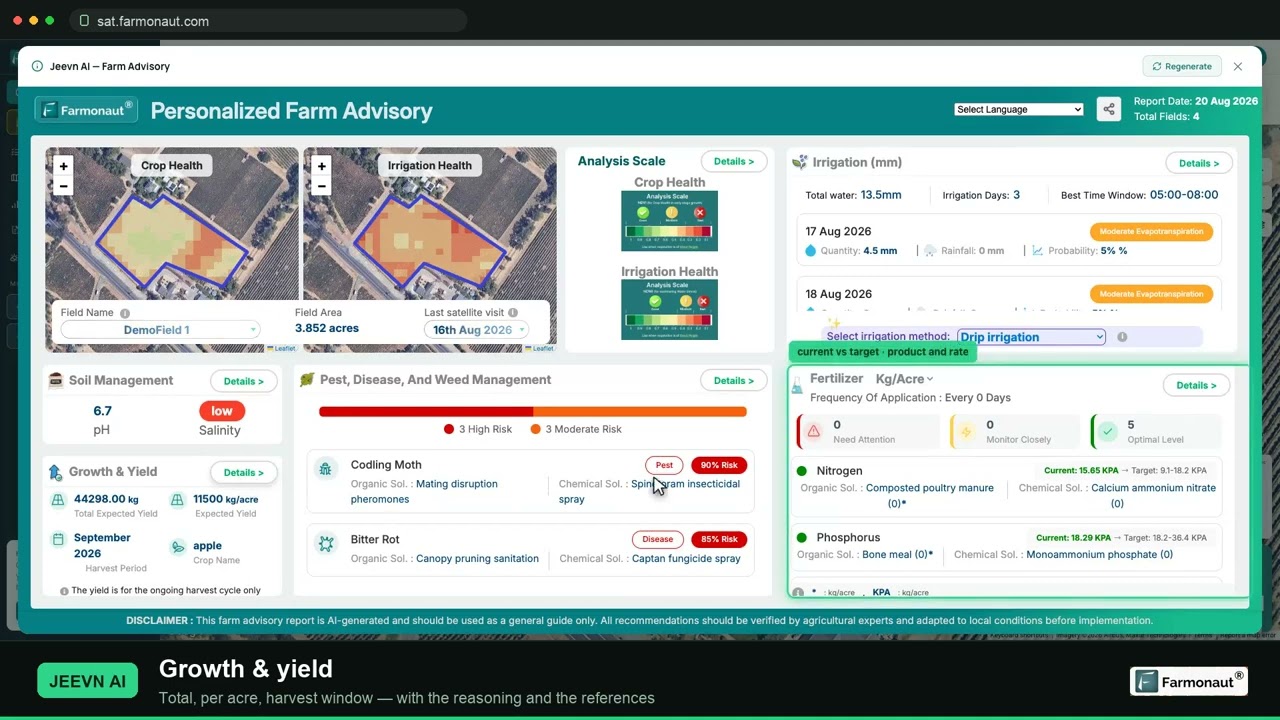
▶ A walkthrough of satellite crop monitoring: reading NDVI maps to find stressed or rank zones before you scout. · 19:36
Is chemical control of boll rot an option?
Chemical control works mainly through the insects. Sprays aimed at stink bugs, plant bugs and bollworms reduce wounds, and fewer wounds mean fewer rots. Use thresholds from your state guide, not a calendar.
For the rot itself, the CRDC guide’s boll rot tactics are all field practices, with no spray step listed. Foliar fungicides are used in US cotton against leaf diseases such as target spot and areolate mildew, and some growers hope for a side benefit on bolls. Ask your local extension pathologist about trial results in your area before you budget for it. Seed treatments help against seedling disease and seed-borne bacteria, not against late-season boll rot. Whatever you use, follow the label, check local rules and get professional advice.
Does an extra control step pay on your farm?
Before you add a spray or extra pass, compare its cost with the lint value it could save. The calculator below does that. The starting values are only examples, set near break-even. Put in your own figures and today’s price.
Try the numbers for your own farm below.
Calculator
Does an extra boll rot control step pay?
Compare the lint value a step could save with what it costs.
- Lint saved: 7,500 lb
- Value of lint saved: 4,875 US$
- Total cost of the step: 5,000 US$
- Loss share needed to break even: 3.1 %
Example values only, set near break-even; they are not a forecast or a benchmark. Use your own yield, your own loss estimate and today’s lint price. The loss share is the boll rot loss you expect without the step; the share prevented is how much of it you think the step avoids. Seed value, grade discounts and harvest savings are not included.
Technology for boll rot risk: what helps and what does not
Several tools can help you act earlier:
- Weather data and forecasts. Rain and dew during boll opening are the main triggers. Local forecasts help plan the last irrigation, defoliation and harvest.
- Satellite vegetation maps. These show canopy vigour across a field, so you can find rank zones and low, wet ground. They point to places to scout; they do not diagnose rot.
- Field sensors. Soil moisture probes help avoid over-watering late in the season. Our guide to IoT in cotton farming explains how they fit together.
- Records. Boll counts, insect checks and harvest notes in one place make the next season’s choices easier.
None of these replaces splitting bolls by hand. They tell you where to look and when.

▶ How to set up fields in a satellite crop monitoring web app and view vegetation maps through the season. · 8:43
A season plan for boll rot
| Stage | Actions |
|---|---|
| Before planting | Pick a variety with blight resistance and a suitable growth habit; plan the seeding rate; check drainage and field levelling; buy clean seed. |
| Early season | Balance nitrogen; keep weeds down; note fields with a history of rot. |
| Bloom | Split bolls weekly for stink bug injury; use growth regulators where growth is rank; plan irrigation with the forecast. |
| Boll opening | Count rotten bolls on ten plants at ten sites; avoid late watering; watch for lodging. |
| Defoliation and harvest | Time defoliation so harvest follows quickly; harvest low, wet blocks first when possible. |
| After harvest | Incorporate residue; clean machinery; record counts and losses by field. |
Common mistakes
- Blaming weather only and missing the insect wounds that let rot in.
- Counting stink bugs instead of checking bolls for internal injury.
- Pushing nitrogen and water for yield, then losing the bottom crop to rot.
- Leaving open bolls in the field through a wet spell.
- Spraying fungicide for boll rot without local trial evidence.
- Not recording which fields rot, so the same blocks suffer every year.
Key points
Boll rot is a group of fungal and bacterial rots that need moisture and an easy way into the boll. The US loss surveys show it can be one of the largest disease losses in a wet year and much smaller in a dry one. The levers are in the field: an open canopy, good drainage, fewer insect wounds, the right variety, clean residue, timely harvest and regular boll counts.
Related pages on our site: IoT in cotton farming · satellite and weather API documentation · farm administration app · mobile app download · carbon footprinting · product traceability · fleet management
How we checked the numbers
Loss figures come from the Crop Protection Network summaries of US cotton disease losses for 2022, 2023 and 2024, and from the Beltwide Cotton Conferences disease loss reports for 2016 and 2020. All bale figures are in 480 lb bales and are estimates made by university extension cotton pathologists, not measured totals. Disease descriptions and tactics come from the CRDC Cotton Pest Management Guide 2025-26 and from extension guides by Alabama, North Carolina State and Texas A&M. The current US crop size comes from the USDA November 2026 Crop Production report, which forecast 13.2 million bales. Each source is listed at the end of the article.
FAQ
What is bollrot?
Bollrot (boll rot) is decay of cotton bolls caused by a group of fungi and bacteria, such as Diplodia, Fusarium, Alternaria, Rhizopus and the bacterial blight pathogen. It browns or blackens bolls, stains lint and can stop locks from opening.
What causes boll rot of cotton?
Wet, humid weather, a dense canopy, rain splash onto low bolls and wounds from insects such as stink bugs. Bolls that stay open in wet weather before harvest are at high risk.
What are the symptoms of boll rot?
Water-soaked spots that turn brown or black, soft bolls, spore masses on the surface, stained or rotten lint, early or partial opening and hard locks that do not fluff out.
Is there a chemical control for boll rot?
Insecticides used at threshold cut the wounds that let rot in. The CRDC guide lists only field practices against the rot itself. Ask your extension pathologist about local fungicide trials, and always follow the label and local rules.
How much yield does boll rot cause?
US estimates range widely: 271,001 bales in 2022, 71,623 in 2023 and 19,903 in 2024 (Crop Protection Network). In 2016 the average loss across reporting states was 3.07% of yield.
Is hardlock the same as boll rot?
Not exactly. Hardlock and tight lock describe locks that stay hard and do not fluff out. Boll rot organisms are one cause, alongside insect injury and wet weather, and US surveys sometimes count them together.
Farmonaut crop monitoring
See your cotton fields from space
Draw your fields once and Farmonaut shows satellite vegetation maps for them through the season, on web, Android or iOS, so you know where to scout first.




Keep reading


Sources
- Crop Protection Network, Cotton Disease Loss Estimates from the United States, 2022: cropprotectionnetwork.org
- Crop Protection Network, Cotton Disease Loss Estimates from the United States, 2023: cropprotectionnetwork.org
- Crop Protection Network, Cotton Disease Loss Estimates from the United States, 2024: cropprotectionnetwork.org
- CRDC, Cotton Pest Management Guide 2025-26 (boll rot, tight lock and seed rot): crdc.com.au
- Alabama Cooperative Extension, Bacterial Blight of Cotton (ANR-3270, 2026): aces.edu
- Alabama Cooperative Extension, Pests of Alabama Cotton: Stink Bugs (2021): aces.edu
- Texas A&M AgriLife Extension, Managing Cotton Insects in Texas: Mid-season and Late-season Pests: extensionentomology.tamu.edu
- NC State Extension, Stink Bug Management in Cotton (2019): cotton.ces.ncsu.edu
- Beltwide Cotton Conferences 2021, Cotton disease loss estimate committee report (2020 losses): cotton.org
- Beltwide Cotton Conferences 2017, Cotton disease loss estimate committee report (2016 losses): cotton.org
- UC IPM, Cotton Bollworm: Pest Management Guidelines: ipm.ucanr.edu
- USDA NASS, Crop Production, November 2026: release.nass.usda.gov
Discussion
Questions, corrections or field experience? Share them below. First-time comments are reviewed before they appear, and your email is never published.
No comments yet. Be the first to add a question or your experience.

 BACF Africa
 Doodlakine
 Exurbia Geospatial
 FieldZero
 Indico Company
 Kubota
 FFBS
 Jontra
 Kalustyan
 Tucor
 Hayleys Agriculture
 Linx Agritech
 Adinet
 Grandstream Algérie
 XOS Realty
 Geospatial Lab Africa
 Agro La Gándara
 HIPSAC
 ZOL Zimbabwe
 Juligerm
 MISE Maroc
 NWNS
 Farm Inc
 WeMe Global
 Agrotoken
 Blue BearX
 Insignito
 DnCubed

 Licence holder · Niger · Gold
 Client · Somalia · Gold
 Client & affiliate partner · Ghana · Gold










