

Combine prices · Buyer guide
New Case IH Combine Price: Specs, Benchmarks, Cost Chart
Case IH does not publish US list prices. A University of Illinois study (2025) puts a new 330 to 540 hp combine at $645,700 to $818,200 list, before header and discount. Compare the current Axial-Flow models, header costs and your own cost per acre below.
Key takeaways
- Case IH gives no public US list price; a written dealer quote is the only real price.
- University of Illinois list prices (2025): $645,700 for a 330 hp combine, $784,500 for 470 hp and $818,200 for 540 hp, without header.
- Manitoba’s 2026/2027 guide uses C$600,000 for a Class 6 rotary combine up to C$1,150,000 for Class 10+.
- The current US Case IH range: Axial-Flow 6160 and 7160, 7260, 8260 and 9260, and the AF9, AF10 and AF11 (up to 775 hp and a 567 bu tank).
- Acres decide cost per acre: a 470 hp combine cost $113.00 per acre of corn at 1,000 total acres harvested and $55.80 at 2,400 (60% corn, 40% soybeans; University of Illinois, 2025).
In this article
- New Case IH combine price: what public data shows
- Case IH Axial-Flow combine models and specs
- Matching a Case IH model to a price class
- Header prices: the part of the quote people forget
- What a combine costs to own per acre
- Own or hire: custom combining rates
- How to choose a Case IH combine size
- Buying a used Case IH combine
- How we checked the numbers
- FAQ
Case IH does not publish US list prices, so the price of a new Case IH combine comes from a dealer quote. Public cost studies give a guide: the University of Illinois priced a generic 330 hp combine at $645,700 and a 540 hp combine at $818,200 before discounts (University of Illinois, August 2025). This page sets those benchmarks next to the current Case IH Axial-Flow combine lineup, shows how prices have moved, and gives a calculator for your own cost per acre.
Below you will find the model and spec table taken from Case IH’s own website, price benchmarks by combine class from two public guides, the cost per acre at different farm sizes, and what custom operators charged in 2025. Use the numbers to plan, then ask your dealer for a written quote.
New Case IH combine price: what public data shows
Each combine is configured with options. The price changes with the engine class, tracks or wheels, grain tank option, technology package, header and any trade-in. Case IH’s site has a Build and Price tool and points buyers to dealers; we found no public US price list on it.
Chart
Benchmark purchase price by combine class
Rotary combine without header, Canadian dollars, Manitoba guide
Two public guides fill the gap. They are not Case IH prices. They are list-price estimates for a typical combine of a given size (Manitoba’s are rotary combines), used by farm economists to work out machine costs.
| Combine size | Benchmark price | Source and date |
|---|---|---|
| 330 hp | $645,700 list | Illinois study, Aug 2025 |
| 470 hp | $784,500 list | Illinois study, Aug 2025 |
| 540 hp | $818,200 list | Illinois study, Aug 2025 |
| Class 6 rotary | C$600,000 purchase | Manitoba Agriculture, 2026/2027 |
| Class 8 rotary | C$800,000 purchase | Manitoba Agriculture, 2026/2027 |
| Class 10+ rotary | C$1,150,000 purchase | Manitoba Agriculture, 2026/2027 |
The Illinois prices do not include a header. The same study lists a 12-row corn head at $173,500 and a 40 ft draper grain platform at $166,250. Its cost model assumes a buyer pays 85% of list price. The Manitoba guide sets a purchase price for each class, from Class 6 (301 to 360 hp) up to Class 10+ (626 hp and more), and prices headers on their own (Manitoba Agriculture, Cost of Production Farm Machinery 2026/2027).
Why the price you pay differs from list
- Discount: the Illinois model assumes 85% of list. Your discount depends on the dealer, the season and your trade.
- Header: a corn head or draper can add $100,000 to $330,000 in the Manitoba guide (Canadian dollars), so always compare quotes with the same header.
- Options: tracks, the larger grain tank and extra guidance packages raise the price.
- Finance offers: in October 2026 the Case IH model pages showed a harvesting finance offer valid until 31 October 2026. Check what is current on the offer page before you sign.
- Trade-in: the value of your old combine often matters more than the discount on the new one.
How fast combine prices have risen
Combine prices jumped after 2021. In the Illinois studies, the list price of the combine used in the cost estimates rose from $587,000 in 2021 to $741,000 in 2023, a 26% rise (farmdoc daily, October 2025). The same authors note that combines are often the largest machinery investment on a grain farm, and harvest can make up more than half of machinery costs.
Prices still rose between the 2023 and 2025 Illinois editions, but the past year has been flat: USDA’s prices-paid index for self-propelled machinery stood at 171.2 in August 2026, against 171.0 in August 2025 (2011 = 100) (USDA NASS, Agricultural Prices, September 2026). In plain terms, prices for this group of machines were about 71% above 2011 and flat over the past year.
Chart
List price of a new combine in University of Illinois cost studies
US dollars, combine only, editions from 2017 to 2025
Case IH Axial-Flow combine models and specs
The current US range has three families. The figures below come from the Case IH US model pages, checked in October 2026. Case IH lists power in different ways for each family (peak power, maximum output or engine horsepower), so read the power column with that in mind.
Chart
Highest power Case IH lists for each current US model
Horsepower; peak power (160 series), max output (260 series), engine hp (AF series)
| Model | Class | Power listed | Grain tank | Unload rate |
|---|---|---|---|---|
| Axial-Flow 6160 | 6 | 348 hp rated, 411 hp peak | 300 bu | 3.2 bu/s |
| Axial-Flow 7160 | 7 | 375 hp rated, 442 hp peak | 350 bu | 3.2 bu/s |
| Axial-Flow 7260 | 7 | 402 hp engine, 468 hp max output | 315 bu, 410 bu option | 4.0 bu/s |
| Axial-Flow 8260 | 8 | 480 hp engine, 555 hp max output | 410 bu | 4.5 bu/s |
| Axial-Flow 9260 | 9 | 550 hp engine, 625 hp max output | 410 bu | 4.5 bu/s |
| AF9 | 9 | 634 hp | 567 bu, 455 bu option | 6.0 or 4.5 bu/s |
| AF10 | 10+ | 775 hp | 567 bu, 455 bu option | 6.0 or 4.5 bu/s |
| AF11 | 10+ | 775 hp | 567 bu | 6.0 bu/s |
Sources: Case IH Axial-Flow 160 series, Case IH Axial-Flow 260 series and Case IH AF series, plus each model page. The 260 series page gives 402 to 550 hp for the family.
Axial-Flow 160 series: best for mid-size grain farms
The 6160 and 7160 are Class 6 and 7 machines with a 300 or 350 bu tank. Case IH says they come with Harvest Command automation and its precision technology with subscription-free connectivity from the factory. Best for: farms that want a single-rotor machine without paying for Class 8 capacity.
Axial-Flow 260 series: best for larger row-crop farms
The 7260, 8260 and 9260 are Class 7, 8 and 9 machines with 402, 480 and 550 hp engines. The 260 series had its first global showing at Agritechnica in November 2023, where the 160 series made its European debut (CNH press release, 2023). Options include the ActiveTrac suspended track, which Case IH says gives 14% more flotation than fixed tracks. The older 7250, 8250 and 9250 are still common on the used market; see our 8250, 9250 and 7250 price and specs page for those models. Best for: larger row-crop farms that need Class 7 to 9 capacity and a bigger tank.
AF series: the largest Case IH combines
The AF9 and AF10 use a single AFXL rotor. The AF11 uses the twin-rotor AFXL2 system. Case IH revealed the single-rotor AF9 and AF10 in August 2024 (CNH press release, 2024). With a 567 bu tank and up to 6.0 bu per second unloading, Case IH calls the AF tank the largest in the industry. Best for: very large farms and custom harvesters who need the most acres per hour.
Matching a Case IH model to a price class
Because Case IH gives no list prices, the best you can do in public is match a model’s class to a class benchmark. Case IH lists the 6160 as Class 6, the 7160 as Class 7, the 7260, 8260 and 9260 as Classes 7, 8 and 9, the AF9 as Class 9 and the AF10 and AF11 as Class 10+.
- 6160 (Class 6): Manitoba benchmark C$600,000 without header.
- 7160 (Class 7): Manitoba benchmark C$700,000.
- 7260 (Class 7, 402 hp): Manitoba benchmark C$700,000.
- 8260 (Class 8, 480 hp): Manitoba benchmark C$800,000.
- 9260 (Class 9, 550 hp): Manitoba benchmark C$900,000. In US dollars, the Illinois 470 hp and 540 hp combines sit at $784,500 and $818,200 list.
- AF9 (Case IH calls it Class 9): at 634 engine hp it falls in Manitoba’s Class 10+ band (626 hp and more, C$1,150,000). Manitoba’s Class 9 benchmark (501 to 560 hp) is C$900,000. Expect the AF9 quote to sit nearer the higher figure.
- AF10 and AF11 (Class 10+): Manitoba benchmark C$1,150,000 for 626 hp and more.
These are planning numbers for a generic combine, not quotes for a Case IH model. A dealer quote with your header, tracks and trade-in is the only real price.
Header prices: the part of the quote people forget
A combine cannot harvest without a header, and a header can add a fifth or more to the bill in the Illinois figures. Both public guides price headers apart from the machine, so add them yourself when you compare quotes.
| Header | Benchmark price | Source and date |
|---|---|---|
| 8-row corn head | $113,700 list | Illinois study, Aug 2025 |
| 12-row corn head | $173,500 list | Illinois study, Aug 2025 |
| 16-row corn head | $228,200 list | Illinois study, Aug 2025 |
| 30 ft grain platform | $69,700 list | Illinois study, Aug 2025 |
| 40 ft draper platform | $166,250 list | Illinois study, Aug 2025 |
| 35 ft flex draper | C$175,000 purchase | Manitoba Agriculture, 2026/2027 |
| 12-row folding corn | C$240,000 purchase | Manitoba Agriculture, 2026/2027 |
A farm that grows corn and soybeans or wheat needs a corn head and a grain platform. In the Illinois 2025 example, a 470 hp combine at $784,500 list plus a 12-row corn head and a 35 ft grain platform ($79,300) comes to about $1,037,300 at list price before any discount. The study then spreads platform costs over the acres of each crop, which is why the cost per acre for corn and for soybeans differs.
Headers also wear and lose value at their own pace. In the Manitoba guide, a corn head is assumed to run 100 hours a year, against 250 hours for the combine separator and grain headers. When you trade, ask for separate values for the combine and each header.
What a combine costs to own per acre
The purchase price matters less than how many acres the machine covers each year. Depreciation, interest, insurance and housing stay almost the same whether you harvest 1,000 or 3,000 acres, so each extra acre lowers the cost per acre. The Illinois study shows this clearly: a 470 hp combine with a 12-row corn head cost $113.00 per acre of corn at 1,000 total acres, and $55.80 at 2,400 total acres, with 60% corn and 40% soybeans (University of Illinois, 2025). Its base case of 2,500 acres gives $54.40 per acre for corn and $47.60 for soybeans.
Chart
Cost per acre of combining corn falls as acres rise
US dollars per acre of corn, includes combine, corn head, fuel and labor; 60% corn, 40% soybeans; the study labels the smallest combine 320 hp in Table 3 and 330 hp in its price table
The farmdoc daily authors found that harvesting more than 3,000 acres per combine lowers costs, which is one reason some farms share a machine or hire part of the harvest. Use the calculator below with your own price, resale value and acres.
Try the numbers for your own farm below.
Calculator
What will a new combine cost you per acre?
Enter your own quote, resale value, years, interest rate and acres, then compare with a custom rate.
- Depreciation per year: $55,000
- Interest per year: $30,450
- Ownership cost per acre: $43
- Your cost minus the custom rate, per acre: $15
- Acres needed to match the custom rate: 3,052 acres
Example values only, not benchmarks or forecasts. Depreciation is straight-line: price minus resale value, divided by years kept. Interest uses the average of price and resale value times your rate. Insurance, housing and the header are not included unless you add them to the price or the operating cost. For reference, respondents to Wisconsin’s 2025 custom rate survey reported an average of $38.47 per acre to combine corn (University of Wisconsin-Madison Extension), and the Manitoba 2026/2027 guide assumes resale at 33% of purchase price at the end of a machine’s service life. Years and acres below 1 are treated as 1. Break-even acres only make sense when the custom rate is above your operating cost.
Own or hire: custom combining rates
If your cost per acre is well above what a custom operator charges, hiring part or all of the harvest can make sense. Respondents to Wisconsin’s 2025 custom rate survey (farmers, farm managers and custom operators) reported an average of $38.47 per acre to combine corn and $38.45 for soybeans, with a range of $26 to $55 (University of Wisconsin-Madison Extension, 2025 custom rate survey). Combining, grain cart and hauling to the farm averaged $51.08 per acre for corn.
In Canada, the Manitoba guide sets custom rates from about C$31 per acre for Class 10 machines to C$40 per acre for Class 6. These rates come from the guide’s cost model and include fuel and labour but not the header.
Custom hire has its own risk. A custom operator may not reach your fields on the best day, and late harvest can mean field losses. The Manitoba guide suggests writing a schedule of operations into the custom agreement.
How to choose a Case IH combine size
- Count your acres per machine. Add all crops you will harvest in a normal year. This is the single biggest driver of cost per acre.
- Set your harvest window. Divide acres by the days you can harvest. A bigger class mainly pays off when your harvest window is short.
- Match the header. In the Illinois study, 8-row, 12-row and 16-row corn heads are paired with 330, 470 and 540 hp combines. Price the header with the combine.
- Check grain logistics. A 567 bu tank with 6.0 bu per second unloading needs carts and trucks that can keep up.
- Compare three numbers: your cost per acre from the calculator, the local custom rate and the cost of a used machine.
- Ask for a written quote that lists the header, tracks, technology package, trade-in value and finance terms.
Once the combine is in the field, the data matter as much as the machine. Yield maps from the combine show where the crop did well or badly. Farmonaut Satellite + AI Farm Monitoring System adds crop health maps from satellite images during the season, which can help you plan which fields to harvest first. Farmonaut also has an Agro Admin app and fleet management tools for larger farms.
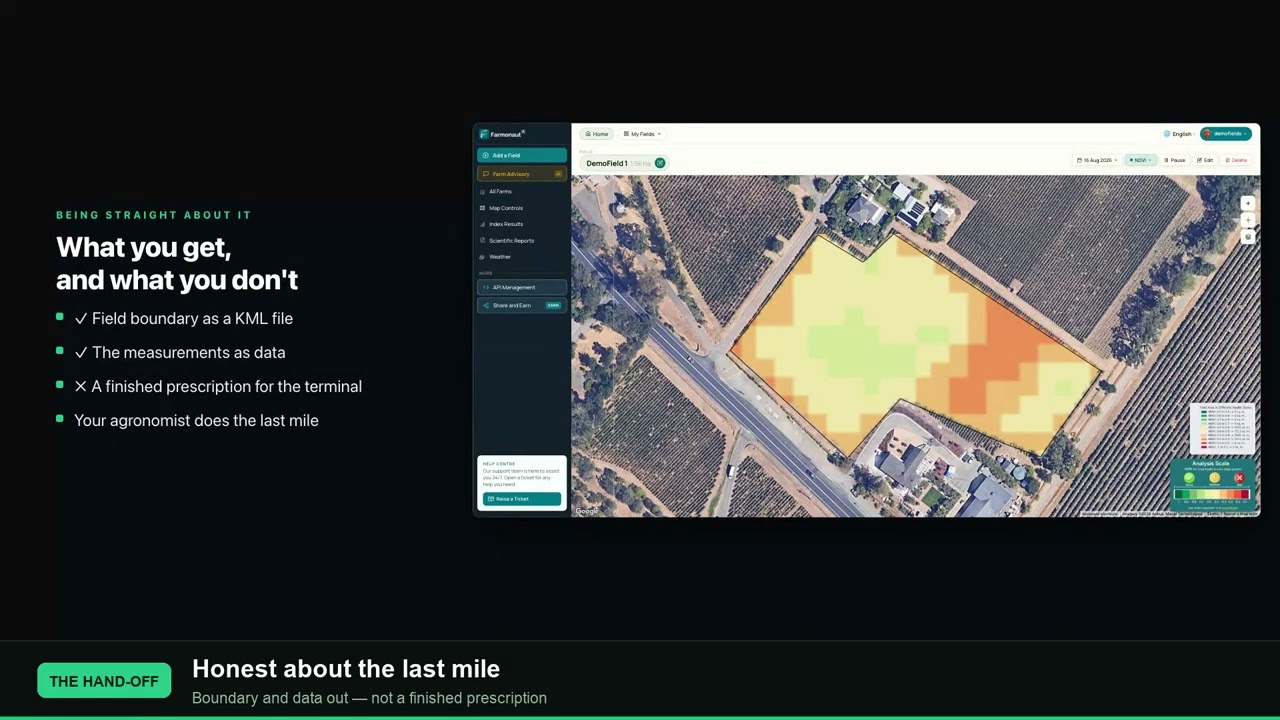
▶ How satellite crop maps create the zones that precision farm machinery acts on · 2:12
Buying a used Case IH combine
A used combine can cut the purchase price a lot, but prices move with hours, condition and region. We did not find a free, public dataset of dated auction results for Case IH combines that we could check, so we do not quote used prices here. Check recent sale results from auction companies and compare like for like: model year, engine and separator hours, tracks or wheels, and header.
- Ask for the service records and the separator and engine hours.
- Inspect the rotor, concaves, feeder chain, cleaning system and unload auger for wear.
- Confirm the display, guidance receiver and software can be updated.
- Check that the header fits and that parts are easy to get in your area.
- Get the machine checked by a dealer technician before you pay.
For field records, see our product traceability and carbon footprinting pages.
How we checked the numbers
Model names, power, tank size and unload rate come from the Case IH US website in October 2026. Prices come only from dated public studies: the University of Illinois machinery cost estimates for 2017 to 2025 and the Manitoba Agriculture 2026/2027 guide. Custom rates come from the University of Wisconsin-Madison Extension 2025 survey. The price trend uses the USDA NASS prices-paid index. We did not use dealer ads or unsourced price lists. Software developers can pull satellite and weather data through the Farmonaut API developer docs, and the mobile apps are listed on the Farmonaut app page.
If this topic matters to you, read Best Knapsack Sprayer: Stihl, Jacto & Battery Models next.
FAQ
How much is a new Case combine?
Case IH does not publish list prices. Public benchmarks for a generic combine run from $645,700 (330 hp) to $818,200 (540 hp) list in the University of Illinois 2025 study, and from C$600,000 (Class 6) to C$1,150,000 (Class 10+) in the Manitoba 2026/2027 guide. Headers cost extra.
What is the largest Case IH combine?
The AF10 and AF11 are the most powerful, at 775 hp and Class 10+. The AF11 has twin rotors; the AF10 has one long rotor. Both list a 567 bu grain tank on the Case IH US site.
Do all Axial-Flow combines have one rotor?
Most do. Case IH says it began single-rotor development in the 1960s. The 160 series, 260 series, AF9 and AF10 use one rotor. The AF11 is the exception, with the twin-rotor AFXL2 system.
Are the 8250 and 9250 still sold new?
The current US 260 series pages list the 7260, 8260 and 9260. The older 250 series still appears in Case IH finance offers, so some dealers may have stock. Ask your dealer what is available.
What does it cost per acre to run a combine?
It depends mostly on acres. In the University of Illinois 2025 estimates, a 470 hp combine cost $54.40 per acre of corn at 2,500 acres, including the corn head, fuel and labor. Custom rates in Wisconsin averaged $38.47 per acre for corn in 2025.
Do Case IH combines need a technology subscription?
Case IH says its factory precision technology on the 160 series is subscription-free for the life of the modem hardware, and the 260 and AF pages also describe subscription-free connectivity. Check which guidance and automation options are in your quote.
Farmonaut crop monitoring
See crop health before harvest
Farmonaut Satellite + AI Farm Monitoring System maps crop health across your fields during the season, which can help you plan the order of harvest.




Keep reading
Sources
- University of Illinois, Machinery Cost Estimates: Harvesting (August 2025): farmdoc.illinois.edu
- University of Illinois, Machinery Cost Estimates: Harvesting (September 2023): farmdoc.illinois.edu
- University of Illinois, Machinery Cost Estimates: Harvesting (September 2021): farmdoc.illinois.edu
- University of Illinois, Machinery Cost Estimates: Harvesting (July 2019): farmdoc.illinois.edu
- University of Illinois, Machinery Cost Estimates: Harvesting (June 2017): farmdoc.illinois.edu
- farmdoc daily, Large Increase in Machinery Costs Suggests Need to Reconsider Machinery Purchase Decisions (October 2025): farmdocdaily.illinois.edu
- USDA NASS, Agricultural Prices, text release (September 2026): esmis.nal.usda.gov
- USDA NASS, Agricultural Prices, PDF (September 2026): release.nass.usda.gov
- Manitoba Agriculture, Cost of Production Farm Machinery (2026/2027): manitoba.ca
- University of Wisconsin-Madison Extension, Custom Rates for 2025 Wisconsin Farm Operations (2026): farms.extension.wisc.edu
- University of Wisconsin-Madison Extension, Custom Rates for 2025 Wisconsin Farm Operations, PDF (2026): farms.extension.wisc.edu
- Case IH US, Axial-Flow 160 Series combines (checked October 2026): caseih.com
- Case IH US, Axial-Flow 260 Series combines (checked October 2026): caseih.com
- Case IH US, AF Series combines (checked October 2026): caseih.com
- Case IH US, Axial-Flow 6160 (checked October 2026): caseih.com
- Case IH US, Axial-Flow 9260 (checked October 2026): caseih.com
- Case IH US, AF11 (checked October 2026): caseih.com
- CNH, Case IH adds Axial-Flow 160 and 260 series (November 2023): media.cnh.com
- CNH, Case IH reveals single-rotor AF9 and AF10 (August 2024): media.cnh.com
- Case IH US, Axial-Flow 7260 (checked October 2026): caseih.com
- Case IH US, Axial-Flow 8260 (checked October 2026): caseih.com
- Case IH US, AF9 (checked October 2026): caseih.com
Discussion
Questions, corrections or field experience? Share them below. First-time comments are reviewed before they appear, and your email is never published.
No comments yet. Be the first to add a question or your experience.

 Shaurya Technosoft
 Polaris Digitech
 Teledarbas
 Wild Oak Farm
 SFX
 BACF Africa
 Doodlakine
 Exurbia Geospatial
 FieldZero
 Indico Company
 Kubota
 FFBS
 Jontra
 Tucor

 Licence holder · Niger · Gold










