

Pepper diseases · Control guide
Pepper Leaf Curl Virus Treatment: 7-Step Control Plan
No spray cures a pepper plant once a leaf curl virus is inside it. Treatment means removing sick plants early, controlling the whiteflies or leafhoppers that carry the virus, and protecting new plantings with clean transplants, reflective mulch, screens and weed control.

Key takeaways
- Leaf curl viruses in pepper cannot be cured in the plant; NMSU says no chemical controls the virus itself.
- Whiteflies (Bemisia tabaci) spread leaf curl begomoviruses such as TYLCV; the beet leafhopper spreads curly top in the dry western US.
- UC IPM’s whitefly threshold for field peppers is about 4 adults per leaf in a 30-leaf sample, and reflective mulch delays damaging numbers by 4 to 6 weeks.
- UC IPM says no curly top-resistant pepper varieties exist, so clean transplants, weed control and roguing carry the load.
- New Mexico’s 2024 chile crop was worth an estimated $52.2 million on 8,000 acres (USDA NASS).
In this article
- What causes leaf curl in peppers
- Symptoms of pepper leaf curl virus
- Why the virus matters: what is at stake in chile fields
- Pepper leaf curl virus treatment: a step-by-step plan
- Insecticides for the whitefly vector
- Organic and low-toxicity options
- Does a spray programme pay? Calculate it
- Comparing the main control methods
- Using field monitoring to find problem patches
- Chilli leaf curl virus treatment at home
- FAQ
There is no spray that cures a pepper plant once a leaf curl virus is inside it. Pepper leaf curl virus treatment therefore means three things: pull out infected plants early, cut the insects that spread the virus, and protect the next planting with clean transplants, reflective mulch, screens and resistant varieties where they exist. The New Mexico State University curly top guide says plainly that no chemical controls the virus itself.
This guide is for chile and bell pepper growers and the advisers who work with them. It covers how to tell which virus you have, a step-by-step control plan, the insecticide groups extension services list for whiteflies, organic options, and a calculator that tells you whether a spray programme pays on your own acres.
What causes leaf curl in peppers
Several different problems make pepper leaves curl. Getting the cause right matters, because the fix for a virus is very different from the fix for heat stress or mites.
Viruses carried by whiteflies
The leaf curl group of viruses are geminiviruses (genus begomovirus). They are spread by the sweetpotato whitefly, Bemisia tabaci, also called silverleaf whitefly. Tomato yellow leaf curl virus (TYLCV) is the best-known one in North America. The University of Hawaii fact sheet on TYLCV notes that pepper is among the crops this virus can infect, and that a whitefly can pick it up after only a few minutes of feeding and stays infective for life. In pepper, TYLCV often causes few or no symptoms, so peppers can act as a hidden source of the virus for nearby tomatoes.
Other begomoviruses cause clear leaf curl in chile peppers in warm regions of Latin America, Africa and Asia. Their names differ by region, but they share the same vector and the same control plan.
Curly top, carried by leafhoppers
In the dry western United States a common viral leaf curl in chile is curly top. It is caused by beet curly top virus, another geminivirus, and spread by the beet leafhopper (Circulifer tenellus), not by whiteflies. NMSU reports that the virus infects over 300 plant species in 44 families, and survives in weeds such as Russian thistle and wild mustards. A leafhopper can pass on the virus after feeding on a sick plant for as little as one minute.
Problems that look like a virus
Not every curled leaf is viral. Broad mites, aphids, heat, sudden water stress and herbicide drift can all curl pepper leaves. Clues that point away from a virus: the curl is even across the whole field, new growth recovers after the weather changes, or you can see mites or aphids with a hand lens. If in doubt, send a sample to your state or provincial plant diagnostic lab before you spend money on sprays.

▶ Our video on papaya ringspot virus shows how an insect-spread plant virus is managed when infected plants cannot be cured. · 16:40
Symptoms of pepper leaf curl virus
Symptoms vary with the virus, the variety and the plant’s age when infected. The signs below come from the NMSU and UC IPM guides.
- Upward rolling or cupping of leaves, often with thick, stiff, crisp leaf tissue.
- Yellow or light green leaves, sometimes with purple veins (curly top).
- Short internodes and stunting. The UC IPM pepper guidelines for curly top describe the top of the plant looking like a rosette or small bouquet.
- Small fruit that stays upright instead of hanging, and poor fruit set.
- Death of young plants. Seedlings infected early may die; plants infected later survive but stay yellow and small.
Timing helps diagnosis. NMSU notes curly top symptoms can appear within 24 hours in high summer heat, in 12 to 14 days at average temperatures, and up to 30 days in cool weather. The UC fact sheet on TYLCV says infected transplants may take up to 3 weeks to show symptoms, so a virus can arrive on plants that look healthy.
Why the virus matters: what is at stake in chile fields
Chile peppers are a high-value crop on a small area, so losing even a few percent of yield costs real money. New Mexico, the largest chile-producing state, harvested 8,000 acres in 2024 that produced 52,000 tons worth an estimated $52.2 million, according to the USDA NASS New Mexico Annual Bulletin for 2024. Average yield was 6.5 tons per acre and the average price was $1,004 per ton.
The value of the New Mexico crop has moved between about $41 million and $54 million a year over the last decade. Disease, water and labour all play a part, so the chart shows the size of the stake, not the effect of any one virus.
The same bulletin ranks New Mexico first and California second for chile pepper output in 2024. Together the two states grew about 86% of the US total. Both have whiteflies, and both have curly top in some years.
Chart
Value of New Mexico chile production
US$ million per year, fresh and processed chile combined, 2015 to 2024
Chart
US chile pepper production by state
Thousand cwt, 2024; chile peppers exclude bell peppers
Pepper leaf curl virus treatment: a step-by-step plan
Since the plant cannot be cured, every step targets the source of the virus or the insect that carries it. The order below follows the season.
1. Start with clean transplants
Buy or raise transplants in a screened house, and check them before planting. The UC IPM fact sheet on TYLCV points to infected transplants as a main route for long-distance spread. Do not grow peppers and tomatoes for transplant in the same house as older infected crops.
2. Use resistant or tolerant varieties where they exist
Resistance depends on the virus. TYLCV-resistant tomato varieties are widely sold, and the University of Hawaii advises against growing other solanaceous crops, such as pepper, next to tomatoes, as they can hold the virus. For curly top, UC IPM states that resistant varieties are available for beans and sugarbeet but not for pepper or tomato. NMSU suggests planting several chile cultivars, since some may be somewhat tolerant.
3. Lay reflective mulch before planting
Silver or aluminium-coloured plastic mulch repels adult whiteflies. The UC IPM pepper whitefly guidelines say reflective mulch laid before seeding or transplanting reduces colonisation and delays damaging whitefly numbers by 4 to 6 weeks. The effect fades once foliage covers more than 60% of the bed, so mulch protects the youngest, most vulnerable plants.
4. Exclude insects from young plants
In greenhouses and tunnels, use insect screen rated for whiteflies on vents and doors. In home gardens and small plots, NMSU suggests netted cages over young chile plants to keep leafhoppers off, removed once the plants mature. Light shade also helps against curly top, because beet leafhoppers prefer sunny spots.
5. Control weeds and host plants around the field
Weeds carry both the viruses and the insects. Russian thistle, London rocket and flixweed are hosts of curly top in New Mexico. For whitefly-borne viruses, UC IPM recommends host-free periods, and the UC fact sheet on TYLCV names a tomato-free period in Imperial County as one possible step. Clean up crop residue promptly after harvest.
6. Rogue infected plants early
Pull out plants with clear symptoms as soon as you see them. The University of Hawaii advises bagging symptomatic plants before removal so whiteflies on them do not fly to healthy plants. Removing a sick plant does not save it, but it removes a source of virus for the rest of the field.
7. Scout weekly and spray only above a threshold
Check plants at least every week, and twice a week when nearby host crops are drying down. For field peppers in California, UC IPM gives a treatment threshold for silverleaf whitefly of about 4 adults per leaf in a random sample of 30 healthy leaves. If whiteflies are concentrated at the edges, treat only the edges; this saves money and protects natural enemies. In greenhouses, the UConn whitefly fact sheet suggests about one yellow sticky card per 1,000 sq ft, changed weekly so you can track whether numbers rise or fall.
For curly top, field-by-field spraying does not help much. UC IPM notes that California runs a statewide programme to spray the leafhopper on its breeding grounds, and does not recommend control measures for individual fields.
Insecticides for the whitefly vector
Insecticides cannot cure infected plants. They lower the number of whiteflies that move the virus to healthy plants. UC IPM’s pepper guidelines list the products below for whiteflies. The list is a guide, not a recommendation; registrations differ between states and countries.
| Active ingredient | Example product | IRAC group | Notes from UC IPM |
|---|---|---|---|
| Acetamiprid | Assail 70WP | 4A | Max four applications a season; toxic to bees |
| Dinotefuran | Venom | 4A | Foliar or soil use; toxic to bees |
| Imidacloprid | Admire Pro | 4A | Soil use; highly toxic to bees |
| Cyantraniliprole | Exirel, Verimark | 28 | Highly toxic to bees |
| Pyriproxyfen | Knack | 7C | Growth regulator; does not kill adults |
| Spiromesifen | Oberon 2 SC | 23 | 1-day PHI; check label |
| Spirotetramat | Movento | 23 | 1-day PHI; check label |
| Mineral oil | JMS Stylet-Oil | UNM | Organic option; needs full coverage |
| Insecticidal soap | M-Pede | None | Organic option; no residual effect |
Two rules make these products last longer. First, rotate between mode-of-action groups. UC IPM advises not using products from the same group more than twice a season, and the Insecticide Resistance Action Committee recommends rotating groups so that successive pest generations are not treated with the same group. Second, avoid using neonicotinoids (group 4A) both as a soil drench and a foliar spray on the same crop. The UConn fact sheet warns that the Q biotype of Bemisia tabaci resists many commonly used insecticides.
The preharvest interval (PHI), the number of days between the last spray and harvest, differs widely between products. Plan any late-season spray around it. Always check the label in your hands, because PHI and rates can change.
Older advice often lists pyrethroids such as cypermethrin and bifenthrin. UC IPM mentions bifenthrin only as a tank-mix partner with pyriproxyfen to kill adults. Broad-spectrum pyrethroids also kill the natural enemies that keep whiteflies down, so use them with care. Follow the product label and local rules, and ask your extension adviser or a licensed crop adviser before you spray.
Chart
Preharvest interval of pepper whitefly products
Days from last application to harvest, as listed by UC IPM (table last updated June 2016); check the current label
Organic and low-toxicity options
Organic options suppress whiteflies but do not cure infected plants. They work best on light infestations and need repeated, thorough coverage of leaf undersides, where whiteflies live.
- Insecticidal soap and horticultural oil. Both kill by contact and have no lasting residual effect. The UC IPM Pest Notes on whiteflies advise using soaps or oils only on plants that are not drought-stressed and when temperatures are below 90°F, to avoid leaf burn.
- Neem oil. The National Pesticide Information Center explains that azadirachtin, the main active part, reduces insect feeding and disrupts growth and egg laying.
- Natural enemies. UC IPM lists parasitic wasps (Encarsia and Eretmocerus), bigeyed bugs, lacewing larvae and lady beetle larvae as whitefly enemies. UC IPM notes Encarsia formosa has been used with success against greenhouse whitefly in protected crops.
- Reflective mulch. UC Pest Notes say reflective mulches deter insects that carry viruses in commercial vegetables. Remove them if summer heat starts to cook the plants.
- Yellow sticky traps. They catch adults and show trends, but will not clear a heavy infestation alone.
Organic does not mean harmless. Check with your certifier before using any product, and follow the label. For more on biological products, see our guides to organic pesticides for farming and sustainable crop protection ingredients. Research on bio-pesticide volatility covers how these products behave after spraying.
Does a spray programme pay? Calculate it
A whitefly programme pays only if the yield it protects is worth more than it costs. Use the calculator below with your own figures. The yield and price defaults echo the 2024 New Mexico averages from USDA NASS, but they are examples only; use today’s price and your own yield.
Try the numbers for your own farm below.
Calculator
Will a whitefly programme pay on your peppers?
Enter your own acres, yield, price, expected loss avoided and programme cost.
- Crop value protected per acre: $130
- Break-even loss avoided: 2.00 %
- Gross crop value of the area: $130,000
Example values only, not a benchmark or forecast. Default yield (6.5 t/acre) and price (about US$1,000/t) echo the 2024 New Mexico chile averages in the USDA NASS New Mexico Annual Bulletin 2024; loss avoided and cost are round examples set near break-even.
Comparing the main control methods
| Method | What it does | Main limit |
|---|---|---|
| Clean transplants | Keeps virus out at planting | Needs a screened nursery |
| Resistant varieties | Plants resist or tolerate infection | None for curly top in pepper (UC IPM) |
| Reflective mulch | Delays whitefly build-up 4 to 6 weeks | Fades above 60% leaf cover |
| Screens and cages | Physically keep vectors off | Practical mainly for tunnels and small plots |
| Weed control | Removes virus and insect hosts | Must cover field edges too |
| Roguing | Removes virus sources | Does not save the sick plant |
| Insecticides | Cuts whitefly numbers | Resistance, bee toxicity, PHI |
| Soaps, oils, neem | Suppresses light infestations | Needs repeat, full coverage |
No single method is enough. Extension guides combine them: clean plants and mulch at the start, weed and host control around the field, weekly scouting, and sprays only when numbers pass a threshold.
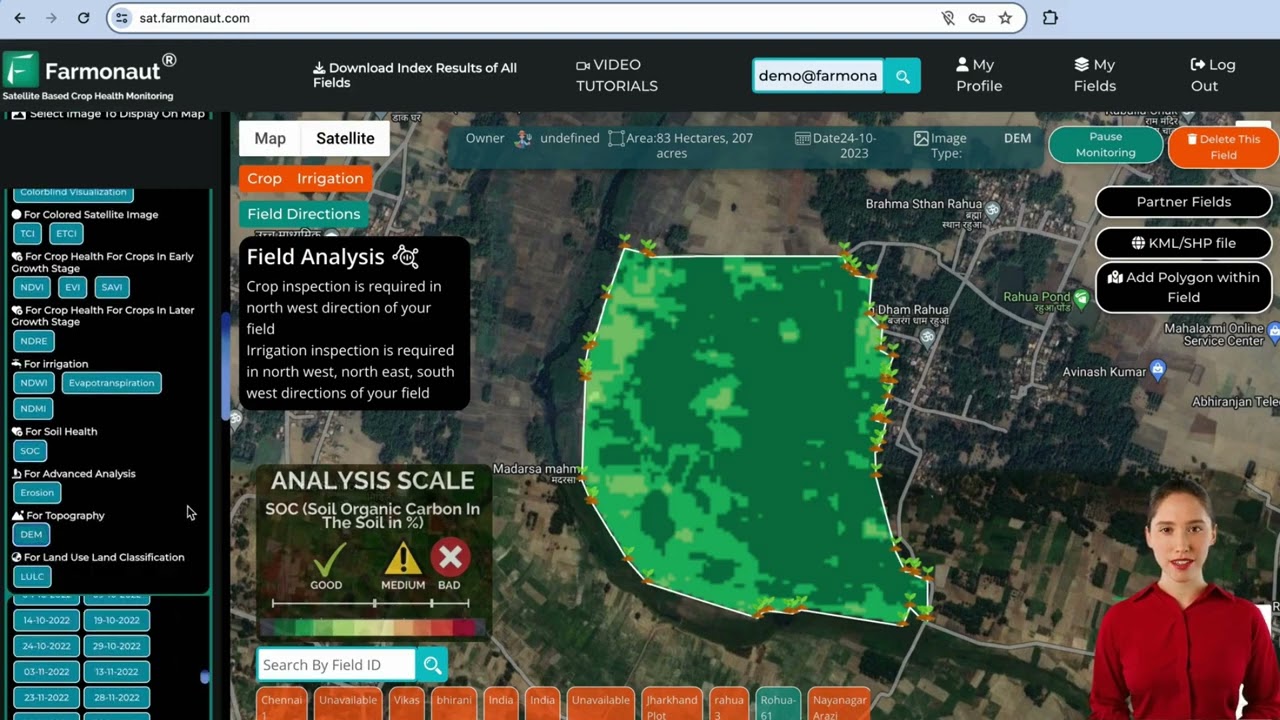
▶ A walk-through of the Farmonaut web app for satellite field monitoring. · 8:02
Using field monitoring to find problem patches
Viral leaf curl often starts at field edges near weeds or older crops, then spreads. Satellite crop-health maps cannot name a virus or count whiteflies, but they can show patches where plants grow less well than the rest of the field. Farmonaut Satellite + AI Farm Monitoring System gives vegetation maps for each field so you can send scouts to weak patches first and confirm the cause on the ground. Weather data, such as the feeds in our satellite weather API documentation, can help time scouting when warm spells favour whiteflies and leafhoppers.
Leaf curl is also a problem in tree fruit, though there it is usually a fungus, not a virus. Our guide to peach leaf curl treatment covers that disease.
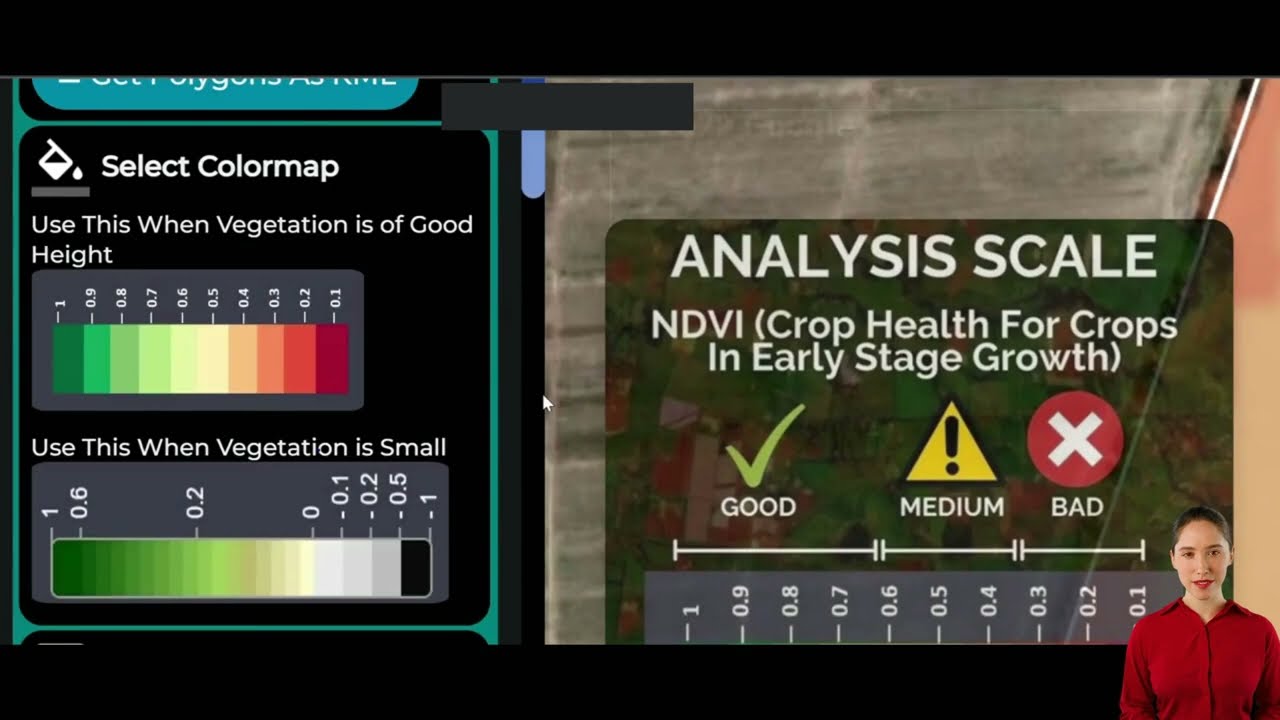
▶ How to read satellite crop-health layers to find weak patches in a field. · 10:16
Chilli leaf curl virus treatment at home
Home gardeners face the same viruses with fewer tools. The steps that work best on a small scale are simple:
- Buy healthy-looking transplants from a trusted nursery and check leaf undersides for whiteflies.
- Cover young plants with fine netting or a cage, and place them where they get a little afternoon shade if curly top is common in your area.
- Pull out and bag any plant with clear leaf curl symptoms.
- Keep weeds down around the garden.
- Use insecticidal soap or oil on light whitefly infestations, below 90°F, and repeat as the label allows.
Home remedies such as garlic or chili sprays may repel some insects, but no home remedy cures a virus-infected plant.
FAQ
Can a pepper plant recover from leaf curl virus?
No. Once a pepper plant is infected, the virus stays in it for life. Plants infected late may still give some fruit, but young infected plants often stay stunted or die. Remove them so they do not spread the virus.
What is the best treatment for leaf curl in chilli plants?
A combined plan: clean transplants, reflective mulch, weed control, early removal of sick plants and threshold-based control of whiteflies. If the curl is not caused by a virus, the fix is different, for example a miticide for broad mites. Confirm the cause first.
Why do chilli leaves curl upwards?
Upward rolling is a typical sign of curly top and of whitefly-borne leaf curl viruses. Heat, water stress, mites and herbicide drift can cause curling too. A plant diagnostic lab can test for viruses.
Does neem oil cure leaf curl virus?
No. Neem oil can reduce whitefly feeding and breeding, which slows spread to healthy plants. It does not affect the virus inside an infected plant.
Which insecticides control whiteflies on peppers?
UC IPM lists acetamiprid, dinotefuran, imidacloprid, cyantraniliprole, pyriproxyfen, spiromesifen, spirotetramat, mineral oil and insecticidal soap for pepper whiteflies. Rotate IRAC groups, follow the label and local rules, and check which products are registered where you farm.
Is curly top the same as pepper leaf curl virus?
Both are geminiviruses and both curl leaves, but they are spread by different insects. Curly top is carried by the beet leafhopper in the dry West; leaf curl begomoviruses are carried by whiteflies.
Related pages on our site: weed control strategies; monitoring app download.
Farmonaut crop monitoring
Find weak patches in your pepper fields
Satellite crop-health maps show where to scout first, so you can confirm the cause on the ground.




Keep reading

Sources
- NMSU Extension, Guide H-106: Curly Top Virus: pubs.nmsu.edu
- UC IPM, Peppers: Beet Curly Top (UC ANR Pub. 3460): ipm.ucanr.edu
- UC IPM, Peppers: Whiteflies (UC ANR Pub. 3460): ipm.ucanr.edu
- UC IPM, Pest Notes: Whiteflies (Pub. 7401): ipm.ucanr.edu
- UC IPM, Tomato Yellow Leaf Curl: A New Disease in California Tomatoes (2007): ipm.ucanr.edu
- University of Hawaii CTAHR, PD-70 Tomato Yellow Leaf Curl: ctahr.hawaii.edu
- USDA NASS, New Mexico Annual Bulletin 2024: nmdeptag.nmsu.edu
- UConn IPM, Whiteflies fact sheet (2023): ipm-cahnr.media.uconn.edu
- IRAC, Modes of action and resistance management: irac-online.org
- National Pesticide Information Center, Neem Oil General Fact Sheet: npic.orst.edu
Discussion
Questions, corrections or field experience? Share them below. First-time comments are reviewed before they appear, and your email is never published.
No comments yet. Be the first to add a question or your experience.

 Sarvome
 Polaris Digitech
 Teledarbas
 Wild Oak Farm
 SFX
 BACF Africa
 Doodlakine
 Exurbia Geospatial
 FieldZero
 Indico Company
 Kubota
 FFBS
 Jontra

 Client · Oregon, USA · Gold
 Licence holder · Niger · Gold
 Client · Tanzania · Gold
 Client · Somalia · Gold
 Client & affiliate partner · Ghana · Gold










