

Reviewed September 2026 against USDA NASS Census of Agriculture and USDA Economic Research Service data.
Try it: Enter values above to calculate. →
What CSA Software Does, and What the Data Shows
Community supported agriculture software is the set of tools a farm uses to sell shares in advance, track what’s ready to harvest, and manage pickup or delivery — replacing spreadsheets and paper sign-up sheets with a system built around the CSA subscription cycle. The category exists because CSA has a specific operating pattern that generic farm software doesn’t handle well: members pay upfront for a season, the farm owes them a share of whatever the harvest produces, and both sides need visibility into that arrangement week to week.
The market context matters here. The USDA Census of Agriculture counted 7,244 farms running CSA operations in 2020, generating $225 million in CSA sales revenue that year, according to the USDA National Agricultural Library. That’s down from 12,617 farms marketing CSA arrangements in the 2012 Census, per the USDA National Agricultural Statistics Service. CSA is a smaller, more specialized slice of direct-to-consumer farming than it was a decade ago — which is exactly why the software running it needs to fit the model precisely rather than being a generic add-on.
This guide covers what CSA management software actually does, how to evaluate it against your farm’s size and member count, where the broader direct-to-consumer numbers stand, and where Farmonaut’s satellite and API tools plug into a CSA’s field-management side.

Community Supported Agriculture Statistics: The Numbers Behind the Model
CSA is one piece of a larger direct-to-consumer farm sales category, and the two get conflated often enough that it’s worth separating them. The 2022 Census of Agriculture recorded 116,617 US farms with direct-to-consumer sales operations, moving $17.5 billion in food through direct marketing channels — but that’s only about 6% of all US farms, according to the USDA Economic Research Service. A further 60,332 farms sold through farm-to-retail and institutional channels (restaurants, grocers, school systems) rather than direct-to-consumer. CSA sits inside that 116,617-farm direct-to-consumer figure as a specific subscription-based subset — the 7,244-farm CSA count from 2020 is roughly 6% of the direct-to-consumer total, which tells you CSA is a minority model even within an already-small direct-sales segment.
Two adjacent numbers explain why software vendors increasingly market to CSA operators specifically. First, sustainability practices are scaling on US farms generally: 40 million acres are under USDA-supported regenerative agriculture practices as of 2023, and cover crop adoption reached 7.5% of US farms in the 2022 Census, per USDA. Second, the software market underneath all of this is growing — IMARC Group projects the US farm management software market will reach $1.75 billion by 2033, per the IMARC Group market report. That figure covers farm management software broadly, not a CSA-specific submarket — no publisher currently breaks out CSA subscription software as its own category, so treat $1.75B as the outer bound of the addressable market CSA tools compete in, not a CSA-specific number.
What the Census does not publish: CSA-specific software adoption rates, average share prices or membership fees by region, member retention/churn by state, or yield and soil-health comparisons between CSA and conventional farms. If your business case depends on one of those, the reliable path is a direct survey of your own membership and a comparison against your state’s Cooperative Extension CSA resources, since no national dataset currently covers them.
Community Supported Agriculture Statistics: Quick Reference
| Metric | Figure | Year | Source |
|---|---|---|---|
| Farms marketing CSA arrangements | 12,617 | 2012 | USDA Census of Agriculture |
| Farms operating CSAs | 7,244 | 2020 | USDA Census of Agriculture |
| CSA sales revenue | $225 million | 2020 | USDA Census of Agriculture |
| Direct-to-consumer sales farms | 116,617 | 2022 | USDA Census of Agriculture |
| Direct marketing food sales | $17.5 billion | 2022 | USDA Census of Agriculture |
| US farms with direct-to-consumer sales | 6% | 2022 | USDA Census of Agriculture |
| Farm-to-retail/institutional sales farms | 60,332 | 2022 | USDA Census of Agriculture |
| Regenerative agriculture acreage (USDA-supported) | 40 million acres | 2023 | USDA |
| Cover crop adoption rate | 7.5% of US farms | 2022 | USDA Census of Agriculture |
| US farm management software market (projected) | $1.75 billion | 2033 | IMARC Group |
The Census of Agriculture is conducted every five years — the 2022 edition is the most recent, and the next release is due in 2027. For figures between Census years, USDA NASS runs the Quick Stats database at data.nass.usda.gov with more frequent updates on subsets of this data. Organic and CSA practice detail specifically will next update through the USDA NASS 2025 Organic Survey, with results scheduled for release on October 30, 2026.
CSA Management Software: Core Features Compared
“CSA management software” and “csa subscription software” both describe the same core category: tools built around the pay-in-advance, share-per-week structure that distinguishes CSA from a farm stand or farmers-market booth. The features that matter for a CSA specifically, versus a generic point-of-sale or e-commerce platform, come down to six areas.
Six Features That Distinguish CSA-Specific Software
- Subscription and share management: handling upfront payment collection, share-size tiers (full/half share), payment plans, and mid-season member additions or pauses — a feature set generic e-commerce carts don’t have because they’re built for one-off transactions, not season-long subscriptions.
- Harvest and inventory tracking: matching what’s actually ready in the field against what’s owed to members that week, so a farm can substitute or adjust share contents in real time rather than promising produce it doesn’t have.
- Crop planning tools: planning succession plantings against member count and share size commitments, so the farm sows enough of each crop to fill shares across the full season rather than running short in August.
- Delivery and pickup scheduling: coordinating home drop-off routes, on-farm pickup windows, or off-site pickup points (including farmers market collection, covered below) without member confusion about where their share is that week.
- Member communication portals: a channel for weekly newsletters, recipe suggestions for that week’s share contents, and direct farmer-to-member messages — the relationship-building layer that differentiates CSA from anonymous retail.
- Resource and field-data integration: connecting soil, irrigation, and crop-health data into planning decisions, which is where satellite-based tools (see the Farmonaut section below) extend what pure subscription-management software covers.
Explore Farmonaut’s Field-Data Tools
Pair CSA subscription management with satellite-based field monitoring.



Integrate satellite data into your CSA’s crop-planning workflow:
- Try Farmonaut’s Satellite API for field-level crop health and soil monitoring.
- See the API Developer Documentation.

Choosing CSA Subscription Software: A Buyer’s Checklist
There’s no single “best” CSA app — the right tool depends on member count, share model, and whether the farm needs field-data integration or just subscription billing. Use this checklist to narrow the field before evaluating specific products:
Questions to Ask Before Committing to a Platform
- How many members and share tiers does it need to support? A 40-member single-tier CSA has different scaling needs than a 400-member operation running full, half, and add-on shares.
- Does it handle mid-season payment plans or only upfront-in-full? Some CSA members can’t pay a full season upfront; software that only supports one-time annual billing will lose those members.
- Can it substitute share contents when a crop fails? Real-time inventory matching against harvest data prevents promising produce that isn’t in the field that week.
- Does it integrate with a farmers market pickup point? If members collect shares at a market rather than the farm, the software needs to reconcile market-day pickup lists against the subscription roster.
- What does it cost per member, and does that scale linearly? Per-member pricing that seemed reasonable at 50 members can become expensive at 300 — model the cost at your target membership size, not your current one.
- Does it export data you can act on? A platform that locks harvest and membership data inside its own dashboard is harder to combine with independent field-monitoring tools like a satellite API.
CSA Share Pricing & Break-Even Calculator
Use the calculator below to estimate the number of members your CSA needs at a given share price to cover a target season budget, and see what revenue is left over as margin.
Enter values above to calculate.
Assumptions: this calculator treats the season budget and software cost as fixed regardless of membership size, and full-share price as the only revenue line — it excludes half-share or add-on tiers, market-stall sales, grants, and payment-processing fees. It is a planning estimate, not a financial projection; run your own numbers against your actual cost structure before setting share prices.
Community Sustainable and Community Managed Agriculture
“Community sustainable agriculture” and “community managed sustainable agriculture” describe CSA operations where stewardship and shared decision-making go beyond the basic pay-for-a-share transaction — members participate in farm decisions, volunteer on-site, or co-manage land access. This model overlaps with what’s sometimes called community shared agriculture, a closely related term used in some regions for the same farmer-member partnership structure.
- Regenerative practices: crop rotation, cover cropping, and organic inputs to build soil health — cover crops were used on 7.5% of US farms as of the 2022 Census, and 40 million acres carry USDA-supported regenerative practices as of 2023, per USDA.
- Carbon tracking: monitoring and verifying emissions reductions and soil carbon storage through carbon footprinting tools.
- Community education: volunteer days, workshops, and school partnerships that build local sustainability literacy.
- Access and inclusion: sliding-scale shares, SNAP/EBT acceptance where a farm’s state program allows it, and structured member intake to keep shares accessible.
These practices intersect with, but are broader than, “community support agriculture” in the narrow subscription sense — they’re what separates a CSA that’s purely transactional from one built around ongoing stewardship of the land and the relationship with members.

Composting and Waste Reduction Inside a CSA
Composting is a standard operational layer for CSAs pursuing circular, low-waste production, and it connects directly to two things covered above: harvest-tracking software (which flags unsellable or surplus produce before it’s wasted) and the regenerative practices described in the previous section.
How On-Farm and Cooperative Composting Typically Works
- On-site compost stations: CSA farms set up drop-off points where members return food scraps, which the farm then composts and returns to its own fields.
- Municipal or cooperative partnerships: some farms work with city composting programs or regional cooperatives to process surplus food and green waste at larger scale than one farm could alone.
- Circular return to the field: finished compost lowers input costs (less purchased fertilizer) and supports the soil-health metrics tracked under regenerative practice adoption.
No national dataset currently breaks out compost volume or landfill-diversion rates specifically for CSA operations — if you need a number for your own farm or county, your state’s Cooperative Extension office or municipal solid-waste department is the direct source, since USDA’s Census tracks farm sales and practices rather than waste-stream volumes.

CSA Apps at Farmers Markets: Pickup and Logistics
Farmers markets remain a common pickup point for CSA shares, particularly for farms without the delivery infrastructure to run home drop-off routes. A csa app that supports market-day pickup needs to reconcile the member roster against who actually collected their share that week — otherwise farms lose track of missed pickups and food goes to waste.
What to Look for in Market-Integrated CSA Software
- Pickup confirmation: a way to check members off as they collect shares at the market stall, so unclaimed shares can be redirected (donated, composted, or reallocated) same-day.
- Multi-location routing: for CSAs running pickup at more than one market or drop point, software that tracks which members are assigned to which location.
- Real-time member communication: alerts for schedule changes, share substitutions, or market cancellations (weather, holidays) sent directly to the member roster.
This is one of the areas where CSA-specific software earns its cost over a generic spreadsheet: reconciling a market-day pickup list against a subscription roster by hand doesn’t scale much past a few dozen members before missed pickups start going untracked.
Where Farmonaut Fits: Satellite Data for CSA Operations
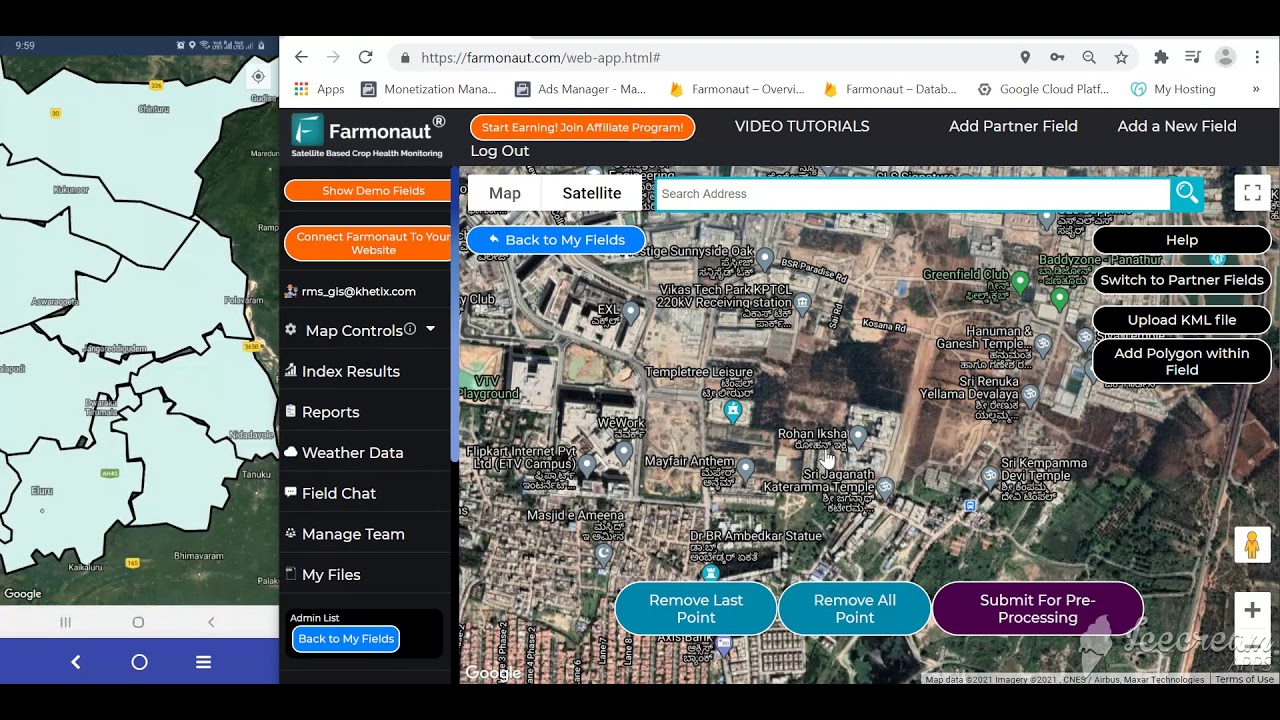
Farmonaut doesn’t replace CSA subscription-management software — it complements it, covering the field-data side that pure subscription platforms don’t. For a CSA managing crop planning, resource use, and supply-chain transparency, satellite and AI tools extend what a member-and-billing system tracks.
- Satellite-based field monitoring: multispectral imagery for soil health, crop status (NDVI, moisture), and field risk, feeding into planting and share-planning decisions.
- Jeevn AI advisory: weather forecasting and field-action guidance to support harvest planning across the season.
- Blockchain traceability: chain-of-custody verification through traceability tools, useful for CSAs that want to show members exactly where their share came from.
- Fleet and delivery management: routing and vehicle tracking tools for CSAs running home delivery or multi-stop market drop-offs.
- Carbon footprint tracking: monitoring tools for farms documenting emissions reductions to members or grant programs.
- Crop loan and insurance access: satellite-verified financing services that can support CSA farmers seeking working capital between seasons.
For CSAs scaling past a single-farm operation, large-scale farm management tools extend the same monitoring across multiple fields or partner farms feeding into one subscription program.

Developers integrating field data into a CSA platform can use Farmonaut’s API and developer documentation.
Frequently Asked Questions: CSA Software and Statistics
What is community supported agriculture?
CSA is a direct arrangement where members pay a farm in advance for a share of the season’s harvest, sharing production risk with the farmer in exchange for a stake in the output. USDA’s Census of Agriculture counted 7,244 US farms running CSA operations in 2020, generating $225 million in sales, per the USDA National Agricultural Library.
What does community supported agriculture software actually manage?
Subscription billing and share tiers, harvest and inventory matching against what’s owed to members, crop planning against membership commitments, pickup or delivery scheduling, and member communication — the operational layer specific to a subscription-and-share model rather than one-off retail sales.
Is there CSA-specific market-size data?
Not published separately. The broader US farm management software market is projected to reach $1.75 billion by 2033, per IMARC Group, but no source currently isolates CSA subscription software as its own tracked category.
How many CSA farms are there in the US, and is the number growing?
The Census counted 12,617 farms marketing CSA arrangements in 2012 and 7,244 operating CSAs in 2020 — a decline, not growth, over that period, per USDA. The broader direct-to-consumer sales category (116,617 farms in 2022) is a separate, larger figure that includes farm stands and farmers-market sales alongside CSA.
What’s the difference between community supported agriculture and community sustainable agriculture?
CSA describes the subscription-and-share transaction structure. Community sustainable or community managed agriculture describes farms layering stewardship practices — regenerative growing, member co-management, carbon tracking — on top of that structure. Many operations are both at once.
How does community composting fit into a CSA?
Composting reduces surplus waste and returns nutrients to the farm’s own fields, often coordinated through on-site drop points or municipal partnerships. No national dataset tracks compost volume by CSA specifically; check with your state’s Cooperative Extension for local figures.
Can CSAs coordinate pickups through farmers markets?
Yes — many CSAs use a local farmers market as a share pickup point rather than running home delivery. CSA apps built for this reconcile the market-day pickup list against the member roster so missed pickups are caught the same day.
Where can I start with satellite-based tools for CSA field management?
Farmonaut’s web and mobile platforms and API (with developer docs) cover field monitoring; pair with a subscription-management platform for the member-facing side.

Getting Started
CSA remains a small but specific slice of US direct-to-consumer farming — 7,244 farms and $225 million in sales as of the 2020 Census, inside a direct-to-consumer category of 116,617 farms and $17.5 billion as of 2022, per USDA. The software layer built specifically for CSA (subscription billing, harvest-matched share allocation, pickup and delivery scheduling) is what separates farms that scale their membership smoothly from ones that hit an administrative ceiling around 50-100 members run by spreadsheet.
For a farm evaluating tools: start with the buyer’s checklist above, run your own numbers through the pricing calculator, and check USDA NASS Quick Stats (data.nass.usda.gov) for any figure here that needs refreshing beyond what’s cited — the Census updates every five years, with the next full release due in 2027, while the 2025 Organic Survey results (due October 30, 2026) will refresh organic and CSA practice detail sooner. Combine CSA-specific subscription software with field-monitoring tools like Farmonaut for the parts a billing platform alone doesn’t cover: crop health, resource use, and traceability.
Ready to bring satellite-based field data into your CSA?

 Cazlv
Cazlv HIPSAC
 ZOL Zimbabwe
 Juligerm
 AdBio
AdBio MISE Maroc
 Drift-Sense
 NWNS
NWNS Red August Group
 Farm Inc
 WeMe Global
 Agrotoken
 Blue BearX
 Insignito
 Croptimum
 DnCubed
 Field Capacity
 Indosistim Teknologi
