

Crop systems · Comparison guide
Double Cropping vs Crop Rotation: Which Fits Your Farm
Double cropping harvests two crops from a field in one year; crop rotation changes the crop from year to year. The first adds output, the second protects yield and soil, and many farms combine them.
Key takeaways
- 6% of US soybean acres were planted after another harvested crop in 2025, up from 4% in 2024 (USDA NASS survey data).
- The share was far higher in Oklahoma (45%), Delaware (36%) and North Carolina (31%) than in Illinois or Ohio (6%).
- Corn yielded 10 to 19% more after soybeans, and soybeans 14 to 23% more after corn, in University of Wisconsin trials.
- In a 12-year North China Plain trial, rotations that skipped the yearly wheat-maize double crop used 14 to 28% less water.
- A corn, wheat and double crop soybean sequence gives three crops in two years and keeps the rotation benefit.
In this article
- Double cropping vs crop rotation at a glance
- What is double cropping?
- What is crop rotation?
- Other cropping farming systems you will see
- Benefits and trade-offs, ranked by what they mean for income
- Does a double crop pay? Test it on your numbers
- How to choose between the two
- How to combine double cropping and crop rotation
- A step-by-step plan for your fields
- Cost-share for crop rotation
- How satellites help track rotations and second crops
- How we checked the numbers
- FAQ
Double cropping means harvesting two crops from the same field in one year, such as winter wheat followed by soybeans. Crop rotation means changing which crop grows on a field from one year to the next, such as corn one year and soybeans the next. In the double cropping vs crop rotation choice, the first adds a harvest, while the second protects yield and soil over time, and many farms do both in one plan.
This guide compares the two cropping farming systems with dated numbers from the USDA, university extension services and peer-reviewed studies. It shows where US farmers double crop soybeans, how large the rotation yield effect is, what each system does to water and nutrients, and gives a calculator to test whether a second crop pays on your own costs.
Double cropping vs crop rotation at a glance
The table sums up the main differences. Each row has its own section below with the source behind it.
| Question | Double cropping | Crop rotation |
|---|---|---|
| Time frame | Two crops within one crop year | Different crops over several years |
| Main goal | More output from the same acre | Higher yield per crop, fewer pest and disease problems |
| Typical US example | Winter wheat, then soybeans | Corn, then soybeans |
| Measured effect | An extra harvest, often with lower yield than a full-season crop | Corn yield up 10 to 19% after soybeans in Wisconsin trials |
| Water | Uses more water per year | Can use less water than a yearly two-crop system |
| Nutrients | Removes more nutrients each year | Legumes in the sequence can supply some nitrogen |
| Main risk | Late planting, dry summers, tight timing | Lower income in years with a less profitable crop |
| Best for | Long seasons, enough rain or irrigation | Almost any field with two or more market crops |
What is double cropping?
The federal crop insurance rules give a plain definition. A double crop means “producing two or more crops for harvest on the same acreage in the same crop year”, according to the Common Crop Insurance Policy in 7 CFR 457.8. The second crop is planted after the first is harvested, so the two crops do not share the field at the same time.
Chart
Double crop soybean share by state, 2025
Percent of soybean acreage planted after another harvested crop, seven highest states
The USDA Economic Research Service studied the practice in its report Multi-Cropping Practices: Recent Trends in Double-Cropping. It describes double cropping as a way to raise output without adding acres, and it built a baseline of US patterns from 1999 to 2012.
Common double crop sequences
- Winter wheat, then soybeans. The most familiar US sequence. Wheat is cut in early summer and soybeans are planted into the stubble.
- Winter barley, then soybeans or sorghum. Barley comes off a little earlier than wheat in many areas, which gives the second crop more time.
- Small grain, then a forage crop. Livestock farms often follow a cereal with summer annual forage for grazing or silage.
- Vegetables in two or three plantings. Market gardens with short-season crops can fit several harvests into one season.
- Winter wheat, then summer maize. The main system on the North China Plain, which produced 61% of China’s wheat and 45% of its maize in 2008 figures cited by a study in Frontiers in Plant Science.
Where US farmers double crop soybeans
Each June, the USDA National Agricultural Statistics Service asks soybean growers how much of their crop follows another harvested crop. In its Acreage report of June 2025, the share for the whole United States was 6%, up from 4% in 2024. NASS notes these are raw survey results that show a trend, not official estimates.
The national share is small because the large Corn Belt states plant almost all soybeans as a single, full-season crop. Illinois reported 6% and Ohio 6% in 2025. The share is much higher in southern and mid-Atlantic states with longer seasons, as the chart shows.
Season length is the main reason. A double crop needs enough warm days after the first harvest for the second crop to mature before frost. Our guide to growing degree days by zip code explains how to count that heat for your own location.
Chart
US soybeans planted after another harvested crop
Percent of US soybean acreage, June survey, 2021 to 2025
What is crop rotation?
Crop rotation is a planned order of different crops on the same field over several seasons. A simple rotation is corn followed by soybeans. A longer one might run corn, soybeans, wheat and a legume hay or cover crop. The point is that each crop leaves the field in a different state for the next one: different roots, residue, nutrient needs and pests.
▶ Seven simple ways to protect soil and water, including cover crops and rotation. · 4:34
SARE, the USDA-funded Sustainable Agriculture Research and Education program, publishes a manual called Crop Rotation on Organic Farms. It covers how rotation affects soil quality, pests, diseases and weeds, and how to draw rotation planning maps. The same ideas apply on conventional farms.
The rotation effect on yield
The yield gain from rotating is well measured in the Corn Belt. In a University of Wisconsin fact sheet, corn agronomist Joe Lauer reports that corn yield increases 10 to 19% when rotated with soybean, and soybean yield increases 14 to 23% when rotated with corn. He adds that the effect is even larger in stressful years.
The same fact sheet says the effect lasts at most two years. With two or more break years, second-year corn yields 7 to 8% more than continuous corn. With only one break year, second-year corn yields the same as continuous corn. In other words, longer breaks between the same crop protect more of the benefit.
Lauer also cites a review of 610 studies in which no-till cut yield by 5.7% on average, but the loss was smallest when no-till was combined with residue retention and crop rotation. Rotation helps reduced-tillage systems work.
Chart
Yield gain from rotating corn and soybeans
Percent yield increase over the same crop grown continuously, Wisconsin trials
Other cropping farming systems you will see
Double cropping and rotation are two of several ways to arrange crops in space and time. Knowing the terms helps when you read seed guides, insurance rules or extension advice.
- Multiple cropping: the general term for more than one crop on a field in a year. Double cropping is the two-crop case; triple cropping is possible in warm, irrigated areas.
- Relay cropping: the second crop is planted into the first before harvest, for example soybeans seeded into standing wheat. It buys time but makes harvest harder.
- Intercropping: two crops grow side by side in the same field at the same time, often in alternating rows or strips.
- Cover cropping: a crop grown mainly to protect and feed the soil rather than for sale. It often fills the gap in a rotation.
- Alley cropping: annual crops grown in the alleys between rows of trees or shrubs. This agroforestry system adds shade, wind protection, habitat for useful insects and a second income from wood, fruit or nuts over the long term.
For a wider list of methods, see our overview of methods of farming in agriculture.
Benefits and trade-offs, ranked by what they mean for income
The six points below are ordered by how directly they affect farm income in a typical year. Each gives the system it favors and the source behind it.
1. More harvests per acre
Best for: double cropping.
A second crop is extra grain or forage from land you already pay for. Rent, taxes and much of the machinery cost are spread over two crops instead of one. That is the main reason the ERS report describes double cropping as a way to raise output without adding acres.
The catch is yield. A soybean crop planted after wheat in early summer has a shorter season than one planted in spring. Purdue Extension notes that seeding rates for soybeans following wheat may be greater because stands are harder to establish. Plan the second crop as a separate enterprise with its own budget, not as a free bonus.
2. Higher yield per crop
Best for: crop rotation.
The Wisconsin figures above show the size of this gain: 10 to 19% more corn and 14 to 23% more soybeans than when each crop follows itself. On a field that would yield 180 bushels of continuous corn, a 10% gain is 18 bushels per acre. That gain needs no extra seed or land, though its size varies from year to year.
3. Soil nutrients
Best for: rotation, with careful fertility planning in either system.
Every harvest carries nutrients off the field. Ohio State University measured how much. With a 180-bushel corn crop, about 62 pounds of P2O5 and 36 pounds of K2O per acre leave in the grain. A 60-bushel soybean crop removes about 47 pounds of P2O5 and 68 pounds of K2O. Over a corn and soybean rotation, the fact sheet puts the total at roughly 100 to 120 pounds per acre of each.
A double crop adds a second harvest, so it adds a second round of removal in the same year. Soil test every few years and replace what leaves the field. Fertilizer choices depend on local soils and rules, so check the label and your state’s guidance, or ask a certified crop adviser.
4. Water use
Best for: rotation in dry or irrigated regions.
Two crops a year use more water than one. The clearest long-term evidence comes from the North China Plain, where irrigation of the wheat and maize double crop has lowered groundwater by about 1 meter a year. A 12-year field trial published in Frontiers in Plant Science found that rotations which skip the double crop in some years used 14 to 28% less water each year. Wheat also produced up to 19% more grain per unit of water in those rotations.
The lesson for US, Australian or southern European farms is not the exact numbers. It is that a double crop on irrigated land should be judged on water cost as well as grain, and in dry summers the second crop may not have enough moisture to pay.
5. Pest, disease and weed breaks
Best for: crop rotation.
Many insects, diseases and weeds build up when the same crop or crop family returns year after year. A break crop starves them of their host. Double cropping alone does not provide that break if both crops are similar, and it can carry residue-borne disease from one crop straight into the next. Pairing unlike crops, such as a cereal and a legume, keeps some of the break inside one year.
6. Cash flow and risk
Best for: both, in different ways.
A double crop gives two sales in one year, which can smooth cash flow. A rotation spreads price risk across two or more markets. On the risk side, crop insurance has specific rules for double crops. The federal policy sets conditions under which a second crop is insured after the first, and different rules apply when the first crop was not planted. Read your policy and ask your crop insurance agent before you plant a second crop.
Chart
Water saved by rotations vs a yearly double crop
Percent lower annual evapotranspiration than winter wheat-summer maize every year, 12-year trial, North China Plain
Does a double crop pay? Test it on your numbers
The calculator below works out the margin on a second crop for one acre. Only count the costs the second crop adds. Land rent and costs already covered by the first crop are left out. The default values are examples set close to break-even. Replace them with your own yield, price and cost figures from your records or your state’s extension budget.
Try the numbers for your own farm below.
Calculator
Does a second crop pay on one acre?
Enter your own yield, price and the costs the second crop adds.
- Gross income: $400 per acre
- Added costs: $390 per acre
- Break-even yield: 39.0 bu/acre
Example values only, set near break-even; they are not a benchmark or a forecast. Use your own records, local harvest bids and your state’s extension crop budget. Only include costs the second crop adds; leave out land rent and costs already paid by the first crop.
If the margin is small, the risk side matters more. A late harvest of the first crop, a dry spell at planting or an early frost can turn a thin profit into a loss. If the margin holds up at a lower yield, the double crop has room for a bad year.
How to choose between the two
Work through these questions for each field. The answers usually point to one system, or to a mix.
- How long is your frost-free season? If the first crop comes off with too little time for a second crop to mature, rotation alone is the safer choice.
- Is there water for a second crop? Check summer rainfall records or your irrigation allowance. A dry spell at planting is a common reason double crops struggle.
- Can you plant fast? The second crop needs to go in within days of harvest. That needs the right planter, labor and, often, no-till.
- Do you have a market for both crops? Price the second crop at harvest-time local bids, not at the year’s high.
- What pests and diseases are on the field? If soybean cyst nematode, corn rootworm or a cereal disease is building up, a true rotation break matters more than an extra harvest.
- What does your soil test say? Low phosphorus or potassium means a second harvest will need more fertilizer.
- How is your insurance written? Confirm that both crops are insurable on the field before you plant.
How to combine double cropping and crop rotation
The two systems are not rivals. A common pattern in the mid-Atlantic and the southern Corn Belt is a three-crop, two-year rotation: corn in year one, then winter wheat sown in the fall, then double crop soybeans after the wheat harvest. Over two years the field produces three crops, and corn still follows soybeans.
Other mixes work as well:
- Cover crops in the gap. Where a full second crop is too risky, a cover crop after harvest protects the soil. SARE’s Cover Crops for Sustainable Crop Rotations notes that many studies show cover crops can raise yield, often after just one year.
- Forage as the second crop. Mixed farms can graze or bale a summer annual after a small grain, which also adds manure back to the field.
- Legumes in the sequence. Soybeans, peas, clover or alfalfa add nitrogen and break cereal pest cycles.

▶ Six benefits of mixing crops and livestock, from manure as fertilizer to crop leftovers as feed. · 2:55
A step-by-step plan for your fields
- Map each field’s history. List what grew on each field for the last three to five years. Gaps show where the same crop has followed itself.
- Group fields by season length and water. Fields with early harvest and good moisture are double crop candidates.
- Draft a rotation for each group. Aim for at least one year break between the same crop, and two where pests are a problem.
- Budget the second crop separately. Use the calculator above with your local bids and costs.
- Soil test and set fertilizer. Replace nutrients removed by each harvest, following label rates and local rules.
- Check insurance and programs. Confirm double crop rules with your agent and ask your local USDA service center about rotation cost-share.
- Watch the crops in season. A second crop planted late is more exposed to stress, so check it more often.
- Record the results. Note yields, costs and problems on each field to improve next year’s plan.
Cost-share for crop rotation
In the United States, the Natural Resources Conservation Service pays farmers to adopt practices such as Conservation Crop Rotation, practice code 328, under the EQIP program. Rates vary by state and year. As one dated example, the Pennsylvania NRCS cost list for fiscal year 2026 shows $11.71 per acre for a basic two-crop-type rotation and $54.64 per acre for a short-term perennial rotation, with an annual cap of $20,000 for the practice. These are published payment rates, not a promise of funding. Check the current list and rules for your state at your local USDA service center.
Outside the US, similar schemes exist under national farm policy in Canada, the UK, the EU and Australia. Rules change often, so check the current program with your local agency or adviser.
How satellites help track rotations and second crops
Rotation records are only as good as the field history behind them. The USDA publishes the Cropland Data Layer, a satellite-based crop map of the United States. Its Crop Frequency Data Layers show how often each field has grown corn, cotton, soybeans or wheat since 2008, which makes it possible to see where corn or soybeans follow themselves.
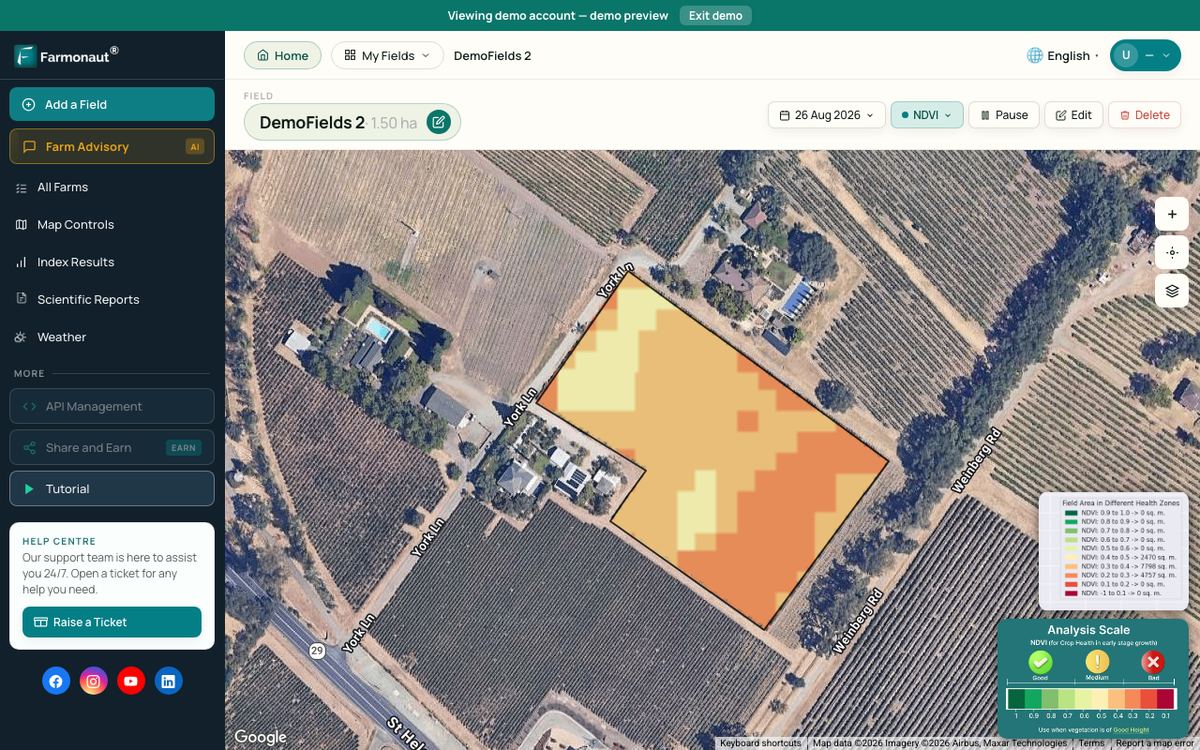
On your own farm, satellite crop health maps show how a second crop is establishing and where it is under stress. Farmonaut gives vegetation and moisture maps for fields you draw once, on web, Android or iOS, so you can compare a double crop field with a rotated field through the season.
▶ How satellite NDVI maps show crop stress across a large farm before it is visible on foot. · 4:09
How we checked the numbers
We used primary sources only: the USDA NASS Acreage report of June 2025 for double crop soybean shares, the USDA ERS double-cropping report, the federal crop insurance rule in 7 CFR 457.8, extension fact sheets from the University of Wisconsin, Ohio State University and Purdue University, SARE publications, a 12-year field trial in Frontiers in Plant Science, and the Pennsylvania NRCS cost list for fiscal year 2026. We removed claims from the earlier version of this page that had no source, including fixed percentages for yield gains, erosion cuts and herbicide savings.
FAQ
What is the main difference between double cropping and crop rotation?
Double cropping grows two crops on a field within one year, one after the other. Crop rotation changes the crop on a field from year to year. Double cropping adds output in a single year; rotation protects yield and soil over several years.
Is double cropping bad for the soil?
Not by itself. A second harvest removes more nutrients and water, so it needs soil testing and fertility planning. When the two crops are different, such as wheat and soybeans, and residue stays on the field, double cropping can sit inside a healthy rotation.
Which crops are best for double cropping in the US?
Winter wheat or barley followed by soybeans is the most common pairing. In the June 2025 USDA survey, the share of soybeans planted after another harvested crop was highest in Oklahoma, Delaware, North Carolina, Alabama and Kentucky.
How long should a crop rotation be?
A two-year corn and soybean rotation gave corn 10 to 19% and soybeans 14 to 23% more yield in Wisconsin trials. Where pests or diseases are a problem, two or more break years between the same crop give a larger benefit.
Can I do both on the same field?
Yes. A corn, wheat and double crop soybean sequence gives three crops in two years and still rotates corn with soybeans. It suits fields with a long season and enough summer moisture.
Related pages on our site: carbon footprinting, crop loan and insurance verification, satellite and weather API, fleet management, product traceability and farm admin app.
Farmonaut crop monitoring
See your own fields from space
Draw your fields once and Farmonaut shows satellite vegetation maps for each crop through the season, on web, Android or iOS.



Keep reading

Sources
- USDA NASS, Acreage (June 2025): nass.usda.gov
- USDA ERS, Multi-Cropping Practices: Recent Trends in Double-Cropping, EIB-125 (May 2014): ers.usda.gov
- 7 CFR 457.8, Common Crop Insurance Policy (Cornell Legal Information Institute): law.cornell.edu
- J. Lauer, The Corn-Soybean Rotation x Tillage Interaction, University of Wisconsin (May 2015): corn.aae.wisc.edu
- Ohio State University, Nutrients Removed with Harvested Corn, Soybean, and Wheat Grain in Ohio, ANR-74 (2019): ohioline.osu.edu
- Purdue Extension, AY-217: Plant Populations and Seeding Rates for Soybeans: extension.purdue.edu
- Yang et al., Mitigating Groundwater Depletion in North China Plain with Cropping System that Alternate Deep and Shallow Rooted Crops, Frontiers in Plant Science (2017): frontiersin.org
- SARE, Crop Rotation on Organic Farms: sare.org
- SARE, Cover Crops for Sustainable Crop Rotations: sare.org
- USDA NRCS Pennsylvania, Published Cost List and Payment Caps for FY 2026 EQIP and CSP: nrcs-prod.azureedge.us
- USDA NASS, Cropland Data Layer FAQs (Crop Frequency Data Layers): nass.usda.gov
Discussion
Questions, corrections or field experience? Share them below. First-time comments are reviewed before they appear, and your email is never published.
No comments yet. Be the first to add a question or your experience.

 M11 Agri
 Sapoznick Farms
 Agrotoken
 Blue BearX
 Insignito
 Croptimum
 DnCubed
 Field Capacity
 Indosistim Teknologi
 Liquify Digital
 CU Foods
 BeyondTech Global
 Rouge VC
 AgroGreen Dynamics
 AgroRisk
 Oath Inc
 Reddane Farming
 Esri North East Africa
 Licence holder · Niger · Gold










