

Soil residues · Farm safety guide
Dieldrin and Aldrin: Uses, Bans and Farm Soil Risks
Dieldrin and aldrin were organochlorine insecticides used on corn, cotton and citrus until about 1970 and on termites until 1989 (ATSDR). Residues still turn up in soil, stream sediment, fish, some wells and cucurbit crops.
Key takeaways
- Aldrin turns into dieldrin in soil and living things; neither has been used as an insecticide in the US after 1989 (ATSDR).
- Both are listed in Annex A (elimination) of the Stockholm Convention on Persistent Organic Pollutants.
- USGS found dieldrin in bed sediment at 17% of agricultural and 42% of urban stream sites sampled in 1992-2001, and it caused most well benchmark exceedances (72 wells).
- Zucchini, cucumber and melon showed high dieldrin uptake in Italian trials; tomato, lettuce and celery were suggested as substitutes.
- EPA’s chronic saltwater criterion for dieldrin is 0.0019 micrograms per litre, far below the acute limit of 0.71.
In this article
- Dieldrin and aldrin at a glance
- What are dieldrin and aldrin?
- Is dieldrin still used today?
- Where dieldrin residues are found on farms
- 7 risks of dieldrin on farmland
- Water limits for dieldrin
- How to check a field for dieldrin: 6 steps
- Managing land with old residues
- Dieldrin compared with other old organochlorines
- How we checked the numbers
- FAQ
Dieldrin is an organochlorine insecticide, and aldrin is a close relative that breaks down into dieldrin in soil, plants and animals. Both were sprayed on corn, cotton and citrus from the 1950s until 1970 and used against termites until 1989, and neither has been used as an insecticide since then, according to the ATSDR fact sheet on aldrin and dieldrin. The problem today is what is left behind: dieldrin binds tightly to soil, breaks down very slowly, and can still turn up in crops, livestock, streams and wells decades later.
This guide is for farmers and landowners in the US, Canada, the UK and Europe, Australia and New Zealand. It explains what the two chemicals are, where their residues are still found, seven practical risks for farmland, the water limits that apply, and how to check a field before you plant a crop that takes up residues. It includes three charts built from US government data and a calculator that compares the cost of soil testing with the crop value you put at risk.
Dieldrin and aldrin at a glance
The table sums up the main facts. Each row is explained in the sections below with its source.
| Question | Short answer | Source |
|---|---|---|
| What are they? | Two very similar organochlorine insecticides; aldrin turns into dieldrin | ATSDR |
| Main past uses | Corn, cotton and citrus pests; soil insects; termites in buildings | ATSDR |
| Still used? | No insecticide use in the US after 1989 | ATSDR |
| Global status | Listed in Annex A (elimination) of the Stockholm Convention | Stockholm Convention |
| Cancer class | Probable human carcinogens (US EPA); probably carcinogenic (IARC) | ATSDR |
| Where found now | Soil, stream sediment, fish, some wells, some cucurbit crops | USGS, EFSA |
| Crops most at risk | Zucchini, cucumber and melon showed high uptake in trials | Donnarumma et al. |
What are dieldrin and aldrin?
Both are man-made insecticides from the cyclodiene group of organochlorines. Pure aldrin and pure dieldrin are white powders with a mild chemical smell, and neither occurs in nature. Sunlight and bacteria change aldrin into dieldrin, and the body does the same, so it is mostly dieldrin that is measured in soil, water, food and blood today (ATSDR).
So, is aldrin a pesticide? Yes. It was sold as a soil insecticide. Once applied, it was converted into dieldrin. Farmers used the pair against soil pests such as corn rootworm, grasshoppers and termites. Small amounts lasted a long time in the soil, and that long life is exactly what later made them a problem.
A review in Environmental Health Perspectives (Jorgenson, 2001) brought together US research on how the two chemicals were made, where they were deposited, how they build up in animals and what health studies found. It treats them as two of the twelve original persistent organic pollutants targeted by international agreements.
Crops and uses in the past
- Corn: soil-applied against rootworms and other soil insects, mainly in the US Corn Belt.
- Cotton and citrus: listed by ATSDR among the main crop uses from the 1950s until 1970.
- Termites: treated around building foundations until 1989.
- Livestock: in New Zealand, organochlorines including dieldrin were used in sheep dips, and mobile dusting units applied aldrin and dieldrin to sheep.

▶ How soil organic matter works, the part of the soil that holds on to many chemicals. · 7:33
Is dieldrin still used today?
No. ATSDR says the two chemicals have not been used as insecticides in the US after 1989. Crop uses ended earlier, around 1970, and termite treatment was the last use. Internationally, both are listed in Annex A of the Stockholm Convention on Persistent Organic Pollutants. Annex A requires member countries to take measures to eliminate production and use of the listed chemicals.
In New Zealand, sheep dipping was a legal requirement from 1849 to 1993, and organochlorine dips were used from 1945 to 1961, according to a Taranaki Regional Council fact sheet. The same sheet puts the number of former sheep dip sites at about 50,000.
So while nobody should be buying or applying these products, the residues are still part of farm life. The European Union’s 2024 report on pesticide residues in food, published by EFSA, notes that some persistent pollutants that are no longer used as pesticides still contaminate food. Its examples include aldrin and dieldrin in courgettes and cucumbers that exceeded legal limits (EFSA 2024 EU report on pesticide residues in food).
Where dieldrin residues are found on farms
The largest US data set comes from the USGS National Water-Quality Assessment, which sampled streams, bed sediment, fish and groundwater from 1992 to 2001. Its summary report, USGS Circular 1291, found that dieldrin in agricultural streams was found most often, and at some of the highest levels, in the Corn Belt, where past use of aldrin on corn was most intensive.
Chart
Stream sites with residues in bed sediment
Percent of sampled US stream sites where the compound was detected, 1992-2001
The study period began years after the last farm use. Even so, USGS found dieldrin in bed sediment at 17% of agricultural stream sites and 42% of urban stream sites. Compounds in the DDT group were found more often: 49% of agricultural sites and 72% of urban sites. USGS links the urban results to past non-farm uses such as termite and mosquito control.
Groundwater showed a smaller but real signal. About 1% of wells sampled in agricultural areas had a pesticide above a human-health benchmark. Across all the wells USGS sampled, dieldrin accounted for most benchmark exceedances (72 wells, 39 of them shallow wells in urban areas). In shallow groundwater under urban areas, dieldrin was the insecticide found most often, in about 5% of wells sampled.
Fish carry residues too. In agricultural streams, whole-fish samples were above the low wildlife benchmark at 87% of sites for total DDT, 11% for dieldrin and 9% for toxaphene. The benchmark protects birds and mammals that eat fish.
Chart
Farm streams with fish above a wildlife benchmark
Percent of sampled agricultural stream sites, whole fish, low wildlife benchmark, 1992-2001
7 risks of dieldrin on farmland
These are the risks that matter for a working farm today. They come from the sources above, not from new use.
1. Long-lived soil residues
Dieldrin binds tightly to soil, evaporates slowly and breaks down very slowly in soil and water (ATSDR). Fields that were treated for corn rootworm or other soil pests before 1970 can still hold measurable amounts.
2. Uptake by cucurbits and root crops
Plants take in and store the two chemicals from soil (ATSDR). Field and greenhouse trials in Italy found that zucchini, cucumber and melon have a high capacity to move dieldrin from soil into fruit, and identified a dieldrin residue level of 0.01 mg/kg as a threshold to protect cucurbit quality (Donnarumma et al., 2009). The same trials named tomato, lettuce and celery as substitute crops for contaminated fields.
Research at the Connecticut Agricultural Experiment Station, funded by the US EPA, found the same pattern with DDE, a related organochlorine: zucchini and other squash (Cucurbita pepo) took up weathered residues from field soil (EPA research grant final report).
3. Residues in meat and milk
ATSDR names root crops, dairy products and meat from animals raised on contaminated land as the most likely route of exposure for people. Grazing stock can pick up residues from soil and feed. New Zealand councils warn that livestock grazing a former sheep dip area can be exposed (Waikato Regional Council sheep dip fact sheet).
4. Stock water and farm wells
The Waikato fact sheet also flags bores used for stock watering near old dip sites. USGS found dieldrin was the main cause of wells exceeding human-health benchmarks in its national survey. Old dip sites, mixing areas and chemical stores near a well are the places to check first.
5. Streams, fish and wildlife
Dieldrin moves with eroded soil into streams, where it settles in sediment and builds up in fish. USGS found it among the compounds that most often exceeded benchmarks for fish-eating wildlife.
6. Human health
People who swallowed large amounts have had convulsions, and some died. Workers exposed to lower amounts over a long time had headaches, dizziness, irritability, vomiting and uncontrolled muscle movement, and recovered once exposure stopped (ATSDR). The US EPA considers both probable human carcinogens. Its IRIS assessment of dieldrin notes that dieldrin caused tumors in seven strains of mice fed the chemical. IARC classifies both as probably carcinogenic to humans.
7. Market and compliance risk
A crop can fail a residue check even when the grower never used the product. The EU report shows that cucurbits with aldrin and dieldrin above legal limits still turn up in official sampling. For a grower, that can mean a rejected load and lost income. This is why testing before planting high-uptake crops is worth pricing out.

▶ A guide to common crop pests and diseases and how to spot problems early. · 17:29
Water limits for dieldrin
The US EPA publishes national recommended water quality criteria to protect aquatic life. For dieldrin, the freshwater acute limit is 0.24 micrograms per litre and the chronic limit is 0.056. In saltwater the acute limit is 0.71 and the chronic limit is 0.0019. For aldrin, only acute limits are listed: 3.0 in freshwater and 1.3 in saltwater (EPA aquatic life criteria table).
Chart
EPA aquatic life criteria for dieldrin
Micrograms per litre; acute (CMC) and chronic (CCC) national recommended criteria
The chronic saltwater limit is more than a hundred times lower than the acute one. That gap reflects how residues build up over time in animals that live in the water. Drinking-water and food limits are set separately by each country, so check your national or state rules if you rely on a well or sell into a regulated market.
How to check a field for dieldrin: 6 steps
Use these steps before you buy land, start growing cucurbits or root crops, or sink a new well. Testing rules and lab methods differ between countries and states, so follow local rules and get professional advice from an accredited lab or environmental consultant.
- Learn the field history. Ask former owners and neighbours about corn rootworm treatment before 1970, orchards, termite treatment near buildings and old sheep dips.
- Map the likely hot spots. Mark dip sites, mixing and loading areas, old chemical sheds and drainage paths from them.
- Plan the samples. Take composite samples across the main field and separate samples at each hot spot. Ask the lab how many cores it needs per sample.
- Use an accredited lab. Ask for an organochlorine pesticide screen that reports both aldrin and dieldrin, with detection limits low enough for food crops.
- Test water where it matters. Sample wells and bores near hot spots, especially if they serve the house or stock.
- Decide and record. If residues are found, choose crops with lower uptake, fence off hot spots and keep the results with the farm records.
The calculator compares the cost of a soil test with the value of a crop you could lose if a load is rejected. All defaults are examples only; use your own lab quote and crop value.
Try the numbers for your own farm below.
Calculator
Is a soil test worth it before planting?
Enter your own field size, lab quote and crop value.
- Total testing cost: $750
- Crop value at risk: $750
- Testing cost per acre: $150
Example values only, not benchmarks or forecasts; every number is your input. The defaults are set near break-even on purpose. ‘Share of crop at risk’ is your own judgement of how likely a load is to be rejected or downgraded; no published figure exists for a single farm. Ask your lab for its price per sample and follow local rules.
Managing land with old residues
There is no quick way to remove dieldrin from a field. The practical options are about managing exposure.
- Choose crops with care. On fields with known residues, the Italian trials point to tomato, lettuce and celery as lower-uptake choices than zucchini, cucumber or melon.
- Keep stock off hot spots. New Zealand councils advise excluding animals from former dip sites and the contaminated ground around them.
- Protect water. Keep soil on the field with cover crops and buffer strips, since dieldrin moves attached to soil particles. Test wells near old use areas.
- Wash and scrub produce. For people living near contaminated sites, ATSDR advises washing hands and scrubbing vegetables grown close to the ground.
- Keep records. Test results help with land sales, buyer audits and future crop choices.
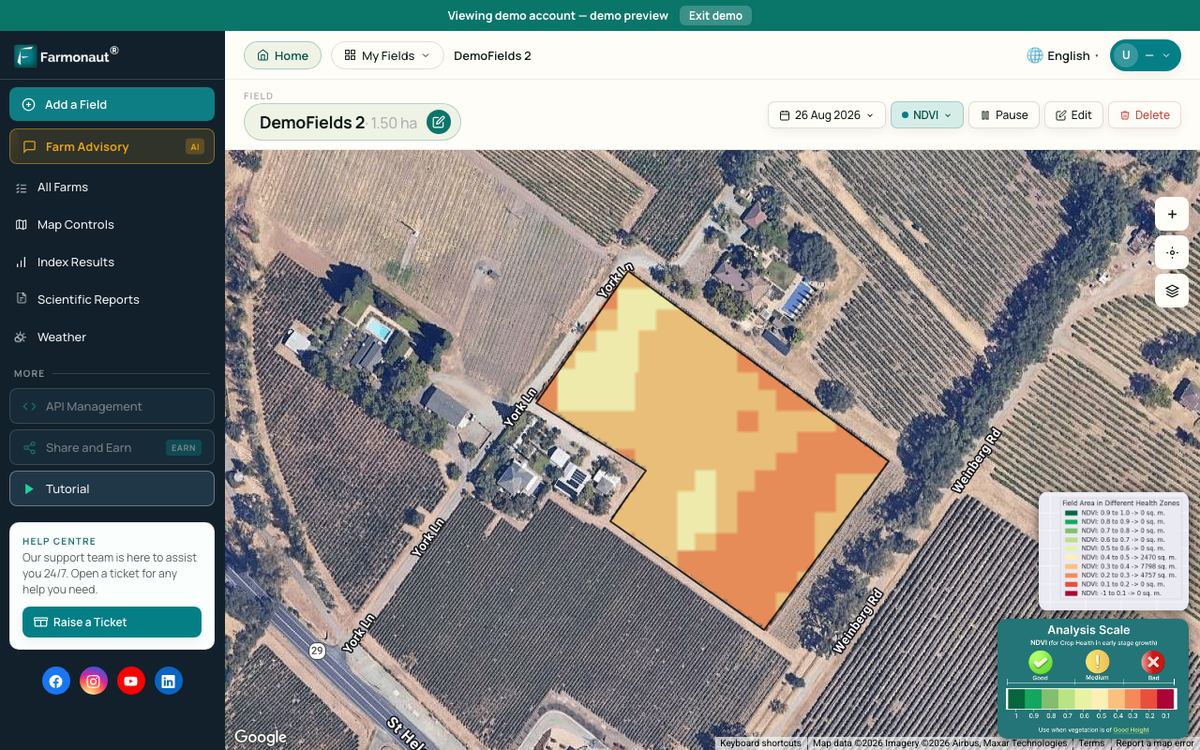
Satellite crop maps cannot detect dieldrin. What they can do is show which parts of a field grow differently over a season, which helps you decide where to place soil samples and how to compare blocks over time. The Farmonaut Satellite + AI Farm Monitoring System provides this kind of vegetation map for fields you draw once.

▶ How satellite NDVI maps show which parts of a field grow differently, useful for placing soil samples. · 4:09
Dieldrin compared with other old organochlorines
Dieldrin is often grouped with DDT, chlordane, heptachlor and toxaphene. All are persistent organochlorines, and all show up in stream sediment and fish decades after use stopped. In the USGS data, the DDT group was found more often than dieldrin, but dieldrin stood out in groundwater, where it caused most benchmark exceedances. Dieldrin is also unusual because it has two sources: direct use and the breakdown of aldrin. That is why USGS reports residues as dieldrin even where the product applied was aldrin.
For pest control today, integrated pest management relies on monitoring, thresholds, crop rotation and products that do not persist for decades. Always follow the product label and local rules for any pesticide you use.
How we checked the numbers
Every figure on this page comes from a named public source: the ATSDR fact sheet, USGS Circular 1291 (data for 1992 to 2001), the US EPA water quality criteria table and IRIS assessment, the Stockholm Convention list of persistent organic pollutants, the EFSA 2024 EU residue report, peer-reviewed crop uptake trials and New Zealand regional council fact sheets. The USGS figures describe the sites sampled in that study, not every farm. Where a source covers a related chemical such as DDE, we say so.
FAQ
Is dieldrin still used today?
No. ATSDR reports no use as an insecticide in the US after 1989, and the Stockholm Convention lists it for elimination. Residues from past use remain in some soils, sediments and wells.
Is aldrin a pesticide?
Yes. Aldrin was a soil insecticide. It changes into dieldrin in the environment and in living things, so dieldrin is what tests usually find.
Which crops take up dieldrin from soil?
Cucurbits stand out. Trials in Italy found high uptake in zucchini, cucumber and melon. ATSDR also names root crops as a likely route of exposure.
How long does dieldrin last in soil?
ATSDR says it breaks down very slowly in soil and water. USGS still found it in stream sediment at many farm sites from 1992 to 2001, decades after most farm use ended.
Should I test my farm for dieldrin?
Testing makes sense if the land grew corn, cotton or citrus before 1970, had an old sheep dip or termite treatment, or you plan to grow cucurbits or root crops for sale. Ask an accredited lab and follow local rules.
Related pages on our site: satellite crop monitoring · web and mobile app · large farm administration · product traceability · carbon footprint records · crop loans and insurance · farm fleet logistics · satellite data API · API developer documentation
Farmonaut crop monitoring
See your own fields from space
Draw your fields once and Farmonaut shows satellite vegetation maps for them through the season, on web, Android or iOS.



Keep reading

Sources
- ATSDR (CDC), ToxFAQs: Aldrin/Dieldrin: wwwn.cdc.gov
- USGS, Pesticides in the Nation’s Streams and Ground Water, 1992-2001, Circular 1291 (2006): pubs.usgs.gov
- US EPA, National Recommended Water Quality Criteria: Aquatic Life Criteria Table: epa.gov
- US EPA, IRIS chemical assessment: Dieldrin: iris.epa.gov
- Stockholm Convention, Listing of POPs in the Stockholm Convention: chm.pops.int
- EFSA, The 2024 European Union report on pesticide residues in food (2026): pmc.ncbi.nlm.nih.gov
- Jorgenson, Aldrin and dieldrin: a review of research in the United States, Environmental Health Perspectives (2001): pmc.ncbi.nlm.nih.gov
- Donnarumma et al., Dieldrin uptake by vegetable crops grown in contaminated soils, J Environ Sci Health B (2009): pubmed.ncbi.nlm.nih.gov
- US EPA NCER, Mechanistic role of plant root exudates in the phytoremediation of persistent organic pollutants, final report: cfpub.epa.gov
- Taranaki Regional Council, Sheep dip fact sheet 1: trc.govt.nz
- Waikato Regional Council, Sheep dips fact sheet: waikatoregion.govt.nz
Discussion
Questions, corrections or field experience? Share them below. First-time comments are reviewed before they appear, and your email is never published.
No comments yet. Be the first to add a question or your experience.

 Save Your Soils
 YelloSkye
 GalaxEye Space
 Grandstream Algérie
 XOS Realty
 Geospatial Lab Africa
 Agro La Gándara
 HIPSAC
 ZOL Zimbabwe
 Juligerm
 AdBio
 MISE Maroc
 NWNS
 Red August Group
 Farm Inc
 WeMe Global
 Agrotoken
 Blue BearX
 Insignito

 Licence holder · Niger · Gold
 Licence holder · Nigeria · Gold + lithium
 Client · Somalia · Gold
 Client & affiliate partner · Ghana · Gold










