

Reviewed September 2026 against USDA NASS, USDA ERS/University of Illinois farmdoc, Purdue Center for Commercial Agriculture, and the NCREIF Farmland Index.
Try it: Run your own numbers →
Invest in Agricultural Land: A Data-Backed ROI Guide
US cropland averaged $5,830 per acre in 2025, up 4.7% from the prior year, while cash rent on that same acre averaged $161, according to the USDA National Agricultural Statistics Service (NASS) Land Values report.1 That combination — a mid-single-digit rent yield plus a mid-single-digit appreciation rate — is the entire investment case for row-crop farmland, and it is also why the asset class does not behave like a stock. If you want to invest in agriculture land, the return comes from two separate engines (rent and land-price appreciation) that you can model separately, and this guide shows you the numbers to plug into each one.
This page answers, with cited figures: how to invest in land, what farmland investment ROI actually looks like over 30-plus years versus a single bad year, how row crop farmland investment compares with other agricultural land investment vehicles, and how farm input costs eat into the return before you ever see a dividend.
Table of Contents
- Why Invest in Agricultural Land
- Farmland Investment ROI: The Real Numbers
- How to Invest in Land: The Vehicles
- Farmland ROI Calculator
- Farm Input ROI: Why Net Returns Went Negative
- Due Diligence Before You Buy
- Valuation: Cap Rates and NOI
- Risk, Water, and Climate
- Carbon Revenue and Sustainability
- Financing, Taxes, and Exit Planning
- Practical Checklist and FAQs
- Try it: Run your own numbers
Why Invest in Agricultural Land
Farmland sits in most institutional portfolios for one structural reason: land is a fixed input into a good — food — whose demand does not disappear in a recession. That is a diversification argument, not a growth argument. Over the 50 years from 1974 to 2024, US farmland appreciated at an average annual rate of 6.1%, per USDA data compiled by Purdue University’s Center for Commercial Agriculture.2 That is the long-run number worth anchoring on before looking at any single year, because single years swing hard in both directions — including the year covered in the next section.
The case for agricultural land investment rests on three separate return streams, and you should evaluate each one on its own terms rather than blending them into a single vague “farmland is a good hedge” claim:
- Cash yield — rent income if you lease out the land, roughly 2–4% of land value historically as a cap rate, per USDA Economic Research Service (ERS) farmland value analysis.3
- Price appreciation — 6.1% per year over the 1974–2024 period nationally,2 though any single year can run well above or below that trend, as the 2024–2025 NASS figures and the 2024 NCREIF figures below both show.
- Operating profit — if you farm the land yourself or take a crop-share lease, your return also depends on crop-level net returns, which were negative for the two largest US row crops in 2024 (see the Farm Input ROI section).
Farmland’s low correlation with equities and bonds is real, but it is not free diversification — it comes with illiquidity (parcels routinely take 90–365 days to transact) and with commodity-price and input-cost exposure that behaves nothing like a bond coupon. The rest of this guide quantifies each of those trade-offs.
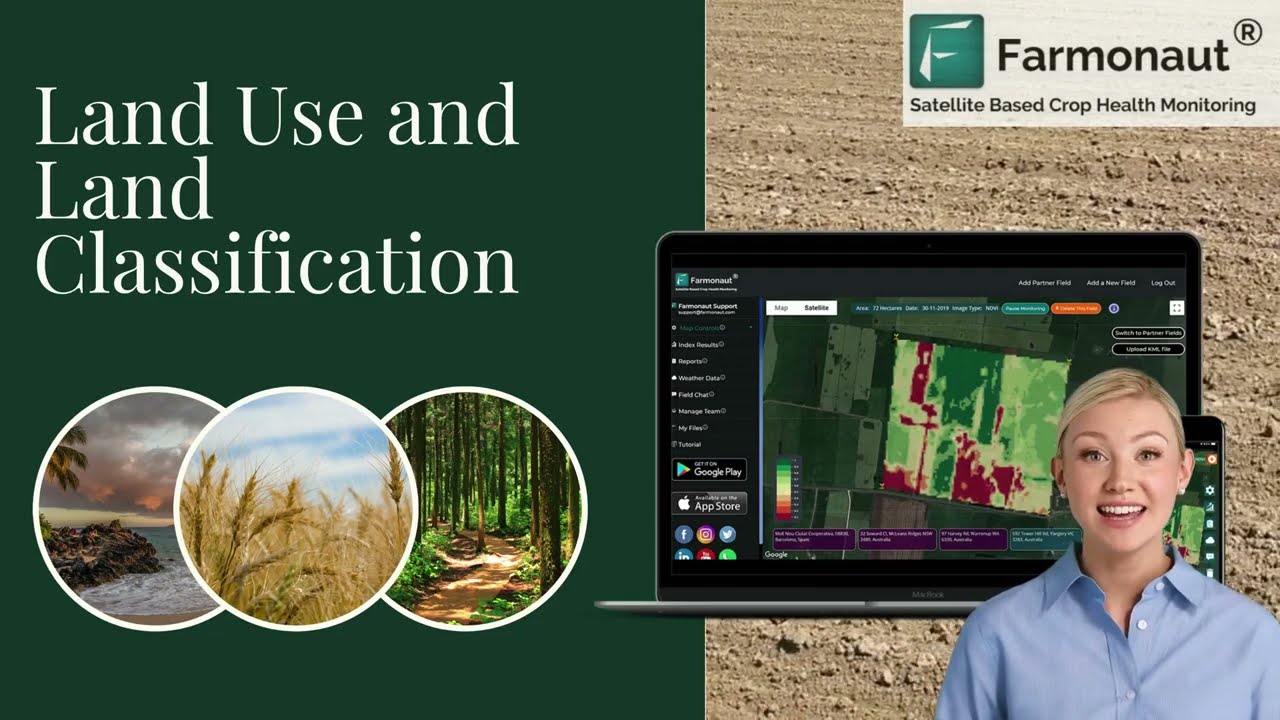
Get decision-grade satellite intelligence for farmland:
- Farmonaut API — programmatic access to satellite analytics and weather for portfolio monitoring.
- API Developer Docs — integrate NDVI, NDWI, and advisory feeds into your due diligence and operations.



Farmland Investment ROI: The Real Numbers
The single most important fact for anyone evaluating farmland investment ROI is that total return has two very different histories depending on the window you pick. Over 1992–2025, the NCREIF Farmland Index — the industry benchmark tracking institutionally owned US farmland — posted an average annual total return (combined appreciation plus rental income) of 10.2%.4 But in 2024, that same index recorded a total return of −1.03%, its first negative reading in years, as land-price gains stalled and commodity prices retreated from their 2022 peaks.5
Read those two numbers together, not separately: farmland investment ROI is a long-hold asset class where a multi-decade average of roughly 10% masks real single-year drawdowns. Anyone sizing an allocation on the 10.2% figure alone without budgeting for a year like 2024 is underwriting the asset wrong. The USDA’s 50-year 6.1% appreciation-only figure (excluding rental income) sits between those two data points and is the more conservative number to use for land-price-only modeling.2
| Metric | Period | Value | Source |
|---|---|---|---|
| Farmland price appreciation (national avg.) | 1974–2024 (50-yr avg.) | 6.1%/yr | USDA / Purdue2 |
| Total return, appreciation + rent (NCREIF Index) | 1992–2025 avg. | 10.2%/yr | NCREIF4 |
| Total return, appreciation + rent (NCREIF Index) | 2024 only | −1.03% | NCREIF5 |
| Indiana cropland appreciation | 2010–2020 avg. | 5.5%/yr | Purdue2 |
| US cropland value increase | 2024–2025 | 4.7% | USDA NASS1 |
| Cash rent yield on cropland value | 2025 ($161/acre rent ÷ $5,830/acre value) | ≈2.8% | USDA NASS1 |
| Historical income cap rate range | Historical average | 2–4% | USDA ERS3 |
Note that the implied 2025 cash-rent yield of roughly 2.8% ($161 rent divided by $5,830 land value) sits inside USDA ERS’s own long-run 2–4% cap-rate range,3 which tells you the current national land price is not obviously over- or under-renting relative to history — the 4.7% one-year appreciation is running ahead of the rent yield, which is normal in years when buyer demand for land outpaces the growth in what tenants can afford to pay.
To Get Your Own Current Numbers
These figures are national averages published once a year. For your specific county or crop mix: USDA NASS republishes the Land Values Summary every August at nass.usda.gov/Publications/Todays_Reports, and the regional Federal Reserve banks covering the Corn Belt (Chicago, Minneapolis, Kansas City) publish their own farmland value surveys quarterly — those tend to lead the annual NASS number by a quarter or two and are worth checking if you are underwriting a deal between August releases.
How to Invest in Land: The Vehicles
“How to invest in land” has at least five distinct answers, and they are not interchangeable — each trades return potential against liquidity, minimum capital, and how much agronomic risk you personally carry.
Direct Ownership (Operate or Lease Out)
Buying a parcel outright gives full control over use, management, and exit timing. You can farm it yourself, rent it out for a fixed cash payment, or use a crop-share lease that splits commodity revenue with the tenant. This is the highest-control, highest-minimum-capital, lowest-liquidity route — expect 90 to 365 days to sell a parcel even in an active local market, and expect to need local agronomic and legal expertise you may not have if you are investing outside your home region.
Farmland REITs and Listed Funds
Publicly traded farmland REITs and listed funds trade daily, like any other equity, with minimums as low as the price of one share. The trade-off is that REIT share prices carry equity-market volatility on top of the underlying farmland fundamentals — in a broad equity selloff, farmland REIT shares can fall even if the underlying land value is flat.
Private Equity and Pooled Farmland Funds
Institutional private funds and syndicates offer professional agronomic management and access to larger, aggregated parcels, but typically lock up capital for 4 to 10 years and layer a management fee plus performance carry on top of the underlying land return.
Crowdfunded Deals, JVs, and Crop-Share Arrangements
Crowdfunded farmland platforms lower the minimum check size, sometimes into the thousands of dollars rather than hundreds of thousands, by pooling many investors into a single parcel or fund. Joint ventures and crop-share arrangements align an investor’s upside directly with an operator’s, trading fixed rent certainty for commodity-price participation.
Permanent Crops and Timberland
Orchards, vineyards, and other permanent crops carry higher upfront establishment cost and a multi-year wait for first production, but historically higher income yield once mature. Timberland offers long-duration cash flows on a different cycle than annual row crops, which is itself a diversification benefit inside a farmland-focused portfolio.

Choosing Between Vehicles
| Vehicle | Typical Exit Time | Control Over Operations | Relative Minimum Capital |
|---|---|---|---|
| Direct ownership | 90–365 days | Full | Highest |
| Farmland REIT | Same-day (public market) | None | Lowest |
| Private fund/syndicate | 4–10 year lock-up | Limited partner only | High |
| Crowdfunded deal | Multi-year, deal-specific | None to limited | Low |
| Crop-share JV | Deal-specific | Shared with operator | Medium |
Learn more about entry strategies in our companion piece, how to invest in farming, which covers operator partnerships in more depth.

Farmland ROI Calculator
Run your own numbers against the two return engines described above — annual cash rent yield and land-price appreciation — using your own acreage, purchase price, and holding period instead of the national averages.
Run your own numbers
Assumes rent stays flat in nominal terms and appreciation compounds annually at the rate you enter; it excludes property taxes, insurance, closing costs, financing interest, and any operating profit or loss from farming the land directly. Default values are the 2025 USDA NASS national averages for cropland price, cash rent, and appreciation.1 Use your own local figures for a real underwriting estimate.
Farm Input ROI: Why Net Returns Went Negative
If you plan to operate the land yourself or take a crop-share position, the rent-yield numbers above do not apply to you — your return depends on farm input ROI, meaning revenue per acre minus the cost of seed, fertilizer, chemicals, fuel, and labor. That number went negative for the two largest US row crops in 2024. Net return to corn production, over total costs, was −$87 per acre, and net return to soybean production was −$61 per acre, per USDA ERS data compiled by University of Illinois farmdoc.6
This is the gap that a pure land-appreciation thesis papers over: even as national cropland value rose 4.7% in the 2024–2025 period,1 the crop grown on that land lost money for the operator once total costs — including a full accounting for owned land's opportunity cost, not just cash costs — were counted. That divergence is exactly why fixed cash rent, where the landowner is paid a set amount regardless of the tenant's crop margin, has historically been the lower-risk lease structure for an investor who is not also the operator: the −$87 and −$61 figures are the tenant's or operator's problem to manage, not the cash-rent landlord's, up to the point where a tenant cannot make rent at all.
Crop yields themselves were not the problem in 2025 — US average corn yield was 186.7 bushels per acre and average soybean yield was 53.0 bushels per acre, per USDA NASS's Crop Production Annual Summary.7 The negative net returns reflect commodity prices and input costs relative to those yields, not a production shortfall.
To Get Current Crop Prices and Cost Data
Net returns move with commodity prices every month. For current corn and soybean prices received by farmers, USDA NASS Quick Stats (quickstats.nass.usda.gov) publishes monthly averages under "Price Received." For updated cost-of-production and breakeven figures, University of Illinois farmdoc issues a new net-return analysis each fall, and Purdue's Center for Commercial Agriculture publishes a comparable quarterly analysis — check both before assuming the 2024 figures above still hold for the current crop year.
Due Diligence Before You Buy
Whichever vehicle you choose, the underwriting checklist is the same. Converting unknowns into quantified risks before closing is what separates the 10.2% long-run NCREIF average from the −1.03% 2024 outcome at the individual-parcel level.4,5
Land, Soil, and Environmental Checks
- Soil quality: texture, organic matter, pH, salinity, nutrient reserves; screen for contamination risk.
- Topography and drainage: slope, erosion exposure, ponding, and whether tile drainage or other infrastructure is needed.
- Contamination history: prior industrial or mining use, pesticide residue, and any remediation obligations attached to the title.
- Practice history: cover crops, tillage regime, and rotation — these affect both current yield and the soil's response to weather stress.
Water Rights and Irrigation
- Confirm legal water rights, adjudication status, and seniority under drought curtailment.
- Assess surface versus groundwater access, pumping limits, conveyance losses, and the condition of existing irrigation infrastructure.
- Model the cost of pump or pivot upgrades and electricity or diesel draw, and quantify the yield and net-operating-income impact of a shortage year.
Zoning, Land Use, and Policy
Check zoning, conservation easements, protected-species rules, and nutrient-management regulations before closing, and model property and transfer taxes into your net return, not just the purchase price.
Production and Operator Verification
- Pull historical yield data, input-cost records, rotation history, and pest or disease pressure for the specific parcel, not just the county average.
- Validate the operator's track record and approach to soil stewardship if you are not farming the land yourself.
- Check access to grain storage, processing, and transport corridors — basis differentials and logistics friction change the effective price you receive versus the county average.
How Satellite and AI Tools Speed Up Diligence
Multispectral satellite imagery and field-level data can validate a seller's claimed yield history before you rely on it in an underwriting model:
- Satellite-based NDVI and soil-moisture proxies help cross-check historic yield consistency against the seller's own records.
- The Jeevn AI advisory system layers in real-time weather and operational recommendations once you own the parcel.
- Environmental impact tracking supports ongoing carbon and compliance monitoring after closing.
To try these tools, use the Farmonaut API and review the API developer docs.
Beyond diligence, these tools support ongoing operational oversight:
- Carbon Footprinting — quantify emissions and track sequestration for carbon-credit planning.
- Traceability — blockchain-based proof of origin, useful for market access and premium buyer programs.
- Crop Loan & Insurance — satellite-aided verification to streamline financing and risk transfer.
- Fleet Management — track equipment to reduce fuel and maintenance costs across operations.
- Large-Scale Farm Management — centrally manage multi-parcel portfolios with data-driven oversight.


Valuation: Cap Rates and NOI
Price per acre alone is a weak valuation anchor. A more rigorous approach centers on productive acres, crop mix, normalized yield, and net operating income (NOI) — with the 2025 US average cropland value of $5,830 per acre and average cash rent of $161 per acre as your national reference point.1
Key Drivers of NOI
- Revenue: fixed cash rent, or crop-share revenue equal to price times yield times owner share.
- Operating costs: property taxes, insurance, repairs, irrigation energy, road and infrastructure upkeep, management, and professional fees.
- Capex: pivot and pump upgrades, tiling, soil amendments, and any transition to regenerative practices.
Cap Rate Math
Cap rate equals normalized NOI divided by price. On the 2025 national averages, $161 of rent against $5,830 of land value works out to roughly a 2.8% cap rate — sitting inside USDA ERS's long-run historical range of 2–4% for farmland income yield.1,3 A parcel priced well outside that range, relative to its actual rent roll, is either being bought mostly for appreciation and non-cash benefits (tax structuring, control, future development optionality) or is mispriced relative to comparable local transactions.

Lease vs. Crop-Share Mechanics
- Fixed cash lease: the owner earns a steady, pre-agreed income regardless of the crop's price or yield outcome that year — the tenant absorbs the risk illustrated by the −$87/acre corn and −$61/acre soybean net returns above.6
- Crop-share lease: the owner participates directly in commodity price and yield upside (and downside), trading a lower guaranteed floor for higher potential ceiling.
Normalize across cycles rather than underwriting off one year: use a trailing 5–10 year average of yields and prices, and stress-test against a repeat of a year like 2024, when both major row crops ran a negative net return nationally.6
Risk, Water, and Climate
Farmland risk is real and quantifiable rather than abstract. The categories to underwrite explicitly:
- Climate and weather risk: extreme weather, pest, and disease exposure. Diversify geography and crop type, and build irrigation redundancy where feasible.
- Water risk: confirm senior water rights and aquifer health; avoid over-allocated basins and price a drought scenario into your NOI model rather than assuming average rainfall every year.
- Commodity price and input-cost risk: the 2024 −$87/acre corn and −$61/acre soybean net returns show this is not theoretical — it happened at the national level in the most recent full-year data available.6
- Regulatory risk: conservation mandates, export controls, and tax-policy shifts. Track proposed changes in your specific state.
- Liquidity risk: direct-ownership exits commonly take 90–365 days; plan around that rather than assuming REIT-like same-day liquidity.
- Operator risk: align incentives through performance clauses and clear agronomic protocols if you are not farming the land yourself.
"1031 exchange deadlines: identify replacement property within 45 days of sale; close within 180 days — a hard constraint for anyone reinvesting farmland sale proceeds tax-deferred."
Carbon Revenue and Sustainability
Soil carbon sequestration programs are a real but still-developing revenue layer on top of rent and appreciation. Programs generally require baseline soil organic carbon measurement, verified additionality (a documented change in practice versus business-as-usual), and ongoing measurement, reporting, and verification (MRV) — all of which carry a cost that should be budgeted directly against the credit revenue rather than treated as pure upside.
The brief for this article does not contain a currently verified per-acre carbon credit price, and rather than repeat an unsourced range, the honest answer is: carbon credit pricing varies by registry, protocol, and buyer, and is not standardized the way USDA publishes land values or crop prices. To get a current, defensible number for a specific parcel, request a quote directly from a soil-carbon program operator (e.g., through a registered protocol under Verra or the American Carbon Registry) using your parcel's actual practice history — do not underwrite off a generic published range.
What It Takes to Earn Carbon Revenue
- Baseline data: initial soil organic carbon measurement and documented management history.
- Additionality: a verifiable practice change that increases sequestration relative to business-as-usual.
- MRV costs: measurement, reporting, and verification fees reduce net credit revenue — budget them into NOI, not around it.
- Durability: most contracts require long-term maintenance of the new practice, which should factor into your exit planning.

Explore our Carbon Footprinting solution to quantify emissions and plan for sequestration reporting, and pair it with Traceability to support market access and buyer verification for sustainably produced crops.
Financing, Taxes, and Exit Planning
Leverage amplifies both the 10.2% long-run NCREIF average and the −1.03% 2024 outcome — debt service does not shrink in a down year, even when NOI does.4,5 Structure loans with fixed rates where possible, stagger maturities, and hold a cash buffer sized to a repeat of a year like 2024's negative row-crop net returns.6
Tax Considerations
- Property taxes: budget realistic assessments, including any special district levies for irrigation or drainage infrastructure.
- Capital gains and depreciation: plan exit timing around federal and state rate schedules.
- Estate and inheritance: succession planning reduces the odds of a forced sale that interrupts compounding.
- Conservation easements: can provide a tax deduction but permanently reduce development-value optionality — weigh this against your exit strategy.
Exit Routes
- Sale to another investor or operator: the most common exit for core row-crop land with a documented rental history.
- Conversion to higher-value use: only where zoning allows and where urbanization proximity has genuinely changed the parcel's best-use economics.
- Roll into a fund or REIT structure: trades a direct parcel for pooled liquidity and professional management.
Build your exit plan into the original underwriting, not as an afterthought — if you lease the land out, set tenant-continuity terms and maintenance standards in the lease itself to protect soil and infrastructure value through to sale.
Practical Checklist and FAQs
Practical Checklist
- Prioritize water-secure parcels: senior rights, reliable aquifers, efficient irrigation infrastructure.
- Verify the operator, not just the parcel: agronomic track record and alignment through lease or JV terms.
- Insist on multi-year data: yield history, input-cost ledgers, and satellite-derived vegetation time series, not a single strong year.
- Model NOI under stress: use the 2024 −$87/acre corn and −$61/acre soybean net returns as your downside case, not an outlier to ignore.6
- Diversify geography and crop type: reduces concentration risk against a single region's weather or a single commodity's price cycle.
- Check current figures before closing: land values (NASS, annually each August), crop prices (NASS Quick Stats, monthly), and net returns (farmdoc/Purdue, seasonally) all update on different schedules.
FAQs
1) What is a realistic farmland investment ROI to underwrite?
Use two anchors, not one: the 6.1% 50-year average land-price appreciation rate,2 and the 10.2% 1992–2025 average total return including rental income from the NCREIF Farmland Index.4 Also budget for a downside year — the NCREIF Index returned −1.03% in 2024.5
2) How to invest in land with a smaller amount of capital?
Farmland REITs (public-market minimums) and crowdfunded farmland platforms (typically thousands, not hundreds of thousands, of dollars) are the lowest-capital entry points, trading direct control for liquidity or pooled ownership.
3) What is row crop farmland investment ROI compared with permanent crops?
Row crops carry lower establishment cost and faster time to first revenue, but their operating margin can go negative in a weak price year, as it did nationally in 2024 (−$87/acre corn, −$61/acre soybeans).6 Permanent crops require a longer establishment period before first harvest but historically carry a different income-yield profile once mature — verify current figures for your specific crop and region before comparing directly.
4) What is farm input ROI, and why did it go negative?
Farm input ROI is revenue per acre minus the full cost of production (seed, fertilizer, chemicals, fuel, labor, land charge). In 2024, that arithmetic came out negative for corn (−$87/acre) and soybeans (−$61/acre) at the US average, per USDA ERS and University of Illinois farmdoc, even though yields were solid.6,7
5) Should I use a fixed cash lease or a crop-share lease?
Fixed leases insulate the landowner from exactly the kind of negative net-return year row crops had in 2024; crop-share leases trade that protection for a share of the upside in a strong price year.
6) How do I value a parcel?
Anchor on productive acres and normalized NOI, then apply a cap rate. On the 2025 national averages ($161 rent, $5,830 value), the implied cap rate is roughly 2.8%, inside USDA ERS's historical 2–4% range.1,3
7) Are farmland REITs enough exposure on their own?
REITs add liquidity and diversification but layer equity-market volatility on top of the farmland fundamentals; direct ownership avoids that but sacrifices liquidity.
8) What are typical holding periods?
Direct ownership: 7–15 years is common in practice; permanent crops and timber: 10–20+ years given establishment time; private funds: lock-ups commonly run 4–10 years.
9) Is farmland an inflation hedge?
Land value and crop prices have both historically moved with broad inflation over multi-decade periods, but the 2024 −1.03% NCREIF total return during an inflationary period shows this is not mechanical or immediate in any single year.5
10) How can satellite data help after I buy?
It speeds up diligence by cross-checking claimed yield history, and supports ongoing vegetation and moisture monitoring to catch problems before they show up in a lower NOI.
Farmonaut Subscriptions
We offer subscription plans to scale from individual parcels to large portfolios, deploying satellite insights, AI advisories, traceability, and environmental monitoring across your holdings.
Bringing It All Together
The durable method here does not depend on any single year's number: split the return into rent yield (check against USDA NASS's annual Land Values release), price appreciation (check against the same release, and against Purdue's longer-run series), and operating margin if you farm or crop-share (check against USDA ERS/farmdoc's seasonal net-return update). Stress-test every deal against the worst of the three — a 2024-style negative operating year, layered onto a flat or negative appreciation year like 2024's NCREIF result — rather than underwriting off the 10.2% long-run average alone.2,4,5,6
Appendix: Field-Ready Due Diligence Checklist
- Title and legal: confirm ownership, easements, liens, and water entitlements.
- Soils: lab analysis; map quality, salinity, depth, and drainage class.
- Water: source reliability, system condition, energy cost, and usage caps.
- Infrastructure: roads, fencing, storage, irrigation hardware, power access.
- Environment: contamination, wetlands, habitat overlays, buffer requirements.
- Operations: input-cost structure, labor availability, machinery status.
- Markets: basis, logistics to elevators or processors, pricing mechanisms.
- Policy: property and transfer taxes, subsidies, nutrient regulations, export controls.
- Financials: normalized NOI, capex plan, stress tests against a negative-net-return year, and exit options.
Important: Nothing here is investment, legal, or tax advice. Work with a qualified advisor and local experts before making a purchase decision.
Explore tools to support your farmland thesis:
- Farmonaut API — portfolio monitoring via satellite.
- Developer Docs — integrate analytics into your workflows.
- Large-Scale Farm Management — operational oversight at scale.
1 USDA NASS Land Values Report, August 2025. 2 Purdue Center for Commercial Agriculture, farmland appreciation analysis. 3 USDA Economic Research Service, farmland value and cap rate analysis. 4,5 NCREIF Farmland Index data via FarmTogether market analysis. 6 University of Illinois farmdoc daily, net returns to farm program crops, October 2024. 7 USDA NASS Crop Production Annual Summary.

 Ascentya
 CU Foods
 BeyondTech Global
 Rouge VC
 Yutz Automation
 AgroGreen Dynamics
 AgroRisk
 Oath Inc
 Reddane Farming
 Esri North East Africa
 Cresol
 Atur Kuliner
 MDCV UK
 Zerella Group
 Etech Consulting Madagascar
 Vestlandsforsking
 Delicio
 WB Dev
 Sama Premium
 Prochecker
 Tres Valles
 LACOS Geoinformation
 Magrifly
 LatConnect 60
