

Organic vs conventional · Switching guide
Organic vs Conventional Farming: Yield, Profit and Costs
Organic yields are lower than conventional yields, by 19% to 25% on average in two large reviews (2012, 2015), but premiums of about 30% made organic 22% to 35% more profitable in a global review of 55 crops (2015). US land needs 3 years without prohibited substances before an organic harvest.
Key takeaways
- Organic yields averaged 25% lower than conventional in a 2012 Nature review and 19.2% lower in a 2015 review of 115 studies.
- Diverse rotations and multi-cropping cut the yield gap to 8% to 9% in the 2015 review.
- With real premiums of 29% to 32%, organic was 22% to 35% more profitable across 55 crops; the break-even premium was only 5% to 7% (Crowder and Reganold, 2015).
- US land must go 36 months without prohibited substances before an organic harvest, and no organic premium is paid during that time.
- Certification costs range from a few hundred to several thousand dollars (USDA AMS); the US cost share pays back up to 75%, capped at $750 per scope.
In this article
- Organic vs conventional farming at a glance
- What "traditional" and "conventional" mean
- Organic vs conventional yields: how big is the gap?
- Profit: premiums, costs and the break-even price
- Organic vs conventional profit calculator
- The 3-year transition and certification costs
- Soil, biodiversity and inputs
- Where organic sells: US and world markets
- How to decide: organic vs conventional farming on your farm
- Where satellite crop monitoring fits
- How we checked the numbers
- FAQ
In organic vs conventional farming, organic yields are lower: large reviews put the gap at 5% to 34% depending on crop and management, with averages of 25% (Seufert and colleagues in Nature, 2012) and 19.2% (Ponisio and colleagues, 2015). Price premiums can more than make up for that. A global review of 55 crops found organic 22% to 35% more profitable when real premiums of 29% to 32% were paid, but less profitable without them (Crowder and Reganold, 2015). In the US, land must also go 3 years without prohibited substances before a crop can be sold as organic.
This guide is for farm owners and managers in the US, Canada, Europe and Australia who are weighing a switch. It compares yields, costs, premiums, the transition period and certification fees, with dated sources for each figure. A calculator lets you test the switch with your own yield, price and cost numbers.
Organic vs conventional farming at a glance
The table sums up the main differences a farm owner faces. Each line is explained further down the page with its source.
| Topic | Conventional farming | Certified organic farming |
|---|---|---|
| Inputs | Synthetic fertilizers and pesticides allowed, following label and local rules | Only substances allowed by the organic standard; most synthetic inputs and GMOs are not permitted |
| Yield | Baseline | Lower on average: 19% to 25% in two large reviews, as little as 8% to 9% with rotations or multi-cropping |
| Price | Market price | Premium over the market price; median 29% to 32% in a global review of farm studies |
| Total costs | Baseline | Similar in the global review; higher on average for US organic farms according to USDA ERS |
| Labor | Baseline | 7% to 13% higher labor costs in the global review |
| Transition | None | 3 years without prohibited substances before the first organic harvest (US rule) |
| Certification | None | Fees of a few hundred to several thousand dollars (USDA AMS); US cost share pays back up to 75% |
| Records | Normal farm records | Organic system plan, input records and a yearly inspection |
What “traditional” and “conventional” mean
People who search for organic vs traditional farming usually mean the farming most of their neighbors do today: modern varieties, synthetic fertilizer, crop protection products and machinery. Researchers call that conventional farming, and every study on this page compares organic with conventional systems.
Older, low-input practices are a different thing. Crop rotation, manure, intercropping, seed saving and mixed crop and livestock farming have been used for centuries, and many of them are now part of organic standards. A farm that uses these traditional methods is not organic in the legal sense unless it is certified. In the US, only certified operations, or very small exempt ones, may sell a product as organic.
Conventional farms also use many of the same practices. Cover crops, rotations and manure are not organic-only tools. The real dividing line is the list of permitted inputs, the transition period and the certification paperwork.
Organic farming in a few rules
- Inputs: fertility comes from rotations, cover crops, manure, compost and approved mineral sources. Pests are managed with rotations, resistant varieties, habitat for beneficial insects and approved products.
- Land history: the field must have defined boundaries and buffer zones, and no prohibited substances for 3 years before harvest, under the US rule in 7 CFR 205.202.
- Plan and records: each certified farm keeps an organic system plan and records of what it applied, where and when.
- Inspection: an accredited certifier inspects the farm every year.
Canada, the EU and the UK run their own organic rules. The US has equivalency arrangements with Canada, the European Union, the United Kingdom, Japan, Korea, Switzerland and Taiwan, which lets certified products trade between them, according to USDA’s Economic Research Service. If you export, check the rules of the buyer’s market with your certifier.
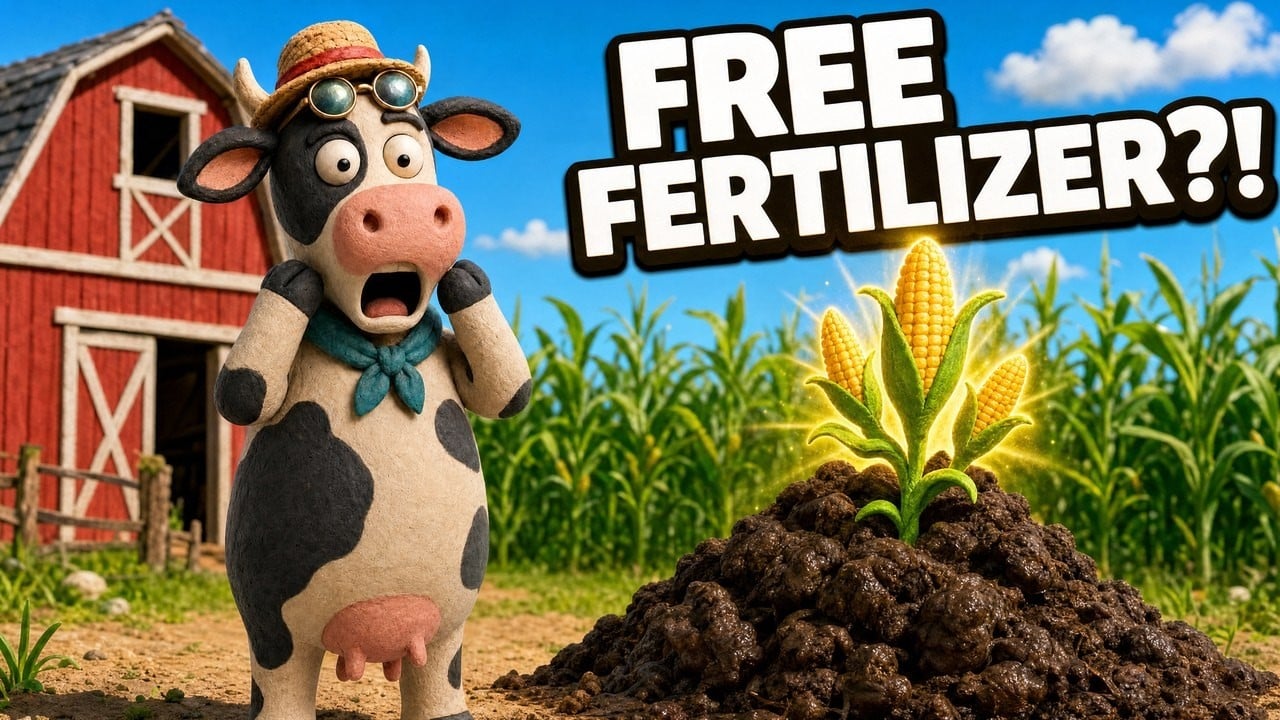
▶ Mixed farming explained: crops and livestock on one farm, with manure as fertilizer and crop leftovers as feed · 2:55
Organic vs conventional yields: how big is the gap?
Three large reviews pooled hundreds of field comparisons. They agree that organic yields are lower on average, and they agree that the size of the gap depends on how the organic farm is managed. Seufert also found big differences by crop; Ponisio found few. Their averages differ because they used different studies and methods, so it is best to read them as a range, not one number.
- Seufert, Ramankutty and Foley (Nature, 2012): organic yields were 25% lower on average. The gap was only 5% for rain-fed legumes and perennials on good soils, 13% when the best organic practices were used, and 34% when the two systems were most alike.
- Ponisio and colleagues (Proceedings of the Royal Society B, 2015): 115 studies and more than 1,000 comparisons showed organic yields 19.2% lower. The gap fell to 9% when the organic farm used multi-cropping and to 8% when it used more crop rotations than the conventional farm (Ponisio et al., 2015).
- Crowder and Reganold (PNAS, 2015): in the farm-finance studies they pooled, gross returns without premiums, which track yields, were 10% lower for single organic crops and 18% lower for organic cropping systems.
The lesson for a farm owner is practical. Diverse rotations and multi-cropping are the levers that most reduced the gap in the 2015 review. A switch that keeps a short conventional rotation and simply swaps inputs is likely to sit at the high end of the range.
Chart
How much lower organic yields are, by review
% below conventional; Crowder rows are gross returns without premiums, which the authors say track yields
Profit: premiums, costs and the break-even price
Lower yields do not mean lower profit if the buyer pays more. In a global review of farm finances, Crowder and Reganold (2015) pooled 44 studies covering 55 crops in 14 countries on five continents, spanning 40 years. Here is what they found:
- Without organic premiums, organic net present values were 23% to 27% lower than conventional ones.
- With the premiums actually paid, organic was 22% to 35% more profitable, and benefit/cost ratios were 20% to 24% higher.
- Median premiums paid were 32% for single crops and 29% for cropping systems.
- The premium needed just to match conventional profit was only 5% for crops and 7% for systems.
- Total costs were not significantly different, but labor costs were 7% to 13% higher on organic farms.
US data add a caution. USDA ERS notes that, on average, US organic farms have higher production costs than conventional farms, and that premiums give farmers a chance to recover those costs. ERS also reports that wholesale premiums for some organic fruits and vegetables, such as strawberries, spinach and apples, have declined in recent years. An older ERS study of 18 retail products found premiums above 20% for 17 of them between 2004 and 2010. Retail premiums are not farm-gate premiums, so ask your own buyers for written prices before you plan on any figure.
Crop type matters too. In the same 2015 review, cereals, fiber and oil crops had the strongest organic results relative to conventional, while forage, vegetables, meat and dairy had the weakest. Longer and more diverse rotations improved the organic result.
What to budget for when you compare
The studies point to five lines that decide whether a switch pays on your farm. Put a number on each before you start.
- Yield change: use your own records and a range, for example the 5% to 34% spread in the reviews above, not a single average.
- Premium: a written price from your buyer. The global review found a median of about 30%, but premiums vary by crop and market and some US wholesale premiums have fallen.
- Labor: the global review found labor costs 7% to 13% higher on organic farms, for example for mechanical pest control, more farm enterprises or new marketing work.
- Inputs: savings on synthetic fertilizer and pesticides, offset by manure, compost, cover crop seed and approved products.
- Fixed costs of the switch: certification fees each year, three transition years without a premium, and any new tools for mechanical weed control.
Then run the numbers twice: once for a transition year and once for a normal certified year. If the farm can carry the first and clearly gains in the second, the switch is worth a closer look.
Chart
Organic premium needed vs premium paid
Median price premium over conventional, %, global meta-analysis of 44 studies and 55 crops
Organic vs conventional profit calculator
Enter your own conventional yield, price and costs, then the yield gap and premium you expect. The calculator compares one year of profit after the transition, shows the break-even premium, and shows a transition year, when you farm organically but cannot yet charge a premium. Use your own buyer quotes and enterprise budgets, not the example values. This is not financial advice; talk to your certifier, lender or a farm business adviser before you commit land.
Try the numbers for your own farm below.
Calculator
Would switching a field to organic pay?
Enter your own conventional yield, price and costs, then the yield gap and premium you expect.
- Conventional profit per year: $7,500
- Organic profit per year after transition: $8,700
- Premium needed to break even: 27.8%
- Profit in a transition year (no premium): -$6,000
Example values only, not a benchmark or forecast. The default 20% yield gap and 30% premium sit inside the ranges reported by Ponisio et al. (2015) and Crowder and Reganold (2015); costs per acre are set equal by default because that review found total costs not significantly different, while USDA ERS reports higher average costs on US organic farms. The transition line assumes organic yields and costs with no premium and no certification fee. Cost share, labor changes and subsidies are left out.
The 3-year transition and certification costs
The transition is often the hardest time financially. Yields can drop as soon as synthetic inputs stop, but the crop cannot be sold as organic until the land has gone 36 months without prohibited substances. Until then you may not sell, label or represent the crop as organic or use the organic seal, according to the USDA Agricultural Marketing Service. Crowder and Reganold (2015) concluded that the lack of a premium appears to be the main factor limiting profit during the transition.
Their data also suggest that organic gross returns without premiums did not improve significantly after the 3-year transition. In other words, do not count on yields bouncing back once you are certified. Plan the premium, the rotation and the market from day one.
What certification costs
USDA AMS says certification fees vary widely with the certifier and the size, type and complexity of the farm, and may range from a few hundred to several thousand dollars. A typical bill has an application fee, an annual renewal fee, an assessment on production or sales, and inspection fees. Ask each certifier for its fee schedule before you apply.
Help is available in the US. The Organic Certification Cost Share Program run by the Farm Service Agency pays back up to 75% of certification costs, capped at $750 per certification scope (crops, wild crops, livestock, handling and state program fees). The deadline to apply for the 2025 and 2026 program years is 31 December 2026. USDA’s Environmental Quality Incentives Program (EQIP) also offers technical and financial help during the transition.
Very small farms have an exemption. Under 7 CFR 205.101, an operation whose gross organic sales total $5,000 or less a year does not need certification, but it must still follow the organic production and labeling rules and keep records.
Steps to certify a field
- Find buyers and get premium quotes in writing for the crops you plan to grow.
- Choose a USDA-accredited certifier (or one accredited in your country) and ask for its fee schedule.
- Write an organic system plan: rotation, fertility, pest control, buffers and records.
- Farm the field for 36 months without prohibited substances, and keep every input record.
- Pass the inspection, receive the certificate, then apply for cost share each year.
Soil, biodiversity and inputs
The 2015 yield review by Ponisio and colleagues notes that studies of organic farming have shown better results than conventional systems on some, but not all, sustainability measures. These include the number and abundance of species, soil fertility, nitrogen uptake by crops, water infiltration and holding capacity, and energy use. Results depend on how each farm is run.
Two points help a farm owner read these claims. First, the benefits come from practices, not from the label: rotations, cover crops, compost and field margins. A conventional farm that uses them gains some of the same benefits. Second, weeds and nutrients still have to be managed without synthetic inputs, so plan weed control as carefully as fertility.
Organic farms still use some crop protection products, but only those the organic standard allows. Check each product with your certifier before you use it, and for any product, organic or not, follow the label and local rules.

▶ Why soil organic matter matters for soil structure, water and crop growth · 7:33
Where organic sells: US and world markets
The US has the most detailed farm data. The USDA NASS 2021 Organic Survey counted 17,445 certified farms that sold $11.2 billion of organic products in 2021, up 13% from $9.9 billion in 2019. Certified land fell 11% to 4.9 million acres, as pasture fell while cropland rose to 3.6 million acres. California led with $3.55 billion of sales, followed by Washington and Pennsylvania.
Chart
Top US certified organic products by sales
Sales, $ million, 2021, certified organic farms
The 2021 survey is the most recent NASS Organic Survey; results of the 2025 Organic Survey are due on 30 October 2026, according to the NASS survey page. ERS also quotes a private market tracker, Argus, which counted 7.2 million certified acres in 2025. That figure comes from a different source and method, so do not compare it directly with the NASS total.
Crops made up 54% of US certified organic sales in 2021 ($6.1 billion), but milk, broiler chickens and eggs were the top three single products. Among crops, apples, corn for grain, strawberries and grapes sold the most.
In Europe, organic farming covered 10.8% of the EU’s farmland in 2023, up from 5.9% in 2012, according to the European Environment Agency. The EU target is at least 25% by 2030 (European Green Deal), and the EEA says the pace would have to more than double to reach it. Worldwide, 98.9 million hectares, or 2.1% of farmland, were organic in 2023, and Australia alone had 53 million hectares, according to FiBL and IFOAM (2025).
Chart
Share of farmland that is organic, selected places
% of agricultural land, 2023; three highest countries and the world average
How to decide: organic vs conventional farming on your farm
Use these questions before you commit a field. They follow the factors that drove profit in the studies above.
- Is there a buyer? Best for: farms with a processor, packer or direct market that pays a written premium. Without one, the 2015 global review found organic less profitable.
- Can you rotate? Best for: farms that can run longer, more diverse rotations, which shrank the yield gap to 8% in the 2015 review.
- Which crops? Cereals, fiber and oil crops did best relative to conventional in the global review; vegetables and forage did least well.
- Can you carry 3 years? You need cash or credit to cover lower yields without a premium during the transition.
- Do you have the labor? Plan for 7% to 13% higher labor costs and more time on weeds and records.
- Start small? You do not have to convert the whole farm at once. Keep clear boundaries, buffers and separate records for organic and conventional fields.

▶ Seven practical ways to protect soil and water, from cover crops to rotations · 4:34
Where satellite crop monitoring fits
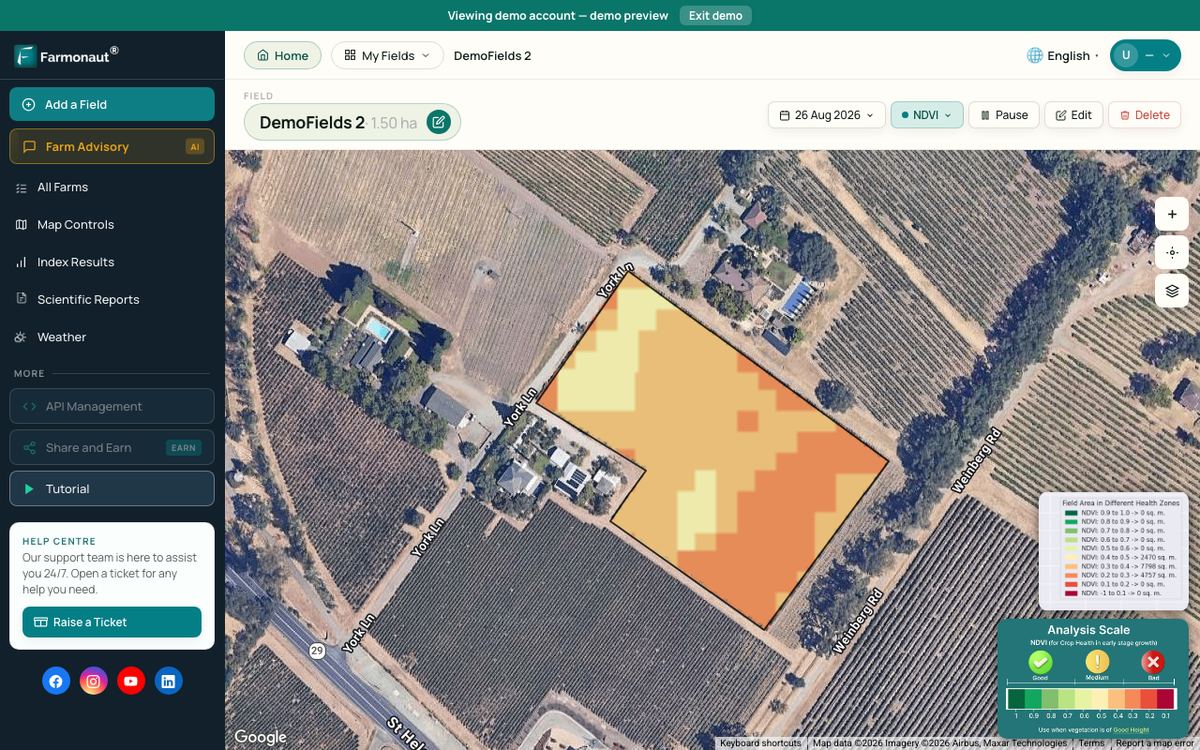
Whichever system you choose, it helps to see how each field is doing through the season, especially during the transition years when you change fertility and weed control. Satellite images show where crop vigor differs across a field. They do not tell you the cause, so you still need to walk the field, test the soil and check for pests.
You can try the Farmonaut Satellite + AI Farm Monitoring System through the Farmonaut app. Farm groups and larger estates can use the farm and forestry management app. There are also pages on product traceability, carbon footprinting, fleet management and crop loan and insurance features. Developers can use the satellite and weather API documentation.
How we checked the numbers
We used peer-reviewed reviews for yields and profit, because single trials vary too much to guide a decision. We give each review’s year and method, and we show the range instead of one average. US farm counts, sales and acres come from the USDA NASS 2021 Organic Survey. We did not mix them with private market estimates. Rules and fees come from USDA AMS, the Farm Service Agency and the US Code of Federal Regulations. Europe and world figures come from the EEA and FiBL. Earlier versions of this page gave figures for soil organic matter and biodiversity that we could not trace to a source; they have been taken out.
FAQ
Is organic farming more profitable than conventional farming?
It can be, if you get a premium. A 2015 global review found organic 22% to 35% more profitable when real premiums of 29% to 32% were paid, but less profitable without premiums. The break-even premium was only 5% to 7%.
How much lower are organic yields?
Large reviews found averages of 25% lower (2012) and 19.2% lower (2015). With diverse rotations or multi-cropping, the 2015 review found gaps of only 8% to 9%. Results vary by crop, soil and management.
How long does it take to switch to organic?
In the US, the land must go 3 years (36 months) without prohibited substances before you can harvest and sell an organic crop. Certification itself follows an application, an organic system plan and an inspection.
How much does organic certification cost?
USDA AMS says fees range from a few hundred to several thousand dollars, depending on the certifier and the farm. The US cost share program pays back up to 75% of the cost, up to $750 per scope.
Is organic vs traditional farming the same comparison as organic vs conventional?
Mostly, yes. In everyday use “traditional” farming means today’s conventional farming. Older traditional practices such as rotation and manure are used on both organic and conventional farms; only certified farms can sell as organic.
Do organic yields recover after the transition?
Not by themselves, according to a 2015 global review: organic returns without premiums did not improve significantly after the 3-year transition. In a separate 2015 review, more crop rotations and multi-cropping were linked to a much smaller yield gap.
Can a small farm sell organic produce without certification?
In the US, farms with organic sales of $5,000 or less a year are exempt from certification, but they must still follow the organic production and labeling rules and keep records.
Farmonaut crop monitoring
Watch your fields through the transition
Satellite crop maps show where growth differs across a field, so you know where to walk, sample soil or check a rotation.



Keep reading
Sources
- Seufert, Ramankutty and Foley, Comparing the yields of organic and conventional agriculture, Nature (2012): nature.com
- Ponisio et al., Diversification practices reduce organic to conventional yield gap, Proc. R. Soc. B (2015): pmc.ncbi.nlm.nih.gov
- Crowder and Reganold, Financial competitiveness of organic agriculture on a global scale, PNAS (2015): pmc.ncbi.nlm.nih.gov
- USDA NASS, 2021 Organic Survey highlights (2022): nass.usda.gov
- USDA NASS, Organic Production survey page (modified October 2026): nass.usda.gov
- USDA ERS, Organic Agriculture topic page (updated September 2026): ers.usda.gov
- USDA AMS, Becoming a certified operation (accessed October 2026): ams.usda.gov
- USDA FSA, Organic Certification Cost Share Program (accessed October 2026): fsa.usda.gov
- 7 CFR 205.202, Land requirements (Cornell LII, current text): law.cornell.edu
- 7 CFR 205.101, Exemptions from certification (Cornell LII, current text): law.cornell.edu
- European Environment Agency, Agricultural area under organic farming in Europe (October 2025): eea.europa.eu
- FiBL and IFOAM, The World of Organic Agriculture 2025, media release (February 2025): fibl.org
Discussion
Questions, corrections or field experience? Share them below. First-time comments are reviewed before they appear, and your email is never published.
No comments yet. Be the first to add a question or your experience.

 Adgrid
 eKGIS
eKGIS Mostas Tech
 Native Seeds
 Andex
Andex FCF India
 Unifrutti Gulf
 Deluxe Conseil
 TVS Electronics
 BW Pipelines
 WICO
WICO Chimera Innovation
 SkyHarvest
 Polaris Digitech
 Teledarbas
 Licence holder · Niger · Gold










