

Papaya Ringspot Virus (PRSV): Symptoms, Organic Treatment, and Control Methods for Infected Trees

As agricultural technology experts at Farmonaut, we understand the devastating impact that Papaya Ringspot Virus (PRSV) can have on papaya orchards and the livelihoods of farmers worldwide. In this comprehensive guide, we’ll delve deep into the world of PRSV, exploring its symptoms, transmission, and most importantly, the organic treatment and control methods available to combat this persistent viral disease.
Understanding Papaya Ringspot Virus (PRSV)
PRSV is a notorious potyvirus that affects papaya trees and some cucurbit crops. It’s one of the most significant threats to papaya production globally, causing substantial economic losses for farmers. The virus is primarily spread by aphids, which act as vectors, transmitting the disease from infected plants to healthy ones.
The Impact of PRSV on Papaya Production
The effects of PRSV on papaya crops can be devastating:
- Significant reduction in fruit yield and quality
- Shortened lifespan of infected trees
- Increased susceptibility to other pests and diseases
- Economic losses for farmers and the papaya industry
Recognizing PRSV Symptoms
Early detection is crucial in managing PRSV. Here are the key symptoms to look out for:
1. Leaf Symptoms
The most noticeable signs of PRSV infection appear on the leaves of papaya trees:
- Chlorosis: Yellowing of leaf tissue between veins
- Mosaic patterns: Light and dark green mottling on leaves
- Leaf distortion and curling
- Stunted growth of new leaves
2. Fruit Symptoms
PRSV also affects the fruit, leading to:
- Circular ringspot patterns on the fruit surface
- Distorted fruit shape
- Reduced fruit size and quality
- Premature fruit drop
3. Stem and Tree Symptoms
As the disease progresses, it affects the entire tree:
- Dark, oily streaks on petioles and stems
- Stunted overall growth
- Reduced vigor and productivity
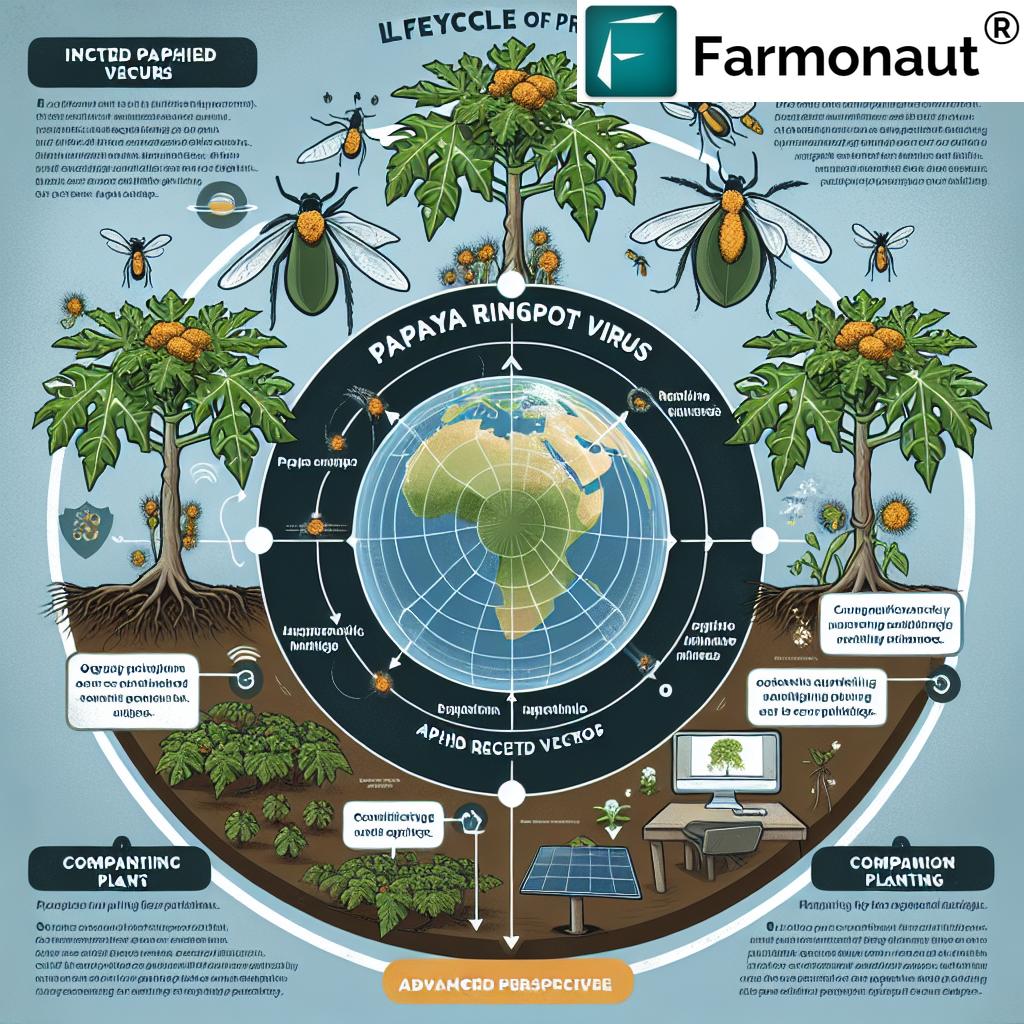
Transmission of PRSV
Understanding how PRSV spreads is crucial for developing effective control strategies:
1. Aphid Vectors
The primary mode of transmission is through aphids:
- Aphids acquire the virus by feeding on infected plants
- They then transmit the virus to healthy plants during subsequent feeding
- This transmission occurs quickly, often within seconds of feeding
2. Mechanical Transmission
PRSV can also spread through:
- Contaminated pruning tools
- Handling of infected plant material
- Grafting using infected plant parts
3. Seed Transmission
While rare, PRSV can occasionally be transmitted through seeds, though this is not the primary mode of spread.
Organic Treatment and Control Methods for PRSV
At Farmonaut, we advocate for sustainable and organic approaches to managing PRSV. Here are some effective strategies:
1. Cultural Control Methods
- Crop Rotation: Implement a crop rotation system to break the disease cycle
- Sanitation: Remove and destroy infected plants promptly
- Weed Management: Control weeds that may act as alternate hosts for the virus or aphids
- Intercropping: Plant barrier crops to reduce aphid movement between fields
2. Biological Control
Encourage natural predators of aphids:
- Ladybugs
- Lacewings
- Parasitic wasps
3. Organic Pesticides
Use organic pesticides to control aphid populations:
- Neem oil
- Insecticidal soaps
- Pyrethrin-based sprays
4. Resistant Varieties
Plant PRSV-resistant papaya varieties when available in your region.
5. Nutritional Support
Enhance plant health through proper nutrition:
- Use organic compost and fertilizers
- Apply foliar sprays with micronutrients
- Maintain optimal soil pH
Advanced Detection and Monitoring with Farmonaut
At Farmonaut, we leverage cutting-edge satellite technology to revolutionize PRSV detection and management:
1. Early Detection
Our satellite-based crop health monitoring system can detect subtle changes in vegetation health, potentially identifying PRSV infection before visible symptoms appear.
2. Large-Scale Monitoring
We offer the ability to monitor vast areas of papaya orchards efficiently, providing a comprehensive view of crop health across entire regions.
3. Data-Driven Decision Making
Our AI-powered advisory system, Jeevn AI, analyzes satellite data to provide personalized recommendations for managing PRSV and optimizing crop health.
4. Integration with Traditional Methods
Farmonaut’s technology complements traditional PRSV management strategies, enhancing their effectiveness through precise, timely interventions.
| Feature | Traditional PRSV Detection | Farmonaut Satellite System Detection |
|---|---|---|
| Speed | Slow, requires physical inspection | Rapid, real-time monitoring |
| Accuracy | Variable, depends on inspector’s expertise | High, uses advanced spectral analysis |
| Cost-effectiveness | Labor-intensive, costly for large areas | Highly cost-effective, especially for large orchards |
| Early Detection Capabilities | Limited to visible symptoms | Can detect stress before visible symptoms appear |
Implementing an Integrated PRSV Management Strategy
To effectively combat PRSV, we recommend an integrated approach that combines traditional methods with advanced technology:
1. Regular Monitoring
- Use Farmonaut’s satellite monitoring system for large-scale surveillance
- Conduct regular physical inspections of trees
- Train farm workers to recognize early symptoms
2. Preventive Measures
- Implement strict sanitation practices
- Use reflective mulches to repel aphids
- Establish windbreaks to reduce aphid movement
3. Prompt Response to Infections
- Quickly remove and destroy infected plants
- Apply organic pesticides to control aphid populations
- Adjust nutrient management to support plant health
4. Data-Driven Decision Making
- Utilize Farmonaut’s AI advisory system for personalized management strategies
- Monitor trends in crop health to adjust practices proactively
- Use historical data to plan for future seasons
The Role of Technology in PRSV Management
At Farmonaut, we’re committed to leveraging technology to enhance PRSV management:
1. Satellite-Based Health Monitoring
Our advanced satellite imagery provides valuable insights into crop health, enabling early detection of PRSV and other stresses. Learn more about our satellite-based services here.
2. AI-Powered Advisory
Our Jeevn AI system analyzes multiple data points to provide tailored advice for PRSV management and overall crop health optimization.
3. Mobile Applications
Access real-time data and advice on-the-go with our mobile apps:
Android App
iOS App
4. API Integration
For developers and businesses looking to integrate our technology into their systems, we offer robust API solutions. Explore our API documentation for more information.
Case Studies: Successful PRSV Management with Farmonaut
While we don’t include specific case studies or success stories, we can highlight the general benefits observed by farmers using our technology for PRSV management:
- Earlier detection of PRSV infections
- Reduced spread of the virus through timely interventions
- Improved overall orchard health and productivity
- Cost savings through targeted treatments and reduced crop losses
Future Perspectives in PRSV Management
As we look to the future, several promising developments are on the horizon for PRSV management:
1. Advanced Genetic Resistance
Ongoing research into genetically modified papaya varieties with enhanced PRSV resistance offers hope for long-term control.
2. Improved Biological Control Agents
Development of more effective natural predators and parasites for aphid control could provide sustainable management options.
3. Precision Agriculture Technologies
Further integration of AI, machine learning, and IoT devices will enhance our ability to detect and respond to PRSV outbreaks rapidly.
4. Climate Change Adaptation
As climate patterns shift, understanding and adapting to changing PRSV dynamics will be crucial for long-term management.
Frequently Asked Questions (FAQs)
Q1: Can PRSV infect other crops besides papaya?
A: Yes, PRSV can also infect some cucurbit crops like cucumber and squash, though papaya is the primary host.
Q2: How long can a papaya tree survive after PRSV infection?
A: The lifespan of an infected tree varies, but typically, productivity declines rapidly within 6-12 months of infection.
Q3: Are there any chemical treatments for PRSV?
A: There are no direct chemical treatments for the virus itself. Management focuses on controlling the aphid vectors and enhancing plant health.
Q4: Can PRSV-infected trees recover?
A: Unfortunately, once infected, trees cannot recover from PRSV. The focus is on preventing spread to healthy trees.
Q5: How effective are PRSV-resistant papaya varieties?
A: PRSV-resistant varieties can be highly effective, but their availability and suitability vary by region. Consult local agricultural experts for recommendations.
Conclusion
Managing Papaya Ringspot Virus requires a multi-faceted approach combining traditional agricultural practices with cutting-edge technology. At Farmonaut, we’re committed to providing farmers with the tools and insights needed to combat PRSV effectively and sustainably. By leveraging our satellite-based monitoring, AI-powered advisory systems, and comprehensive data analysis, farmers can stay one step ahead of this devastating disease.
Remember, early detection and prompt action are key to managing PRSV. Regular monitoring, implementing good sanitation practices, and utilizing advanced technologies like those offered by Farmonaut can significantly improve your orchard’s resilience against PRSV.
For more information on how Farmonaut can help you manage PRSV and optimize your papaya production, visit our website or contact our team of experts today. Together, we can work towards healthier, more productive papaya orchards and a sustainable future for papaya farming.
Subscribe to Farmonaut Services
Discussion
Questions, corrections or field experience? Share them below. First-time comments are reviewed before they appear, and your email is never published.
No comments yet. Be the first to add a question or your experience.

 Tucor
Tucor Saraswati Agro
 Geno
Geno Hayleys Agriculture
 Linx Agritech
 Adinet
 Save Your Soils
 Grandstream Algérie
 XOS Realty
 Geospatial Lab Africa
 Agro La Gándara
 HIPSAC
 ZOL Zimbabwe
 Juligerm
 MISE Maroc
 NWNS
NWNS
 Licence holder · Niger · Gold










