

Farm tools · Uses and buyer guide
Farming Tools and Their Uses: 16 Hand Tools Ranked
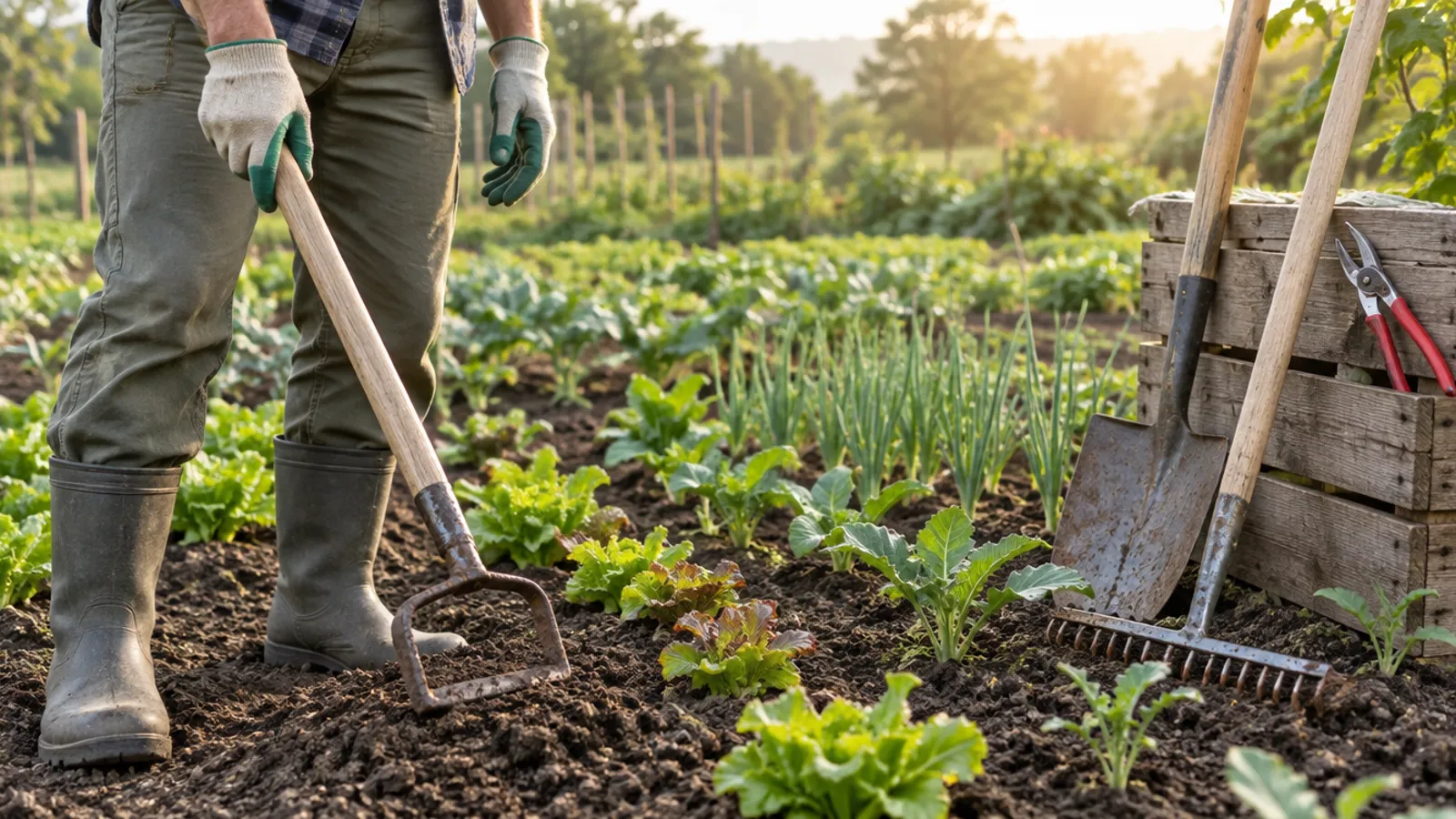
Farm hand tools cover a few jobs: dig, loosen, level, plant, weed, cut, carry, spray and test soil. 42% of US farms had under 50 acres in the 2022 census (USDA NASS), and on those farms hand tools still do much of the work.
Key takeaways
- A basic kit of spade, fork, rake, hoe, pruners and cart covers most weekly jobs on a small farm.
- Of 1,900,487 US farms in the 2022 Census of Agriculture, 801,504 (about 42%) had fewer than 50 acres (USDA NASS).
- Kansas State University extension says well-kept pruners need sharpening about every six weeks, even with heavy use.
- OSHA says the greatest hand tool hazards come from misuse and poor maintenance, such as loose or cracked handles.
- The NASS tractor price index rose from 114 in 2020 to 138 in 2023 (farmdoc daily, 2025), so renting can beat buying for machines used a few days a year.
In this article
- Farming tools and their uses at a glance
- How we chose and ranked these tools
- 16 farming tools and their uses, ranked by season
- Watering tools: hoses, hose reels and drip kits
- How to choose farming tools for your farm
- Who uses hand tools most: farm size in the US
- Tool care and maintenance through the year
- Hand tool safety rules
- Modern tools that work alongside hand tools
- Rent or buy: costs of bigger farm machines
- Small tools and tax records
- From hand tools to machines: the mechanization ladder
- FAQ
Farming tools and their uses come down to a few basic jobs: digging and loosening soil, shaping beds, planting, weeding, cutting, carrying, spraying and checking the soil. This guide covers 16 hand and small field tools, what each one does, which farm it suits and how to keep it working. Most farms in the US are small: 42% of the 1.9 million farms counted in the 2022 Census of Agriculture had fewer than 50 acres, and on those farms hand tools still do much of the daily work.
Below you will find a ranked list with a “Best for” line for each tool, a quick table, a buyer guide, a care schedule, safety rules, a chart of rental rates for bigger machines and a rent-or-buy calculator you can fill in with your own numbers.
Farming tools and their uses at a glance
The table sorts the 16 tools by the job they do. Use it to check which tasks your current kit covers and where you have a gap.
| Tool | Main job | Season | Best for |
|---|---|---|---|
| Spade and shovel | Dig, edge, move soil | All year | Every farm and garden |
| Digging fork | Lift roots, turn compost | Spring, autumn | Root crops, compost piles |
| Broadfork | Loosen deep soil without turning it | Spring | Permanent vegetable beds |
| Garden rake | Level and smooth seedbeds | Spring | Bed preparation |
| Draw hoe | Chop weeds, hill, cut furrows | Spring, summer | Row crops, potatoes |
| Stirrup hoe | Slice small weeds at the surface | Summer | Weekly weeding |
| Wheel hoe | Weed and cultivate long rows | Spring, summer | Market gardens up to a few acres |
| Trowel, hori-hori | Transplant, dig out weeds | Spring, summer | Transplants, herbs |
| Dibble, push seeder | Make holes, sow seed in rows | Spring | Direct-sown vegetables |
| Hand pruners | Cut stems up to finger thickness | Winter, summer | Orchards, vines, berries |
| Loppers, pruning saw | Cut thicker branches | Late winter | Fruit trees, hedges |
| Sickle | Cut grass, greens, small grain | Summer | Small plots, fodder |
| Scythe | Mow grass and grain by hand | Summer | Small hay fields, verges |
| Wheelbarrow, cart | Move soil, compost, harvest | All year | Every farm |
| Backpack sprayer | Spot-spray crops and weeds | Spring, summer | Spot treatment |
| Soil probe, meter | Take soil samples, check moisture | All year | Irrigation and fertilizer planning |
How we chose and ranked these tools
We ranked the tools in the order a grower usually needs them through the season: first soil work, then planting, weeding, pruning, harvest, moving material and checking the soil. We did not rank by brand or price. Prices for hand tools change often and differ by country and shop, so we do not quote them. Where we give costs for bigger machines, they come from a named government or university source with its date.
The list focuses on tools that a small or mid-size farm, a market garden or a homestead uses every week. Tractors, combines and planters are covered only where they help with the rent-or-buy choice later in the guide.
16 farming tools and their uses, ranked by season
Each entry says what the tool does, who it suits and one point on use or care.
1. Spade and shovel
A spade has a flat, square blade for cutting straight edges, digging planting holes and slicing turf. A shovel has a curved, pointed blade for scooping and moving loose soil, sand or compost. Shovels and other digging tools are not sharp when you buy them; Kansas State University extension says the buyer needs to file an edge for the tool to work as intended.
Best for: every farm. Tip: choose a handle length that lets you keep your back straight.
2. Digging fork
A digging fork has four strong, flat tines. It lifts potatoes, carrots and other roots with less damage than a spade, breaks up clods and turns compost. Push it in, rock it back and lift.
Best for: root crops and compost piles. Tip: do not use it as a lever on rocks; bent tines are hard to fix.
3. Broadfork
A broadfork is a wide frame with long steel tines and two upright handles. You step on the bar, pull the handles back and the tines crack the soil below the surface without turning it over. Growers use it to loosen permanent beds before planting while keeping the soil layers in place.
Best for: no-till or low-till vegetable beds. Tip: work across the bed in short steps of about a hand’s width.
4. Garden rake
A bow rake or level-head rake has short, stiff teeth. It breaks small clods, removes stones and levels a seedbed so seeds sit at an even depth. A wide bed-prep rake does the same over a whole bed in fewer passes.
Best for: preparing beds for direct seeding. Tip: flip the rake over to smooth the final surface.
5. Draw hoe
The draw hoe is the classic hoe: a flat blade set at a right angle to the handle. You chop and pull toward you to cut weeds, pull soil up around potatoes and open furrows for seed. Heavier versions also break hard ground.
Best for: row crops and hilling. Tip: file the edge at the start of each season.
6. Stirrup hoe
The stirrup (scuffle or hula) hoe has a loop-shaped blade that cuts on both the push and the pull stroke. It slices weeds just below the surface without moving much soil, so fewer new weed seeds are brought up.
Best for: fast weekly weeding while weeds are small. Tip: weed on a dry day so cut weeds wilt and die.
7. Wheel hoe
A wheel hoe is a push frame with one wheel and swap-in blades or tines. Walking behind it, one person can weed and cultivate long rows much faster than with a hand hoe. Attachments include oscillating blades, cultivator teeth and furrowing ploughs.
Best for: market gardens of up to a few acres. Tip: keep row spacing to the width of your blades.
8. Hand trowel and hori-hori
A trowel digs small holes for transplants and bulbs. The hori-hori, a Japanese digging knife, has one straight and one serrated edge; it digs, cuts roots and twine and pries out deep-rooted weeds such as dandelion.
Best for: transplanting and close work in beds and pots. Tip: keep it in a sheath on your belt so it is always at hand.
9. Dibble and push seeder
A dibble is a pointed stick or a board with pegs that punches evenly spaced holes for seeds or seedlings. A push seeder is a small wheeled tool with seed plates; it opens a furrow, drops seed at a set spacing and covers it in one pass.
Best for: direct-sown carrots, beets, salad greens and beans. Tip: test the seed plate on a board before you go to the field.
10. Hand pruners (secateurs)
Hand pruners cut live stems up to about finger thickness. Bypass pruners slide past each other like scissors and give clean cuts on live wood; anvil pruners crush against a flat plate and suit dead wood. According to Kansas State University extension, well-kept pruners need sharpening only about every six weeks even with heavy use, and a sharp blade gives a cleaner cut, resists rust and lasts longer.
Best for: orchards, vineyards, berries and tomatoes. Tip: clean sap off the blade with warm soapy water or a solvent before you sharpen.
11. Loppers and pruning saw
Loppers are long-handled pruners for branches too thick for hand pruners. A curved pruning saw cuts on the pull stroke and handles larger limbs. Together they cover most winter pruning in a small orchard.
Best for: fruit trees, hedges and windbreaks. Tip: use a wire brush and coarse cloth to clean saw teeth.
12. Sickle
The sickle is one of the oldest farm tools. A curved blade with a cutting edge on the inside of the curve cuts grass, greens and small amounts of grain. A study of flint sickle blades from Natufian sites in the Levant, published in a peer-reviewed journal, found wear patterns from harvesting cereals between about 1,000 and 4,500 years before crops were domesticated.
Best for: small plots, fodder and cut-flower stems. Tip: cut away from your body and your other hand.
13. Scythe
A scythe has a long blade on a long shaft with two hand grips. You mow with a smooth swing from the hips. The Pitt Rivers Museum at the University of Oxford notes that the sickle was replaced in the nineteenth century by the scythe, which was more comfortable, and later by combine harvesters and tractor machinery.
Best for: small hay fields, orchards and field edges where a mower cannot go. Tip: hone the blade with a whetstone every few minutes of mowing.
14. Wheelbarrow and garden cart
A one-wheel barrow tips easily into tight spots. A two-wheel cart carries heavier loads with less strain and does not tip over on slopes. Both move compost, mulch, soil, tools and harvest crates.
Best for: every farm. Tip: keep tyres pumped; a soft tyre makes every load much harder to push.
15. Backpack sprayer
A backpack sprayer holds liquid in a tank on your back and pushes it through a wand and nozzle. Growers use it for spot treatment of weeds, small blocks of crops and foliar feeds. A pump-up model works without an engine; a battery model keeps steady pressure.
Best for: spot spraying on small areas. Tip: always follow the product label and local rules, wear the protective equipment the label lists and rinse the tank after each use.
16. Soil probe and moisture meter
A soil probe is a steel tube that pulls out a narrow core of soil. You use it to take samples for a lab soil test and to see how deep moisture reaches after rain or irrigation. A handheld moisture meter or sensor gives a quick reading at root depth.
Best for: planning irrigation and fertilizer. Tip: take samples in a zigzag across a field and mix them for one test.
Watering tools: hoses, hose reels and drip kits
Water is the job that hand tools often miss. On a small farm, three simple items cover most of it. A good rubber or reinforced hose carries water to beds, troughs and the tool wash area. A hose reel, either wall-mounted or on a cart, stores the hose off the ground so it does not kink, crack in the sun or trip people. You unreel only the length you need and wind it back after each use.
A drip kit with a filter, a pressure regulator, a timer and drip tape or emitter line puts water at the roots of each row. It uses less water than an overhead sprinkler and keeps leaves dry, which helps limit some leaf diseases. A watering wand with a gentle rose head is still the best tool for seed trays and new transplants.
- Best for small beds: a hose, a wand and a hose reel near the tap.
- Best for rows and orchards: drip tape or emitter line on a timer.
- Check each week: leaks at joints, clogged emitters and the filter screen.
Pair watering tools with a soil probe or moisture meter. Push the probe in a day after watering to see how deep the water reached, and change run times until moisture reaches the main root zone without pooling on the surface.
How to choose farming tools for your farm
Start from the work you do each week, not from a catalogue. These steps help you buy the right tool once.
- List your jobs and your area. A half-acre market garden needs hoes, a wheel hoe and a seeder. A five-acre orchard needs pruners, loppers, a saw and a cart.
- Match the tool to your soil. Heavy clay needs strong forged tools and a digging fork; light sandy soil suits a stirrup hoe and a wide rake.
- Check the build. Look for a forged or thick steel head, a solid joint between head and handle and a handle that suits your height.
- Think about your body. Long handles reduce bending. Lighter tools reduce fatigue over a full day. Try tools before you buy where you can.
- Buy fewer, better tools. A small set of good tools that you keep sharp does more work than a shed full of cheap ones.
- Plan the next step up. If weeding or bed prep takes too many hours, a wheel hoe, a walk-behind tractor or renting a machine for a day may pay back faster than more hand labor.

▶ Ten small farm businesses you can start with little land, including renting out a tractor. · 6:03
Who uses hand tools most: farm size in the US
Tool needs follow farm size. The USDA National Agricultural Statistics Service counted 1,900,487 farms in the 2022 census. Of these, 234,592 had 1 to 9 acres and 566,912 had 10 to 49 acres. Those two groups make up about 42% of all farms. On farms this size, spades, hoes, pruners and carts do a large share of the work, while farms of 1,000 acres or more depend on tractors and self-propelled machines.
Chart
US farms by size
Number of farms by acres operated, 2022 Census of Agriculture
The same census put the average market value of machinery and equipment at $164,212 per farm in 2022. That average hides a wide spread: small farms own far less, and many rent or hire bigger machines for a few days a year.
Tool care and maintenance through the year
Good care makes a tool safer and longer-lasting. Kansas State University extension says well-kept tools give a cleaner cut, resist rust and last longer, and that wooden handles cared for properly are less likely to splinter or break. A simple routine works for most hand tools.
- After each use: knock off soil, wipe the blade dry and hang the tool up off the floor.
- Every few weeks in season: touch up edges on hoes, pruners and sickles with a file or whetstone.
- End of season: scrub off rust with a wire brush, sharpen every edge, oil metal parts and rub boiled linseed oil into wooden handles.
- Before spring: check every handle for cracks and every joint for play; replace what is worn.
Test a cutting edge by holding it up to a light. If light reflects off the edge, it is still dull. A sharp pruner cuts a branch of the right size cleanly without pulling or catching.
Hand tool safety rules
The OSHA guide to hand and power tools says the greatest hazards from hand tools come from misuse and poor maintenance. Its examples include a loose or cracked wooden handle that lets the head fly off, and a chisel used as a screwdriver whose tip breaks off. OSHA also notes that dull tools can cause more hazards than sharp ones.
- Use each tool only for the job it was made for.
- Replace splintered, cracked or loose handles before use.
- Wear gloves and eye protection when you sharpen, prune or cut overhead.
- Carry sharp tools with the blade down and away from other people.
- Keep paths and floors clear and dry to prevent slips.
- For sprayers, follow the product label and local rules on protective equipment, mixing and re-entry times.
Modern tools that work alongside hand tools
Hand tools do not replace measurement. Many growers now pair a basic kit with digital tools that show where work is needed. In a USDA Economic Research Service report on precision agriculture (2023), auto-steer and guidance systems were used on 5.3% of planted corn acres in 2001 and on 58% in 2016. Yield maps, soil maps and variable-rate tools are also spreading, with higher adoption on large farms than on small ones.
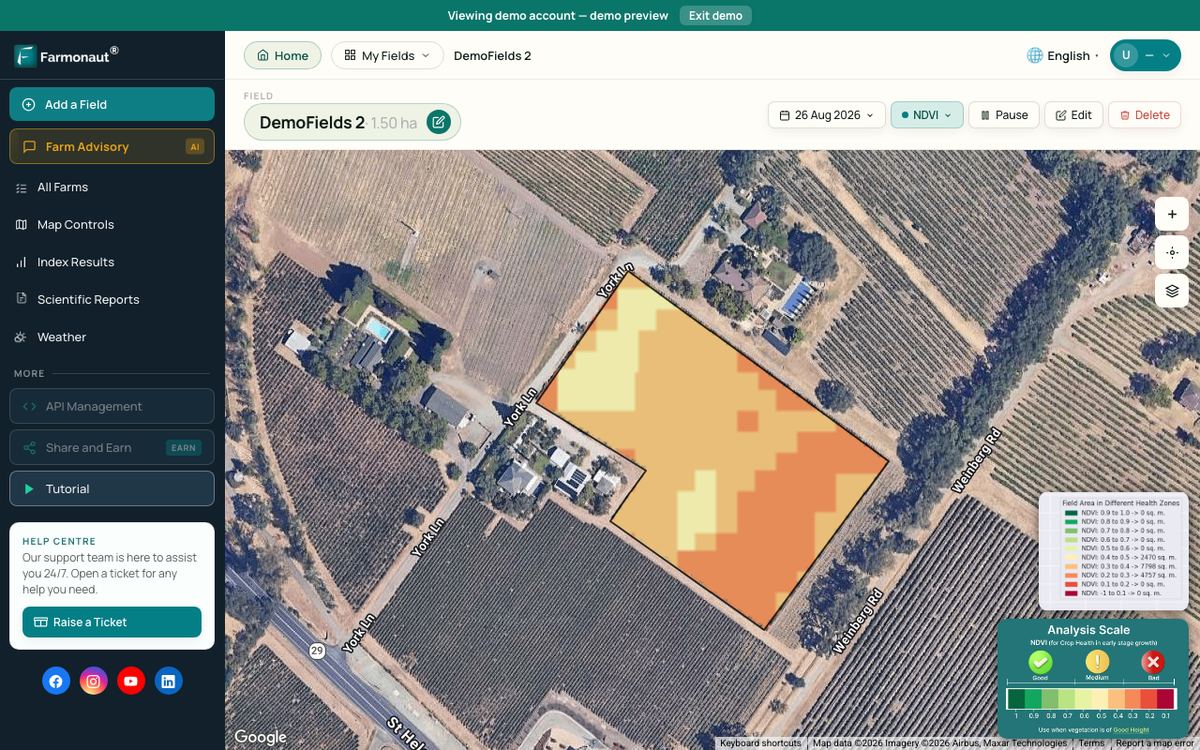
The most useful modern tools for a small or mid-size farm are often low-cost: a soil moisture sensor, a phone app for field records, a weather station or satellite crop maps. Farmonaut, for example, shows satellite vegetation maps of each field so you can see which part of a block to check first, then walk there with your probe or hoe.
Other tools in the same family include small drones for scouting, GPS units for mapping beds and drip irrigation controllers with timers. Each one helps you decide where to send people and hand tools, rather than doing the field work itself.

▶ How satellite NDVI maps show crop stress across a large farm before you can see it on foot. · 4:09
Rent or buy: costs of bigger farm machines
When a job outgrows hand tools, the next question is whether to buy a machine or rent one. Machine costs have risen fast. A farmdoc daily article from the University of Illinois (October 2025) reports that the NASS tractor price index rose from 100 in 2011 to 114 in 2020 and then to 138 in 2023, a 21% jump in three years. The same article puts machinery-related costs on central Illinois corn farms on high-productivity farmland at $136 per acre in 2021 and $171 per acre in 2024.
Chart
US tractor price index
Index of prices paid for tractors, 2011 = 100, selected years
Renting is one way to use a bigger machine without owning it. The Manitoba Agriculture farm machinery custom and rental guide for 2026-27 lists hourly rental rates in Canadian dollars. They are calculated guide rates for the machine alone, without an operator, not dealer quotes. For example, a two-wheel-drive tractor rents for $46 to $51 per hour and a pull-type mower conditioner for $23 to $57 per hour.
A machine pays to own only when you use it enough hours a year. If you use it a few days a season, renting or hiring a custom operator is often cheaper. The calculator below lets you test this with your own numbers.
Chart
Hourly rental rates for selected farm machines
Canadian dollars per hour, machine only, low and high of the guide’s range, 2026-27
Try the numbers for your own farm below.
Calculator
Is it cheaper to rent or buy a farm machine?
Enter your own machine price, hours and rental rate.
- Yearly cost to own: $2,600
- Yearly cost to rent: $2,700
- Owning cost per hour: $43
- Break-even hours per year: 58 hours
Example values only, not a benchmark or a forecast; every number is your input. The example is set close to break-even. Yearly owning cost = (price – resale value) / years kept + interest on the average value + repairs as a share of price. It leaves out insurance, housing, fuel and labor, which you pay in both cases or which vary by farm. Get professional advice before a large purchase.
Small tools and tax records
In the US, the IRS Farmer’s Tax Guide (Publication 225) lists small tools expected to last one year or less among the farm costs that can be deducted as expenses. Tools and machines that last longer are usually depreciated over several years instead. Rules differ by country and change over time, so keep receipts and get advice from a tax professional before you file.
From hand tools to machines: the mechanization ladder
The UN Food and Agriculture Organization describes farm mechanization as a range of steps, from simple hand tools to animal-drawn and then motorized equipment. In its framework on sustainable agricultural mechanization (FAO and African Union, 2018), it argues for a mix of improved hand tools, animal power and machines that suits each farm, rather than rushing to tractors. The same logic applies on a small farm anywhere: improve the hand tools first, then add a wheel hoe or a two-wheel tractor, and rent large machines for the few jobs that need them.

▶ Six plain steps to start precision farming without buying a robot. · 4:18
FAQ
What are the most important farming tools and their uses?
A basic kit covers six jobs: a spade or shovel to dig, a fork or broadfork to loosen soil, a rake to level beds, a hoe to weed, pruners to cut stems and a wheelbarrow or cart to move material. Add a soil probe if you want to check moisture or take soil samples.
What is the difference between a hoe and a cultivator?
A hoe has a blade that chops or slices weeds and moves soil. A hand cultivator has curved tines or claws that scratch and loosen the top layer of soil and pull out small weeds. Many growers use a stirrup hoe for weeds between rows and a cultivator close to plants.
How often should I sharpen farm hand tools?
It depends on use. Kansas State University extension says well-kept pruners need sharpening about every six weeks even with heavy use, while a gardener who prunes four hours a week may need to sharpen only once or twice a year. Hoes and spades benefit from a file at the start of each season.
Should a small farm buy or rent a tractor?
Compare the yearly cost of owning (loss in value, interest, repairs, insurance and housing) with the cost of renting for the hours you need. If you need a machine only a few days a year, renting or hiring a custom operator is often cheaper. Use the calculator on this page with your own prices.
Which modern tools are worth adding to a basic kit?
A soil moisture sensor, a simple app for field records and satellite crop maps are low-cost additions that show where to work first. Larger farms add GPS guidance; USDA data show auto-steer on 58% of planted corn acres by 2016.
Related pages on our site: Farmonaut home, web and mobile apps, developer docs, fleet management, product traceability, carbon footprinting and crop loan and insurance support.
Farmonaut crop monitoring
See your own fields from space
Draw your fields once and Farmonaut shows satellite vegetation maps for them through the season, on web, Android or iOS.



Keep reading
Sources
- USDA NASS, 2022 Census of Agriculture, United States Summary and State Data, Volume 1 (2024): nass.usda.gov
- Kansas State University Research and Extension, How to Clean and Sharpen Garden Tools (MF3288): bookstore.ksre.ksu.edu
- OSHA, Hand and Power Tools (OSHA 3080): osha.gov
- USDA Economic Research Service, Precision Agriculture in the Digital Era: Recent Adoption on U.S. Farms, EIB-248 (2023): ers.usda.gov
- farmdoc daily, University of Illinois, Large Increase in Machinery Costs Suggests Need to Reconsider Machinery Purchase Decisions (October 2025): farmdocdaily.illinois.edu
- Manitoba Agriculture, Farm Machinery Custom and Rental Rate Guide 2026-27: manitoba.ca
- IRS, Publication 225, Farmer’s Tax Guide: irs.gov
- FAO and African Union, Sustainable Agricultural Mechanization: A Framework for Africa (2018): fao.org
- Pitt Rivers Museum, University of Oxford, Agricultural tools used for harvesting cereal crops: england.prm.ox.ac.uk
- Natufian sickle blades reveal cereal cultivation before domestication (PMC, peer-reviewed article): pmc.ncbi.nlm.nih.gov
Discussion
Questions, corrections or field experience? Share them below. First-time comments are reviewed before they appear, and your email is never published.
No comments yet. Be the first to add a question or your experience.

 Pulsar Supernova
 Magrifly
 LatConnect 60
 Disease Free Life
 WebsEdge
 Blickwinkel
 Agricultural Credit Policy Council
 BayWa
BayWa MCSOD
MCSOD Marei Nursery
 eKGIS
eKGIS Mostas Tech
 Andex
Andex FCF India
 Unifrutti Gulf
 Deluxe Conseil
 WICO
WICO Chimera Innovation
 Licence holder · Niger · Gold
 Licence holder · Nigeria · Gold + lithium










