

Reviewed September 2026 against USDA NRCS technical standards and the USDA NASS 2022 Census of Agriculture.
Try it: Run your own numbers →
Table of Contents
- Which Fence Type Is Right for Your Farm?
- 7 Farm Fencing Options Compared
- Cost & Durability Comparison Table
- Cheapest Farm Fencing Options
- Livestock Fencing Options by Animal
- USDA Wire, Voltage & Spacing Specifications
- Best Materials for Farm Fences
- Installation: Posts, Spacing, Tensioning
- ATV Farm Fencing Solutions
- Maintenance for Longevity
- Farm Security Fencing
- Fencing Cost Calculator
- Financing & Cost-Effective Strategies
- Planning Fences with Farmonaut
- Frequently Asked Questions
- Conclusion
- Try it: Run your own numbers
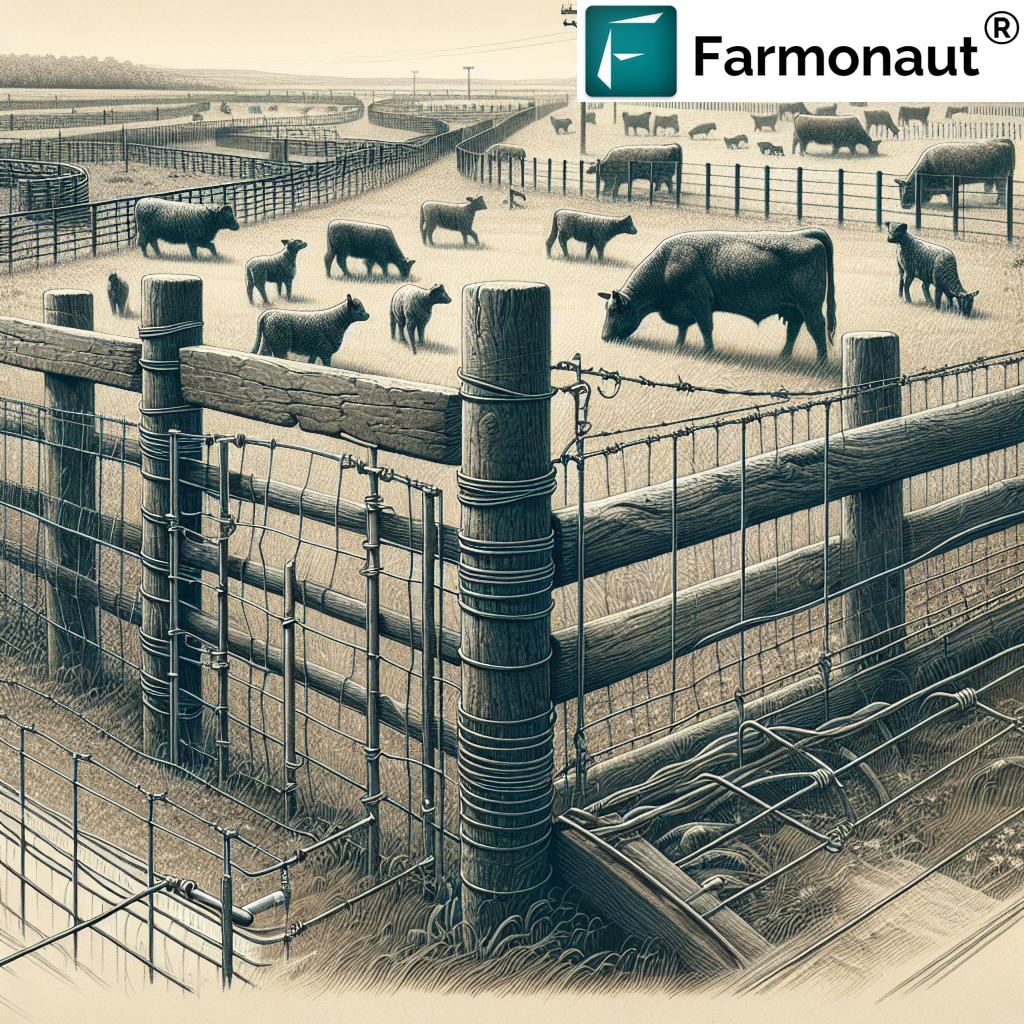

Which Fence Type Is Right for Your Farm?
Fencing around a farm falls into three cost tiers: high-tensile electric wire runs roughly $1.50–$4.00 per linear foot installed, standard barbed and woven wire sit in the middle, and wood post-and-rail or welded panel systems cost the most per foot but need less annual upkeep. Which option wins depends on what you’re containing — cattle need fewer, higher strands of electric wire, sheep need more strands set closer to the ground, and a security perimeter around equipment or a homestead needs a different structure than a pasture boundary. This guide breaks down agricultural fence by type, by cost, by animal, and by USDA specification, so you can match a fence to your actual containment problem instead of guessing.
The United States had 1.9 million farms as of the 2022 Census of Agriculture, according to USDA NASS — the census is taken every five years, with the next release due in 2027, so check the NASS AgCensus page directly for any update. Most of those operations rely on some combination of the seven fence types below, and the right combination almost always mixes two or three types rather than fencing an entire property in one material.
7 Farm Fencing Options Compared
Understanding the types of agricultural fences available is essential for selecting the right boundary solution for your farm. Below are seven options, each with its structure, best use case, and where it falls short.
1. Barbed Wire Fencing
- Structure: Two to five strands of galvanized mild steel wire twisted together with sharp barbs spaced at regular intervals.
- Use Case: Large grazing areas, especially cattle containment on extensive acreage.
- Advantages:
- One of the cheapest options at $1.20–$2.50 per linear foot installed
- Fast installation over long boundary runs
- Low material cost compared to panel or wood systems
- Drawbacks:
- Not suited to sheep or goats — entanglement and injury risk is higher with smaller, wool-bearing livestock
- Barbs can cause physical injury to any animal that presses against the line
Barbed wire remains the most common perimeter option for cattle operations because it covers ground cheaply. Regular inspection of posts and wire tension is what keeps it safe over a 10–15 year service life.
2. High-Tensile Electric Wire Fencing
- Structure: Galvanized high-tensile steel wire, typically 12.5 gauge Class III galvanized wire; state NRCS standards set the minimum tensile strength, for example 110,000 psi in Iowa NRCS Fence-Electric standard, strung with fewer posts than conventional wire fence.
- Use Case: Large-scale containment, rotational grazing paddocks, and long perimeter runs.
- Advantages:
- Installed cost of $1.50–$4.00 per linear foot for a full high-tensile electric system, per 2026 aggregate data from SSG Game Fence
- Longest lifespan of any wire fence at 20–40 years when properly tensioned
- Wide post spacing cuts labor and material costs versus barbed or woven wire
- Drawbacks:
- Requires a mechanical tensioner to hit the USDA-specified 200 lb wire tension for large livestock
- Higher upfront cost than basic barbed wire, offset by the longer replacement cycle
On the low end, a simpler electric fence setup can run as little as $0.36 per linear foot according to Valley Farm Supply’s cost estimator — the gap between $0.36 and $4.00 is almost entirely the number of wire strands, gauge, and whether posts are wood or step-in plastic.
3. Woven Wire Fencing
- Structure: A grid of vertical and horizontal woven wires, sometimes called “field” or “non-climb” fence.
- Use Case: Multi-species farms running goats, sheep, pigs, and poultry together, or gardens needing wildlife exclusion.
- Advantages:
- Stops livestock from pushing through or climbing, unlike a wire-strand fence
- Effective at excluding ground-level wildlife
- Lower foot-entrapment risk than barbed wire
- Drawbacks:
- Costs $2.50–$4.50 per linear foot, roughly double plain barbed wire
- Needs more frequent inspection for sagging where wire crosses uneven ground
For small ruminants and mixed-species operations, woven wire is the most reliable single-material option, at a 15–20 year service life.
4. Welded Panel (Hog Panel) Fencing
- Structure: Heavy-duty welded steel wire panels forming a rigid, self-supporting grid.
- Use Case: Pigs, goats, sheep, and any escape-prone livestock that will test a fence physically.
- Advantages:
- Longest durability among wire-based systems at 20–25 years
- Rigid panels don’t sag the way strand wire does
- Fast to install for temporary pens as well as permanent runs
- Drawbacks:
- Most expensive per-foot wire option at $4.50–$7.00 per linear foot
- Panels are heavy — installation is more labor-intensive per section than strand wire
Where the containment pressure is highest — farrowing pens, sorting corrals, sale yards — welded panel earns its higher cost through near-zero maintenance.
5. Electric Fencing for Livestock
- Structure: One or more strands of electric wire powered by a charger, used alone or layered onto an existing barbed or woven wire fence.
- Use Case: Temporary paddocks, rotational grazing, and adding a psychological deterrent to a physical fence.
- Advantages:
- Cheapest full system at $0.36–$4.00 per linear foot depending on strand count and post type
- Easy to move or reconfigure as paddocks change
- Trains animals to respect the boundary rather than relying purely on physical restraint
- Drawbacks:
- Needs a reliable energizer and regular voltage checks — grass and weed growth against the wire causes grounding and voltage loss
- Iowa’s NRCS standard sets a minimum shock of 1,000 volts for cattle and horses and 2,000 volts for sheep (Iowa NRCS), so an undersized or poorly grounded charger fails silently
Electric fencing pairs well with carbon footprint tracking for operations documenting land-use and grazing-rotation data for sustainability reporting.
6. Wooden Post & Rail Fencing
- Structure: Wooden posts — cedar, pine, or treated lumber — spaced evenly and connected by horizontal rails.
- Use Case: Horses, decorative boundaries, and road-facing property lines where appearance matters.
- Advantages:
- Traditional, visually appealing look that suits horse farms and highway frontage
- Customizable height and rail count
- 10–20 year lifespan when built from rot-resistant wood and maintained with stain or sealant
- Drawbacks:
- Most expensive option in this comparison at $6.00–$12.00 per linear foot
- Requires the most ongoing maintenance of any type here — regular inspection for rot and insect damage
Wood fencing makes sense where visibility and curb appeal justify the premium; it is rarely the answer when the goal is simply cheap linear containment.
7. Chain Link Fencing
- Structure: Interlocked steel wire mesh stretched between metal posts.
- Use Case: Small livestock pens, dog runs, and garden protection rather than open pasture.
- Advantages:
- Quick, straightforward installation
- Full visual access and airflow through the fence line
- Drawbacks:
- Costs $5.00–$8.00 per linear foot — more than barbed or woven wire for less containment strength against large livestock
- Deforms under sustained pressure from cattle or horses
Chain link is a niche choice on a working farm — useful for small enclosures, rarely the right call for pasture perimeter.
Cost & Durability Comparison Table
| Fence Type | Suitable For | Cost per Linear Foot | Durability (Years) | Maintenance Load |
|---|---|---|---|---|
| Barbed Wire | Cattle, large boundary runs | $1.20–$2.50 | 10–15 | Medium |
| High-Tensile Electric Wire | Cattle, rotational grazing, perimeter | $1.50–$4.00 | 20–40 | Low |
| Woven Wire | Sheep, goats, mixed livestock, gardens | $2.50–$4.50 | 15–20 | Medium |
| Welded/Hog Panels | Pigs, sheep, goats, high-pressure pens | $4.50–$7.00 | 20–25 | Low |
| Basic Electric Fence | All livestock; temporary/rotational paddocks | $0.36–$4.00 | 15–25* | Low |
| Wooden Post & Rail | Horses, visible/decorative fencing | $6.00–$12.00 | 10–20 | High |
| Chain Link | Small pens, dog runs, garden enclosures | $5.00–$8.00 | 15–20 | Medium |
*Electric fence wire itself can last 15–25 years, but energizer and insulator components need periodic replacement; actual lifespan depends on environment and maintenance frequency. Cost figures are 2026 aggregate estimates from SSG Game Fence and Valley Farm Supply — get a current local quote through a contractor database such as HomeAdvisor or ANGI, entering your state and acreage, since material costs shift with steel and lumber pricing.
Cheapest Farm Fencing Options
If minimizing cost per foot is the deciding factor, the ranking from the table above holds: basic electric fence starts as low as $0.36 per linear foot, barbed wire starts at $1.20, and high-tensile electric starts at $1.50. All three beat woven wire, welded panels, wood, and chain link on raw material and installation cost. The tradeoff is that the cheapest options — plain electric and barbed wire — need an energizer or more frequent tension checks to stay effective, so the lowest sticker price isn’t always the lowest cost over a 20-year ownership period.
A practical cheapest-option strategy many farms use: run high-tensile electric wire ($1.50–$4.00/ft) for long perimeter boundaries where per-foot cost matters most because the run is long, then switch to woven wire or welded panels only at gateways, corrals, and high-pressure corners where a cheaper fence would fail structurally. This mixed approach keeps the average cost per foot low across the whole property while putting money only where physical strength is actually needed.
How much fence you need per acre
Before you price any agricultural fence, work out the length. An acre is 43,560 square feet. For a square field, the side is the square root of the area, and the perimeter is four sides. The table gives perimeter lengths for square fields; gates and corners are extra.
| Field size (square) | Side length | Perimeter fence |
|---|---|---|
| 1 acre | 209 ft | 835 ft |
| 5 acres | 467 ft | 1,867 ft |
| 10 acres | 660 ft | 2,640 ft (0.5 mile) |
| 20 acres | 933 ft | 3,734 ft |
| 40 acres | 1,320 ft | 5,280 ft (1 mile) |
| 80 acres | 1,867 ft | 7,467 ft |
| 160 acres | 2,640 ft | 10,560 ft (2 miles) |
Three things change the number:
- Shape. A rectangle twice as long as it is wide needs about 6% more fence than a square of the same area. Long, narrow or irregular fields need more.
- Cross fences. Splitting a square field into two paddocks adds one side length; four paddocks add two.
- Wire runs. For strand fences, multiply the fence length by the number of strands to get wire length, then add a margin for ties and splices.
Multiply the length by a local per-foot quote for your chosen fence type, then add gates, corner and end bracing, and an energizer for electric fence.
Livestock Fencing Options by Animal
The right livestock fencing option depends on the species being contained, not a blanket “best fence” answer. Cattle are contained primarily by pressure and training — three strands of electric wire hold most herds. Sheep are smaller and can slip under or push through gaps that would stop cattle, so fence standards call for wires set closer together and closer to the ground. Goats climb and test fences physically, which is why woven wire or welded panels outperform strand wire for goat containment. Pigs root and push at ground level, making welded panels or heavy woven wire the standard choice. Horses need visibility to avoid injury, which is why wooden post-and-rail or wide-strand systems are preferred over barbed wire, which can cause serious injury to a horse that contacts it.
- Cattle: Three-wire electric fence (Iowa NRCS suggests 10″, 20″ and 32″ for internal fences) — or barbed/high-tensile wire fence.
- Sheep: Electric fence with at least three wires (Iowa NRCS suggests 8″, 20″ and 32″ for internal fences) — or woven wire.
- Goats: Woven wire or welded panels; goats defeat simple strand wire by climbing or pushing through gaps.
- Pigs: Welded panels or heavy-gauge woven wire set low to the ground to stop rooting.
- Horses: Wooden post-and-rail or wide-board fencing for visibility; avoid barbed wire due to injury risk.
USDA Wire, Voltage & Spacing Specifications
NRCS state offices publish technical specifications for electric fence construction, and they differ from state to state, and building to these numbers is what separates a fence that holds livestock from one that merely looks like it should. These are the figures worth writing down before you order materials.
- Wire gauge: 12.5 gauge, Class III galvanized high-tensile wire. Minimum tensile strength varies by state: 110,000 psi in Iowa and 130,000 psi in a Rhode Island job sheet.
- Wire tension: 200 pounds for large livestock fencing, achieved with in-line tensioners, not by hand-pulling. The Rhode Island NRCS job sheet calls for 300 pounds for sheep and hair goats.
- Cattle strand heights: Iowa NRCS suggests 10, 20 and 32 inches for a three-wire internal fence, and five wires at 10, 20, 30, 40 and 50 inches for a cattle perimeter.
- Sheep strand heights: Iowa suggests three wires at 8, 20 and 32 inches for internal sheep and goat fences, and eight wires from 4 to 52 inches for a predator-resistant perimeter. Spacing is closer than for cattle because sheep slip under wider gaps.
- Minimum shock: at least 1,000 volts for cattle and horses and 2,000 volts for sheep, per Iowa’s standard.
- Sheep need a higher minimum than cattle because wool insulates them from a shock.
These figures come from state NRCS documents: the Iowa Fence-Electric standard (382) and a Rhode Island electric fence job sheet. NRCS technical standards are reviewed on a 5–10 year cycle through each state’s Field Office Technical Guide — check efotg.sc.egov.usda.gov directly for your state’s current amendment before finalizing a build, since a state office can publish a locally adjusted spec.
Best Materials for Farm Fences
Choosing the best material for farm fences affects durability, maintenance load, and total lifetime cost. Three material families cover nearly every farm fence built in the United States.
Owners of bigger holdings can check fencing costs for large properties before committing to a material.
Wood
- Cedar, redwood, and treated pine resist decay and pests better than untreated softwoods.
- Best suited to post-and-rail or decorative fencing where appearance matters.
- Needs paint, stain, or sealant plus regular inspection at post bases, where moisture contact is highest.
- Pressure-treated or naturally rot-resistant wood extends service life toward the upper end of the 10–20 year range.
Galvanized & Welded Steel
- The backbone material for woven wire, welded panels, and high-tensile fence.
- Zinc galvanizing protects against rust for the multi-decade service life these systems are rated for.
- Welded panels resist deformation better than any strand-wire system under sustained animal pressure.
Sustainable & Eco-Friendly Materials
- Bamboo fencing: Fast-growing and renewable; best for non-load-bearing or supplemental panels rather than primary livestock containment.
- Recycled plastics: Made from post-consumer waste, resistant to rot, insects, and UV exposure — a durable option for posts and boards.

Farmonaut’s carbon footprinting tools help track emissions tied to farm operations, including material choice and land-use changes from new fence construction. Learn more about Farmonaut’s Carbon Footprinting capabilities here.
Installation: Posts, Spacing, Tensioning
Proper livestock fence installation determines whether a fence performs to its rated lifespan or fails years early. Three variables matter most: post choice, post spacing and depth, and wire tension.
Choosing the Right Fence Posts
- Wooden posts: Best for high-pressure areas; use rot-resistant species or pressure-treated lumber.
- Steel T-posts: Faster to drive, resistant to decay, and standard for both permanent and temporary electric fence runs.
- Recycled plastic posts: Durable, low-maintenance alternative suited to eco-conscious builds.
Spacing, Depth, and Tension
- Post Spacing: Space wire-fence posts 10–20 feet apart depending on terrain; tighten spacing on curves and high-pressure zones for added strength.
- Post Depth: Drive posts at least one-third of their total length into the ground — 2–3 feet for most installations, deeper in sandy or loose soils or for heavy livestock.
- Tensioning: High-tensile wire must be pulled to the USDA-specified 200 lb tension using a mechanical stretcher, not tightened by hand. Recheck tension after the first few weeks, since new wire settles.
Mark all boundaries and check for underground utilities before digging any post hole. A fence built to correct post depth and wire tension is what actually delivers the 20–40 year lifespan high-tensile wire is rated for — skipping the mechanical stretcher is the single most common reason a high-tensile fence underperforms its rating.


The Farmonaut app, available for Android and iOS, lets farmers lay out fence runs against satellite imagery before a single post goes in the ground, reducing measurement errors on long perimeter jobs.
ATV Farm Fencing Solutions
An ATV-based fencing solution isn’t a distinct fence type — it’s a workflow: using an ATV or UTV to haul post-driving equipment, wire spools, and tensioning tools along a fence line too long or too rough for hand-carrying materials. This matters most for high-tensile electric wire and barbed wire projects on large acreage, where a crew covering a half-mile or mile-long boundary run needs a way to move a step-in post driver, wire reel stand, and fencing pliers without walking each load. A UTV with a trailer or bed rack lets one or two people string wire, set T-posts, and tension a line in a single pass rather than multiple trips on foot.
For rotational grazing setups specifically, an ATV-towed reel unwinds and rewinds polywire or poly-tape for temporary paddock fencing in minutes rather than the hour or more it takes by hand — this is the main reason electric fence dominates rotational grazing on farms large enough to run an ATV between moves. Pairing this workflow with satellite paddock mapping (covered in the Farmonaut section below) lets a crew plan the ATV route and fence line together before driving a single post.
Maintenance for Longevity
Regular, proactive fence maintenance extends lifespan toward the upper end of each type’s durability range and avoids the cost of premature full replacement.
Routine Inspection
- Walk fence boundaries at least monthly — check for loose wires, leaning or broken posts, rust, rot, or physical damage.
- Test electrified sections for proper voltage; a reading below your state standard’s minimum (1,000 volts for cattle and 2,000 for sheep in Iowa) means the fence is no longer an effective deterrent.
Prompt Repairs
- Replace broken rails, rotten wood, or failed fasteners immediately — delayed wood repairs compound into full-section replacement.
- Patch sagging or downed sections of woven or barbed wire before livestock discover the gap, not after.
Seasonal Adjustments
- In cold climates, recheck wire tension as temperature swings cause expansion and contraction; adjust to prevent sagging or overstretching.
- Clear grass and brush under electric fences — vegetation contact against a hot wire is the most common cause of voltage loss in the field.
- Inspect wooden components for insect damage or fungal decay during wet seasons.
Pairing a maintenance schedule with Farmonaut’s product traceability platform creates a documented repair and inspection history — useful for insurance claims and compliance audits after a containment failure.
Farm Security Fencing
Farm security fencing addresses a different problem than livestock containment: deterring theft of equipment, fuel, and stored inputs, and controlling unauthorized vehicle access rather than holding animals inside a boundary. The fence types best suited to livestock — barbed wire, high-tensile electric, woven wire — double as effective security perimeter, particularly barbed wire, which combines a low $1.20–$2.50 per linear foot cost with a physical deterrent against people as well as animals. Welded panel fencing at $4.50–$7.00 per linear foot and chain link at $5.00–$8.00 per linear foot are the two options in this comparison most often used around equipment yards and input storage specifically because they resist cutting and climbing better than strand wire, at a materially higher per-foot cost.
A complete farm security setup typically layers three elements: a physical perimeter fence (from the seven types above), locked gates with sturdy hinges and latches at every access point, and a monitoring layer — cameras or, increasingly, satellite-based land monitoring that flags unusual vehicle activity or boundary breaches on a map rather than requiring a physical patrol. Farmonaut’s satellite monitoring (detailed further down) is one way to add that third layer without new physical infrastructure.
Fencing Cost Calculator
Use the calculator below to estimate a materials-and-labor cost range for your own fence run, based on the per-foot cost bands cited above for each fence type.
Run your own numbers
Assumptions: uses the low/high per-linear-foot cost bands cited in this article for each fence type; does not include gates, corner bracing, energizer units, or site-specific labor premiums for difficult terrain. Get a current local quote through a contractor database such as HomeAdvisor or ANGI for a firm price.
Financing & Cost-Effective Strategies
High-quality fencing is a major investment, but several approaches reduce upfront and ongoing costs without sacrificing containment or safety.
- Government Programs: The USDA’s Environmental Quality Incentives Program (EQIP) supports fencing tied to conservation practices and livestock water management, with cost-sharing available in many states.
- Grants and Loans: Federal, state, and private-sector programs exist for fencing tied to wildlife protection, rotational grazing conversion, or land management improvements.
- Material Mixing: Use barbed or high-tensile wire for long boundary runs where per-foot cost matters most, and reserve woven wire or welded panels for gateways and corrals where physical strength matters more than cost.
- Maintenance Discipline: A proactive maintenance routine pushes a fence toward the top of its durability range instead of the bottom, cutting the effective annualized cost substantially.
Use this guide to farm fence grants and loans to identify current financial support options.
Farmonaut’s digital tools help document fencing projects for grant and loan applications, including boundary maps and land-use records that many programs require as supporting evidence.
Planning Fences with Farmonaut
Farmonaut provides digital tools that make fence planning, installation, and ongoing management more informed for farms of any size.
- Satellite-Based Land Mapping: Lay out fence boundaries against real satellite imagery, measure run lengths before ordering materials, and monitor vegetative growth that could compromise electric fence grounding.
- AI-Based Farm Advisory: Jeevn AI Advisory offers guidance on paddock boundaries, rotational grazing layout, and maintenance scheduling.
- Blockchain Traceability: Log fence inspections, repairs, and livestock movements for full-farm audit and compliance records.
- Carbon Footprint Tracking: Quantify the land-use and material impact of new fence construction for sustainability reporting.
- Fleet and Resource Management: Coordinate farm fleet management for material transport and installation crew logistics on large fencing projects.
Farmonaut’s platform, available on Android, iOS, Web, and API, gives farmers, agribusinesses, and land managers a way to plan and monitor fencing infrastructure alongside every other layer of farm operations.
Developers integrating fence-planning tools into their own systems can use the Farmonaut API for satellite, weather, and geospatial data, with full setup details in the developer documentation.
Managing fencing infrastructure across multiple properties or leased parcels? Farmonaut’s Large Scale Farm Management solution tracks boundary records and maintenance history across every location from one dashboard.
Frequently Asked Questions
What’s the cheapest farm fencing option?
Basic electric fence starts around $0.36 per linear foot on the low end, with barbed wire close behind at $1.20–$2.50 per linear foot. Both are cheaper up front than woven wire, welded panels, wood, or chain link — the tradeoff is more frequent voltage or tension checks.
What fence height and voltage do cattle need?
Specs are set by each state’s NRCS office. Iowa suggests three wires at 10, 20 and 32 inches for internal cattle fences with at least 1,000 volts, and 8, 20 and 32 inches for sheep with at least 2,000 volts.
How do I choose the best material for my farm’s fencing?
Match material to livestock type, terrain, budget, and desired lifespan. Galvanized steel wire systems (barbed, woven, high-tensile, welded panel) suit most livestock containment; wood suits horses and visible boundaries; recycled plastic posts suit eco-conscious builds.
How often should farm fencing be inspected?
At least monthly, and again after severe weather or heavy animal pressure. Electrified sections should be voltage-tested at each inspection against the USDA thresholds for the species contained.
What government grants support farm fencing?
The USDA’s EQIP program and various state-level agricultural grants help offset fencing costs tied to conservation and sustainable grazing practices — see the grant and loan guide above for current options.
Can an ATV or UTV be used for fence installation?
Yes — an ATV or UTV hauls post drivers, wire reels, and tensioning tools along long boundary runs, and is standard equipment for stringing and rewinding polywire on rotational grazing paddocks.
How can Farmonaut’s technology support my fencing strategy?
Farmonaut offers satellite mapping, AI-based advisory, blockchain traceability, and carbon tracking — useful for planning fence layout, documenting maintenance for grant applications, and monitoring boundary integrity from a dashboard.
Conclusion
There is no single best fence for a farm — there’s a best fence for each job on that farm. Barbed wire and high-tensile electric wire cover long cattle boundaries cheaply; woven wire and welded panels hold sheep, goats, and pigs where physical strength matters more than cost per foot; wood earns its higher price where visibility and appearance are part of the requirement. Build to the USDA’s specified wire gauge, strand height, and voltage for the species you’re containing, tension wire mechanically rather than by hand, and inspect monthly — that combination is what determines whether a fence hits the top or bottom of its durability range.
Use the comparison table and calculator above to price out your own fence run, and revisit the USDA NRCS Field Office Technical Guide for your state before finalizing a design, since technical specifications are amended locally on a multi-year cycle.

 DnCubed
 Pistachio ST
 Field Capacity
 Abhishta Agri
 Indosistim Teknologi
 Liquify Digital
 CU Foods
 BeyondTech Global
 Rouge VC
 AgroGreen Dynamics
 AgroRisk
 Oath Inc
 Reddane Farming
 Esri North East Africa
 Cresol
 MDCV UK
 Etech Consulting Madagascar
 Vestlandsforsking
