

Vertical Farming Pros and Cons: 2026 Innovations & Challenges
Table of Contents
- Introduction: Vertical Farming in 2026
- Quick Trivia
- Understanding Vertical Farming: The Practice & Promise
- Vertical Farming Pros: Resource Efficiency & Urban Advantages
- Vertical Farming Cons: Capital, Complexity & Sustainability Pressures
- Vertical Farming: Pros, Cons, and Future Trends (Estimated for 2025–2026)
- Modern Innovations Shaping Vertical Farming in 2026
- Future Planning: Integration Within Infrastructure & Supply Chains
- Urban Farming Pros and Cons
- Key Insights & Highlights
- Farmonaut’s Perspective: Satellite-Driven Insight & Decision Support
- FAQ: Vertical Farming Pros and Cons, Innovations & Planning for 2026
- Conclusion: Navigating the Future of Vertical Farming
“By 2026, vertical farms can yield up to 350 times more produce per acre than traditional farming methods.”
Understanding Vertical Farming: The Practice & Promise
In the evolving landscape of modern agriculture, vertical farming stands at the intersection of sustainability, technology, and urban planning. Vertical farming is the practice of growing crops in vertically stacked layers or inclined surfaces, typically within controlled environments such as high-tech warehouses, refurbished shipping containers, or custom-built urban facilities. Advanced hydroponics or aeroponics systems often replace conventional soil, drastically reducing water use—sometimes by up to 95% compared to field farming. This leap in resource efficiency enables year-round food production even in land-scarce, urbanized areas.
As urbanization accelerates and food security concerns intensify heading toward 2025 and beyond, interest in vertical farming pros and cons is surging among stakeholders—including city planners, agricultural scientists, investors, and innovators. Let’s explore the main advantages, key limitations, emerging technologies, and forward-looking trends shaping the pros and cons of vertical farming—from resource optimization to integration with future-ready infrastructure.
“Over 60% of urban agriculture innovations in 2025 will focus on automated vertical farming systems for sustainable food production.”

Vertical Farming Pros: Resource Efficiency & Urban Advantages
The pros of vertical farming extend far beyond the novelty of growing crops inside controlled environments. As we forecast into 2026, these advantages are set to play a pivotal role in transforming global food systems—especially in urban and peri-urban settings.
1. Dramatic Land Use Reduction and Space Optimization
- ✔ Stacked layers and vertical design enable farming in spaces traditionally unsuitable for agriculture (rooftops, warehouses, retrofitted buildings).
- 📊 Space efficiency: Some vertical farms produce up to 350x more food per acre than field farms.
- ✔ Urban integration supports local food production, reducing demand on rural land.
2. Superior Water Efficiency
- ✔ Hydroponic or aeroponic systems can use 70–95% less water than traditional farming by recycling and minimizing evaporation.
- 📊 Important for water-scarce regions, supporting urban resilience in the face of climate shifts.
3. Year-Round Production & Consistent Yields
- ✔ Enclosed, climate-controlled environments deliver reliable yields regardless of external weather, drought, or local microclimate.
- ✔ Multiple harvest cycles per year reduce price volatility and seasonal supply gaps.
- ✔ Enhanced food security and urban supply chain resilience.

4. Pesticide Reduction & Improved Product Safety
- ✔ Controlled settings minimize pest and disease pressure, often allowing reduced use of pesticides and fungicides.
- ✔ Enhanced food quality and improved worker safety due to limited chemical exposure.
5. Energy and Emissions Savings via Local Supply
- ✔ Localization: Proximity to urban centers cuts transportation distances, reduces post-harvest spoilage, and trims emissions tied to food miles.
- ✔ Supports urban economies by keeping agricultural revenue local.
6. Circular Resource Recovery Potential
- ✔ Many large-scale vertical farms integrate renewable energy, nutrient recycling, and heat exchangers to further bolster sustainability.
- ✔ Resource recovery (e.g., capturing heat, recycling nutrients) aligns with circular economy goals.
7. Technological Innovation, Automation, and Data-Driven Precision
- ✔ Integration of sensors, artificial intelligence (AI), and robotics enables highly precise nutrient delivery, lighting control, and workflow optimization.
- ✔ Supports lower operating costs over time through labor reduction and smart planning.
- ✔ Promotes rapid technology adoption and digital skill development in agriculture.
Vertical Farming Cons: Capital, Complexity & Sustainability Pressures
While efficiency and sustainability headline the pros of vertical farming, significant cons and barriers must be addressed for widespread adoption and economic viability, especially as the sector matures beyond 2025.
1. High Capital Costs
- ⚠ Initial buildouts—LED lights, HVAC systems, automation, and building retrofits—require heavy up-front investment.
- ⚠ Return on investment (ROI) can be slow unless offset by consistent high-value crop output and/or subsidies.
2. Ongoing Energy Demands & Environmental Footprint
- ⚠ Year-round lighting and climate control can mean high energy costs, especially in regions with costly or non-renewable grids.
- ⚠ If primarily powered by fossil fuels, energy use may offset water and land savings.
- ⚠ Lifecycle environmental impact of equipment, building materials, and end-of-life disposal requires careful assessment.
- ⚡High energy intensity—lighting, heating and cooling—remains a defining bottleneck for many vertical facilities in 2026.
- 🌱Regenerative approaches and carbon footprint monitoring are helping to manage the environmental impact of high-tech urban agriculture.
3. Technical Complexity and Labor Requirements
- ⚠ Operation demands skilled labor for facilities maintenance, system troubleshooting, and data analytics.
- ⚠ Robust training and cybersecurity are essential for sensitive, automated equipment and digital farm management platforms.
- ⚠ Unplanned downtime can disrupt food supply, compromise quality, and erode profitability.
4. Crop Selection Limitations
- ⚠ Leafy greens, herbs, and some berries thrive, but root vegetables, large fruits, trees, and staple grains remain impractical for most vertical facilities.
- ⚠ Customization for new crops is possible but demands significant R&D investment and technological innovation.
5. Market & Economic Viability
- ⚠ Profitability hinges on local demand, crop pricing, scale, and relentless operational efficiency.
- ⚠ Markets can saturate quickly—oversupply risks driving down prices for commonly grown vertical produce.
6. Planning, Infrastructure, and Urban Utility Challenges
- ⚠ High resource density (water, energy, heat) may strain urban utilities without careful integration and zoning planning.
- ⚠ Heat from lighting and electronics can contribute to the local heat island effect if not properly mitigated with heat exchangers or green infrastructure.
- ⚠ Waste management and recycling must be robust to support environmental goals and city regulations.

Vertical Farming: Pros, Cons, and Future Trends (Estimated for 2025–2026)
| Aspect | Pros (2025–2026) | Cons | Innovations / 2026 Trends |
|---|---|---|---|
| Water Usage | Up to 95% less water used via closed-loop hydroponics/aeroponics | Requires highly purified water; system failure risks total crop loss | Smart sensor networks and AI water management optimize consumption and recycling |
| Yield per m² | Up to 350x more per acre than field farming; year-round production | Limited primarily to leafy greens, herbs, and select berries | Genetic crop optimization and modular rack designs increase variety and output |
| Energy Consumption | Can transition to 100% renewable; precision lighting reduces excess wattage | Energy costs 30–65% higher than traditional farms; nonrenewable use offsets sustainability | LED innovations & waste heat recovery; on-site solar, battery, and wind integration |
| Space Efficiency | Enables urban food supply—uses marginal or previously unviable land | High-rise building retrofits may involve regulatory and structural challenges | Lightweight composite racks and modular container units ease location flexibility |
| Automation Level | Full integration possible: robotics, remote monitoring, automated feeding & harvest | Technical complexity requires specialized workforce and cybersecurity controls | AI-driven workflow optimization; blockchain traceability for smart audits |
| Pesticide Usage | Often 90%+ lower chemical inputs than field models; improved crop health and worker safety | Pathogen outbreaks can spread rapidly in enclosed systems | UV sterilization and ozone-based controls support chemical-free growing |
| Labor Needs | Digital skills training creates future-ready urban jobs | Fewer but more highly trained workers required; ongoing system maintenance | Remote diagnostics and automated fleet management reduce on-site labor costs (Fleet Management Tools) |
| Economic Viability | Premium pricing for local, fresh, “pesticide-free” produce | Capital and operating costs challenge entry/survival without incentives/smart planning | Policy grants and digital platforms offer dynamic market adaption and traceability (Blockchain Traceability) |
Modern Innovations Shaping Vertical Farming in 2026
By 2026, vertical farming is no longer in its experimental infancy—it is maturing rapidly, integrating innovations from the fields of automation, energy systems, genetics, and digital agriculture. Here are five cutting-edge trends driving the new wave of vertical farming:
- 🚀AI-driven climate control for precise management of lighting, temperature, and humidity, reducing wasted energy and maximizing crop yields
- 💡LED spectrum customization (targeting growth stages) for up to 30% lower operating costs
- 🤖Robotics and drones for hands-free planting, monitoring, and harvesting—supporting scalability even in high-rise facilities
- 🔗Blockchain traceability for product origin verification and streamlined audits (see more: Farmonaut Traceability)
- 🦾Nutrient and irrigation automation—based on real-time satellite, IoT, and climate data for consistent quality (Advanced Farm Management)

Visual: Key 2025–2026 Innovation Drivers for Vertical Farming
- 🌱 Precision LED Lighting
- 📈 Satellite + IoT Data Integration
- 🔋 Renewable Energy Storage
- 🔕 Fully Automated Nutrient Delivery

Future Planning: Integration Within Infrastructure & Supply Chains
Making vertical farming mainstream in 2026 will depend not just on on-site innovation, but also on how facilities fit within broader infrastructure, urban ecosystems, and food supply chains.
- Urban resilience: Vertical farms dramatically bolster city food security and can supply perishables quickly in response to demand spikes or logistics shocks.
- Utility integration: Careful planning avoids grid stress. Facilities may partner with renewable installations, tap industrial waste heat, and recycle water locally.
- Forestry, mining, and industrial site integration: Even traditionally non-agricultural sectors (e.g., mineral extraction, mining camp administration) are evaluating on-site vertical farms to serve remote staff, reduce meal transportation, and enhance resource management in challenging environments.
- Supply chain resilience: On-site or local farms can shorten the chain, reduce spoilage, and withstand disruptions like border closures or extreme weather.
Urban Farming Pros and Cons: Broader Perspectives
-
📦 Pros:
- Enhanced localization reduces supply chain emissions.
- Supports community food security and urban employment.
- Revitalizes underused city spaces (e.g., rooftops, warehouses, parking decks).
- Supports circular waste-reuse initiatives (compost, greywater recycling, biogas from food waste).
-
⚠ Cons:
- Land and energy costs are highest in urban areas.
- Zoning, utility limitations, and market competition may limit expansion.
- Cultural acceptance and local policy frameworks vary, affecting adoption speed.
Key Insights & Highlight Boxes
Farmonaut’s Perspective: Satellite-Driven Insight & Decision Support
At Farmonaut, we believe that the future of agriculture—including vertical and urban farming—rests on actionable, real-time intelligence and seamless digital infrastructure integration.
Here’s how our technology empowers next-generation farming:
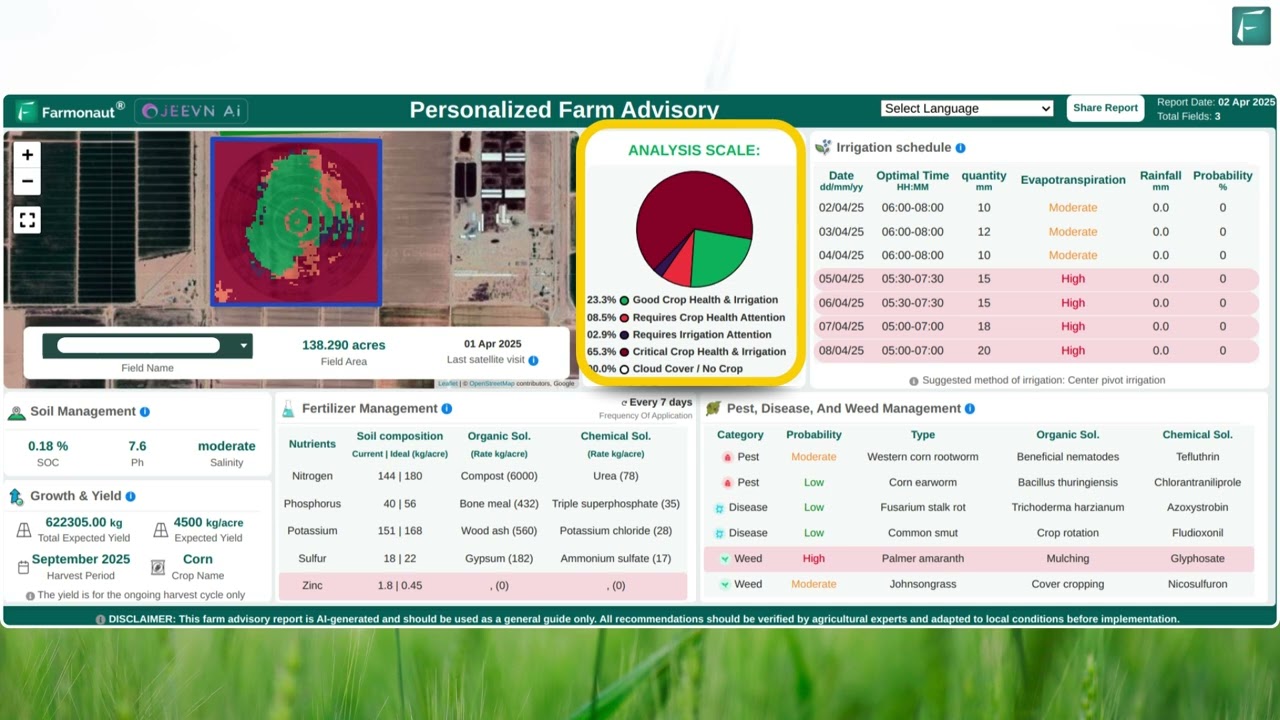
- Satellite-based crop health and soil monitoring (NDVI) for precise detection of stress, pest pressures, and irrigation issues—essential for proactive management inside vertically stacked environments.
- AI-driven advisory (Jeevn AI) helps optimize climate control, resource allocation, and workflow automation according to hyper-local weather and satellite trends.
- Blockchain-based traceability solutions ensure complete transparency in high-value supply chains—a major demand for urban consumers and global markets.
- Fleet and equipment management tools streamline maintenance scheduling, energy optimization, and logistics, supporting lean operating models in vertical systems.
- Real-time environmental impact monitoring (carbon footprint, emissions, energy use) helps secure regulatory compliance and strengthen sustainability credentials for urban facilities.
For users, businesses, and governments planning vertical or urban farming projects in 2026, Farmonaut’s ecosystem—mobile and web-based, with robust API support (API Info / Developer Docs)—delivers critical insights and decision support at global scale.



FAQ: Vertical Farming Pros and Cons, Innovations & Planning for 2026
1. What are the main pros and cons of vertical farming compared to traditional agriculture?
Pros: Up to 95% lower water use, year-round production, reduced pesticide need, rapid urban integration, and steady yields.
Cons: High capital and energy costs, technical skill requirements, limited crop diversity, and site utility planning needs.
2. Is vertical farming environmentally sustainable in 2026?
It can be, provided energy sources are renewable, resource recovery is robust, and lifecycle impacts are managed. However, if fossil-fuel power dominates, environmental gains could be negated.
3. Which crops are best for vertical farming?
Leafy greens (lettuce, spinach, kale), herbs (basil, mint), microgreens, and some berries (strawberries) are optimal. Root vegetables, cereals, and tree fruits remain challenging for now.
4. What innovations are most likely to shape vertical farming success in 2026?
AI-driven climate and nutrient optimization, custom-spectrum LED lighting, blockchain traceability, advanced automation/robotics, and integrated energy storage.
5. How does Farmonaut support vertical farms?
Our platform provides real-time satellite-based advisory, AI-driven recommendations, digital traceability, and robust resource management to optimize yields, reduce environmental impact, and streamline compliance and planning for all sizes of vertical farms.
Conclusion: Navigating the Future of Vertical Farming—2026 and Beyond
The vertical farming pros and cons landscape is nuanced. The promise—dramatically increased yields per square meter, revolutionary water and land use efficiency, and local supply chain resiliency—is accelerating its adoption for high-value, sustainably grown leafy crops in urbanized environments. Yet, challenges around energy intensity, technical complexity, urban planning, and crop selection remain substantial.
As we approach 2026, technological innovation and evidence-based planning will increasingly drive who benefits from this transformation. Policy support, integrated digital infrastructure, and a strategic focus on environmental sustainability will be essential. With digital intelligence and real-time monitoring—like those enabled by Farmonaut’s satellite and AI tools—vertical and urban farming can take their place as essential pillars in the future of global food production.
Visual: Key Takeaways
- 🌍 Sustainable urban food solutions
- ⚡ Tech-driven efficiency improvements
- 🛠 Essential utility and digital integration
- 🚀 Planning for scale and resilience
Ready to power your next-generation agricultural operations?
Explore real-time analytics, precision climate control, and secure traceability with Farmonaut’s satellite-driven solutions—designed for urban, vertical, and integrated agri-infrastructure worldwide.
Discover, plan, and grow with confidence—harnessing powerful data, AI, and traceability for your vertical farming journey in 2026 and beyond.

 CGIAR
CGIAR Hayleys Agriculture
 Linx Agritech
 Adinet
 Save Your Soils
 GalaxEye Space
 Grandstream Algérie
 XOS Realty
 Geospatial Lab Africa
 Agro La Gándara
 HIPSAC
 ZOL Zimbabwe
 Juligerm
 AdBio
AdBio MISE Maroc
 NWNS
NWNS Red August Group
 Farm Inc
 WeMe Global
